Nicaragua has increased human rights violations and persecution of the opposition as it ratchets up its efforts to stifle dissent, a United Nations group of experts monitoring the country said on 12 September 2023.
The Group of Human Rights Experts on Nicaragua told the U.N. Human Rights Council in Geneva, Switzerland, that the government continues increasing pressure on human rights defenders to force them to leave the country.
That persecution has extended to the education sector, where the government has systematically cancelled the legal status of private universities and seized their campuses.
“We have observed the intentional and severe deprivation of economic and social rights, in particular the right to education and academic freedom,” said Jan-Michael Simon, chair of the group. “Today, the university sector of Nicaragua as a whole no longer has independent institutions. Nicaragua is being stripped of its intellectual capital and critical voices, leaving the country’s prospects and development on hold.”
Last month, the government confiscated the prestigious Jesuit-run University of Central America in Nicaragua. It was the latest in a series of actions by authorities against the Catholic Church, but also among some 27 higher education institutions that have been cancelled and confiscated.
The group noted that religious figures, in particular from the Catholic Church, are increasingly targets of attacks and some have been forced to leave the country. Once abroad they are sometimes stripped of their nationality and have their assets in Nicaragua confiscated.
The university and other education institutions were important centers of dissent during the popular protests in April in 2018 that became a referendum on President Daniel Ortega’s administration. Ortega was re-elected after jailing seven potential competitors in 2021.
The government’s pursuit of the opposition has continued and intensified. Students and other opposition figures have been imprisoned or forced into exile.
In February, the Nicaraguan government put 222 prisoners on a plane to the United States, declaring them traitors.
“The seriousness of these violations, in conjunction with the other crimes documented to date, perpetrated by reason of the political identity of the group targeted, leads the Group of Experts to conclude that these constitute prima facie the crime against humanity of persecution on political grounds,” the group said.
A group of rights activists in India have urged President Droupadi Murmu to withdraw terror-related cases against late Jesuit Father Stan Swamy and 15 other accused in the 2018 Bhima Koregaon violence case.
“It is a false case registered against Father Swamy and others and it should be withdrawn,” said Father Antony P.M, a social activist at a gathering to mark the second death anniversary of the priest, on July 5 in the eastern Jharkhand state. Tributes were paid to the Swamy across the country.
He said a group of activists is appealing to the president, who hails from an indigenous community in eastern India, to use her good office to withdraw “the totally false case registered against right defenders,” Antony told UCA News on July 6.
The activists had gathered in front of the Raj Bhavan, the official residence of the Jharkhand governor, in the state capital Ranchi. It was organized by the Shahid Father Stan Swamy Nyaya Morcha (Martyer Stan Swamy Justice Forum).
“Father Swamy, who fought for the rights of indigenous people in Jharkhand finally had to die for want of medical care as a prisoner,” said Antony, the director of Bagaicha, a Jesuit social center in Jharkhand, where Swamy lived and worked.
Murmu served as the governor of Jharkhand when Swamy’s residence in Ranchi was raided twice and the federal terror investigative agency arrested him in 2020.
He was accused of having links with outlawed Maoists along with 15 well-known human rights activists accused in a case linking them to a violent clash in Bhima-Koregaon village in western Maharashtra state in 2018.
The late priest and others including rights activists, lawyers, academicians, and writers, were also charged under the provisions of a draconian anti-terror law, the Unlawful Activities Prevention Act (UAPA), alleging they had conspired to unleash violence in Bhima-Koregaon.
The priest was also accused of sedition and conspiring with Maoist rebels to overthrow the federal government.
The 85-year-old activist priest died as an under trial prisoner in a private hospital in Mumbai, the capital of Maharashtra.
“We hereby request Your Excellency to take cognizance of the entire Bhima-Koregaon case wherein the intention of the state and the investigation agencies is highly suspicious and does not inspire any confidence in common citizens,” they said in a memorandum.
“Several independent investigations, including by US-based Arsenal Consultancy, have exposed how the case, based on fabricated evidence, is just a witch-hunt by the state,” it said.
“We request that all the human rights activists be immediately released on bail, the case and prosecution be withdrawn and criminal proceedings be initiated against those responsible for fabricating and planting evidence,” the memorandum added.
It also briefly provided details of the findings from Arsenal Consultancy, a digital forensic lab, that said digital evidence was planted on the computer of Father Swamy and others, leading to their arrest and incarceration.
Antony further demanded the scrapping of the draconian UAPA, under which Swamy was arrested.
“Once a person is charged under the UAPA, he/she is not treated well in jail even if there is no connection with the case remotely,” the priest said, citing the example of Swamy.
Despite suffering from Parkinson’s and other age-related diseases, Swamy was denied bail by both the trial court and the high court before his death.
“If the jail authorities cared for him well or the courts had granted bail in time, I think he would have been with us,” Antony, also a Jesuit, observed.
“The investigating agency has still not filed the charge sheet and activists are languishing in jail. This is a gross violation of human rights,” the priest said.
Indian Jesuits have approached the Mumbai High Court seeking “to clear his name from the false cases” that led to his arrest, imprisonment and death in custody.
Stan Swamy and the adivasis he supports in an impossible battle for their own ancestral lands are pawns pitted against mammoth mining companies. Falsely branding activists as Maoists is the easiest way to condemn to enable vested interests to finish them off.
A file photo of human rights activist Stan Swamy. Photo: PTI
Mari Marcel Thekaekara wrote in the Indian Wire of 10 October 2020 a detailed and personal piece about “The Indomitable Spirit of Father Stan Swamy”
“No, it’s not possible,” were my first thoughts when I heard that Father Stan Swamy, an 83-year-old Jesuit priest and activist had been arrested – for the second time. His crime? He defended the rights of adivasis being exploited in their homeland Jharkhand.
Father Swamy has been accused of having links to a Maoist plot connected to the Bhima Koregaon case and was arrested by the National Investigation Agency on Thursday night. The rights activist is one of the gentlest and kindest men I have ever met. So the entire premise – for anyone who knows him – is entirely ludicrous. Funny even, if it were not so tragic. He has Parkinson’s disease. His hand shakes when he raises a cup of tea to his lips. He speaks so softly, you have to strain to hear him.
Social activists hold a protest after the arrest of Father Stan Swamy by the NIA in the Bhima Koregaon case, in Ranchi, October 9, 2020. Photo: PTI
He assures his interrogators that he has no connection with Maoists. He believes in peaceful, non-violent protest. I believe him. Because I know that his integrity is above reproach.
I heard of Father Stan Swamy in the early seventies, because he was among the first people I knew who advocated living with the adivasi community in Jharkhand to understand their lives and their problems; to help find solutions and a way forward. I went there in the early seventies while still in college to write a story for our student magazine.
On a more personal note, Stan Swamy, introduced my husband, also named Stan, to the adivasi world. He shared Father Swamy’s hut in a Ho village in Jharkhand. My husband always told young activists:
“Gandhiji’s non violence was not merely moral or religious. It was strategic. Gandhi was a brilliant general. Oxymoronic though that sounds. He understood that the fight for freedom could not be won by violence because mere ordinary Indians, even if they poured out on the streets with justice on their side, with God on their side, could never win. Even if there were thousands or lakhs of people marching in protest, they could never match the might of the state. Before 1947, the British could bring out the artillery and finish us off. One wrong step could have changed the course of our history. But the entire world watched India’s non violent battle for independence, open mouthed. Non violence was a new word, a new tactic, made in India. The world sympathised and empathised. Gandhi’s strategic non violence was the most brilliant weapon in our war for Independence’
The same scenario is playing out today. And the average activist understands that putting ordinary villagers, adivasis, Dalits or women in the line of fire is counterproductive and unfair. We learnt this strategy from Gandhi and Jayaprakash Narayan.
In recent times, it has become the norm to equate the word activist with ‘anti-national’. But who is an activist? What do they do?
It’s quite simple. All over India, there are thousands of people who took up the cause of fighting for social justice for the poor, the marginalised and the voiceless. These people were inspired by the brightest and best minds in our country – from Gandhiji to Vinobha Bhave to JP.
Post Independence, when the battle for freedom was won, Gandhi urged his followers to go out and continue the fight for freedom. This time, it was to free the poorest from hunger and poverty, to teach and educate, to weave and spin, to spread harmony and peace. Thousands rallied to his call and Gandhi ashrams were filled with people determined to continue the freedom struggle on a new battlefield – India’s villages.
The sixties saw the rise of the Dalit movement. New leaders emerged. Gandhi raised the question of untouchability in the early days of the Independence movement, but his ‘Harijan’ epithet was subsequently dismissed by Dalits as patronising. Dalit power became a clarion call, drawing inspiration from the African-American Black Panther movement. Dr B.R. Ambedkar showed the way.
The term activist gained popularity during the JP movement and during the fight against the Emergency in the mid seventies. After the Emergency, thousands of young patriots, drawing their inspiration from JPs charisma, accepted his challenge to go out and organise the poor, the under privileged and the vulnerable; to fight for their rights. This period saw a proliferation of human rights defenders, though the term was not used till later.
Women and men dedicated their lives to fighting for Dalit rights, adivasi rights, womens’ rights, farmers’ unions and fisherfolk movements. These activists evolved in their understanding of rights based movements. They often lived with the communities they worked with. They identified with the people and though many were middle class, they tried to live simpler lives than their parents, than the backgrounds and privileged upbringing they had been born into. They were pleased to be branded activists and wore the badge with pride.
From the fifties and sixties, when Gandhians prevailed, we moved into the seventies where a sea change took place. Global thinking wafted across the world to India. The 1968 student movement in France, Latin American thinking, Marxist ideology – all these gained ground and influenced grass roots workers. The focus changed from the passive Gandhian way – the giving of food, clothes, free education and medicine to changing unjust situations at the base. ’Daan’ or mere giving was now passe. Activists were trained to encourage people to ask who was cheating them and why? So if people were encroaching on adivasi or Dalit land, it was time to establish basic human rights; time to equip people to defend themselves, to fight injustice – non-violently, the Gandhian way, and the strategic way.
Soon, womens’ groups began to take action against dowry deaths and acid attacks, and took to the streets and courts to protest and demand justice. Dalit groups found lawyers willing to fight caste atrocity cases in court. Adivasis had activists urging them to defend their ancestral millennia old homelands from dominant caste landlords who shamelessly cheated them and usurped their lands. Environmentalists and eco-warriors hugged trees and stopped forests from being denuded. A huge green movement began. The protest movements grew from strength to strength.
In reality, these people are defending human rights and saving the Earth for future generations. When it comes to central India and defending tribal land from powerful mining companies, the battle assumes David versus Goliath proportions.
Stan Swamy and the adivasis he supports in an impossible battle for their own ancestral lands are tiny pawns pitted against mammoth mining companies. Falsely branding activists as Maoists is the easiest way to condemn them and to enable vested interests to finish them off.
The frail 83-year-old has trumped up charges levelled against him. Yet he has a core of steel, an indomitable strength that comes with moral conviction and a commitment to truth and to the powerless. As they took him to prison, Stan Swamy announced he would begin a fast. His fellow Jesuits who rushed to the prison with his medicines, say he has refused even a sip of water.
I kept asking why, they would arrest this gentle, kind man. Father Cedric Prakash, who is also a Jesuit and activist, said in a TV interview, “It’s to create a fear psychosis. If they can imprison an 83-year-old who has spent his life committed to the poor, who is safe?”
Asianet phoned to interview my husband Stan. People cautioned him, “You will draw attention to yourself. It can boomerang and have repercussions on your work in the Nilgiris.”
Nelson Renteria of WTVB (The Voice of Branch County) came with the surprising report that the U.S. State Department issued a public designation for 13 current and former Salvadoran military officials for what it called gross human rights violations during El Salvador’s civil war three decades ago, for their alleged involvement in the planning and execution of the extrajudicial killings of six Jesuit priests and two others on a university campus in 1989.
The crime is one of the most emblematic of the Central American country’s civil war that pitted then-leftist guerrillas the Farabundo Marti National Liberation Front (FMLN) against the U.S.-backed Salvadoran army. The FMLN is now a political party. The case had a lot in common with the killings of the Dutch IKON TV crew a few years earlier [see: https://humanrightsdefenders.blog/2018/09/25/murder-of-dutch-ikon-journalists-in-1982-in-el-salvador-revisted/]
In a statement, the U.S. Secretary of State said it had “credible information” that the current or former officials were directly or indirectly involved in “a gross violation of human rights or significant corruption.” It was not clear what had prompted the United States to issue the designation at this point in time.
[In El Salvador, the Supreme Court of Justice declared a 1993 amnesty law unconstitutional in 2016 and ordered lawmakers to create a new law that would guarantee justice and reparation for victims. However, the process has been delayed.]
German-born Jesuit Father Franz Magnis Suseno has become an Indonesian citizen and an outspoken champion of democracy and interfaith dialogue in Indonesia. (Photo by Siktus Harson/ucanews.com)
Ryan Dagur painted on 15 April 2019 (in UCA News) a portrait of a remarkable man, the Jesuit priest Franz Magnis Suseno,doesn’t mince his words when promoting democracy and dialogue in Indonesia. “An adopted son’s passion for Indonesian pluralism”
Not so long ago, Jesuit priest Father Franz Magnis Suseno ..ruffled a few feathers by.. calling people who are threatening to boycott the polls fools, parasites, and psycho freaks.His scathing comments came in an article about the upcoming Indonesian presidential and legislative elections published by Kompas, the country’s bestselling newspaper.Many criticized him for the remarks, some even sent him letters of protest, but many also supported him. The German-born priest, a professor at the Driyarkara School of Philosophy, has apologized for his choice of words but argued the article was a call for all citizens to care for democracy and prevent the worst individuals from being elected to office.
…..The 82-year-old, born into a noble family and who was once called Count von Magnis, is now widely known as a philosopher, human rights defender, and culturalist, with his main area of expertise being Javanese culture. He has written 41 books on philosophy, political ethics, and Christianity, as well as made countless television appearances.During his time in the country, Father Magnis has witnessed a major shift in Indonesia’s political climate from a 32-year dictatorship under Suharto to the reform era that began in 1998 when the tap of democracy was opened.“It’s my moral obligation to speak up when democracy is threatened,” he said.He says he is optimistic that Indonesia will remain a leading democracy in Southeast Asia, but admitted various threats do concern him, especially what he calls the politicization of religion by hard-line Muslims. “Indonesia will only fall to another authoritarian regime if people continue to use religion in politics,” he said. He said it is dangerous because, for many people, religion is more important than democracy.
…. Father Magnis has built close friendships with several respected Muslim leaders, including the late Abdurahman Wahid, a highly respected figure, and Indonesia’s fourth president, as well as Nurcholish Majid, an avid defender of pluralism in Indonesia. Holding dialogue with extreme elements is also important, he said, especially when conflict occurs.He has met the now exiled Islamic Defenders Front chief, Muhammad Rizieq Shihab, several times when his organization sought to impose its own ban on worshiping activities in a number of churches in Jakarta. In 2011, Father Magnis met Shihab, to discuss the issue of an American pastor burning a Quran in Florida, which angered Muslims all over the world. Following the discussions, Shihab told his angry followers not to take out their anger on Indonesian Christians. In building a relationship with believers of other faiths, it is important for Christians to be humble and sensible and to avoid belittling acts or gestures. “It’s better to be low profile, rather than something fancy,” he said, adding that this philosophy should be especially applied in poor areas. This was why he called the erection of a 46-meter-high Marian statue in Ambarawa, Central Java in 2015, “inappropriate.” ..
Father Magnis is also critical of Christians who measure the success of their work by the number of people they attract to Christianity because it leads to aggressive Christianization. “Our mission is to bring the goodness of Christ into our society and let people decide whether to join us,” he said.He said Indonesia will remain an Islamic country, and what Christians can do is to help them build a better democratic system, where freedom of religion is upheld and interfaith relations are well established. Father Antonius Benny Sustyo, an outspoken activist priest, said Father Magnis’ openness and willingness to communicate with others are among his finest characteristics. “..Achmad Nurcholish, a Muslim activist said Father Magnis had contributed a lot to the progress of humanity in Indonesia, especially through his writings that have an enriched perspective.
Father Magnis’ endeavors have been duly recognized and have earned him a number of awards.In 2015, he received an award from Indonesian President Joko Widodo for his dedication to education and culture. A year later, in 2016, he won the Matteo Ricci International Prize for his commitment to promoting interreligious dialogue from the Catholic University of the Sacred Heart in Milan. However, the one that gives him the most pleasure is a so-called “Mud Award”, bestowed on him by communities in East Java whose land and homes were buried by mud caused by the activities of a company belonging to Aburizal Bakrie, a businessman cum politician. It was given in 2007 after the priest refused to accept a Bakrie Award — handed out by Aburizal Bakrie’s family — to show solidarity with people affected by the mud disaster. “I was very happy with that award. I’ll always treasure it,” he said.


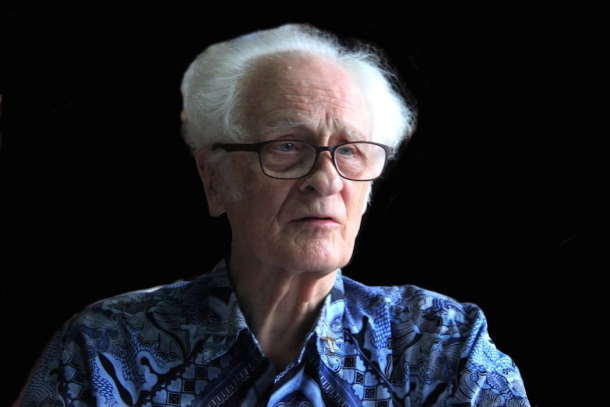
 Hans Thoolen on Human Rights Defenders and their awards