Posts Tagged ‘Human Rights Watch’
September 24, 2013
On 18 September the Ford Foundation announced $6.25 million in grants to seven leading human rights organizations that will strengthen and diversify the global human rights movement. The 7 grants focus on human rights organizations that operate in numerous countries and international forums, underscoring the foundation’s long commitment to supporting collaboration. Combined with a five-year, $50 million initiative announced last year to support human rights organizations based outside Europe and the United States, Ford is spurring innovative thinking about the way the global human rights system functions and its capacity to address 21st century issues such as economic and social inequality.
“The human rights movement has arguably been the most effective and wide-reaching social movement of our time,” said Darren Walker, president of the Ford Foundation. “But the movement faces a notably different set of challenges today than it did even 15 years ago, along with a new set of opportunities for advancing human rights in today’s world. The grants we make today will enable these institutions to more actively adapt, diversify and retool the way the movement works for all of us.”
The seven grants announced today will support: Read the rest of this entry »
Posted in human rights, Human Rights Defenders | Leave a Comment »
Tags: Africa, Amnesty International, Business and Human Rights Resource Centre, Civil society, Crisis Action, economic and social rights, equality, FIDH, Ford Foundation, funding, Global Witness, human rights, Human Rights Defenders, human rights organizations, Human Rights Watch, International Federation for Human Rights, International Network of Civil Liberties Organizations, media, non-governmental, Non-governmental organization, Social and Cultural Rights, strategy, the Association for Women's Rights in Development, The International Network for Economic, United States, Witness (human rights group)
September 19, 2013

(Sudanese IDPs – (c) AI private)
In a long letter to the UN Human Rights Council now in session a group of 13 NGOs urges the Council to continue monitoring Sudan. The letter has two main chapters on:
Conflicts in Darfur, Southern Kordofan, and Blue Nile, ………and
Repression of Civil and Political Rights……….
The letter ends with urging the Human Rights Council to:
- condemn the human rights violations in Darfur, Southern Kordofan and Blue Nile, as well as the government’s continued use of indiscriminate bombing in all three states, attacks on civilians, and other abuses by government forces and allied militia;
- establish an independent investigation into ongoing human rights violations in Southern Kordofan, Blue Nile, and Darfur, and report back to the Human Rights Council promptly;
- urge Sudan to grant humanitarian agencies access to Southern Kordofan and Blue Nile states, in compliance with international human rights and humanitarian law obligations;
- express concern over the continued restrictions of basic civil and political rights, and the continued harassment of critics of the government, including the practice of arbitrary detention, torture and ill-treatment, preventing meaningful public dialogue on critical issues at a time when Sudan is preparing to adopt a new constitution and for national elections in 2015;
- urge Sudan to reform its repressive National Security Act of 2010 and other laws granting immunity to officials, seriously investigate allegations of human rights violations and hold perpetrators to account;
- renew the special procedure country mandate on Sudan for at least three years under Item 4 with a clear mandate to monitor and report twice a year to the Human Rights Council and the General Assembly on violations of human rights in all parts of Sudan.
——-
Earlier on AI’s Global Blog, Khairunissa Dhala, Researcher on Sudan/South Sudan team at Amnesty International has answered her own question: “Does the human rights situation in Sudan still require a UN-mandated Independent Expert to monitor and report back on developments?” as follows: “Given Sudan’s dire human rights situation – ongoing armed conflicts in three different states, restrictions on freedoms of expression, association and assembly, including arbitrary arrest and torture of human rights defenders and activists – it is hard to imagine that there is even a question on whether this is needed. But we’ve been here before.
Two years ago, I attended the HRC’s 18th session where members of the Council reached a “compromise” on human rights monitoring in Sudan. It was a “compromise” because, while the Independent Expert’s mandate was renewed, it solely focused on providing technical assistance and capacity-building support to the national authorities. In other words, the Independent Expert would no longer be asked to monitor the human rights situation in Sudan. [….]Compromising on the Independent Expert’s mandate was seen as a concession to Sudan by the international community. A concession given to a country where widespread and systematic violations and abuses of international human rights and humanitarian law are taking place.
But there should be no compromise on human rights. Since then, the Independent Expert’s mandate has successively been renewed to provide technical assistance, while the awful human rights situation in Sudan calls for a clear need for monitoring.. Conflict remains ongoing in Southern Kordofan and Blue Nile, to the detriment of the civilian population. Over the past two years I have interviewed numerous men, women and children from these two states. They have shared harrowing accounts of how their loved ones were killed when bombs dropped by Antonov aircrafts, from high altitudes, by the Sudanese Armed Forces, landed on their homes. Coupled with ground attacks by Sudanese forces and the armed opposition group the SPLA-N, this conflict has led to more than 200,000 people fleeing to refugee camps in South Sudan and Ethiopia, in addition to the tens of thousands of internally displaced people in the two areas. The Sudanese authorities are still denying unhindered humanitarian access to all affected areas. Meanwhile, in Sudan’s Darfur state, a decade after the start of the armed conflict, the crisis is ongoing and violence has again intensified. This year alone, more than 300,000 people were forced to leave their homes behind, fleeing violent clashes between predominantly ethnic Arab groups.
Across Sudan, freedom of expression, association and assembly also remain restricted. Journalists and activists face constant harassment, arbitrary arrests, as well as torture and other forms of ill-treatment by Sudan’s National Intelligence and Security Service. Given the critical human rights situation, any compromise on the Independent Expert’s mandate is an abdication of the Human Right Council’s duty to promote and protect human rights in Sudan…..The Independent Expert should have their mandate strengthened to monitor Sudan’s human rights situation under item 4 (Human rights situations that require the Council’s attention) and report twice a year to the Council and the UN General Assembly on violations of international human rights and humanitarian law taking place anywhere in the country.”
Read more:
Sudan: Letter to the UNHRC regarding the renewal and strengthening of the special procedure mandate on the situation of human rights in Sudan
Why monitoring human rights in Sudan still matters | Amnestys global human rights blog.
Posted in AI, FIDH, HRW, human rights, Human Rights Defenders | Leave a Comment »
Tags: Amnesty International, Blue Nile, Cairo Institute for Human Rights Studies, Darfur, East and Horn of Africa Human Rights Defenders Project, experts, human rights, Human Rights Defenders, Human rights in Sudan, human rights violations, Human Rights Watch, International Federation for Human Rights, international human rights and humanitarian law, Khairunissa Dhala, killings, South Kordofan, Special Procedures, Sudan, UN Special Rapporteur, United Nations Human Rights Council
September 9, 2013
Today I simply copy the tribute paid by a blogger, A Paper Bird, to Sunila Abeysekera (1952-2013):

The last time I saw Sunila Abeysekera was almost three years ago, over breakfast on one of her very occasional visits to New York. Some people, myself included, were trying to talk her into applying for my old job at Human Rights Watch, a post I thought far too small for her. She politely demurred, in different terms: “My life is enough of a problem,” she said, “and the last thing I need in it is a large organization.” She talked about the dangers of having your work commodified and separated from the people it’s about – either by a bureaucracy, or by the kinds of personality cults that thrive around those who get called (as she was: often, unwillingly, and accurately) “heroes.” Both distract from the simple realities of the stories you try to tell, and the stories, she said, were what counted.At the same time, she was at one of those points (they came quite frequently) where her life was in serious danger in Sri Lanka. People were threatened enough by the stories for which she was witness and messenger that they wanted to kill her. Her friends wanted her to get out, and she herself said she wanted a quiet place somewhere, to rest and think. She said that kind of thing much more often than she meant it. The resting part was something of which she was utterly incapable. She never did it, not till the very last.
Sunila died on 9 September, back in Colombo, at 61, after a long battle with cancer. I didn’t know her very well, but I thought of her as a role model as well as friend. She was scholar, activist, intellectual, feminist, and listener. Others will have more and better things to say about her. I’ll just remember this: while always subordinating herself to the stories she had to tell – – horrible stories, many of them, about rape, torture, murder in the long Sri Lankan civil war – her passion for truth and her personal compassion were always part of them. Without being that kind of person, a kind you instantly recognize but can’t possibly describe, she would never have heard them, would never have won trust or become a witness. A lot of august philosophers these days write and theorize about the role of the witness in contemporary politics and ethics, but the writing was unnecessary as long as she was alive. You could point at Sunila, and understand.
I would say “rest in peace,” but wherever she is, she isn’t resting.
via Sunila Abeysekera, witness: 1952-2013 | a paper bird.
Posted in human rights | 1 Comment »
Tags: A Paper Bird, Colombo, death, human rights, human rights def, Human Rights Watch, New York, obituary, Sri Lanka, Sri Lankan, Sri Lankan Civil War, Sunila Abeysekera, woman human rights defender
September 4, 2013
The Business Standard reports on 4 September that Human Rights Watch urged the Fiji government to amend articles that undermine human rights in a draft constitution scheduled to be promulgated Friday. Under the current draft, significant restrictions in articles 17, 18 and 19 would allow the government to interfere with key rights of freedom of expression, assembly and association. The draft constitution sets out broad limitations to these rights “in the interests of national security, public safety, public order, public morality, public health, or the orderly conduct of elections”. In January, the government scrapped a draft of the constitution developed by a committee headed by a noted constitutional and human rights lawyer, Yash Ghai, and handed duties to draw up the constitution to government legal officers in the attorney generals chambers.”This draft constitution represents a major step backwards for human rights from the constitution thrown out by Fiji’s military in April 2009,” said Phil Robertson of Human Rights Watch.”Unless the government revises this draft constitution to guarantee freedom of association, assembly and expression, its hard to see how Fiji could become a rights-respecting democracy.” Since Commodore Frank Bainimarama took power in a military coup 5 December 2006, his government has consistently attacked critics, including arbitrarily detaining them, and instituted heavy censorship. The military and police have indiscriminately arrested and detained human rights defenders, journalists and labour leaders.
via Fiji urged to revise draft constitution | Business Standard.
Posted in HRW, human rights, Human Rights Defenders | Leave a Comment »
Tags: Constitution, controversial restrictions, Fiji, Frank Bainimarama, freedom of association, freedom of expression, human rights, Human rights defender, Human Rights Watch, National security, Politics of Fiji, Yash Ghai
September 3, 2013
A recent 100-page report by Human Rights Watch, “Tightening the Screws: Azerbaijan’s Crackdown on Civil Society and Dissent,” documents the dramatic deterioration of the government’s record on freedom of expression, assembly, and association in the past 18 months. The authorities have arrested dozens of political activists on bogus charges, imprisoned critical journalists, broken up peaceful public demonstrations, and adopted legislation imposing new restrictions on fundamental freedoms. Read the rest of this entry »
Posted in HRW, human rights, Human Rights Defenders | Leave a Comment »
Tags: activism, Azerbaijan, Civil society, critical journalists, Election, facebook, freedom of expression, Giorgi Gogia, HRW, human rights, Human Rights Defenders, Human Rights Watch, illegal detention, imprisonment, judicial harasment, protest, twitter
August 29, 2013
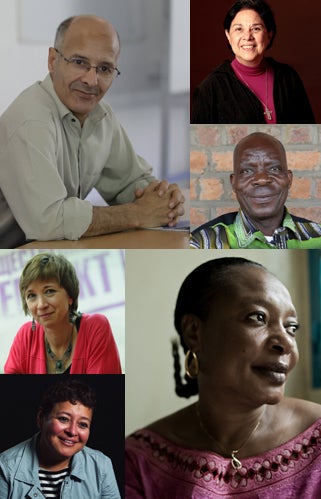
Clockwise: Hassan al-Amin, Consuelo Morales, Natalia Taubina, Jacqueline Moudeïna, Alina Diaz, and Abbé Benoît Kinalegu.
On 28 August Human Rights Watch announced the 2013 recipients of its Alison Des Forges Award for Extraordinary Activism: Read the rest of this entry »
Posted in HRW, human rights, Human Rights Defenders | Leave a Comment »
Tags: Alina Diaz, Alison Des Forges, awards, Chad, Hassan al-Amin, human rights, human rights awards, Human Rights Watch, Jacqueline Moudeina, Kenneth Roth, Libya, MEA, Natalia Taubina, Russia, United States
August 22, 2013
Repressive governments are using different and increasingly ‘indirect’ means to silence human rights defenders. Intimidation, administrative restrictions, fiscal regulations aimed at reducing funding, terminating rental agreements, judicial harassment, etc. According to a report by Human Rights Watch of 14 August 2013, Rwanda is practicing a slightly different tactic: wholesale infiltration and ‘take over’ of independent NGOs.
Read the rest of this entry »
Posted in HRW, human rights, Human Rights Defenders | Leave a Comment »
Tags: Africa, freedom of association, HRW, human rights, human rights abuses, Human rights defender, Human Rights Defenders, human rights group, human rights groups, Human Rights Watch, infiltration, LIPRODHOR, Non-governmental organization, Rwanda
August 13, 2013
On 12 August Human Rights Watch issued a report on Ecuador and urged it to revoke a presidential decree that grants far-reaching powers to the government to oversee and dissolve nongovernmental organizations.
On June 4, 2013, President Rafael Correa adopted a decree [a similar decree in December 2010 was shelved after criticism] that creates new procedures for Ecuadorean nongovernmental organizations to obtain legal status and requires international organizations to undergo a screening process to seek permission to work in Ecuador. Read the rest of this entry »
Posted in HRW, human rights, Human Rights Defenders | Leave a Comment »
Tags: administrative rules, Bahrain, decree, Ecuador, foreign funding, freedom of association, HRW, Human Rights Defenders, Human Rights Watch, Inter-American Court of Human Rights, NGOs, Non-governmental organization, Rafael Correa, Russia, Uganda, Venezuela
August 2, 2013
In the ongoing saga concerning the asylum request by Snowden, Kenneth Ross, the director of Human Rights Watch, makes on 2 August an interesting and courageous comment on Twitter: “Instead of trying to extradite Snowden, Congress should ask him to testify by video as spur to end mass NSA snooping.”
Defiant Russia Grants Snowden Year’s Asylum – NYTimes.com.
Posted in HRW, human rights, Human Rights Defenders | Leave a Comment »
Tags: asylum request, HRW, Human Rights Watch, Kenneth Ross, Moscow, National Security Agency, nytimes, right to privacy, Russia, Sheremetyevo International Airport, Snowden, United States
June 29, 2013
The City of Geneva and the Martin Ennals Foundation announce the 2013 edition of Martin Ennals Award, which will take place on Tuesday 8 October 2013 at 18h00 at the Uni-Dufour, Geneva. The Laureate will be announced Read the rest of this entry »
Posted in AI, FIDH, Front Line, HRF, HRW, human rights, Human Rights Defenders, HURIDOCS, ICJ, MEA | Leave a Comment »
Tags: 2013 ceremony, Amnesty International, awards, baby doc duvalier, Chechnya, City of Geneva, Diakonie, Egypt, Final Nominees for the Martin Ennals Award 2013, Front Line (NGO), Geneva, Haiti, human rights, human rights abuses, human rights awards, Human Rights Defenders, Human Rights First, human rights lawyer, human rights organizations, Human Rights Watch, HURIDOCS, International Commission of Jurists, International Federation for Human Rights, International Service for Human Rights, Joint Mobile Group, Mario Joseph, Martin Ennals Award, Martin Ennals Award for Human Rights Defenders, Martin Ennals Foundation, MEA, Mona Seif, Russia, World Organisation Against Torture

 Hans Thoolen on Human Rights Defenders and their awards