Posts Tagged ‘freedom of association’

NGOs call on Malaysian authorities to stop intimidating human rights defenders

November 16, 2025

Malaysia: Authorities must stop intimidating human rights defenders - Civic Space

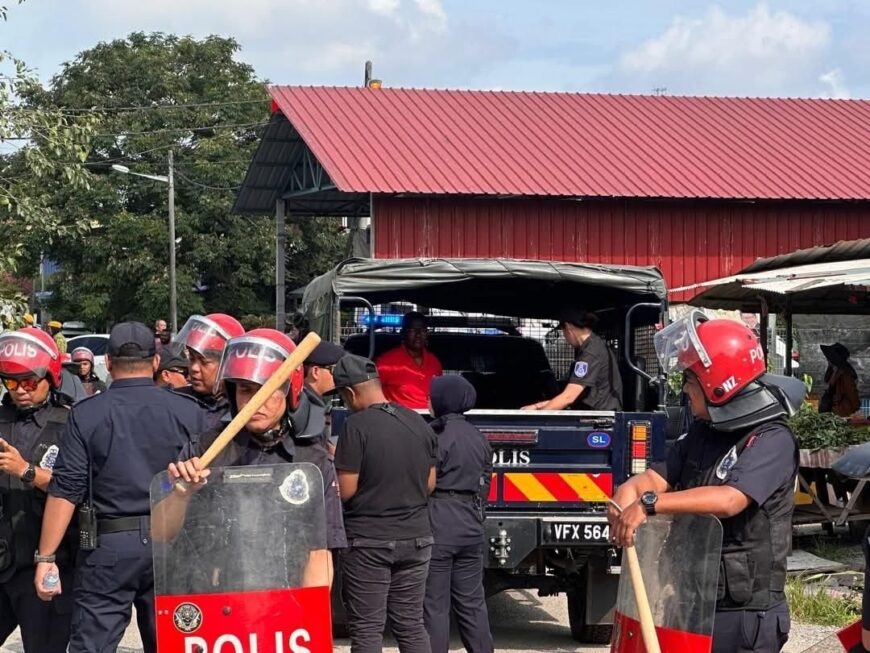
Photo credit: PSM

On 14 November 2025, ARTICLE 19 and the Centre for Independent Journalism (CIJ) expressed alarm about the arrests of and use of force against human rights defenders and residents who attempted to prevent the demolition of houses in Kampung Jalan Papan, which began on 11 November in the Malaysian state of Selangor. We call on the authorities to immediately release human rights defenders and end investigations into their activities. 

On 14 November, two  human rights defenders and seven local residents were arrested under Section 186 of Malaysia’s Penal Code for allegedly obstructing public servants from discharging their duties – a clause that carries a penalty of up to two years’ imprisonment and/or a maximum fine of RM10,000 (approximately USD 2,410). The two activists are Yee Shan from Parti Sosialis Malaysia (PSM) and Jernell Tan from the human rights organisation SUARAM. The seven local residents are Than Bee Hooi, Than Kim Kim, Lim Wee Chun, Ser Li Fang, Lim Eng Hui, Teoh Ah Guat, and Ng Ban Ping. 

This follows previous arrests earlier in the week. On 13 November, 10 people were arrested, also under Section 186 of the Penal Code: PSM Secretary-General Sivaranjani Manickam, PSM National Treasurer Soh Sook Hwa, PSM activist Aein Aneera Anuar, PSM activist Ramasamy Karupan, PSM activist Tan Ka Wei, PSM activist Hridhay Praveen, activist Wong Kueng Hui from the non-governmental organisation Mandiri, local resident Tang Bing Ai, and activist Fakrurrazzi Khairur Rijal from the advocacy group Himpunan Advokasi Rakyat Malaysia. They were  detained at the Pandamaran and Pelabuhan Klang police stations and later released on 14 November .  

On 12 November, Deputy Chairperson of PSM Arutchelvan Subramaniam, also known as Arul, activist M. Mythreyar, and M. Logesvaran, a representative for the residents affected by the demolition, were arrested under Section 186 of the Penal Code.  They were remanded one day before release on 13 November under police bail.  

‘This is a blatant attack against human rights defenders who dare speak out on behalf of local communities living in a climate where forced evictions and development pressures are being used to displace long-time residents. The arbitrary arrests of the activists highlight the risks faced by human rights defenders advocating housing rights. These actions seem intended to intimidate others and discourage efforts to stop forced evictions,’ said Nalini Elumalai, Senior Malaysia Programme Officer at ARTICLE 19. ‘Using such forms of intimidation to silence human rights defenders and the residents not only threatens their safety but also undermines the ability of communities to assert their right to adequate housing and partake in meaningful decisions that affect their lives.’

This case stems from a 1995 agreement between the Selangor government and private limited company TPPT, under which affected families were to be given homes after the state government transferred 95 acres of land to the company. More than 30 years on, the residents have yet to receive their promised homes. Residents,  known as Kampung Papan settlers, have lived in the area for decades, since 1939 – before Malaysia’s independence from the British in 1957. Despite a court ruling allowing the eviction, the Selangor government has said that demolition work should only be limited to vacant houses and business premises. Despite this promise, demolition work began on 10 November and as of 13 November, at least 15 occupied houses had been demolished. Residents of 44 out of 83 homes have obtained an interim injunction against the demolition. 

The authorities’ actions violate the United Nation’s Declaration on Human Rights Defenders and other related resolutions, including General Assembly resolution 70/161 on human rights defenders in the context of the Declaration on the Right and Responsibility of Individuals, Groups and Organs of Society to Promote and Protect Universally Recognized Human Rights and Fundamental Freedoms. Among other things, the resolution urged States to ensure the rights and safety of human rights defenders in exercising their rights to freedom of expression, peaceful assembly, and association.

https://www.article19.org/resources/malaysia-authorities-must-stop-intimidating-human-rights-defenders/

Incredible number of NGOs (3700!!) condemn attacks on civil society in USA

October 9, 2025

Human Rights Watch stands with civil society and signed this letter, alongside more than 3700 other organizations, condemning the Trump administration’s attacks. It is a testament to our community’s solidarity.

“We are a coalition of nonprofit and nonpartisan organizations formed to champion causes dear to all Americans. We work in communities across the country to protect our air and water, our right to vote, to worship, and to organize; we fight for consumers, workers, and our children; we advocate for civil and human rights at home and abroad; we have made it safer to drive on our roads, easier to start a business, and healthier to live in our cities. We span the full ideological spectrum. And today, we stand together for our democracy and in solidarity with the nonprofit groups unjustly and illegally targeted by the Trump administration, including in a new September 25 presidential memorandum. 

We of course unequivocally reject political violence. But we won’t mince words. No president–Democrat or Republican–should have the power to punish nonprofit organizations simply because he disagrees with them. That is not about protecting Americans or defending the public interest. It is about using unchecked power to silence opposition and voices he disagrees with. That is un-American and flies in the face of the Constitution, including the First Amendment bar on targeting organizations for their advocacy. 

Charities perform crucial functions in every community across our country, including providing healthcare, housing, education, religious services, food and water, and so much more. Like other nonprofits, the organizations threatened by President Trump have a mission to serve the public good and are composed of everyday people fighting for dignity, safety, and opportunity. 

This attack on nonprofits is not happening in a vacuum, but as a part of a wholesale offensive against organizations and individuals that advocate for ideas or serve communities that the president finds objectionable, and that seek to enforce the rule of law against the federal government. Whether the target is a church, an environmental or good government group, a refugee assistance organization, university, a law firm, or a former or current government official, weaponizing the executive branch to punish their speech or their views is illegal and wrong. It is also an attack on the very notion that government power must serve the people, not those in office. 

Charitable organizations serve our communities in various ways, playing a central role in public protection, health, accountability, anti-discrimination, and in creating the moral fabric of our nation. That is, of course, precisely why this administration is targeting them. They know that the organizations they are attacking exist to lift up the voices of everyday Americans and shine the spotlight of accountability on those who seek to abuse power. 

Political violence is unacceptable. But efforts by the president of the United States to defund, discredit, and dismantle nonprofit groups he simply disagrees with are reprehensible and dangerous—a violation of a fundamental freedom in America. This Administration is trying to bully people into silence but speaking out is, and has always been, our collective mission. We stand with those wrongly targeted and with each other. No exceptions.”

https://www.hrw.org/news/2025/10/08/an-open-letter-rejecting-presidential-attacks-on-nonprofit-organizations

https://www.commondreams.org/news/letitia-james-indicted

Kyrgyzstan (and Slovakia) on their way to emulate Russia with draft law on ‘foreign representatives (agents)’

March 24, 2024

On 21 March 2024, Nikkei Asia carried the story on Kyrgyzstan taking a page from Russia in pushing for a ‘foreign agents’ law

Kyrgyzstan: Veto the draft law on ‘foreign representatives’ - Civic Space

Kyrgyz President Sadyr Japarov faces a high-stakes decision on whether to sign new legislation that critics warn will significantly impair how human rights defenders and independent media, among others, can work in his mountainous Central Asian state. On March 14, Kyrgyzstan’s parliament voted overwhelmingly in favor of a “foreign agents” bill that mirrors legislation adopted in Russia over a decade ago. The law is designed to control the activities of nonprofit and nongovernmental organizations that receive funding from abroad by compelling them to register as “foreign representatives,” leading to closer scrutiny of their activities by the authorities.

Japarov has a month from that date to sign it into law. Many observers have been vocal in their opposition and are urging the president to veto the bill. Syinat Sultanalieva, Central Asia researcher at Human Rights Watch, told Nikkei Asia that this law “would see the further and sharper shrinking of civil society,” a sector that has been under attack in Kyrgyzstan for more than a decade. BUT see: https://www.aol.com/kyrgyzstan-adopts-law-targeting-foreign-100124498.html

In the meantime the Prague based NGO, People in Need, speaks out against the Slovakian government’s proposed measures to curb critical media and NGOs, which would mirror tactics employed by autocrats and dictators in places ranging from Russia to Latin America, It has raised concerns about the erosion of civil liberties and the stifling of dissent. In a move reminiscent of authoritarian regimes, officials seek to designate these entities as “foreign agents,” a term often utilised to suppress opposition voices. The Fico government has already taken steps to cut NGO funding, raising further alarms about the independence of civil society activities. Additionally, Culture Minister Martina Šimkovičová and Justice Minister Boris Susko have initiated cuts to subsidy programmes, redirecting funds away from NGOs to other areas, citing concerns about transparency and favouritism in grant allocation. The government’s actions have prompted backlash from NGOs, with 90 organisations signing a petition against the minister’s decisions. 

As an organisation with roots steeped in the freedom and civic movements of post-Cold-War Czechoslovakia, we are appalled to see the illiberal turn taken by the Slovak government. The Fico government’s proposal to impose a Russian-style foreign agents’ law is anathema to the shared goals of the Czech and Slovak people who fought to end the Russian subjugation of our homelands. This is of great concern and sadness to us at People in Need.  

https://www.peopleinneed.net/slovak-government-targets-ngos-with-proposed-foreign-agents-act-11299gp

On 21 March 2024, a large group of civil society organisations jointly called on the president of Kyrgyzstan, Sadyr Japarov, to veto the amendments to the Law on Non-commercial Organisations, known as the law on ‘foreign representatives’ which clearly violates the country’s international human rights obligations and would be a devastating blow the civil society. [see also: https://humanrightsdefenders.blog/tag/foreign-agent-law/]

We are writing to you on behalf of the undersigned civil society organisations from different countries to express support for Kyrgyzstan’s civil society and urge you to veto the amendments to the Law on Non-commercial Organisations, known as the law on ‘foreign representatives’, which parliament adopted on third reading on 14 March 2024. The proposed amendments fall seriously short of Kyrgyzstan’s international human rights obligations and risk delivering a devastating blow to its vibrant civil society. The amendments will impair civil society’s ability to carry out its important and legitimate work to the benefit of the people of Kyrgyzstan, and to promote public participation, transparency, accountability and good governance, thereby eroding democratic and human rights progress made by Kyrgyzstan with negative implications for its international reputation. Further, the proposed amendments will endanger international development and economic assistance programmes in the country, which will also undermine prospects for the achievement of sustainable development goals contrary to your government’s ambitious agenda in this area. Thus, we urge you to veto the amendments for the benefit of Kyrgyzstan and its people.

Both national and international human rights experts have concluded that the draft law on ‘foreign representatives’ clearly violates Kyrgyzstan’s international human rights obligations. For example, such conclusions were presented in a joint communication addressed to your government by three UN Special Rapporteurs, appointed by the UN Human Rights Council, of which Kyrgyzstan currently is a member. The three rapporteurs stated: ‘many provisions in the proposed law would be contrary to the international human rights obligations of the Kyrgyz Republic, including the right to the freedom of association, the right to freedom of opinion and expression, the right to non-discrimination and the right to privacy. If passed, this draft law could have a chilling effect on the operation of all associations in the Kyrgyz Republic, limiting their ability to advocate for human rights, provide social services, and contribute to the development of a robust and inclusive society.’

In an earlier legal assessment prepared at the request of Kyrgyzstan’s Ombudsperson, the OSCE Office for Democratic Institutions and Human Rights (ODIHR) found that the proposed provisions lack legitimate justification and do not meet the requirements of international human rights law for acceptable restrictions on the right to freedom of association. ODIHR also stressed that the key concepts of ‘foreign representatives’ and ‘political activities’ used in the draft law are inconsistent with the principle of legal certainty and predictability and ‘would allow unfettered discretion on the part of the implementing authorities’. ODIHR further found that the proposed provisions are contrary to the principle of non-discrimination and risk stigmatising organisations carrying out legitimate work and triggering mistrust, fear and hostility against them.

The draft law on ‘foreign representatives’ does not only violate your country’s international obligations but also contradicts provisions of the Constitution of the Kyrgyz Republic (including articles 36, 32, 24 and 29), which protect the right to freedom of association and other fundamental rights. In this way, the draft law challenges the legitimacy of the current Constitution, which was initiated by you and endorsed by citizens in a national referendum in 2021.

The proponents of the draft law on ‘foreign representatives’ have argued that it is aimed at ensuring the transparency of civil society organisations (CSOs). However, while transparency is an important issue, it is not a legitimate reason under international human rights law for imposing invasive, discriminatory, and stigmatising restrictions on CSOs. On the contrary, transparency can be ensured in ways that do not contradict international law nor hamper the work of CSOs. Moreover, all non-commercial organisations in Kyrgyzstan, including those that receive foreign funding, are already subjected to extensive state control and regularly report about their activities and finances to various state bodies, which ensures transparency of their work. In particular, amendments to the Law on Non-commercial Organisations, adopted in 2021, oblige non-commercial organisations to annually provide detailed information on their sources of funding, use of funds and assets for publication on the Tax Service’s website. This information is thus already publicly accessible.

Rather than increasing the transparency of non-commercial organisations, the draft law risks undermining civil society’s crucial role in assisting public bodies with the provision of support to vulnerable groups of the population, and also in promoting public sector transparency and accountability. Watchdog organisations have already warned of a significant decline in government transparency in Kyrgyzstan, preventing the exposure of wrongdoing and increasing the risk of corruption. This impairs foreign investments as well as economic growth and well-being in the country.

Kyrgyzstan’s international partners have warned that the adoption of the law on ‘foreign representatives’ would negatively affect development assistance programmes in the country. For example, in a joint statement issued on 14 March 2024, the Delegation of the EU to the Kyrgyz Republic and the Embassies of Canada, France, Germany, the United Kingdom, and the United States stated that the proposed provisions would ‘jeopardise our ability to provide assistance that improves the lives of the citizens and residents of the Kyrgyz Republic’. They stated that, if signed in its current form, the law ‘has the potential to hurt the most vulnerable who rely on the essential services – such as food, healthcare, and education – that non-profits and NGOs [non-governmental organisations] provide’. The UN Resident Coordinator in the Kyrgyz Republic pointed out that enacting the law would threaten civil society engagement in development initiatives and the achievement of UN Sustainable Development Goals (SDGs). Thus, the law contradicts the government’s aim of being among the top 30 countries in the realisation of SDGs by 2030.

The World Bank and the European Bank for Reconstruction and Development have also stressed the importance that they attach to CSO engagement for the success of their in-country operations, when commenting on NGO concerns about the draft law’s potential impact on the activities of international financial institutions in Kyrgyzstan.

As you know, as a beneficiary of the General Scheme of Preferences Plus (GSP+), the Kyrgyz Republic is required to effectively implement international human rights conventions, including the International Covenant on Civil and Political Rights (ICCPR) in return for trade benefits afforded by the EU. Thus, the adoption and enforcement of the law on ‘foreign representatives’ is likely to negatively affect these benefits. The European Commission’s recent GSP+ monitoring report on the Kyrgyz Republic highlighted shrinking space for civil society as a key area of concern and called for swift measures to reverse this negative trend in the light of the country’s ICCPR obligations. Moreover, in its resolution adopted in July 2023, the European Parliament called for a reassessment of Kyrgyzstan’s GSP+ benefits in view of recent developments, in particular draft legislation that runs counter to the country’s international human rights obligations.

We are aware that proponents of the draft law on ‘foreign representatives’ have argued that it is similar to the US Foreign Agent Registration Act (FARA). However, FARA differs from the proposed legislation in Kyrgyzstan in crucial respects. In particular, FARA is not targeted at non-commercial organisations that receive foreign funding. Instead, FARA requires persons who conduct certain activities ‘at the order’ or ‘under the direction or control’ of a foreign government or other foreign entity to register as an ‘agent of a foreign principal’ and periodically file supplementary information about their activities in this capacity. The purpose of FARA is to ensure the public disclosure of such information rather than to subject those registered under it to ongoing, invasive state control.

President Japarov, when you consider whether or not to sign the draft law on ‘foreign representatives’, you are deciding the fate of civil society in Kyrgyzstan. Will you opt for the path taken by authoritarian countries, where similar legislation has been used in campaigns to systematically dismantle independent civil society, with negative implications for the reputation, prosperity and well-being of these countries? Or for a more forward-looking, inclusive, and democratically-oriented approach under which CSOs are treated as important, respected partners who can work together with state bodies in addressing societal problems, and international partners retain their confidence in Kyrgyzstan’s commitment to sustainable development?

For the reasons outlined above, we urge you to refrain from signing the draft law on ‘foreign representatives’ and ensure that any new legislation impacting non-commercial organisations reflects Kyrgyzstan’s international human rights obligations and undergoes thorough and inclusive consultations with civil society, as well as national and international experts. When elaborating this type of legislation, it is crucial to take the opinions of CSOs directly affected by it into account.

Signed by the following organisations (listed in the order of signature):

International Partnership for Human Rights (IPHR), Belgium

IDP Women Association Consent, Georgia

Norwegian Helsinki Committee

Hungarian Helsinki Committee, Hungary

Legal Policy Research Centre, Kazakhstan

Public Association “Dignity”, Kazakhstan

Netherlands Helsinki Committee

Civil Rights Defenders, Sweden

Protection of Rights without Borders NGO, Armenia

Swedish OSCE-network

Helsinki Citizens’ Assembly – Vanadzor, Armenia

Center for Civil Liberties, Ukraine

Public Verdict, Russia

Turkmen Helsinki Foundation, Bulgaria

Crude Accountability, USA

Freedom Files, Poland

Human Rights Center “Viasna”, Belarus

Center for Participation and Development, Georgia

Human Rights Defence Center Memorial, Russia

Civic Assistance Committee, Russia

Austrian Helsinki Association

Bulgarian Helsinki Committee

Human Rights Center (HRC), Georgia

Macedonian Helsinki Committee

Sova Research Center, Russia

Promo LEX Association, Moldova

Helsinki Foundation for Human Rights, Poland

ARTICLE 19 Europe

FIDH (International Federation for Human Rights), within the framework of the Observatory for the Protection of Human Rights Defenders

World Organisation Against Torture (OMCT), within the framework of the Observatory for the Protection of Human Rights Defenders

Amnesty International

https://asia.nikkei.com/Politics/Kyrgyzstan-takes-page-from-Russia-in-pushing-foreign-agents-law

Algerian League for the Defence of Human Rights (LADDH) shut down

February 9, 2023

Eric Goldstein, Deputy Director, Middle East and North Africa Division of Human Rights Watch, wrote on 8 February 2023 about the demise of Algeria’s first independent human rights league, and do so with a personal touch.

Ali Yahia Abdennour, long-time president of the Algerian League for the Defense of Human Rights.
Ali Yahia Abdennour, long-time president of the Algerian League for the Defense of Human Rights, receiving an award from Human Rights Watch in New York in 1992. © 1992 Human Rights Watch

Shortly after I started my first human rights job in 1986, Amnesty International issued an alert about a group of Algerians sentenced to up to three years in prison for creating the country’s first independent human rights league.” The league became a fixture of the transnational Arab human rights movement in the early 1990s. Those events came to mind as I learned of an Algerian court’s decision, issued in 2022 but made public in January 2023, to dissolve the league, in response to a petition by the ministry of interior. The court found that the group had violated Algeria’s regressive law on associations by failing to “respect national constants and values” when it met with nongovernmental organizations “hostile to Algeria” and engaged in “suspicious activities” such as “addressing … the issue of illegal migration” and “accusing the authorities of repression of protests.”

The LADDH loudly denounced abuses during the bloody 1990s. After the terrorism and savage repression of that decade subsided, the League accompanied families of the disappeared in demanding answers and justice. Recently, it supported protesters of the peaceful Hirak movement that burst onto the scene in 2019, demanding political reform. Ali Yahia Abdennour, who was among those arrested in 1985 and served as president of the LADDH for decades, died at 100 in 2020.

The LADDH is the latest of several independent organizations authorities have shut on flimsy pretexts. They have jailed hundreds of Hirak protesters for peaceful expression and practically obliterated Algeria’s independent media – another product of the 1989 reforms – most recently by arresting on December 24 Ihsane Kadi and sealing the offices of his two online outlets, Radio M and Maghreb Emergent.

Fearing arrest, activists have been fleeing the country when they have not been arbitrarily blocked at the border, including three prominent League figures now in exile in Europe.

The pretexts used to shut Algeria’s flagship human rights organization are no less absurd than those used to convict its founders four decades ago. Though much has changed since the 1988 protests, Algeria is governed once again by those who brook almost no dissent.

https://www.hrw.org/news/2023/02/08/algeria-shuts-down-its-flagship-rights-group

Now it is the turn of the Moscow Helsinki Group to be liquidated

January 3, 2023

Tanya Lokshina, Associate Director, Europe and Central Asia Division, reported on 21 December 2022 on how the Moscow Helsinki Group MHG), Russia’s oldest Human Rights Group, faces ‘Liquidation’

Moscow Helsinki Group’s logo
Moscow Helsinki Group’s logo.  © 2022 Moscow Helsinki Group

Last week, Russia’s Justice Ministry filed a petition with the Moscow City Court seeking “liquidation” of the Moscow Helsinki Group (MHG), a leading Russian human rights organization.

On 12 May Tanya Lokshina received one of MHG’s annual awards for contributions to human rights and the Russian human rights movement. She writes: “By then, in the aftermath of Russia’s full-scale invasion of Ukraine, the authorities had shut down Human Rights Watch’s Moscow office, along with the offices of 14 other foreign nongovernmental organizations. I had already left the country with the rest of our team, and my 9-year-old son received the beautifully framed award on my behalf. I first saw it several weeks later, when he joined me in Tbilisi, Georgia, where I had relocated to continue my work. I generally don’t display awards and diplomas, but receiving one from MHG was so special that it now hangs on my wall.”

MHG was founded in 1976 by Soviet dissidents to expose governmental repression. It lasted nine months before the government jailed or forced practically all its members into exile. After the USSR’s collapse, the group revived in the 1990’s under the leadership of Lyudmilla Alexeeva, a legendary human rights defender, and has been working tirelessly to expose abuses, build up a country-wide human rights movement in Russia, and advocate for the rule of law. [see also: https://humanrightsdefenders.blog/2018/12/10/russian-human-rights-defender-ludmila-mikhailovna-alexeeva-is-no-longer/]

The liquidation lawsuit is based on the Justice Ministry’s ad hoc inspection of MHG. The liquidation petition cites several supposed violations of Russia’s stifling legislation on nongovernmental organizations, including the group being registered in Moscow but operating elsewhere in Russia, and the group’s charter lacking information on the location of its executive body. These are obviously bureaucratic pretexts that could not justify such a drastic move.

This year, Moscow courts liquidated four other major human rights groups in addition to Memorial, so it’s hard to find optimism for a fair trial for MHG. But it’s not hard to be optimistic about Russia’s human rights movement. It outlasted the Soviet Union; it will outlast today’s oppressors. See: https://humanrightsdefenders.blog/2022/12/12/foreign-agent-law-in-russia-from-bad-to-worse/.

And it goes on, the Andrei Sakharov Foundation, see: 24 January 2023 HRW post: https://www.hrw.org/news/2023/01/24/russia-designates-another-rights-organization-undesirable

https://www.hrw.org/news/2022/12/21/russias-oldest-human-rights-group-faces-liquidation

Cambodia: Quash Convictions of ‘ADHOC 5’

June 22, 2022
201808asia_cambodia_adhoc
© 2018 ADHOC

The Cambodian authorities should quash the baseless criminal convictions of four members and one former member of the Cambodian Human Rights and Development Association (ADHOC), Human Rights Watch said on 22 June 2022. On June 21, 2022, four of the defendants, Yi Soksan, Lim Mony, Ny Sokha, and Ny Chakrya appealed a May 23 appeals court ruling upholding their convictions to the Cambodian Supreme Court.

From the very beginning, the Cambodian authorities have sought to unjustly punish the ADHOC 5 as a way to intimidate all civil society activists from criticizing Prime Minister Hun Sen’s government,” said Phil Robertson, deputy Asia director at Human Rights Watch. “Foreign governments, the United Nations country team, and international donor agencies should urge the authorities to drop these cases and end all repression of human rights defenders.” See also: https://humanrightsdefenders.blog/2017/03/11/even-landmark-un-decision-does-not-change-cambodias-treatment-of-human-rights-defenders/

In April 2016 the government’s Anti-Corruption Unit arrested ADHOC members Ny Sokha, Nay Vanda, Yi Soksan, and Lim Mony, along with the former ADHOC member Ny Chakrya, who was then deputy secretary-general of the National Election Committee, and accused them of making false statements regarding a criminal case against the then-opposition leader Kem Sokha.

The five activists spent 14 months in pretrial detention. During their criminal trial, the prosecution failed to present any of the witnesses mentioned in the case or provide any credible evidence to substantiate the charges.

On September 26, 2018, the Phnom Penh municipal court convicted Vanda, Sokha, Soksan, and Mony of “bribery of a witness” (article 548 of Cambodia’s criminal code) and Chakrya of being an accomplice (articles 28 and 548). All five received suspended five-year prison terms, minus 14 months of time served.

On October 24, 2018, the defendants appealed the guilty verdicts to the Court of Appeal. The prosecutor’s office also filed an appeal, seeking to have the defendants serve the remainder of their suspended sentence in prison. The Court of Appeal denied both appeals on May 23, 2022.

The ADHOC 5 case arose during a broader government crackdown on civil society and the political opposition, specifically on the Cambodia National Rescue Party (CNRP), which the government-dominated Supreme Court later dissolved in a politically motivated ruling.

The former CNRP leader, Kem Sokha, continues to face unsubstantiated, politically motivated treason charges brought in September 2017. While he is no longer detained, his trial only recommenced in January, after being suspended for two years ostensibly because of the Covid-19 pandemic and the government deemed his case to not be a “priority”. The allegations against Sokha are based on the government’s groundless claim that the CNRP fomented a “color revolution” to overthrow the government.

Human Rights Watch has documented the situations of more than 50 current political prisoners in Cambodia, including both those in pretrial detention and those serving prison sentences following politically motivated convictions. They include political opposition members, human rights defenders, land and environmental rights activists, and journalists.

“The Cambodian authorities should recognize that every day the ADHOC 5 case persists, the greater this travesty of justice inflicts harm to the government’s reputation,” Robertson said. “The only way for justice to be served is for the prosecutor to quash the convictions and provide the defendants with an appropriate remedy for the years of hardship the case caused them.”

see also: https://www.martinennalsaward.org/hrd/the-khmer-5/

https://www.hrw.org/news/2022/06/22/cambodia-quash-convictions-adhoc-5

UN and NGOs denounce ODHIKAR’s deregistration in Bangladesh

June 16, 2022

The Office of the United Nations High Commissioner for Human Rights and 11 international and regional rights organisations have demanded that the government must immediately cancel its decision to deregister rights organisation Odhikar and allow the rights organisation to function without fear of reprisal.

Ravina Shamdasani, spokesperson for the UN High Commissioner for Human Rights, said in a press briefing in Geneva statement on Friday, ‘We are concerned by the Government of Bangladesh’s decision not to approve the renewal of registration for Odhikar, a prominent and respected human rights organisation in the country’.

She said, ‘We urge the government to immediately reconsider this decision, and to ensure that Odhikar has the ability to seek full judicial review of any such determination. We are further concerned that this decision will have a chilling effect on the ability of civil society organisations to report serious human rights violations to UN human rights mechanisms.’

Odhikar has documented and reported on rights violations for many years to the Office of the UN High Commissioner for Human Rights, UN Special Procedures mandate holders and human rights treaty bodies, she mentioned in the briefing available on the website of the UN body.

Intimidation and reprisals against Odhikar have been documented since 2013, and appear to have intensified, with accusations of ‘anti-state’ and ‘anti-government’ activities, she added.

‘There has been increased surveillance of its activities in recent months. The UN Secretary-General has also raised concerns about reprisals against Odhikar over the past decade for cooperating with the UN,’ she said.

On June 5, 2022, the bureau sent a letter to Odhikar, denying its application for renewal of registration. Odhikar’s application for renewal of its registration with the NGO Affairs Bureau under the Prime Minister’s Office has been pending since 2014, she said, adding that Odhikar’s bank account was also frozen in 2014. ‘We call for Odhikar to be permitted access to its banked funds pending reconsideration of the renewal application,’ said the UN official.

Eleven international and regional human rights organisations, meanwhile, in a joint statement called on the government to immediately reverse the decision to deregister Odhikar.

Human rights defenders should be allowed to conduct their work without fear of reprisals, intimidation, and harassment from the authorities,’ read the statement issued by Human Rights Watch, Amnesty International, Anti-Death Penalty Asia Network, Asian Federation Against Involuntary Disappearances, Capital Punishment Justice Project, Elios Justice at Monash University, Human Rights First, International Coalition Against Enforced Disappearance, International Federation for Human Rights, within the framework of the Observatory for the Protection of Human Rights Defenders, Robert F Kennedy Human Rights and World Organisation Against Torture. {See also: https://humanrightsdefenders.blog/2022/03/17/un-experts-urge-bangladesh-to-end-reprisals-against-human-rights-defenders/]

The rights organisation in the statement said this latest development appeared to be part of a pattern of reprisals by the government against human rights organisations groups and defenders following the US sanctions against the Rapid Action Battalion on December 10, 2021. [See https://humanrightsdefenders.blog/2022/03/21/bangladesh-sanctions-seem-to-work/]

On 14 June 2022 Forum Asia in a strong statement said: FORUM-ASIA expresses its solidarity with Odhikar and calls on the Bangladeshi authorities to immediately recall the decision of rejecting Odhikar’s renewal application thereby ensuring it to carry on their human rights work. FORUM-ASIA reiterates its earlier call to repeal the Foreign Donation (Voluntary Activities) Regulation Act, 2016 as it imposes restrictions on civil society organisations’ ability to access resources.

The same day, the Asian Human Rights Commission (AHRC) and CIVICUS: World Alliance for Citizen Participation said they “are extremely alarmed by the decision of the government to arbitrarily revoke the registration of Odhikar, a leading human rights organisation in Bangladesh. This move is another blow to civil society and human rights defenders who have been facing systematic repression by the Sheikh Hasina regime.

http://www.humanrights.asia/opinions/AHRC-ETC-004-2022/

https://www.newagebd.net/article/172898/un-11-intl-orgs-slam-odhikar-deregistration

Assault by Israel on Palestinian human rights NGOs

October 23, 2021

As if the fight against terrorists is not already complex enough, Israel has muddied the water more by accusing six prominent Palestinian human rights groups of being terrorist organisations, saying they have undercover links to a militant movement. Not surprisingly. most of the groups document alleged human rights violations by Israel and the Palestinian Authority.

The six are Al-Haq, a human rights group founded in 1979, [and the winner of 5 human rights awards, see: https://www.trueheroesfilms.org/thedigest/laureates/0F74BF45-72C4-9FDD-F96D-2B87BF6C7728] Addameer, Defence for Children International – Palestine, the Bisan Center for Research and Development, the Union of Palestinian Women’s Committees and the Union of Agricultural Work Committees.

The Israeli defence ministry said they were linked to the Popular Front for the Liberation of Palestine (PFLP), a secular political movement with an armed wing that in the past carried out attacks against Israel. The groups “were active under the cover of civil society organisations, but in practice belong and constitute an arm of the [PFLP] leadership, the main activity of which is the liberation of Palestine and destruction of Israel”, the defence ministry said. It claimed they were “controlled by senior leaders” of the PFLP and employed its members, including some who had “participated in terror activity”. The groups serve as a “central source” of financing for the PFLP and had received “large sums of money from European countries and international organisations”, the defence ministry said.

The groups, well known for their human rights work, have indeed quite openly received funding from EU member states, the United Nations and other donors.

Shawan Jabarin, the director of Al-Haq, said the move was an attempt to stifle criticism. “They may be able to close us down. They can seize our funding. They can arrest us. But they cannot stop our firm and unshakeable belief that this occupation must be held accountable for its crimes,he told the Times of Israel.

The Israeli human rights group B’Tselem called the government’s declaration “an act characteristic of totalitarian regimes, with the clear purpose of shutting down these organisations”. It added: “B’Tselem stands in solidarity with our Palestinian colleagues, is proud of our joint work over the years and is steadfast to continue so.”

Human Rights Watch and Amnesty International, who work closely with many of these groups, said in a joint statement:

This appalling and unjust decision is an attack by the Israeli government on the international human rights movement. For decades, Israeli authorities have systematically sought to muzzle human rights monitoring and punish those who criticize its repressive rule over Palestinians. While staff members of our organizations have faced deportation and travel bans, Palestinian human rights defenders have always borne the brunt of the repression. This decision is an alarming escalation that threatens to shut down the work of Palestine’s most prominent civil society organizations. The decades-long failure of the international community to challenge grave Israeli human rights abuses and impose meaningful consequences for them has emboldened Israeli authorities to act in this brazen manner.

How the international community responds will be a true test of its resolve to protect human rights defenders. We are proud to work with our Palestinian partners and have been doing so for decades. They represent the best of global civil society. We stand with them in challenging this outrageous decision.

The US Department of State spokesperson Ned Price said his office had not been given advance warning of the designation. “We will be engaging our Israeli partners for more information regarding the basis for the designation,” Price said on a telephone briefing with reporters in Washington.

The move by the Israeli government represents a challenge for the many European countries that provide financing to the six organizations, European governments, .. now risk being accused of funding terrorism if they continue financing the six groups. One senior European official working in the region admitted the move was likely aimed at putting pressure on donors’ decision-making but said there needed to be an analysis of any evidence put forward by Israel, said CNN Europe.

See also the 4 November post by Just Security: https://www.justsecurity.org/78884/the-downstream-effects-of-israels-terrorist-designation-on-human-rights-defenders-in-the-us/

See also: https://humanrightsdefenders.blog/2019/11/27/al-haq-named-2019-recipient-of-human-rights-and-business-award/

https://www.theguardian.com/world/2021/oct/22/israel-labels-palestinian-human-rights-groups-terrorist-organisations

https://www.aljazeera.com/news/2021/10/22/israel-palestinian-human-rights-groups-terrorism

https://www.msn.com/en-gb/news/world/stars-sign-letter-criticising-israel-s-move-to-label-palestinian-charities-as-terror-organisations/ar-AAQNM7

See also: https://www.commondreams.org/news/2022/01/06/dont-abandon-us-palestinian-rights-group-rebukes-dutch-government-halting-funding

https://news.un.org/en/story/2021/10/1103982

NGO Statement remembers the one-year anniversary of the ban on the Maldivian Democracy Network

December 19, 2020

Today – 19 December 2020 – marks one year since the Government of the Maldives arbitrarily shut down the longest serving human rights group in the country, the Maldivian Democracy Network (MDN) and arbitrarily confiscated all of its funds. Since then, the Government has not reversed any of its unconstitutional actions related to the dissolution of MDN.

We remind the Government of the Maldives that Article 30(b) of the country’s Constitution guarantees the right to establish societies and non-governmental organisations (NGOs). Article 43 affords everyone the right to fair administrative action that adheres to basic fairness and procedural propriety. MDN has been deprived of these rights through arbitrary action taken without due process.

An administrative decision was taken based on allegations of a criminal offence, depriving the organisation and the human rights defenders involved of their right to appeal in the criminal and civil processes initiated by the Government of the Maldives. The right to appeal is guaranteed by Article 56 of the Constitution. Furthermore, the organisation has not been given the right of reply or to defend itself against what is widely seen as a biased decision based on the interpretation of an academic research.

We are disappointed that the Parliament of the Maldives has refused to investigate the matter and hold the government accountable. We urge the Parliament not to use its mandate selectively, and call on it to conduct its affairs equally, uphold the Constitution and the rule of law.

The Government of the Maldives, by taking arbitrary and unconstitutional actions to silence civil society, has set a dangerous precedent that has resulted in a violent witch-hunt of human rights defenders and civil society organisations. We call on President Ibrahim Mohamed Solih to conduct a fair and open enquiry into these deplorable actions and stop the harassment of the human rights community in the Maldives, as several United Nations Member States recommended during the third Universal Periodic Review of the Maldives in November 2020[1].

Signed by:

The Asian Forum on Human Rights and Development (FORUM-ASIA)

CIVICUS

The International Federation for Human Rights (FIDH),

The Commonwealth Human Rights Initiative (CHRI)

The Maldivian Democracy Network (MDN) is a non-partisan civil society organisation based in the Canton of Geneva, Switzerland, operating under the Swiss civil code. MDN, registered  in the Maldives from 2006 until December 2019, was one of  the longest-running human rights groups in the country until the Government of  Maldives forcefully shut down the organisation.

See also; https://humanrightsdefenders.blog/2017/06/26/maldives-mohamed-nasheed-from-human-rights-defender-to-president-to-exile/

[1] Recommendations made to the Maldives at the 36th session of the Universal Periodic Review

UN Guidelines for use of emergency powers in time of covid-19 pandemic

April 14, 2020
UN Special Rapporteur on Extra-Judicial Executions Agnes Callamard. Photo: Foreign and Commonwealth Office/Wikipedia.

a set of guidelines issued by the UN’s Human Rights’ Committee on Economic, Social and Cultural Rights (CESR), in whcih governments are urged to respect human rights across the spectrum, including economic and social rights, and civil and political rights as this would be fundamental to the success of the public health response.

The announcement shed light on the controversial decision by the Maltese government to close the country’s ports as migrant boats were stranded. The UN said it was aware that governments had to take difficult decisions in light of the coronavirus pandemic, but insisted measures should be proportionate. Emergency powers must be used for legitimate public health goals, not used as a basis to quash dissent or silence the work of human rights defenders or journalists.

This was also highlighted by Agnes Callamard, the UN Special Rapporteur on Extra-Judicial Executions, who said these emergency measures also had to be lifted when these were no longer necessary for protecting public health. People needed to be informed about the emergency measures, where these applied and for how long they were meant to be in effect. “As the crisis passes, it will be important for governments to return life to normal and not use emergency powers to indefinitely regulate day-to-day life, recognizing that the response must match the needs of different phases of this crisis,” the CESC said.

Unfortunately, several governments around the world – and in the EU – have taken advantage of the coronavirus pandemic to implement a series of measures that roll back human rights.

  • As people are being called upon to stay at home, governments must take urgent measures to help people without adequate housing. …The authorities should also take particular care to prevent more people from becoming homeless and implement good practices such as moratoriums on evictions, deferrals of mortgage or loan payments.
  • It was also important to keep in mind people who relied on community and home services to eat, dress and bathe – including people with a disability or the elderly.
  • The guidelines also refer to prisoners and those kept in detention, saying these were at a higher risk of infection in case of an outbreak. Social distancing was difficult to maintain in these places, which had a high risk of contamination. States should “urgently explore options for release and alternatives to detention to mitigate the risk of harm within places of detention,” it said.
  • The document also tackled the issue of migration, saying migrants and refugees also faced “particular risks” as these may be confined to camps and settlements, which might be overcrowded, overstretched and with poor sanitation. “It is also vital that any tightening of border controls, travel restrictions or limitations on freedom of movement do not prevent people who may be fleeing from war or persecution from accessing safety and protection,” the committee said.

This recommendation is the exact opposite of the decision taken by the Maltese government last week to close its ports, making it very clear that it would not be taking any more migrants as a measure to prevent the spread of COVID-19. This announcement came 24 hours after Italy closed all its ports, saying its harbours could not be considered safe. The decision was harshly criticised by more than 20 non-governmental organisations who called on the prime minister to ensure that all persons within Malta’s responsibility were rescued and their safety guaranteed. “The nation cannot quietly celebrate Easter while men, women and children are drowning on our doorstep. Saving lives and ensuring their disembarkation at a safe place is a fundamental legal obligation and also a moral imperative that can in no way be negotiated or renounced,” the NGOs said.

The guidelines called on governments to take “specific actions” to include migrants and refugees in national prevention and response campaigns by ensuring equal access to information, testing, and health care for all, regardless of their status. Earlier this month, the Maltese authorities put the Hal Far open centre under a two-week quarantine after eight migrants tested positive for coronavirus. The decision was slammed by local NGOs who said this would exacerbate the situation where the virus could potentially spread among the 1,000 residents.

On 14 April 2020 Clément Nyaletsossi Voule, the UN Special Rapporteur on the rights to freedom of peaceful assembly and of association, called on States not to use state of emergency declarations during the COVID-19 crisis to impose wholesale restrictions on freedom of peaceful assembly and association, and released detailed Guidelines governments and law enforcement agencies must follow to avoid human rights abuses.

No country or government can solve this health crisis alone and I am concerned about worrying trends and limitations emerging from civil society reports around the world, including on civil society’s ability to support an effective COVID-19 response,” said Clément Nyaletsossi Voule, the UN Special Rapporteur on the rights to freedom of peaceful assembly and of association. “Civil society organisations are key in helping States to frame inclusive policies, disseminate information, and provide social support to vulnerable communities in need,” he said.

In his 10 Guidelines, the expert said that where new laws or regulations are adopted, any limitations on rights imposed must adhere to the principles of legality, necessity and proportionality. Free-flow of information is crucial in times of crisis and laws criminalising ‘false news’, including those targeting human rights defenders, must be avoided. “It is inadmissible to declare blanket restrictions on human rights and fundamental freedoms,” Voule said. “Exemptions should be foreseen for civil society actors, particularly those monitoring human rights, trade unions, social services providing humanitarian assistance, and journalists covering the management of the crisis. “State of emergency does not halt the freedoms of peaceful assembly and of association,” the human rights expert said.

Voule said his Guidelines could help States reassess measures already in place to ensure compliance with their human rights obligations and to take citizens’ demands fully into account.

https://reliefweb.int/report/world/covid-19-restrictions-should-not-stop-freedom-assembly-and-association-says-un-expert

Coronavirus emergency measures must be timely and proportionate