Police have arrested four human rights activists at the Robert Gabriel Mugabe International Airport on their return from a foreign trip. Police officers also took away cellphones and laptops belonging to the activists. In a statement on Tuesday, 21 May 2019 Zimbabwe Lawyers for Human Rights (ZLHR) spokesman Kumbirai Mafunda said: “They were detained upon disembarking from a South African flight at Robert Mugabe International Airport last night and held for several hours without access to their lawyers”. Lawyers were only allowed access to them 5 hours hours after they were arrested.
The four are George Makoni, 38, advocacy officer for the NGO Centre for Community Development Zimbabwe; Tatenda Mombeyarara, 37, coordinator for lobby group Citizens Manifesto; Gamuchirai Mukura, 31, executive director of Community Tolerance Reconciliation and Development (COTRAD); and Nyasha Mpahlo, 35, governance officer at Transparency International Zimbabwe.
The arrest of the human rights activists follows a report carried in State daily publications, The Herald and Chronicle that suggested that civic organisations are plotting to cause mayhem in the country. The Herald ran a story claiming that “a group of shady organisations with links to the (main opposition) MDC-Alliance has been hard at work laying the groundwork for civil unrest to be unleashed next month.” The newspaper said some activists had attended a workshop on the Maldives archipelago that was conducted by a non-profit Serbian organisation, Center for Applied Nonviolent Action and Strategies (CANVAS).
The civil society alliance Crisis in Zimbabwe Coalition condemned the latest arrests. It said in a statement: “The police, government and state media have been colluding to criminalise the work of human rights defenders, laying unfounded allegations against civil society leaders as agents of regime change who want to topple the government.”
“Courts around the world are increasingly being used to silence dissidents and target the vulnerable. But so far there has been no systematic response to this,” said Amal Clooney, Co-President, Clooney Foundation for Justice. “The Clooney Foundation for Justice’s TrialWatch program is a global initiative to monitor trials, expose abuses, and advocate for victims, so that injustice can be addressed, one case at a time.”
TrialWatch is an initiative focused on monitoring and responding to trials around the world that pose a high risk of human rights violations. TrialWatch aims to be the first comprehensive global program scrutinizing criminal trials around the world. CFJ will recruit and train trial monitors, including non-lawyers, who can observe and report on criminal trials around the world, and use a specialised app to record the proceedings. The Clooney Foundation for Justice will then work to expose injustice and rally support to secure justice for defendants whose rights have been violated. For each trial monitored, CFJ will work with an eminent legal expert to produce a Fairness Report assessing and grading the fairness of the trial against human rights standards, and, where necessary and possible, will be followed up with legal advocacy to assist a defendant in pursuing remedies in regional or international human rights courts. Ultimately, the data that is gathered will populate a global justice index that measures states’ performance in this area.
TrialWatch will focus on trials involving journalists, LGBTQ persons, women and girls, religious minorities, and human rights defenders. In recent months, TrialWatch monitors have observed proceedings in Africa, Asia, Europe, the Middle East, and Latin America. The cases have involved journalists being prosecuted under a wide variety of laws, including cyber laws, administrative laws, and terrorism laws, in six countries. TrialWatch has covered a trial of individuals being prosecuted under anti-LGBTQ laws in sub-Saharan Africa and proceedings involving a journalist detained under India’s National Security Act for criticizing the government on social media. TrialWatch monitors are also monitoring the trial of a lawyer in Eurasia, who is being prosecuted in connection with his work on behalf of human rights defenders and the trial of a journalist in Nigeria, who is being prosecuted for writing about internal government documents and refusing to reveal his source. Fairness reports are being produced to assess each of these trials, and many more trials will be monitored on an ongoing basis around the world.
JON GAMBRELL of Associated Press reported on 21 April 2019 that the Bahrain king has reinstated citizenship of 551 people amid mass trials. Bahrain’s king on Sunday reinstated the citizenship of 551 people convicted and stripped of their nationality amid a series of mass trials conducted as part of a yearslong crackdown on dissent. [see: https://humanrightsdefenders.blog/2018/02/25/i-am-bahraini-website-launched-in-effort-to-stop-denationalizations/]
The surprise royal order gave no explanation for King Hamad bin Isa Al Khalifa’s decision, other than to say that he had the final authority in such cases. “The study and evaluation of the situation of convicts should be based on criteria pertaining to the seriousness, impact and consequences of the crimes, as well as on the danger the convict may pose on national security,” the state-run Bahrain News Agency said in announcing the king’s decision. Authorities later will announce the names of those having their citizenship restored.
[Last week, 138 people lost their citizenship in a mass trial. That drew a rebuke from U.N. High Commissioner for Human Rights Michelle Bachelet, who described the convictions as giving “rise to serious concerns” about the country’s legal system. The Bahrain Institute for Rights and Democracy said last week’s verdict brought to 990 the number of people ordered stripped of their nationality since 2012.]
Sayed Ahmed AlWadaei, the director of advocacy at the institute, said he was surprised by the news. However, he cautioned that those like himself who had their citizenship stripped at the ministerial level, rather than through the courts, likely wouldn’t benefit from the king’s order. “I honestly think there is something going on behind scenes, maybe some diplomatic pressure is applied to the government,” AlWadaei said. “There must be a state behind it, maybe Britain or the United States.”
Israel must fully honour and implement the rights and obligations contained in the UN’s Declaration on human rights defenders, and in particular end the use of criminal, legal and security tools to obstruct the legitimate work of human rights defenders, say two UN rapporteurs: Michael Lynk, the special rapporteur on the situation of human rights in the Palestinian Territory and Michel Forst, the special rapporteur on the situation of human rights defenders .
Their comments come on 11 April 2019 after the latest hearing on 7 April in the case of Issa Amro, a human rights defender and founder of Youth Against Settlements, a Hebron-based group which seeks to end settlement expansion through non-violent civil resistance. “Israel must provide for the protection of human rights defenders in the context of their work and ensure that, if charged with any offence, their right to a fair trial is respected,” said the Rapporteurs “The case of Issa Amro is emblematic of the sophisticated array of obstacles faced by Palestinian human rights defenders who engage in non-violent activities.”
“Cracking down on individuals whose work is essential to denouncing violations and creating safe and peaceful societies, sends a troubling message that the Israeli authorities make little effort to abide by international human rights standards, including the right to a fair trial.
“We are very concerned that in January 2019 Israel did not renew the mandate of the Temporary International Presence in Hebron (TIPH), an international observer force that was instrumental in efforts to avoid violence – a decision which led to a group of human rights defenders, including Issa Amro, deciding to accompany children to school.”
The UN experts also expressed deep concern about the repressive working environment faced by Palestinian human rights organisations in recent years.
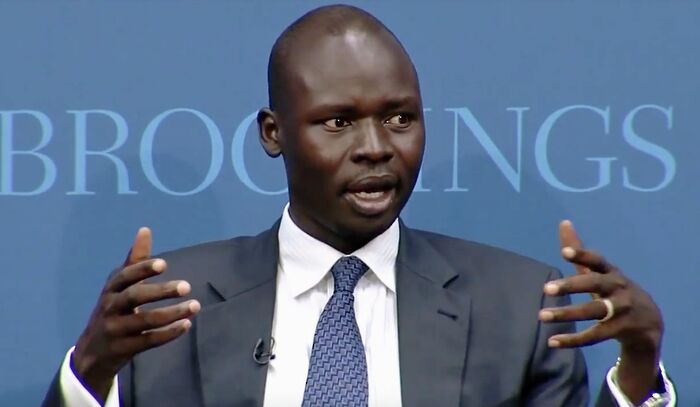
It clearly helps to get attention for a human rights defender in trouble if there is a connection to a western country as shown in the case of Cambridge PhD student Peter Biar Ajak who was with charged with sabotage and insurgency in South Sudan.
Peter Biar Ajak, a Cambridge University PhD student who has been detained in a South Sudan prison since last July, was charged on Monday with sabotage, insurgency and possession of weapons, along with six others, all of whom have pled not guilty. According to a report by the Associated Press, the charges have been brought forward by South Sudan’s National Security Service (NSS), and relate to an alleged prison uprising by other detainees in October 2018 in South Sudan’s main national security prison, the “Blue House”. The charges carry possible death penalty if the accused are found guilty.
Jared Genser, an international human rights lawyer who took on Ajak’s case, called the recent charges “unequivocally false”, telling Newsweek that his client “was not involved in any way in the planning or execution of the protest.”
Ajak was originally detained by the NSS at Juba International Airport on 28th July 2018, and has still not been formally charged for anything relating to this initial arrest eight months ago.
Ajak had been an outspoken critic of the South Sudanese government’s response to the country’s ongoing civil war. He is a chairperson of the South Sudan Young Leaders Forum, and was arrested while on the way to an event held by the Red Army Foundation, an organisation created by former child soldiers to advocate for peace and address social issues in the country.
Shortly before his arrest Ajak had tweeted that: “We must stop thinking that the so-called leaders will bring peace #SouthSudan. We, the great people of #southsudan, must organize ourselves to bring about the peace we deserve!”
Over the past few months there has been mounting international pressure on the South Sudanese government to release Ajak and others who have been similarly detained. Detaining a person without charge for more than 24 hours is illegal under the South Sudanese constitution.
The United Nations condemned Ajak’s continued detention earlier this month, citing a “clear trend in the use of national security and counter-terrorism legislation by states to criminalize free expression and the legitimate work of human rights defenders.”
On 27 March 2019, 21 international and Burundian human rights organisations condemn new irregularities in the case of Germain Rukukiin a Joint statement:
Almost four months after his appeal hearing at the Bujumbura Court of Appeal on 26 November 2018, the judicial case file of Burundian human rights defender, Germain Rukuki, has gone missing. In December 2018, the Government of Burundi decided to divide the Bujumbura Court of Appeal into three separate appeal courts, and the file apparently went missing during the reorganization.
Germain is appealing against his wrongful conviction by the Ntahangwa High Court and 32-year prison sentence, the longest prison sentence imposed on a human rights defender in Burundi. He is still awaiting the Court’s decision, which was initially expected within 30-days of the appeal hearing.
The loss of his case file further violates Germain Rukuki’s right to a fair trial, in addition to the multiple irregularities and undue delays that have characterized the legal proceedings since his arrest in July 2017.
We, the undersigned non-governmental organisations, strongly condemn this blatant miscarriage of justice and insist that Germain’s conviction is unlawful and part of a pattern of systematic attacks against human rights defenders and dissent voices since 2015, as echoed by the international human rights community, international and national civil society, as well as the United Nations and the Commission of Inquiry on Burundi in its reportreleased in September 2018.
We, the undersigned organisations, call on Burundian authorities to:
Release Germain Rukuki immediately and unconditionally, and quash his conviction and sentence;
Comply with international and regional human rights standards, notably the rights to freedom of expression, association and peaceful assembly, and the right to a fair trial;
Until he is released, ensure Germain Rukuki and his lawyer have timely and adequate access to his case file;
Launch an immediate, effective, impartial and transparent investigation into the circumstances of and responsibility for the loss of Germain Rukuki’s file;
Recognise the legitimacy of human rights work in Burundi and ensure a safe and enabling environment in which it is possible to defend and promote human rights without fear of punishment, reprisal or intimidation…..
For details about the arrest, please see the link below to HRW
AnEU spokesperson on 19 March stated:
“We believe that the sentencing of Oyub Titiev is directly connected to his human rights work for Memorial, an organisation that has been the subject of ongoing intimidation and harassment in the North Caucasus and beyond. We also believe that Mr Titiev has not received a fair trial. His sentencing continues a trend of arrests, attacks and discrediting of human rights defenders and journalists who work in that region of the Russian Federation. Mr Titiev’s predecessor as head of Memorial in Chechnya, Ms Natalia Estemirova, was killed in 2009 and, almost ten years later, not a single person has yet been brought to justice for this crime,”.
“The European Union expects Mr Titiev to be released immediately and unconditionally. The Russian Federation freely entered into commitments, first in Helsinki in 1975 and later in Copenhagen in 1990, to ensure “the right of everyone, individually or in association with others, to seek, receive and impart freely views and information on human rights and fundamental freedoms, including the rights to disseminate and publish such views and information.” We expect these commitments to be upheld”.
It is not often that this blog can quote the Chinese authorities in full agreement:
A Chinese foreign ministry spokesperson told reporters: “…detention without giving any reason violates a person’s human rights.”
[“We have made solemn representations to Canada and the US, demanding that both parties immediately clarify the reasons for the detention, and immediately release the detainee to protect the person’s legal rights.”]


 Hans Thoolen on Human Rights Defenders and their awards