Posts Tagged ‘extra-territorial’

The 46/2 Collective demands protection of Nicaraguan opponents exiled in Costa Rica

June 30, 2025

ISHR and the Colectivo 46/2 condemn the assassination of opposition leader Samcam Ruìz by the Nicaraguan Government.

In the joint letter published on 23 June 2025 The 46/2 Collective denounces to the international community the assassination of retired Nicaraguan Army Major Roberto Samcam Ruíz, which took place on 19 June in his home in San José, Costa Rica.

Samcam Ruíz was a strong voice of denunciation against the Ortega-Murillo dictatorship, denouncing the Nicaraguan army and pointing it out as a participant in the repression and extrajudicial executions committed since 2018. He had also denounced an espionage network against opposition refugees in Costa Rica.

The retired major was one of the 94 Nicaraguans denationalised in February 2023 by the dictatorship and since 11 July 2018 had been a refugee in Costa Rica due to persecution and criminalisation by the dictatorship of Daniel Ortega and Rosario Murillo. He obtained Spanish nationality on 26 July 2023.

The assassination of the former retired military officer is not the first attack against opponents on Costa Rican soil.  In 2023, opposition member Joao Maldonado and his wife were shot at with the clear intention of killing them. Maldonado had already suffered another attack in 2021, also in San José, Costa Rica. In 2022, the Nicaraguan opposition leader Rodolfo Rojas was found dead in Honduras. According to relatives, he had been lured to Honduras from Costa Rica, where he had gone into exile. To the list must be added the murder of another refugee, Jaime Luis Ortega, in 2024, in Upala, a canton on the border with Nicaragua. Following these events, Roberto Samcam had spoken to the press, pointing out the direct involvement of the Ortega Murillo regime and indicating that he knew that his life was at risk.

Although the investigations into Samcam’s murder are ongoing, the circumstances of the murder and the profile of the victim raise strong suspicions that it may be a political crime with possible transnational links. This murder takes place in a context in which various human rights organisations have been documenting a sustained pattern of surveillance, threats, harassment and acts of intimidation directed against Nicaraguans in exile in the region, especially in Costa Rica.

We consider that this crime should be analysed and investigated as part of a broader strategy of transnational repression promoted by the Nicaraguan regime to persecute and silence dissent outside its borders, in open violation of the human rights of refugees and exiles. This transnational repression has been documented by the Group of Experts on Human Rights in Nicaragua (GHREN), who have pointed out that ‘The Government’s repressive actions transcend the country’s borders and affect people who are opponents or perceived as such abroad. The government has also continued to target family members of opponents inside Nicaragua, including children, by mere association, as a way of punishing opponents and/or deterring them from speaking out wherever they are’.

Given the gravity of this crime and the sustained pattern of transnational repression against exiled Nicaraguans, we urgently call on the international community to demand that the Nicaraguan State immediately cease all forms of persecution, surveillance and violence against dissidents in exile. We also request that the international community strengthen political, technical and financial support for the protection mechanisms for human rights defenders in exile. We also urge the establishment of bilateral or multilateral channels of communication with the host countries of Nicaraguans in order to assess the security situation and articulate preventive responses to possible acts of transnational persecution. Finally, we call on international human rights bodies to urgently follow up on these cases as part of a systematic pattern of cross-border repression, and to ensure justice and truth for the victims.

Signatories:

  • Collective Nicaragua Never Again
  • Centre for International Law and Justice – CEJIL
  • International Federation for Human Rights – FIDH
  • International Institute on Race, Equality and Human Rights
  • Autonomous Women’s Movement – MAM
  • World Organisation Against Torture (OMCT)
  • Peace Brigades International – PBI
  • International Network on Human Rights Europe – RIDHE
  • Legal Defence, Registry and Memory Unit – UDJUDR
  • Open ballot boxes
  • International Service for Human Rights – ISHR

Additional information:

The 46/2 Collective is a coalition of 19 international, regional and Nicaraguan human rights organisations that regularly informs the international community about the lack of action by the Nicaraguan regime to meet its international human rights obligations.  
https://ishr.ch/latest-updates/the-international-community-must-act-to-protect-nicaraguan-opponents-in-exile-in-costa-rica

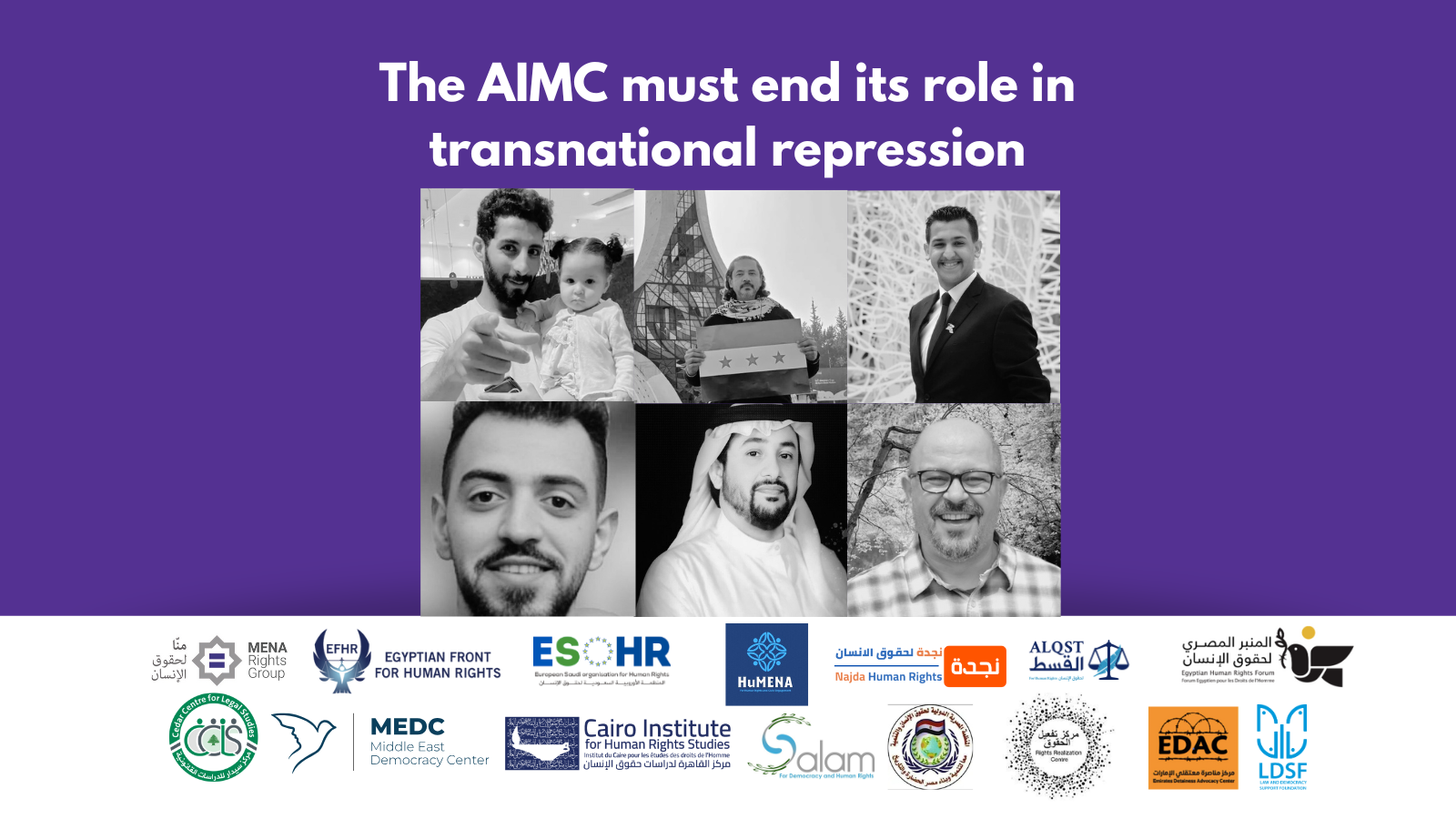
The Arab Interior Ministers’ Council must end its role in transnational repression

February 20, 2025

MENA Rights Group leads a coalition of 15 civil society organisations in urging the Arab Interior Ministers’ Council to cease its facilitation of arbitrary extraditions of peaceful dissidents and human rights defenders across Arab League countries and to align its legal framework and systems with international human rights law

From left to right: Ahmed Kamel, Abdelrahman al-Qaradawi, Salman al-Khaldy, Hassan al-Rabea, Khalaf al-Romaithi, Sherif Osman

February 17, 2025The undersigned organisations call on the Arab Interior Ministers’ Council (AIMC) to cease its facilitation of arbitrary extraditions of peaceful dissidents and human rights defenders across Arab League countries and to align its legal framework and systems with international human rights law.

On Sunday, February 16, 2025, the AIMC held its 42nd annual conference in its headquarters in Tunis. Often misleadingly referred to as “Arab INTERPOL”, the AIMC is an Arab League body tasked with enhancing cooperation among Arab states in the fields of internal security and crime prevention. Through its Department of Criminal Prosecution and Data, the AIMC circulates state-requested warrants to liaison divisions in Member States and facilitates wanted individuals’ extradition.

Although extraditions for “crimes of a political nature” are explicitly prohibited by the AIMC’s legal framework, specifically article 41 of the Riyadh Arab Agreement for Judicial Cooperation, they still occur in practice. Lacking an oversight body to prevent the abuse of its systems, the AIMC has become the perfect tool for Arab League states to request politically motivated extraditions.

Between 2022 and 2025, MENA Rights Group has documented the unlawful extraditions of four individuals: Khalaf al-Romaithi, Hassan al-Rabea, Salman al-Khaldy, and Abdulrahman al-Qaradawi. Currently, one individual is facing an imminent risk of extradition: Ahmed Kamel.

Ahmed Kamel is an Egyptian national currently detained in Saudi Arabia, where he had been living for a decade. In reprisal for peacefully protesting during the Arab Spring in Cairo in 2011 and 2014, Kamel faces imminent extradition to Egypt, where he may be subjected to human rights abuses including torture.

Despite their prohibition, Arab states continue to request and fulfil politically motivated extraditions, weaponising domestic laws which conflate peaceful criticism and human rights activism with terrorism or threats to state security.

Furthermore, the AIMC’s legal framework makes no reference to international human rights standards. More specifically, it fails to mention the principle of non-refoulement, enshrined in article 3 of the UN Convention against Torture, which provides that individuals must not be extradited to a country where they would face torture. 

UN Special Procedures mandate holders have raised concerns over the AIMC’s operations in a communication addressed to the Arab League, notably raising the impossibility for individuals to access their criminal file and challenge their arrest warrant. However, the UN experts have been provided with no response, and the Council has yet to undertake any reform.

As the AIMC continues to facilitate grave human rights violations across the Arab region, substantial change is required to ensure peaceful dissidents and human rights defenders are not at risk of transnational repression.

The undersigned organisations therefore urge the AIMC to immediately halt its facilitation of politically motivated extraditions, and undertake urgent reforms, in consultation with civil society, to align its legal framework and systems with international human rights law.

Signatories:

  1. MENA Rights Group
  2. Egyptian Front for Human Rights
  3. Egyptian Organization for Human Rights
  4. ESOHR
  5. Cedar Centre for Legal Studies 
  6. Law and Democracy Support Foundation – LDSF 
  7. Middle East Democracy Center (MEDC)
  8. ALQST for Human Rights
  9. Egyptian Human Rights Forum ( EHRF)
  10. Rights Realization Centre / مركز تفعيل الحقوق
  11. Salam for Democracy and Human Rights
  12. Najda for Human Rights
  13. Emirates Detainees Advocacy Center (EDAC) 
  14. HuMENA for Human Rights and Civic Engagement
  15. Cairo Institute for Human Rights Studies (CIHRS)

https://menarights.org/en/articles/aimc-must-end-its-role-transnational-repression-say-ngos

Q&A: Transnational Repression

June 14, 2024

On 12 June 2024, Human Rights Watch published a useful, short “questions-and-answers” document which outlines key questions on the global trend of transnational repression. 

Illustration of a map being used to bind someone's mouth
© 2024 Brian Stauffer for Human Rights Watch
  1. What is transnational repression?
  2. What tactics are used?
  3. Is transnational repression a new phenomenon?  
  4. Where is transnational repression happening? 
  5. Do only “repressive” states commit transnational repression?
  6. Are steps being taken to recognize and address transnational repression? 
  7. What should be done? 

What is transnational repression?

The term “transnational repression” is increasingly used to refer to state actors reaching beyond their borders to suppress or stifle dissent by targeting human rights defenders, journalists, government critics and opposition activists, academics and others, in violation of their human rights. Particularly vulnerable are nationals or former nationals, members of diaspora communities and those living in exile. Many are asylum seekers or refugees in their place of exile, while others may be at risk of extradition or forced return. Back home, a person’s family members and friends may also be targeted, by way of retribution and with the aim of silencing a relative in exile or forcing their return.

Transnational repression can have far-reaching consequences, including a chilling effect on the rights to freedom of expression and association. While there is no formal legal definition, the framing of transnational repression, which encompasses a wide range of rights abuses, allows us to better understand it and propose victim-centered responses.

What tactics are used?

Documented tactics of transnational repression include killings, abductions, enforced disappearances, unlawful removals, online harassment, the use of digital surveillance including spyware, targeting of relatives, and the abuse of consular services.  Interpol’s Red Notice system has also been used as a tool of transnational repression, to facilitate unlawful extraditions. Interpol has made advances in improving its vetting systems, yet governments continue to abuse the Red Notice system by publishing unlawful notices seeking citizens who have fled abroad on spurious charges. This leaves targets vulnerable to arrest and return to their country of origin to be mistreated, even after they have fled to seek safety abroad.

Is transnational repression a new phenomenon?

No, the practice of governments violating human rights beyond their borders is not new. Civil society organizations have been documenting such abuses for decades. What is new, however, is the growing recognition of transnational repression as more than a collection of grave incidents, but also as an increasing phenomenon of global concern, requiring global responses. What is also new is the increasing access to and use of sophisticated technology to harass, threaten, surveil and track people no matter where they are. This makes the reach of transnational repression even more pervasive. 

Where is transnational repression happening? 

Transnational repression is a global phenomenon. Cases have been documented in countries and regions around the world. The use of technology such as spyware increases the reach of transnational repression, essentially turning an infected device, such as a mobile phone, into a portable surveillance tool, allowing targeted individuals to be spied on and tracked around the world. 

Do only “repressive” states commit transnational repression?

While many authoritarian states resort to repressive tactics beyond their own borders, any government that seeks to silence dissent by targeting critics abroad is committing transnational repression. Democratic governments have also contributed to cases of transnational repression, for example through the provision of spyware, collaborating with repressive governments to deny visas or facilitate returns, or relying upon flawed Interpol Red Notices that expose targeted individuals to risk.

Are steps being taken to recognize and address transnational repression? 

Increasingly, human rights organizations, UN experts and states are documenting and taking steps to address transnational repression.

For example, Freedom House has published several reports on transnational repression and maintains an online resource documenting incidents globally. Human Rights Watch has published reports, including one outlining cases of transnational repression globally and another focusing on Southeast Asia. Amnesty International has published a report on transnational repression in Europe. Many other nongovernmental organizations are increasingly producing research and reports on the issue. In her report on journalists in exile, the UN Special Rapporteur on freedom of expression dedicated a chapter to transnational repression. The UN High Commissioner for Human Rights used the term in a June 2024 statement.

Certain governments are increasingly aware of the harms posed by transnational repression. Some are passing legislation to address the problem, while others are signing joint statements or raising transnational repression in international forums. However, government responses are often piecemeal, and a more cohesive and coordinated approach is needed. 

What should be done? 

Governments should speak out and condemn all cases of transnational repression, including by their friends and allies. They should take tangible steps to address transnational repression, including by adopting rights-respecting legal frameworks and policies to address it. Governments should put victims at the forefront of their response to these forms of repression. They should be particularly mindful of the risks and fears experienced by refugee and asylum communities. They should investigate and appropriately prosecute those responsible. Interpol should continue to improve vetting process by subjecting governments with a poor human rights record to more scrutiny when they submit Red Notices. Interpol should be transparent on which governments are continually abusing the Red Notice system, and limit their access to the database.  

At the international level, more can be done to integrate transnational repression within existing human rights reporting, and to mandate dedicated reporting on cases of transnational repression, trends, and steps needed to address it.

see also: https://humanrightsdefenders.blog/2024/03/19/transnational-repression-human-rights-watch-and-other-reports/

https://www.hrw.org/news/2024/06/12/qa-transnational-repression

HRDs from Hong Kong fear arrest warrants and bounty

July 19, 2023

On 13 July 2023 the ITUC has protested to the Hong Kong authorities, the ILO and the UN over its deep concern about the escalation in the climate of fear, intimidation, arrests, arbitrary prosecutions, threats for the exercise of trade union rights and civil liberties in Hong Kong.

In particular, the disproportionate and unwarranted extra-territorial application of the National Security Law to target trade unionists, human rights defenders and pro-democracy advocates by the Authorities of the Hong Kong Special Administrative Region (HKSAR) undermines its commitment to fulfil their international obligations.

The ITUC has called on the HKSAR Chief Executive Officer to respect and fully implement the conclusions and recommendations of ILO supervisory bodies and UN Human Rights bodies, in law and practice, including those regarding the National Security Law.

And he has been urged to release all those arrested and imprisoned for allegations related to the exercise of civil liberties including freedom of assembly, expression, press and association and those participating in pro-democracy activities.

On 4 July 2023, the HKSAR authorities announced, under the National Security Law, the issuance of arrest warrants against eight human rights defenders and pro-democracy advocates and placed a bounty of HK$ one million on each of their heads.

ITUC Acting General Secretary Luc Triangle said: “We unequivocally deplore the HKSAR authorities’ criminalisation and securitisation of trade union and democracy-promoting activities. We consider it particularly egregious, especially given the risks to life and safety faced by trade unionists, human rights defenders and pro-democracy advocates around the world for their legitimate activities, that the HKSAR authorities approved and announced a bounty on the heads of these eight people for exercising their civil liberties or trade union rights.

“As a special administrative region of a member State of the ILO, China, the HKSAR is also obliged to respect and promote the fundamental principles and rights at work including freedom of association and treat with the utmost regard, the authoritative guidance of the ILO’s supervisory bodies.”

The ITUC letter of protest sets out the recent findings of the ILO and other UN bodies on the abuse of workers’ and trade union rights by the HKSAR. It says that seeking to apply the National Security Law in an extraterritorial manner and placing a bounty on the heads of pro-democracy advocates and human rights defenders for alleged crimes related to the exercise of civil liberties and trade union rights is an overreach and certainly not proportionate – its coercive and chilling effective is wide ranging. With the use of the National Security Law in this disproportionate and arbitrary manner, the HKSAR authorities are violating their obligations under the Constitution of the ILO and Convention 87.

https://www.ituc-csi.org/hong-kong-bounty-enhttps://www.ituc-csi.org/hong-kong-bounty-en