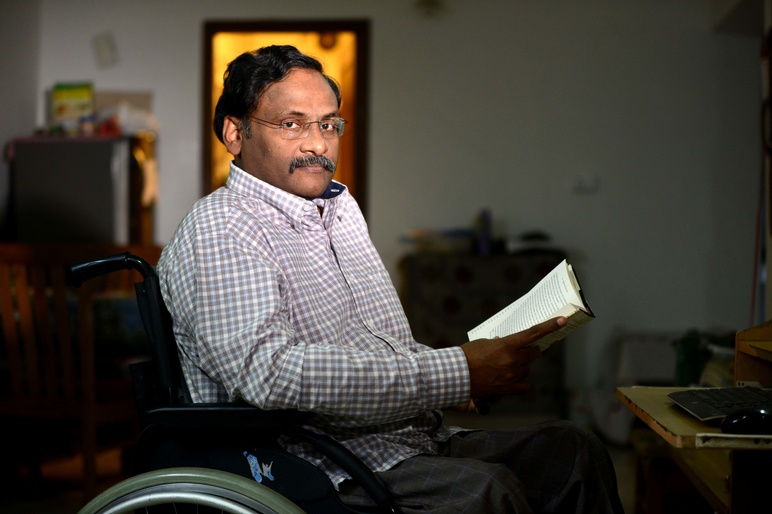
A wheel-chair using, human rights activist and former university lecturer of English, G. N. Saibaba has endured years of cruel, inhumane solitary confinement ©DR
I still stubbornly refuse to die
The sad thing is that
They don’t know how to kill me
because I love so much
The sound of growing grass
OMCT published this impressive story in calling for the immediate release of G. N. Saibaba:
These are the defiant words of Gokarakonda Naga “G. N.” Saibaba, written from his cell in Nagpur Central Jail in the Indian state of Maharashtra. A wheel-chair using, human rights activist and former university lecturer of English, Sai has endured years of cruel, inhumane solitary confinement. Still, his irrepressible resilience shines through. And Sai’s poetry fills a recently published anthology. But he did not write it in verse. In order to evade the prison’s punishing censors, and to disguise his messages of equality, positivity and love, Sai penned letters to friends and his partner of 30 years. These were transcribed, and became his book entitled, Why Do You Fear My Way So Much?
Prison conditions
Now, G. N. Saibaba is much less able to write. Since his erroneous conviction for terrorism-related crimes in 2017, and a sentence of life imprisonment, Sai’s health has progressively deteriorated. Suffering from a heart condition, a brain cyst, a lump in the abdomen and breathing difficulties, his multiple medical conditions require specialised treatment only available in New Delhi. And his disability as a result of childhood polio has been compounded by untreated nerve damage in his left arm, that has spread to his right, leaving him with no strength in his upper limbs. Sai needs support to perform any simple human function like sitting up, eating, drinking or using the toilet, a task which has been assigned to two fellow detainees. His dependency has been underlined by the constant monitoring of his cell. It was only recently – after Sai went on another hunger strike – that the prison authorities agreed to change the direction of CCTV cameras, giving him some semblance of privacy. Before that, his bed and toilet were recorded 24/7. This was a small victory. Despite repeated advocacy by the UN and human rights groups on G. N. Saibaba’s behalf, he is forced to inhabit a small, egg-shaped cell exposed to extreme weather conditions and with little space to move, particularly for someone in a wheelchair as Sai. Given his disability, some commentators believe the conditions of his detention may amount to torture.
Arrest in Delhi
It was 9th May 2014, and G. N. Saibaba was returning home for lunch from his lecturing duties at Delhi University. Without warning, a van jack-knifed in front of the car he was travelling in, forcing it to stop. Sai’s driver was pulled roughly from the vehicle, and replaced by a man in civilian clothing. Two others flanked their captive in the back. G N Saibaba was driven directly to the airport. He was never shown an arrest warrant, and nobody informed Sai’s relatives about his arrest. He was put on a plane to Nagpur, Maharashtra. On arrival, he was transported in an anti-landmine vehicle, in a convoy of commandos armed with automatic weapons. The military clearly wanted to send a message they had detained a hard-core terrorist – not a committed campaigner who has fought most of his life against discrimination and caste-based oppression, and for the rights of women and indigenous Indians.
Activism
G. N. Saibaba grew up in a small, rural community in southern India. Disabled by polio as a young child, he understood early on how unfairness and prejudice are perpetrated. Excelling in school, Sai went on to university where he became involved in student politics. His appointment as a professor of English did not dilute his outspoken criticisms of injustice.
In particular, he became a leading detractor of what became known as ‘Operation Green Hunt’ – a military campaign in central India, home to a large population of several indigenous communities (known as Adivasis), to eliminate Maoists, also called Naxals. Central India has witnessed numerous people’s movements opposing forceful occupation of indigenous land, and the exploitation of ancient forests and rich mineral resources. This military campaign against Naxals was used to quash such movements, leading to numerous human rights violations against civilians.
Conflict in this region dates back to the 1960s. ‘Operation Green Hunt’ began in 2009 – an all-out, on-going offensive by the Indian armed forces to rid the area of Naxals. G. N. Saibaba led the Forum Against War on the People – a solidarity organisation, and an attempt to shine a light on human rights abuses in the region. These atrocities – committed for the most part by the military and paramilitaries – have been well documented. They include extrajudicial killings, multiple rapes, and the deeply disturbing desecration of civilian corpses. It has been estimated more than 2,000 people have lost their lives since 2009.
Conviction
G. N. Saibaba’s advocacy certainly gave pause for thought to national and transnational mining corporations thinking about investing in the region. So, it was inevitable perhaps he would become a target. His persecution began under the Congress government – his Delhi home was raided more than once – and then continued under the BJP, and the prime ministership of Narendra Modi.
At G. N. Saibaba’s trial in 2017, with the courthouse fortified by hundreds of police officers to reinforce the impression of a dangerous extremist, he was tried under India’s anti-terror legislation – the Unlawful Activities (Prevention) Act. With five others, Sai was convicted of alleged links to the banned Maoist organisation.
Judicial rollercoaster
In October this year, the Nagpur Bench of the Bombay High Court ruled G. N. Saibaba’s initial trial had been flawed. The case against him was discharged. The elation he, his family and supporters felt quickly turned to disbelief. The government – infuriated, no doubt by the court’s decision to release an ‘urban Naxal’, a term regularly used to stigmatise human rights defenders – applied for a special sitting of the Supreme Court. The very next day, on a non-working day the special bench of the Supreme Court suspended the decision of the Bombay High Court. This leaves G N Saibaba still in that heavily monitored isolation cell, struggling to negotiate its curved walls in his wheelchair.
Above all, love
G. N. Saibaba’s hope of liberty has once more been dashed. Even so, his spirit is strong. The untreated infections in his hands, and the pain he experiences, means Sai cannot write more than two or three pages a month. But letters from home, especially from his partner, help sustain him.
I defeat the purpose
of the solitary confinement
by drowning myself
in your letters of love.
 Hans Thoolen on Human Rights Defenders and their awards