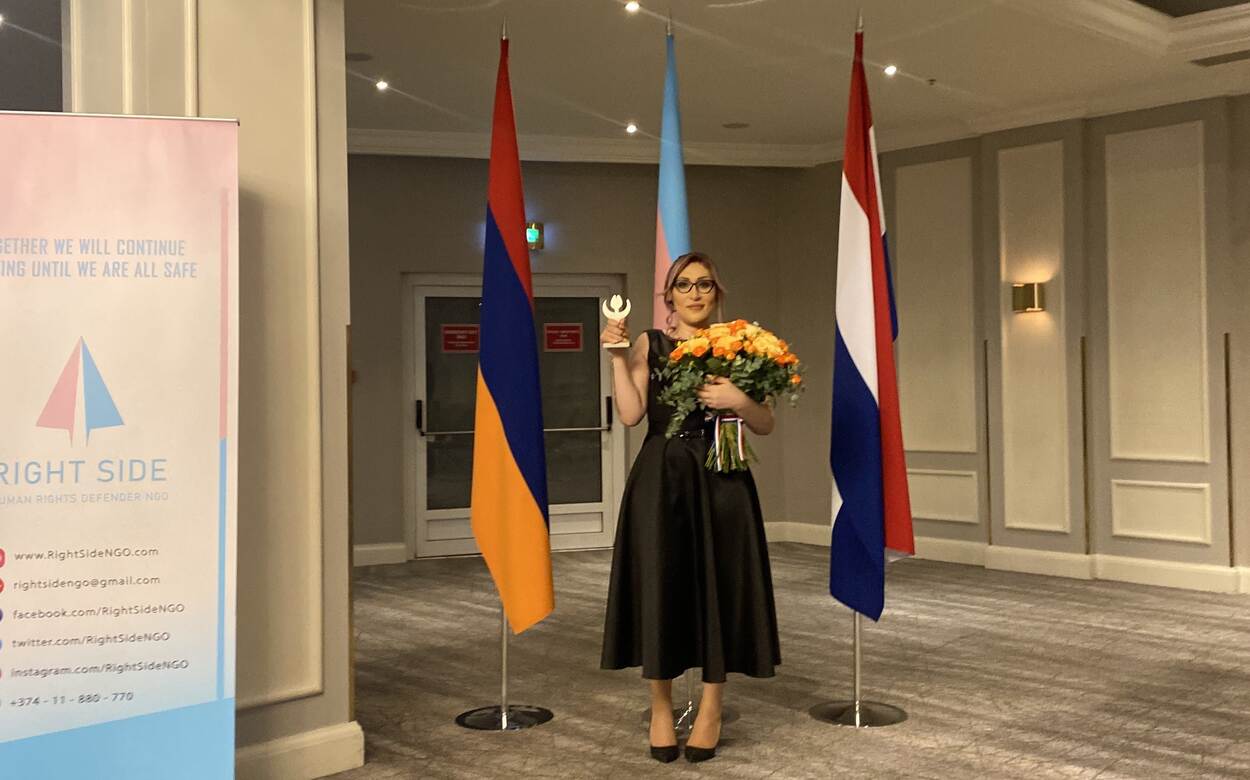
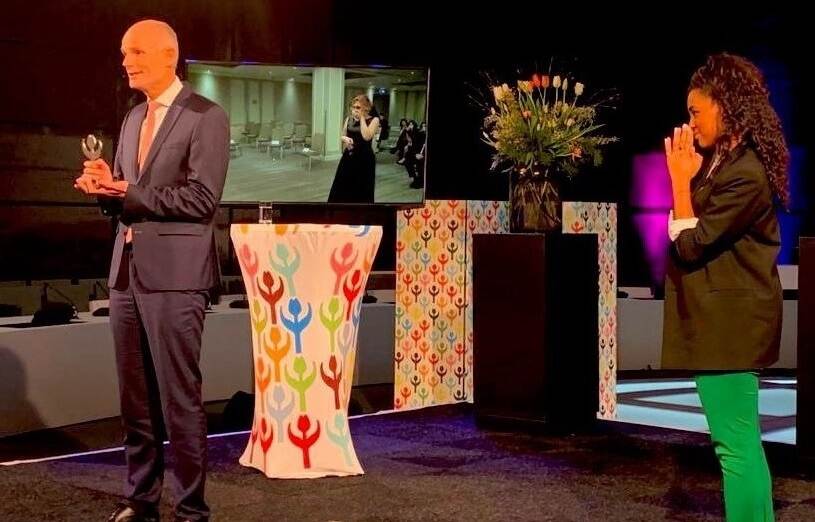
On Human rights Day 10 December 2020 the Netherlands Minister of Foreign Affairs Stef Blok presented the Tulip award during an online ceremony to Lilit Martirosyan.
‘This year,’ said Mr Blok, ‘the three candidates shortlisted for the Human Rights Tulip 2020 were an indigenous women’s rights advocate from Guatemala [on behalf of a network of female healers], a doctor from Sudan [on behalf of an association of trade unions] and a transgender woman from Armenia. They all share a common dedication to promoting human dignity and equality, and work to defend other people’s fundamental rights. They have demonstrated the true meaning of hope, and shown that human rights are for everyone. Regardless of who you are, where you’re from or how much money you have. [see: https://humanrightsdefenders.blog/2020/10/15/final-three-nominees-human-rights-tulip-2020/]
Lilit Martirosyan is Armenia’s first registered transgender woman. As founder and current president of the Right Side human rights defender NGO, she works fearlessly for equal rights for everyone, regardless of their sexual orientation, gender identity or gender expression. ‘Lilit has never given up on the peaceful path towards change,’ said Mr Blok, ‘even after receiving death threats. Throughout everything she has remained hopeful and has stood up to defend what she believes in. Hopefully this prize will help her continue to make meaningful strides in her human rights work.’
Thanks to the peaceful activities of Lilit and Right Side, there is now a community centre that serves as a home and safe place for the LGBTI community and sex workers in Armenia. They receive legal and social-psychological support, and if they want to change their name in their passport they can do so without undergoing gender reassignment. The Dutch government recognises Lilit Martirosyan for her constant leadership in demanding attention and respect for transgender people and sex workers in Armenia. Her nomination has also drawn attention to the plight of transgender people and sex workers throughout the region.
“I believe in the power of music to inspire us, to connect our hearts, to give voice to feelings for which words alone won’t suffice, to wake us up out of complacency, to galvanize and fuel social movements,” the singer said upon accepting his award. “Artists have a rich tradition of activism. We have a unique opportunity to reach people where they are, beyond political divisions, borders, and silos. And it’s been my privilege to use my voice and my platform to advance the cause of equity and justice.” See: <a href="http://<iframe src="//content.jwplatform.com/players/Ge9Alkkq-zFOPDjEV.html" width="640" height="360" frameborder="0" scrolling="auto">//content.jwplatform.com/players/Ge9Alkkq-zFOPDjEV.html
Over his 20-year career, Legend has been closely involved with a variety of causes. In 2007, he started the Show Me Campaign to improve access to education, while the Bail Project has advocated for ending mass incarceration and making it easier for released prisoners to find work by removing criminal background checks from job applications. In his High Note Global Prize speech, he touched on his most recent campaign, #FreeAmerica, which is aimed at broad criminal justice reform.
He went on to highlight his most recent campaign, #FreeAmerica, which works toward criminal justice reform. “As a citizen of the United States, and of the world, I know that for far too long our most essential systems have served to perpetuate inequity and injustice,” he shared. “In order for us to create a just world those systems need to change.”
“With this award we celebrate a multitude of advocates, generations of movement leaders who have put their shoulder to the wheel of progress,” he concluded. “I don’t stand here absorbing these accolades for myself. I stand here grateful for their ideas and their energy and honored that I can amplify their voices by using my platform.”
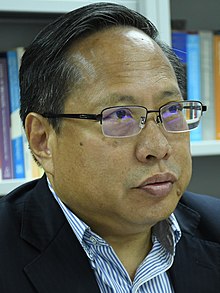
Human Rights First announced today that it will award the 2020 Roger N. Baldwin Medal of Liberty to Hong Kong human rights defender Albert Ho. The award will be presented today 10 December in a virtual event that will include a conversation between Ho and Human Rights First Senior Advisor Brian Dooley.
Albert Ho is a veteran Hong Kong lawyer and advocate whose career in human rights and political activism stretches back almost four decades. A leading figure in the pro-democracy movement for many years, he remains prominent in the protest movement that energized Hong Kong in 2019 and 2020.
“No dictatorship is too big or too strong to take on,” said Vladimir Vladimir Kara-Murza, Senior Advisor for Human Rights Accountability at Human Rights First and 2020 Baldwin Award jury member. “This decision shows who is right and wrong, and Albert Ho is in the right. There are no lost causes, and the cause of democracy in China is not lost.”
Ho is now facing a dozen charges related to those peaceful protests and his law firm continues to represent many others who have protest-related charges.
“I’m honored to accept this award,” said Ho, “but I do it on behalf of many colleagues who have shared the case of human rights in Hong Kong with me for so many years.”
Ho is the co-founder and senior partner of Ho, Tse, Wai and Partners (HTW), a Hong Kong law firm renown for advocacy on landmark human rights cases. Ho and HTW have represented many arrested pro-democracy protestors and challenged many of the Hong Kong government’s dubious actions, such as the banning of face masks under a colonial-era law and the disqualification of numerous pro-democracy lawmakers.
Ho has also done extensive advocacy for human rights lawyers in mainland China. He founded the China Human Rights Lawyers Concern Group in 2007 to provide humanitarian assistance to detained human rights lawyers and their families, advocate on behalf of detained lawyers, and share knowledge and experience with Chinese lawyers.
Despite surveillance and threats by Chinese authorities, Ho has maintained his steadfast support for his peers in mainland China in the face of the government’s crackdown on human rights lawyers, the “709 crackdown” known for the day it began – July 9, 2015. Placing the pursuit of justice before his own safety, Ho continues to raise awareness of the plight of human rights lawyers in China to see that the world holds the Chinese Communist Party accountable for human rights abuses.
The Council of Bars and Law Societies of Europe (CCBE) has granted its 2020 Human Rights Award to seven Egyptian lawyers who are currently in prison.
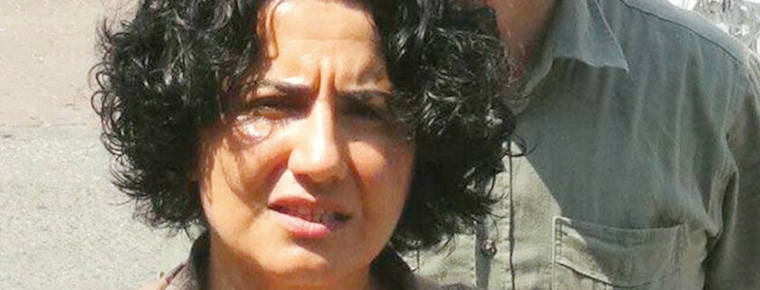
The body, which represents the Bars and Law Societies of 45 countries, has also given an exceptional posthumous award to Turkish lawyer Ebru Timtik (pictured), who died in August 2020.
Haytham Mohammadein, a human rights lawyer and labour activist,
Hoda Abdelmoniem, former member of the National Council for Human Rights, spokesperson for the Revolutionary Coalition of Egyptian Women and consultant for the Egyptian Commission for Rights and Freedoms (ECRF),
Ibrahim Metwally Hegazy, a lawyer, member of the ECRF and co-founder of the Egyptian Association of Families of the Disappeared (EAFD),
Mahienour El-Massry, who is often described as a voice of the revolution and is active in the defence of women’s rights and many other citizen’s rights,
Mohamed El-Baqer, director of Adalah Center for Rights and Freedoms,
Mohamed Ramadan, a lawyer whose work involves legally representing human rights defenders,
Zyad El-Eleimy, a lawyer and a former parliamentarian in Egypt.
The Edelstam Prize 2020 is awarded toOsvalinda Marcelino Alves Pereira from the Amazon rainforest territory in Brazil for outstanding contributions and exceptional courage. She has fearlessly and continuously been reporting to federal authorities illegal logging of the forest in the Areia region. For more on this and similar awards, see: https://www.trueheroesfilms.org/thedigest/award/CAA00E38-C320-41E0-9FD4-B3BF3DC0D54F
Mrs. Osvalinda Alves Pereira from Pará in Brazil is an Amazon rainforest defender and community organizer who puts herself at great risk in defending the forest and its population. Defending the forest from illegal logging is very dangerous, as laws are rarely enforced against the perpetrators of the abuses. Criminal logging networks deploy men to protect their illegal activities and intimidate, threaten and kill those who obstruct their activities which are causing the deforestation and destruction of the Amazon rainforest.
Osvalinda Alves Pereira and her husband, Mr. Daniel Alves Pereira, have received numerous threats for nearly a decade from criminal networks involved in illegal logging in the state of Pará. For more than 18 months they have been in hiding, with the support of the Federal Program to Protect Human Rights Defenders, Journalists, and Environmental Defenders; however, they are now back in Pará as they feel that, even if the security is not strong enough, they have to continue their work within the rainforest areas where the illegal logging is taking place.
“The courageous activity of Mrs. Osvalinda in reporting illegal logging of the Amazon rainforest despite constant threats and in standing up for her convictions in times when justice is required sets an important example for the resilience needed to protect and defend our environment. Brazil has signed the Paris Agreement on Climate Change and has committed to eliminate illegal deforestation in the Amazon by 2030. However, authorities are failing to implement and enforce environmental laws in the Amazon, which heavily undermines the work to protect the forest,” says Caroline Edelstam, Chair of the Edelstam Prize Jury and co-founder of the Edelstam Foundation
Large farmers involved in illegal logging often use land-reform settlements where poor farmers have small plots to have access to the nearby protected forests. Osvalinda Alves Pereira founded the Areia II Women’s Association to develop sustainable organic agriculture and to reforest areas where logging has occurred. She is a local leader of the Areia Settlement Project, which is geographically situated as a gateway to three major conservation units: the Trairao National Forest, the Riozinho de Afrisio Extractive Reserve, and the Jamanxim National Park, which are areas of great interest to illegal loggers. Pará is today the state with the highest reported number of conflicts over land and resources.
In spite of offers of bribes and persistent threats, Osvalinda Alves Pereira has courageously continued to report the activities of the illegal loggers. Criminal networks are engaged in the large-scale extraction, processing, and sale of timber, illegal land seizures, as well as illegal mining in the Amazon. They employ armed men to intimidate the local population. The vast majority of threats and attacks against forest defenders is never properly investigated or punished. As a consequence, forest defenders are at great risk, and Osvalinda Alves Pereira fears for her life.
“It is important to find ways to enforce national and international law and promote accountability for serious abuses of human rights. In this case, Brazil, should be able to provide protection to forest defenders who receive death threats. Impunity is not an option. The international community also has a responsibility to uphold justice and ensure the protection of victims and defenders of the forest, including both environmental enforcement officials and members of the Indigenous and other local communities, and to uphold the principle that nobody is above the law. This year, nearly 8000 square kilometres have been deforested,” says Caroline Edelstam, Chair of the Edelstam Prize Jury.
The prize will be awarded during a live-streamed ceremony tomorrow, the 24th of November at 5 pm CET, 2020 on http://www.edelstam.org
Migrant Workers Rights Network is a grassroots member-based association that works to protect the rights of migrant workers who live and work in Thailand, the majority being from Myanmar. The organization was founded in 2009 by nine Myanmar migrant leaders after seeing extensive exploitation and abuse of migrant workers in Thai factories, the seafood industry, agriculture, and construction. They decided that empowerment of migrants is the best way for migrant workers to protect themselves.
Hussein al-Qaidi, director of the Office of Rescuing Kidnapped Yezidis for the Kurdistan Regional Government (KRG), has been named the recipient of the Sergio Vieira De Mello Prize, which is awarded yearly in Poland (!) to individuals and organizations which promote human rights and dialogue.
Qaidi is a Yezidi, born in the Duhok province of Iraqi Kurdistan. In 2014, after ISIS overran the Yezidis’ homeland, he organized campaigns to find missing people, free them, and help then return to a normal life.
The KRG supported Qaida’s efforts and already in August 2014, he was named to lead a new unit: the Office of Rescuing Kidnapped Yezidis. It is based in Duhok, and Qaida remains its head.
Last November, Qaida received the prestigious Mother Teresa Memorial Award for rescuing thousands of Yezidi women from the clutches of the ISIS terrorists.
Raoof hopes that the award will put Yezidis in the spotlight again in Poland, since previous awards were widely reported in the Polish media.
“I believe that it will once again make Polish people aware of the difficult fate of Yezidis and also show that there are still many people and organizations helping Yezidi people with great courage and commitment, ”he continued.
On 10 November 2020 Scholars at Risk (SAR) announced that Dr. Rahile Dawut is the recipient of its Courage to Think Award for 2020. Dr. Dawut is being recognized for her own work, as well as that of all the scholars and students of the Xinjiang Uyghur Autonomous Region, who together struggle for academic freedom and freedom of opinion, expression, belief, association, and movement.
Dr. Dawut is an Associate Professor in the Human Science Institute of Xinjiang University and founder of the Minorities Folklore Research Center in Xinjiang University. In December 2017, Dr. Dawut told a relative of her plans to travel from Urumqi to Beijing. Shortly thereafter, her family and friends lost contact with her. Professor Dawut’s disappearance was made public in August 2018. It is suspected that she is held by state authorities at an undisclosed location.
“My mother is a scholar, not a criminal,” said Akeda Pulati. “She studies the folklore and cultural traditions of minority populations. That is not a threat to the government, other institutions, or the people of China.”
“The imprisonment of Dr. Dawut, an internationally recognized scholar of Uyghur culture, reveals the Chinese government’s blatant repression of voices and ideas it finds displeasing,” said Rob Quinn, executive director of SAR. “This constricts academic activity and public expression, threatening minority traditions, histories, and languages. The disappearance of Dr. Dawut, along with many thousands of others, is an atrocity we should all strive to end.”
Bulatlat of 10 November 2020 reports that Neri Colmenares, one of the country’s most prominent public interest lawyers, has won the human rights award of the International Bar Association (IBA) for his “extensive contribution to human rights, and his continuing determination and advocacy, in the face of great adversity.”
Himself a victim of unrelenting red-baiting by military, police and government officials for his human rights advocacy and activism, Colmenares is a former three-term member of the Philippine House of Representatives and is currently the national chairperson of the National Union of People’s Lawyers (NUPL). He is also a leader of the Concerned Lawyers for Civil Liberties and adviser for advocacy of the Integrated Bar of the Philippines.
Colmenares’ human rights advocacy began when he became the Western Visayas regional chairperson of the Student Catholic Action of the Philippines during martial law in the 1970s. While campaigning for the return of student councils in schools ordered closed by then President Ferdinand Marcos, Colmenares was arrested and tortured by the military.
He spent four years in jail as one of martial law’s youngest political prisoners at 18. After his release from prison, Colmenares earned his BA Economics degree from San Beda University (SBU), his law degree from the University of the Philippines and his Master of Laws degree from the University of Melbourne in Australia on scholarship.
As a human rights lawyer, Colmenares has argued a number of cases before the Supreme Court and championed causes in the legislature in support of marginalized sectors, including the following:
* The Party List Election Case in 2000, which led to the High Court ordering that 20 per cent of the seats in Congress be reserved for the marginalized and underrepresented poorer .
* The Pork Barrel Case during the Gloria Macapagal-Arroyo administration that led the Supreme Court to declare the Congressional practice as unconstitutional.
* In 2017 Mr Colmenares, alongside fellow human rights lawyers, constitutionalists and several law students, established Manlaban sa EJK that campaigns against the continuing extra judicial killings under President Rodrigo Duterte.
* Colmenares is also acting as co-counsel in a complaint against President Duterte for crimes against humanity, filed to the International Criminal Court (ICC) by families of extrajudicial killing victims.
* Colmenares is a counsel-complainant in one of the 37 petitions questioning the constitutionality of the Anti-Terrorism Act of 2020
As a parliamentarian, Colmenares advocated for the democratic rights of those with disabilities and the elderly, such as special election precincts to assist them in voting, as well as introducing the Early Voting Law for media personnel who would be covering the election on the day.
He also authored the law mandating the Philippine government to issue early warning to citizens during disasters and calamities as well as an increase of benefits given to social security system pensioners, among many other pieces of legislation.
In 2005, Colmenares helped organize the Counsels for the Defense against Attacks on Lawyers, a group of lawyers and law students advocating against the unlawful killings and arrests of their colleagues under then President Arroyo.
Colmenares (second from left) denouncing extra-judicial killings. (Photo from Neri Colmenares’s Facebook account)
In bestowing him the award, IBA Human Rights Law Committee co-chairperson Federica D’Alessandra said Colmenares has drawn on every tool in the legal toolbox, from legislation, to litigation, to advocacy in order to advance human rights and the rule of law for the protection of the Filipino people.
“With this award the IBA recognizes [Colmenares’] incredible accomplishments, and celebrates his great resolve as he continues to fight for media freedom, and stand against extrajudicial killings, forced disappearances and unlawful detention in the Philippines,” D’Alessandra said.
“It could not have come at a better time than now that human rights lawyers and defenders in the Philippines are under attack especially in the form of vicious vilification commonly referred to as red-tagging,” the NUPL said.
Colmenares said the award is both an honor and an inspiration to human rights lawyers like them to continue their work with the people despite the threats and difficulties. He said awards from established international institutions like the IBA serves as a mantle of protection to threatened lawyers worldwide.
“Fifty (50) lawyers and judges have been killed in the Philippines since 2016 and this award will also provide a mantle of protection for human rights lawyers like me,” Colmenares said.
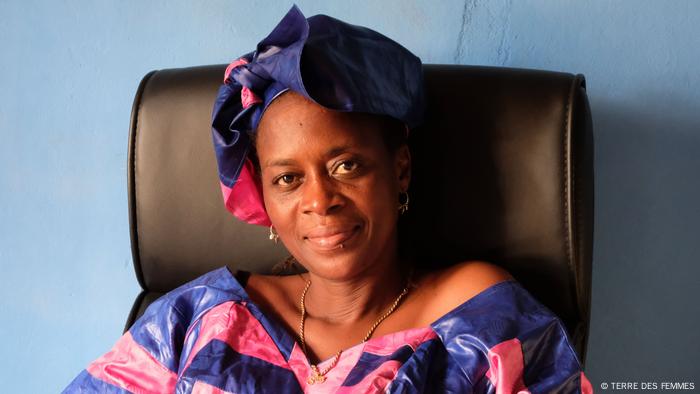
When Rugiati Turay was 12, she was taken to an aunty together with her three sisters and a female cousin.
“We were told it was just a visit,” Turay, now 47, recalls. “But I was grabbed and blindfolded and taken to a room. Women sat on me and held me down.”
Turay’s clitoris was then cut off. She still remembers the pain.
“I bled excessively and I almost lost my life. For one week, I could not walk,” Turay told DW. “All I knew was just the pain and the bleeding.”
Like Turay, some 90% of women and girls in Sierra Leone undergo female genital mutilation, or FGM. It is a cultural practice that involves the partial or total removal of the female genital organs, such as the clitoris or labia.
In Sierra Leone, the cutting is part of the initiation into secret women’s societies, known as Bondo, that prepare girls for marriage and motherhood.
When she was cut as a girl, Turay didn’t have the knowledge to express what had happened to her. She just knew it was wrong, she said in a telephone interview from Lunsar, a town some 120 kilometers (74 miles) from the capital, Freetown. Rugiatu Turay works to persuade traditional practitioners to lay down the tools used to cut girls
“I started talking to my friends, explaining to them what I went through,” she said. “Because we were all eager … to become members of the Bondo society. But when I experienced what I experienced, I thought it is high time to talk to others and not to be fooled.”
More than a decade later, Turay found herself in Kalia refugee camp in Guinea, where she had fled Sierra Leone’s civil war that raged from 1991 to 2002. In the camp, she was shocked that amid the hardship and insanitary conditions of the camp, mothers were still organizing for their daughters to be cut.
That was the moment when Turay, who had trained and worked as a teacher before fleeing the fighting, started on her journey to campaign to stop female genital mutilation in Sierra Leone.
The nation is one of 28 African countries where female genital mutilation is practiced
“I decided [that] we needed to engage these people. They needed to know that we have run away from violence committed to us by people and we are now perpetuating that violence on us,” she said.
In 2000 while still in Kalia camp, Turay founded the Amazonian Initiative Movement (AIM), together with a group of like-minded women, to reduce the incidence of FGM among the refugees.
The name was taken from the “strong and fearless” Amazonian warrior women from Greek mythology, explains Turay, chosen because “looking at the issues I was determined to address and knowing [Sierra Leone] and the people where I came from, I knew it was going to be a rough battle.”
In 2003, when she returned home after the end of the civil war, Turay started up a branch of the grassroots organization in her hometown of Lunsar.
As part of their activities, Turay and other AIM activists visit villages to talk to those involved in FGM, from women and girls, to local chiefs and imams. They also seek out the soweis, the traditional cutters, who earn a living from the practices. They seek to convince them to stop cutting and look for alternative livelihoods for these women. AIM has held several public ceremonies involving hundreds of soweis who have vowed to lay down their knives and razor blades.
It has also held a large alternative rites of passage lasting for 14 days to replace the traditional Bondo bush ceremony that girls usually pass through during initiation but without the cutting.
As well as running a safe house for girls fleeing from FGM and other violence such as forced marriage, AIM has built a school that includes a curriculum teaching about cutting.
Turay’s work hasn’t been easy. Initially, she couldn’t even rent a building for AIM as no one wanted to have anything to do with an anti-FGM organization. Luckily, her father supported her efforts, turning over his own house to use as her office.
She, and others involved in the organization, have also faced numerous death threats as well as being banned by the village chief – something Turay says has only hardened her resolve.
“When you threaten me and say you’ll kill me, I come back and I engage you,” she said.
“I ask, ‘Why do you really want to kill me? Tell me, what have I done? Have I killed anyone? No, I want to change your beliefs that are not progressive, that have killed so many people, that have kept others quiet but suffering in silence’.”
And so I use those threats and I talk to the leaders of the secret society and I engage them.”
Because of coronavirus travel restrictions, Turay will attend the awards ceremony on October 24, 2020 virtually. Turay was nominated by the German women’s rights organization, Terres des Femmes, for the award.

 Ebru Timtik


 Hans Thoolen on Human Rights Defenders and their awards