Posts Tagged ‘Canada’

Canadian Lawyers write for detained Human Rights Defender Asma Ahmed in Sudan

May 21, 2013

Canada LRWC is a committee of Canadian lawyers and law professors who campaign internationally for advocacy rights and advocates in danger and on rule of law issues. The following is both an illustration of professional solidarity and giving information on a Sudanese woman human rights lawyer, Asma Ahmed: Read the rest of this entry »

Humberto Prado Sifontes in Venezuela falsely accused by Minister

April 10, 2013

On 8 April 2013, the Minister for the Prison Services, Ms Iris Valera, accused prominent human rights defender, Dr Humberto Prado Sifontes, of instigating violence within the country’s prisons ahead of upcoming elections on 14 April. Humberto Prado Sifontes is the Director of the Observatorio Venezolano de Prisiones – OVP (Venezuelan Prisons Observatory) which documents cases of violations against persons in detention in Venezuela.

At a press conference at her office,the Minister stated that on 3 April Humberto Prado Sifontes had met with the families of prisoners in the Comunidad Penitenciaria de Coro. The Minister accused the human rights defender of planning protest actions within prisons all over the country, beginning with hunger strikes before escalating to blood strikes, where prisoners self-mutilate in order to bring attention to their situation. She alleged that Dr Humberto Prado Sifontes quickly departed from the Plaza and went to the Diocesan of the Archbishop when he noticed the presence of officials from the Ministry of Prison Services who were there to investigate what was going on. She claimed to have found evidence for these plans in the notebooks of a prisoner. Minister Valera also linked the human rights defender to two unrelated incidents; one in which five women tried to smuggle grenades into the same prison, and a foiled escape attempt at the Metropolitan Prison Yare II in Caracas. Dr Humberto Prado Sifontes was in fact in Coro to participate in two conferences organised by the University of Falcón. When the families of the prisoners heard of his presence in the State, they arranged to meet him in order to give him photographic and video evidence of torture in the prison.

In 2009 Dr Humberto Prado Sifontes was the winner of the Canadian Embassy in Venezuela’s first human rights award. Front Line Defenders has previously issued appeals to protect him in his peaceful and legitimate work on behalf of prisoner’s human rights in Venezuela. Given the political climate in the run-up to elections in Venezuela, Front Line Defenders is seriously concerned that statements such as those made by the Minister could lead to reprisals against the human rights defender, up to and including physical attack.  Frontline NEWlogo-2 full version - cropped

Disabled Peoples International has special project for Human Rights Defenders

February 16, 2013

Disabled Peoples International (DPI) has a special Human Rights Defenders Project, funded by the Canadian International Development Agency (CIDA). It aims to positively influence the lives of persons with disabilities in mainly five CIDA Countries of Focus that have ratified the Convention on the Rights of Persons with Disabilities CRPD: Bangladesh, Jamaica, Peru, Tanzania and Ukraine.The Human Rights Defenders Project includes four components: (1) Institutional strengthening of five national member organizations to monitor the Convention (2) Development and the use of educational material to assist with the monitoring of the Convention (3) Publications,  promotion and networking related to the rights of disabled people, and (4) Data collection, reporting and monitoring related to disability issues.

via Human Rights Defenders: Disabled Peoples International.

A Canadian Human Rights Defender teaching in the USA put in the limelight

January 31, 2013
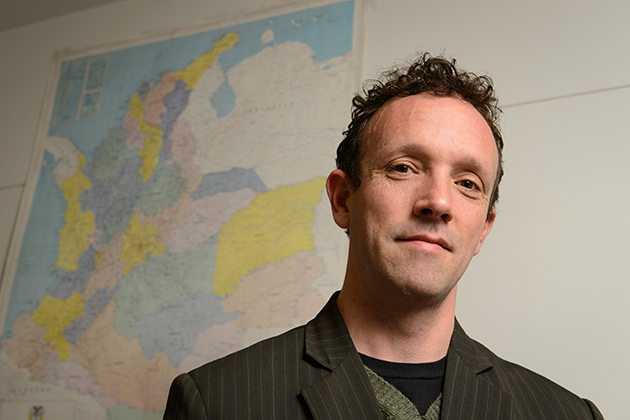
When writing about individual Human Rights Defenders the tendency is to give attention to those in the front line who are in immediate trouble. This time I want to refer to a HRD teaching at the University of Connecticut based on a blog post by Kenneth Best of 30 January 2013. It concerns Luis van Isschot, an assistant professor of history, who specializes in the study of human rights in Latin America ( photo by Peter Morenus/UConn Photo).

Luis van Isschot, assistant professor of history (Peter Morenus/UConn Photo)

Conversation around the dinner table in the van Isschot home in Montreal was a bit different than in most Canadian homes. Growing up with a Spanish, Peruvian, and Dutch family heritage, Luis van Isschot listened to discussions about Latin American history and politics led by his father, a physician who treated families in a clinic based in Montreal’s Latino community…….

…His path to a doctoral degree developed from his volunteer work in Guatemala and later in Colombia, where he served as a human rights observer. It was during his time in Colombia that a friend who was a university professor and a historian told him that one of the most important books of Colombian history was written by a professor from his hometown of Montreal, Catherine Le Grand at McGill University, and that he should look her up. He did, and it led to his enrollment in the doctoral program. “She made it seem that you could be a wonderful teacher, a cutting-edge scholar, and have a balanced life of engagement in your community, and that the Ph.D. was a way of doing that,” van Isschot says. “The university is central to the community, not apart from it. That makes sense to me.”

He later became involved with MEA Laureate 2001 Peace Brigades International, a nonpartisan organization that sends international volunteers to areas of conflict to provide protective accompaniment to human rights defenders threatened by political violence in 11 nations, including in Asia, Africa, and Latin America. In addition to serving as a human rights observer in Colombia, he also traveled to the Great Lakes Region of Africa, doing research in the Democratic Republic of Congo, Rwanda, and Burundi.

It was a really important experience for me to go somewhere where the language of human rights and social justice and the understanding of history really enriched my own understanding of what I was working on in Latin America,” he says. His experience in Colombia led him to focus his doctoral studies on human rights activities in that nation’s oil capital, Barrancabermeja, where he lived for a year. The city was the center of a major urban war between Colombian paramilitary groups and leftist guerillas. Between 1998 and 2002, in a city of 300,000 there were about 2,000 violent murders. “It was a devastating period. The relationships I made with Colombian human rights activists, teachers, and scholars convinced me that I needed to find some place to explore the issues,” he says.

His book, The Social Origins of Human Rights: Protesting Political Violence in Columbia’s Oil Capital, 1919-2010, is near completion, and scheduled to be published in early 2014. His new research project is titled “When the Courts Make History: the Impact of the Inter American Court of Human Rights in Latin America’s Conflict Zones,” and examines the historical changes set in motion by the pursuit of justice across borders.

http://today.uconn.edu/blog/2013/01/focusing-on-human-rights-with-a-latin-american-perspective/

Defending Human Rights: The Havel Example

January 16, 2012

Aurel Braun and David Matas recently wrote an article for OpEdNews that puts strongly the case for seeing Havel foremost as a HRD. The article starts with a well-worded call to support HRDs abroad: “One reason we should stand up in Canada for human rights abroad is that we are safe in doing this.  Human rights defenders in repressive states are not.In spite of those risks, there are people of extraordinary courage and unrelenting commitment even in the most repressive states who at great personal risk to themselves and their families, respect human rights, call for others to do so and decry violations.  These human rights defenders give us yet another reason to raise our voices.   If they can risk so much, we who have nothing to lose should do our part.” ………”Havel was one of the co -‘writers of Charter 77, which in 1977 challenged the totalitarian Czechoslovak government to abide by the 1975 Helsinki Accords that had stipulated the protection of human rights. Fewer than 300 people signed the Charter, and the reaction of the Prague regime was to imprison many of the signatories, including Havel. He never retracted, he never stopped advocating, and repeated imprisonment never deterred him.”

Though very ill towards the end of his life, Vaclav Havel continued to fight for principles and wrote to HRDs in Belarus “I will continue to use every opportunity in the future, with my friends, to draw the international community’s attention to the violations of human rights in Belarus“.

Havel, who lived to see freedom and democracy come to Eastern Europe despite all the might of the Soviet superpower, and who played such a central role in that historic victory for human rights, proved that principles can and do prevail over power.

for the full article see: OpEdNews – Article: Defending Human Rights: The Havel Example.