Posts Tagged ‘arbitrary arrest’

Why Maryam Al-Khawaja boycotted the Bahraini court on 1 December

December 1, 2014

The leading human rights defender Maryam Al-Khawaja explains her reasons for boycotting the court hearing in Bahrain that on Monday 1 December saw her sentenced to one year in prison. This impressive statement was originally posted on the website of the Gulf Center for Human Rights on 30 November 2014. For more posts on Maryam Al-Khawaja see: https://thoolen.wordpress.com/tag/maryam-al-khawaja/

Maryam-e1409582320645

As a human rights defender, I, Maryam Al-Khawaja, Director of Advocacy at the Gulf Center for Human Rights, have decided to boycott my court hearing on the 1 December 2014. During this hearing I am due to be sentenced on trumped up charges of assaulting two policewomen at the Bahrain International Airport. (Update: Al-Khawaja was sentenced to one year imprisonment on 1 December)

The decision to boycott the court was reached based on several grounds:

  • The lack of independence and due process in the Bahrain judiciary system:

It has become evidently clear that it is not possible to have a fair and independent trial in Bahraini courts as they stand. The judicial system in Bahrain is highly flawed, and is overrun with egregious human rights violations which usually start during the arrest, and continue throughout what is supposed to be a legal process. I was personally subjected to numerous human rights violations since the moment of arriving in Bahrain and until I was able to leave the country as can be read in my testimony here.

There are medical reports about the injuries I sustained during the assault I was subjected to, for which I continue to need physiotherapy. My case was sped up, and quickly turned for sentencing with complete disregard to legal procedures.

  • The lack of independency and neutrality of the judge himself:

The presiding judge, Mohammed Ali Alkhalifa, in the case brought against me is a member of the ruling family, and has been himself, as well as members of his family, identified previously during my advocacy campaigns as implicated in human rights violations. This makes his presiding over the case a clear case of conflict of interest given the personal grievances he may have against me. This judge in particular, it is important to note, has been involved in the sentencing of numerous human rights defenders including Nabeel Rajab and Naji Fateel in unfair trials.

  • The cooperation of the Special Investigations Unit (SIU) with the Ministry of Interior:

During my imprisonment I met with the SIU, headed by Nawaf Hamza, to submit a complaint against the three policewomen and the first lieutenant who assaulted me at the airport. The prosecutor, Mohammed Al-Hazaa, rewrote my statement in his own words, attempting to implicate me in violations, and refused to correct what he had misquoted. This resulted in my refusal to sign the papers and filing of a complaint against the prosecutor. One day before the sentencing, namely on the 30th of November 2014, and due to almost daily follow up by my lawyer, the public prosecution notified him that the complaint case had been revoked. Despite my complaint about the assault since the beginning of my arrest, it was only one day before the sentencing that my lawyer was finally able to get a statement from the public prosecution that my complaint case had been revoked, at a time when the trumped up assault charges against myself were speedily processed and turned for sentencing.

  • The violation of my rights by the public prosecution:

During the interrogation I was subjected to, I was refused access to my lawyer by the prosecutor dealing with my case. During my imprisonment my lawyer was not given any visits, nor was the Danish embassy. The way that the public prosecution deals with politically motivated cases is it uses all aspects of the government to provide impunity for the perpetrators of violations.

Based on the reasons stated above, I find any and all cooperation with the court or attendance of the hearings by myself as a problematic legitimisation of an unfair and biased court. Therefore I have decided to boycott the hearings, and have asked my lawyer to do the same.

It is important to note here, if I, as a human rights defender, whose case receives international media and diplomatic attention is handled in this way; it is gravely concerning how cases not receiving attention are handled by the authorities in Bahrain.

Maryam Al-Khawaja
Director of Advocacy
Gulf Center for Human Rights
30th November 2014

Maryam Al-Khawaja: Why I am boycotting my date with Bahraini justice – Index on Censorship | Index on Censorship.

Bahrain: Travails of a Family of Human Rights Defenders

September 12, 2014

On Tuesday, 16 September, Maryam Al Khawaja, the Bahraini human rights defender will return to court for her second hearing on charges of assaulting a police officer, which she denies. It’s now been nearly two weeks since Maryam was arrested at the airport following her return to Bahrain to visit her father. She was initially detained for seven days, but over the weekend a Bahraini judge ruled to extend her detention by an additional 10 days. This is a good occasion to draw your attention to a long but fascinating piece by Lawrence Weschler on Truthdig of 11 September 2014. Under the title “Terrorizing a Family of Human Rights Champions” he describes in detail what happened to the remarkable al-Khawaja family of democratic non-violent human rights defenders [it is rumored that for the first time a family as such was considered for the 2013 Nobel Peace Prize].  Read the rest of this entry »

25 Years Tiananmen ‘celebrated’ with over 100 detentions

June 13, 2014

(A map of all individuals detained in the wake of the Tiananmen anniversary. Some of these persons have already been released. Photo: CHRD)

Yesterday China Human Rights Defenders has released a list of over 100 activists, journalists, lawyers, dissidents and other assorted individuals who are thought to have been detained by the government in the wake of the 25th anniversary of the 1989 Tiananmen Square protests. As of June 11, 116 individuals from various parts of China, including Beijing, Shanghai, Sichuan, Xinjiang and Guangdong are all listed, with an estimated 49 criminal detentions and two confirmed arrests. Many who were not detained were invited by local authorities to “drink tea” – a veiled phrase for questioning – and were warned to avoid participating in any anniversary activities. Chief among the detainees is veteran human rights lawyer Pu Zhiqiang, who was placed in criminal detention on May 6 under charges of “picking quarrels and provoking trouble” after he attended a May 3 Tiananmen commemoration.

(Pu Zhiqiang. Photo: Reuters)

Pu was … a student lawyer in the 1989 protests, [and he] became a prominent human rights lawyer and advocate, taking up some of the most politically sensitive rights-defending cases,” said David Zhao, researcher and representative for CHRD. “He [has made] earlier remarks that he is still ‘deeply emotionally tied to [Tiananmen]’ and has ‘no regrets over his involvements’.”


(Yu Shiwen (left) and Chen Wei (right). Photo: Screenshot via RFA)

Other persons on CHRD’s list include Wang Xiuying, an 83-year-old activist who had her home searched by Beijing police after signing a Tiananmen commemoration petition, Chen Wei and Yu Shiwen, an activist couple who organised Tiananmen memorial services, and Wu Wei, a former South China Morning Post journalist in Beijing who interviewed Pu Zhiqiang in the past. “The clampdown on commemorative events this year is the most severe of all years and this reflects the [government’s] determination to wipe out the memory of Tiananmen,” Zhao said.

View CHRD’s list in full here.

via http://www.scmp.com/news/china-insider/article/1530899/human-rights-group-releases-list-over-100-people-detained-during

A few days earlier, 6 June, Mary Lawlor of Front Line wrote a thoughtful piece on the same issue stating that it “would be fitting that the 25th anniversary of the  Square massacre be marked by a renewed international effort to provide greater support to Chinese human rights defenders.

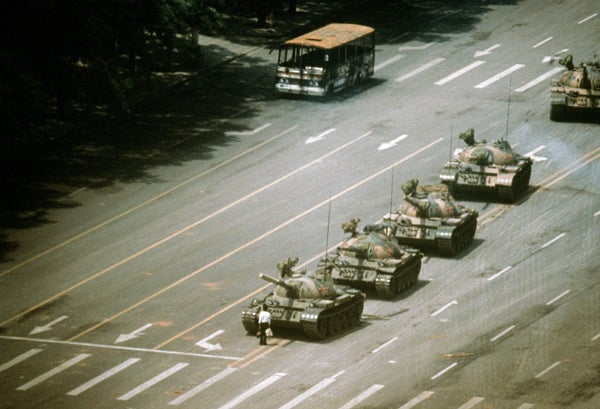
China-Tiananmen-Square

Human rights defenders (HRDs) currently working in China are frequently seen as challenging the Party and as such must be prepared to risk everything, including death, to continue their work. Although the Party’s methods may have changed in the past quarter of a century, its intention to crush dissent at any cost has not. On 3/4 June 1989 hundreds of peaceful demonstrators were killed in the approach roads to Tiananmen Square in Beijing, bringing an end to seven weeks of protests which had drawn up to a million people onto the streets. What started off as a student protest in the capital calling for political reform quickly morphed into a mass movement supported by broad cross-sections of society which spread to dozens of other cities throughout the country.

The legacy of these protests and the massacre that followed is still keenly felt by HRDs in today’s China. The events of 1989 remain a key touchstone to many Chinese HRDs and as the CCP works to erase the memory of what happened that June, HRDs are equally determined to keep that memory alive, and honor those who died. They do this not only through yearly commemorations of the dead, but also through their day-to-day work defending the rights for which the 1989 protesters struggled. These HRDs highlight injustice, campaign against discrimination, defend in court those who have been arrested for expressing themselves freely and shine a spotlight on the myriad of abuses, including corruption, carried out by the CCP.

So threatened does the Party feel by the memory of its actions 25 years ago that it criminalizes the very act of remembering. In early May, five HRDs were arrested following a low-key memorial at a private residence in Beijing. They are being held on charges of “picking quarrels and provoking trouble.” The only “quarrel” these HRDs “picked” was with the CCP’s whitewashed version of history, and the Party’s hysterical overreaction to such a commemoration is as clear an admission of guilt as any signed confession. The author then refers to groups such as the  The Tiananmen Mothers and the New Citizens Movement…

On the surface, the China of today is a much changed place to the China of 1989… Yet beneath the confident exterior lies the reality that the CCP remains a fragile entity, haunted by the possibility that the values of equality, justice and dignity espoused by HRDs in China might threaten its legitimacy, which is based almost solely on an economic growth model…..While various countries trip over each other in a race to secure lucrative trade deals with China, emphasis on human rights gets pushed further and further down the agenda. The CCP knows that no matter how egregious its abuse of rights – as in the recent death of human rights defender Cao Shunli in custody – international reaction will be muted at best. These are the same rights which workers and students died for twenty five years ago and whose deaths were met at the time with a robust international response.

The weakening of such international support for HRDs working today can only be seen as a betrayal of the values espoused in 1989. It would be fitting that the 25th anniversary of the massacre be marked by a renewed international effort to provide greater support to Chinese HRDs as they bravely continue their work in advancing and protecting internationally recognized rights, despite knowing with full certainty that they will be targeted as a result of this work.

Tiananmen 25: More than a Symbolic Legacy | Sharnoffs Global Views.

Six Members of Blogging Collective “Zone 9” Arrested in Ethiopia

April 29, 2014

zonenine

On April 25, six members of the Zone Nine blogging collective were arrested in Ethiopia. They are now reported to being held at Maekelawi, a detention center in Addis Ababa. News of the arrests first broke on Twitter, where fellow bloggers and social media users voiced support for those arrested and expressed their own fears about what may be to come. Writer Bisrat Teshome, who lives in Addis Ababa, tweeted: “Terrified with the rant of EPRDF on journalists & bloggers. I almost fainted when my door was knocked at about 7pm. #Ethiopia — Bisrat Teshome (@_Bisre)“. As of this evening, no charges had been issued to the members of our group.

[Formed in 2012, the Zone Nine group has leveraged significant critiques of ruling government policy and practice through online campaigns in an effort to raise awareness about political repression in the country. Translating international news for local audiences — through partnership with Global Voices, launched Global Voices in Amharic two years ago. Have been a surveillance target of the Ethiopian government.]

[Kality prison is divided into eight different zones, the last of which — Zone Eight — is dedicated to journalists, human right activists and dissidents. Thus the name of the blog for the proverbial prison in which all Ethiopians live: Zone Nine]

via Six Members of Blogging Collective Arrested in Ethiopia – Global Voices Advocacy.

Sad anniversary in Bahrain today: Abdulhadi Al-Khawaja arrested 3 years ago

April 9, 2014

30 human rights organizations express their serious concern for the health and well-being of imprisoned Bahraini human rights defender Abdulhadi Al-Khawaja. Mr. Al-Khawaja was arrested three years ago today, on 9 April 2011, and continues to require medical attention for injuries sustained during his arrest and subsequent torture.

Former president and co-founder of the Bahrain Centre for Human Rights (BCHR), Mr. Al-Khawaja was sentenced to life in prison in June 2011 by a military court as part of a group of human rights activists and political leaders known as the Bahrain 13. The NGO state their belief that Mr. Al-Khawaja is being unjustly persecuted for his legitimate human rights activity.[In its September 2012 decision, the United Nations Working Group on Arbitrary Detention concluded that Mr. al-Khawaja’s arrest was due to his exercise of the fundamental rights to freedom of expression, peaceful assembly, and association. [According to the Working Group, the charges against Mr. al-Khawaja—including membership in a terrorist organization— were “vague” and “raise doubts as to the actual purpose of detention.” The Working Group also concluded that throughout Mr. Al-Khawaja’s arrest, detention, and trial, “the Government violated numerous international norms to the right to fair trial.”]
[The Bahrain Independent Commission of Inquiry (BICI) further concluded that Mr. Al-Khawaja was subjected to torture and inhumane treatment during his arrest and detention. Mr. Al-Khawaja was severely beaten, resulting in a broken jaw, and later spent two months in solitary confinement where he was subjected to physical, psychological and sexual torture. A full testimony from Mr. Al-Khawaja regarding his torture can be found here.]

BAHRAIN: Third Anniversary of Arrest: Calls for the Release of Abdulhadi Al-Khawaja – FIDH.

Death in detention of human rights lawyer Maen Al-Ghoneimi in Syria

April 2, 2014

On 26 March 2014, the family of human rights defender Mr Maen Al-Ghoneimi was informed by the Damascus Military Police in Syria that he had died in detention two months earlier, on 14 January 2014. The police declared that he died of heart failure and delivered to the family the personal possessions of the human rights defender, but refused to disclose where he had been buried. Maen Al-Ghoneimi was a human rights lawyer and a member of the lawyers’ syndicate in Damascus. The human rights defender was an active participant in lawyers’ peaceful protests and sit-ins and provided legal aid to internally displaced people in Syria. Maen Al-Ghoneimi was arrested on 20 May 2013, and was then kept incommunicado until news of his death emerged. No charges had been brought against him. The family stated that he was in good health at the time of the arrest, and therefore believes that he may have been tortured or have become ill and denied medical treatment while in detention.

Front Line Defenders rightly demands a thorough, impartial and immediate investigation into the deaths of detained human rights defenders, including also Ayham Mostafa Ghazzoul https://www.frontlinedefenders.org/node/21602

Sadly, this fits too well with the special campaign I mentioned on 16 March https://thoolen.wordpress.com/2014/03/16/the-silenced-voices-of-syria-special-campaign-aimed-at-human-rights-defenders/


Human rights defender Osama Al-Najjar detained in Emirates

March 20, 2014

On 17 March 2014 UAE human rights defender Mr Osama Al-Najjar was arrested as he returned home from visiting his father in prison. Front Line Defenders states that he was held at his home for approximately three hours before being brought to an unknown location by state security forces. No charges have been brought against the human rights defender thus far. Osama Al-Najjar is the son of one of the so-called UAE94 – 94 individuals including human rights defenders sentenced to 7 to 15 years imprisonment on charges of attempting to overthrow the government. Osama Al-Najjar’s father is serving eleven years in prison. The son lobbies for detainees’ rights and disseminates information regarding conditions and ill-treatment particularly via social media websites. He has also appeared on television and given talks on the case of the UAE94. It is alleged that this arrest is directly related to his online activism.

[On 16 March 2014 Osama Al-Najjar responded, on Twitter, to remarks made by the Ruler of Sharjah during a radio interview that families of the UAE94 should not fill their children with hate and malice against the country. The human rights defender tweeted, “your highness, the doctor, we do not hate our country and we do not forget injustice we faced even if our mothers forgot it. Those who were unjust to my father carry 20 months of unfair jail and harassment on their conscience”]

Swaziland should immediately release two Human Rights Defenders arrested on 17 March

March 19, 2014

Swaziland should immediately release Mr. Thulani Maseko and Mr. Bheki Makhubu, the Pan-African Human Rights Defenders Network said today. The human rights defenders (the first a lawyer and the second a journalist) were arrested on Monday 17 March 2014, reportedly in response to articles published in a national magazine. Maseko is a prominent human rights lawyer working at the national and regional levels, a senior member of Lawyers for Human Rights Swaziland and the Southern Africa Human Rights Defenders Network, which is part of the Pan-African Human Rights Defenders Network. Makhubu is the Editor-in-Chief of the Nation. The two men were arrested under the same warrant, issued by Chief Justice Ramodibedi, on charges of “scandalizing the judiciary” and contempt of court. Their lawyer was not permitted to represent the pair when they were jointly charged on 18 March 2014. They have been remanded pending a bail hearing on 24 March 2014. The charges are apparently in relation to articles published in the Nation Magazine questioning the circumstances surrounding the arrest of Chief Government Vehicle Inspector, Bhantshana Gwebu. Mr. Gwebu had been arrested and charged with contempt of court after he arrested the driver of a High Court judge. As an absolute monarchy, the King of Swaziland has the discretionary power to suspend constitutional rights such as freedom of expression and in practice these rights are frequently curtailed. Mr. Maseko has previously been charged with sedition for public statements made.“Human rights defenders must be able to speak out on issues of public interest,” said Hassan Shire, Chairperson of the Pan-African Human Rights Defenders Network. “We call on the Swaziland authorities to drop the charges against Mr Maseko and Mr Makhubu and allow them to continue with their important work.

via Swaziland: Release Human Rights Defender and Journalist – East and Horn of Africa Human Rights Defenders Project.


Sri Lanka: champion retaliator against human rights defenders

March 17, 2014

Today, 17 March 2014, the Asian Human Rights Commission, comes out with a statement that makes Sri Lanka look like one the worst offenders when it comes to retaliation and reprisals against human rights defenders.  My feelings about reprisals are well-known and were recently  expressed in: https://thoolen.wordpress.com/2014/03/13/zero-tolerance-for-states-that-take-reprisals-against-hrds-lets-up-the-ante/ 

A draft resolution promoting reconciliation, accountability, and human rights in Sri Lanka is being discussed at the United Nations Human Rights Council. The proposed resolution calls for, among other things, the Office of the High Commissioner, “To lead a comprehensive investigation into alleged serious violations and abuses of human rights and related crimes by both parties in Sri Lanka and establish the facts and circumstances of such violations and of the crimes committed with the view to avoiding impunity and ensuring accountability with assistance from relevant experts”. 

The statement of the AHRC reads: Read the rest of this entry »

Six UN human rights experts urge probe into recent violence in Venezuela

March 9, 2014

On 6 March 2014 a group of six United Nations experts has asked the Venezuelan Government for prompt clarification of allegations of arbitrary detention and excessive use of force and violence against protesters, journalists and media workers during recent protests. “The recent violence amid protests in Venezuela need to be urgently and thoroughly investigated, and perpetrators must be held accountable,” the experts stressed in a news release. They also expressed their shock at the reported deaths of at least 17 persons during the demonstrations. “We are deeply disturbed by the allegations of multiple cases of arbitrary detention of protesters. Some were reportedly beaten – and in some cases severely tortured – by security forces, taken to military facilities, kept in incommunicado detention, and denied access to legal assistance,” they said….“The reconciliatory dialogue that is so deeply needed in Venezuela is not going to take place if political leaders, students, media groups and journalists are harassed and intimidated by the authorities,” they stated.

The experts speaking out on Venezuela are Frank La Rue, Special Rapporteur on the promotion and protection of the right to freedom of opinion and expression; Maina Kiai, Special Rapporteur on the rights to freedom of peaceful assembly and of association; Mads Andenas, Chair-Rapporteur of the Working Group on arbitrary detention; Juan Méndez, Special Rapporteur on torture and other cruel, inhuman or degrading treatment or punishment; Christof Heyns, Special Rapporteur on extrajudicial, summary or arbitrary executions; and Margaret Sekaggya, Special Rapporteur on the situation of human rights defenders.

via United Nations News Centre – UN human rights experts urge probe into recent violence amid Venezuelan protests.

PS: It is ironic that at the same time the Government of Venezuela has invited the UN Committee on the Exercise of the Inalienable Rights of the Palestinian People to hold a special meeting at the historic Yellow House in Caracas on 17-18 April 2013.