Posts Tagged ‘Angkhana Neelapaijit’

HRW asks to drop charges against Human Rights Defenders in Thailand

March 20, 2023
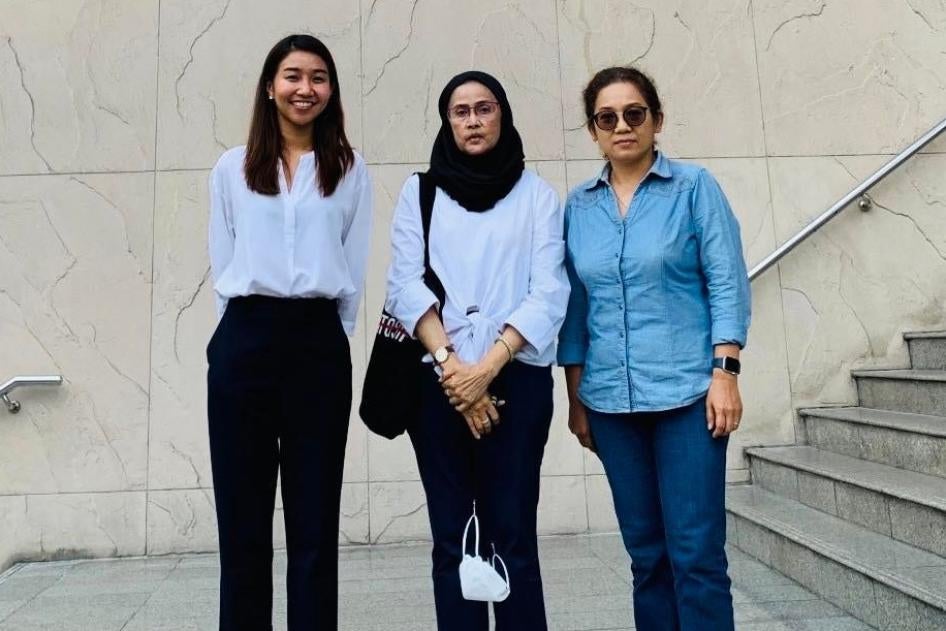
Three Thai human rights defenders—Angkhana Neelapaijit, Puttanee Kangkun, and Thanaporn Saleephol—face criminal defamation charges for reporting abuses.
Three Thai human rights defenders—Angkhana Neelapaijit, Puttanee Kangkun, and Thanaporn Saleephol—face criminal defamation charges for reporting abuses. © 2022 Prachatai

Prosecutors in Thailand should immediately withdraw the criminal defamation cases brought by Thammakaset Company Ltd. against three prominent human rights defenders for their support of other activists facing criminal charges, Human Rights Watch said on 16 March 2023. The Thai government should act to repeal criminal defamation provisions and introduce strong safeguards to prevent the use of frivolous, vexatious, or malicious legal actions that would have chilling effects on free speech.

On March 14, 2023, the Bangkok South Criminal Court began the trial that involves 28 counts of alleged criminal defamation under Thailand’s Criminal Code sections 326 and 328. The charges stem from posts or re-posts on social media by Angkhana Neelapaijit, Puttanee Kangkun, and Thanaporn Saleephol expressing solidarity with other human rights defenders already facing lawsuits brought by Thammakaset for alleging labor rights abuses at the company’s chicken farm in Lopburi Province. The company has filed at least 37 civil and criminal cases against rights defenders, journalists, and workers since 2016.

See also: https://humanrightsdefenders.blog/2022/03/03/fortify-rights-calls-on-thailand-to-drop-charges-against-human-rights-defender-angkhana-neelapaijit/

The Thai authorities should not help companies use criminal defamation or other legal avenues to silence workers from filing complaints about their working conditions or human rights defenders or journalists for reporting about alleged abuses at the company,” said Elaine Pearson, Asia director at Human Rights Watch. “The charges against Angkhana, Puttanee, and Thanaporn should be immediately dropped, and Thai authorities should act to prevent similar cases from being filed in the future.”

The United Nations Human Rights Committee has stated in its General Comment No. 34 on freedom of expression that governments “should put in place effective measures to protect against attacks aimed at silencing those exercising their right to freedom of expression, including persons who engage in the gathering and analysis of information on the human rights situation who publish human rights-related reports.”

On December 16, 2022, the UN Working Group on Business and Human Rights urged Thai authorities to take action to stop the Strategic Litigation Against Public Participation (SLAPP) lawsuits increasingly used by Thai companies to intimidate reporters and human rights advocates.

The Working Group specifically mentioned Thammakaset, stating that: “The cases filed by companies, such as Thammakaset Company Limited, against human rights defenders are a clear example of businesses abusing the legal system in order to censor, intimidate, and silence criticism through SLAPPs as a method of judicial harassment.” See also: https://humanrightsdefenders.blog/2022/04/28/eu-finally-moves-on-law-to-protect-media-from-legal-abuse-slapps/

Thai Prime Minister Prayut Chan-ocha has repeatedly emphasized the importance of companies respecting human rights in their operations and upholding the UN Guiding Principles on Business and Human Rights. In October 2019, Thailand was the first country in Asia to announce a National Action Plan on Business and Human Rights, committing to protect human rights defenders and prevent judicial harassment. But the charges against Angkhana, Puttanee, and Thanaporn, as well as the failure to assist those still facing many of the other civil and criminal cases filed by Thammakaset, stand in stark contradiction to the Thai government’s pledges to take action to protect rights, Human Rights Watch said.

In 2018, the National Assembly amended the Criminal Procedure Code to prevent the misuse of criminal cases. While that is a useful step, the Thai government should repeal all criminal defamation provisions. Neither prosecutors nor courts in Thailand have actually carried out, much less considered, amended section 161/1, which allows judges to dismiss and forbid the refiling of a criminal complaint by a private individual if the complaint is filed “in bad faith or with misrepresentation of facts to harass or take advantage of a defendant.” Furthermore, section 165/2 allows the presentation of evidence to show that the complaint “lacks merit.”

These reform provisions of the Criminal Procedure Code remain unused and untested, though. It is also crucial to provide prosecutors with adequate resources and support to exercise their powers under section 21 of the 2010 Public Prosecutor Organ and Public Prosecutors Act to screen out frivolous cases.

Human Rights Watch, along with an increasing number of governments and international agencies, has consistently called for the repeal of criminal defamation laws because they are an inherently disproportionate punishment for expressions of speech judged to damage reputations. Civil defamation laws, when supplemented by strong anti-SLAPP safeguards, balance the need for fair reporting in the public interest with concerns about reputational harm to private actors. In addition, as the charges against Angkhana, Puttanee, and Thanaporn show, criminal defamation laws in Thailand are easily abused and can have adverse impacts on free expression in the public interest.

Thailand should enact comprehensive anti-SLAPP legislation to strengthen safeguards to protect freedom of speech and expression and prevent retaliation against workers, human rights defenders, and journalists, Human Rights Watch said.

The UN special rapporteur on rights of freedom of peaceful assembly and association recommended that “States should protect and facilitate the rights to freedom of expression, assembly and association to ensure that these rights are enjoyed by everyone” including by “enacting anti-SLAPPs legislation, allowing an early dismissal (with an award of costs) of such suits and the use of measures to penalize abuse.”See also: https://humanrightsdefenders.blog/tag/strategic-lawsuits-against-public-participation-slapps/

“The UN and governments from around the world should share with Thailand their reform efforts to strengthen anti-SLAPP protections and point out that criminal defamation laws coupled with the absence of strong anti-SLAPP protections impede the ability of businesses to conduct essential human rights and environmental due diligence,” Pearson said. “Unless the Thai government moves now to protect Angkhana, Puttanee, and Thanaporn from retaliation, the promises that Thai officials made on business and human rights will ring hollow.”

https://www.hrw.org/news/2023/03/16/thailand-drop-charges-against-rights-defenders

Human Rights Defender Angkhana Neelapaijit in Thailand harassed

April 14, 2022
Photo captured on a security camera of the alleged assailant, a woman wearing a mask and a black t-shirt.
Photo captured on a security camera of the alleged assailant, a woman wearing a mask and a black t-shirt. © 2022 Private

The authorities in Thailand should urgently investigate an incident intended to intimidate a prominent human rights defender, Human Rights Watch said on 13 April, 2022.

On April 12, 2022, at about 6 a.m., an unidentified assailant threw a pair of 9-inch-long scissors at the house of Angkhana Neelapaijit in Bangkok, making a hole in her front door. Security camera footage showed what appeared to be a woman wearing a face mask and a dark t-shirt with the Thai numeral 9 standing in front of the house, throwing the scissors, and then running away. Angkhana, 66, is a former commissioner of the National Human Rights Commission of Thailand and a newly appointed member of the United Nations Working Group on Enforced or Involuntary Disappearances. See: https://www.trueheroesfilms.org/thedigest/laureates/0D5DED3E-F79F-4AB4-8261-F6A19486F062

Violent acts intended to intimidate a well-known figure like Angkhana not only pose a threat to her and her family, but send a spine-chilling message to the entire Thai human rights community,” said Elaine Pearson, acting Asia director at Human Rights Watch. “The Thai government should respond immediately by undertaking a serious investigation to ensure that everyone responsible for this incident is held accountable.”

Angkhana told Human Rights Watch that she and her family felt vulnerable after the Justice Ministry canceled her protection under the government’s witness protection program on April 1. The authorities claimed the service was no longer needed because Angkhana’s life would no longer be in danger after the Department of Special Investigation ended its investigation of the enforced disappearance of her husband, the prominent human rights lawyer Somchai Neelapaijit. [See also: https://humanrightsdefenders.blog/2021/03/17/where-is-somchai-a-brave-wifes-17-year-quest-for-the-truth/]

The Thai government should not ignore this disturbing incident, which appears to be a response to Angkhana’s effective human rights advocacy,” Pearson said. “Foreign governments and the United Nations should press the Thai government to urgently act to protect Angkhana and other human rights defenders in the country.”

https://www.hrw.org/news/2022/04/13/thailand-prominent-rights-defender-harassed

Fortify Rights calls on Thailand to drop charges against human rights defender Angkhana Neelapaijit

March 3, 2022

On 2 March 2022, Fortify Rights called on the Thai authorities to drop all remaining cases brought by Thai chicken company Thammakaset Company Limited against human rights defenders and protect the right to freedom of expression. On February 22, the Bangkok South Criminal Court rescheduled the start of the criminal defamation trial against Angkhana Neelapaijit to 25 April. See: https://www.trueheroesfilms.org/thedigest/laureates/0D5DED3E-F79F-4AB4-8261-F6A19486F062
 
Delaying the trial affects access to justice and leaves the defendant in fear and worry,” said Angkhana Neelapaijit. “It affects the person’s livelihood and freedom during the bail process. The delays are incredibly traumatizing.” 
 
Thammakaset first filed a complaint against Angkhana Neelapaijit more than two years ago, on October 25, 2019, alleging criminal defamation for posting two tweets on social media on December 3, 2018 and June 28, 2019 that expressed support for human rights defenders facing lawsuits by the company. On August 16, 2021, the court concluded that the case should proceed to trial following four preliminary hearings that spanned more than 17 months. The court originally scheduled the trial to start on March 3, 2022 but postponed the start due to rising COVID-19 cases in Thailand.
 
Angkhana Neelapaijit also faces a second criminal defamation complaint brought by Thammakaset in June 2020 that is part of a combined case that includes charges against Fortify Rights Senior Human Rights Specialist Puttanee Kangkun and Thanaporn Saleephol, a former Fortify Rights Communications Associate. The complaints against the three women all relate to similar social media posts expressing solidarity with others facing lawsuits brought by Thammakaset. The Bangkok South Criminal Court is scheduled to continue preliminary hearings on the combined case on March 21.

The Community Resource Center Foundationa Thai nonprofit and legal aid organization committed to promoting human rights, community rights, and environmental protection – is providing legal representation to human rights defenders facing complaints by Thammakaset, including in the cases against Angkhana Neelapaijit, Puttanee Kangkun, and Thanaporn Saleephol.

“Thailand should be proud and promote the work and achievements of Angkhana Neelapaijit as a strong Thai woman human rights defender, a winner of the prestigious Magsaysay award, and a former National Human Rights Commissioner,” said Amy Smith, Executive Director of Fortify Rights. “These types of lawsuits create an insecure environment for human rights defenders, hampering their ability to conduct critical activities that benefit the public. The case against Angkhana Neelapaijit and others should be dropped.” See: https://humanrightsdefenders.blog/2019/08/03/magsaysay-awards-2019-honor-4-outstanding-asians/

On March 31, the Court of Appeal will also decide whether to uphold an earlier decision by the Criminal Court to acquit human rights defender and former Thammakaset employee Nan Win and former Fortify Rights Thailand Human Rights Specialist Sutharee Wannasiri of criminal defamation charges brought by Thammakaset in October 2018.
 
Since 2016, Thammakaset has filed at least 37 complaints against 22 human rights defenders. The courts have dismissed or ruled against the company in almost all cases.
 
In 2018, the National Legislative Assembly amended Section 161/1 of the Thailand Criminal Procedure Code, allowing judges to dismiss and forbid the refiling of a complaint by a private individual if the complaint is filed “in bad faith or with misrepresentation of facts to harass or take advantage of a defendant.” Section 165/2 also allows the presentation of evidence to show that the complaint “lacks merit.” Despite these amendments and specific requests for the court to apply Section 161/1 to prevent cases brought by Thammakaset from moving forward, the courts have allowed these cases to proceed.

See also: https://humanrightsdefenders.blog/2020/07/09/andy-hall-finally-acquitted-of-criminal-defamation-in-thailand/

https://www.scoop.co.nz/stories/WO2203/S00035/thailand-drop-criminal-complaint-against-2019-magsaysay-award-winner-angkhana-neelapaijit.htm

Magsaysay Awards 2019 honor 5 outstanding Asians

August 3, 2019

The Ramon Magsaysay Award, one of Asia’s best known prizes, celebrates transformative leadership. In the past five decades, the award has been bestowed on over three hundred men, women and organizations whose selfless service has offered their societies, Asia, and the world successful solutions to some of the most intractable problems of human development. For more on this regional award, see: http://www.trueheroesfilms.org/thedigest/awards/ramon-magsaysay-award-for-community-leadership] The trustees of the Ramon Magsaysay Award Foundation annually select the awardees. The Award is presented to them in formal ceremonies in Manila, Philippines on August 31st, the birth anniversary of the much-esteemed Philippine President whose ideals inspired the Award’s creation in 1957.

The winners for 2019 are:

Kim, Jong-ki, South Korea

  • In 1995, Kim Jong-ki was a highly successful businessman handling market operations in China for a giant Korean electronics company.  Married, with a son and daughter, he was at the height of his career when tragedy struck.
  • In the year his son died, Jong-ki established the Foundation for Preventing Youth Violence (FPYV), the first organized effort in South Korea to address school violence as a systemic social problem affecting students, families, schools, and the community-at-large.
  • The impact of Jong-ki and FPYV on Korean society has been profound, establishing a nationwide presence and creating collective action on a social problem hitherto neglected.
  • In electing Kim Jong-ki to receive the 2019 Ramon Magsaysay Award, the board of trustees recognizes his quiet courage in transforming private grief into a mission to protect Korea’s youth from the scourge of bullying and violence, his unstinting dedication to the goal of instilling among the young the values of self-esteem, tolerance, and mutual respect, and his effectively mobilising all sectors of the country in a nationwide drive that has transformed both policy and behaviours towards building a gentler, non-violent society.

Kumar, Ravish, India

  • In 1996, he joined New Delhi Television Network (NDTV), one of India’s leading TV networks and worked his way up from being a field reporter. After NDTV launched its 24-hour Hindi-language news channel — NDTV India — targeting the country’s 422 million native speakers of Hindi, he was given his own daily show, “Prime Time.”
  • As an anchor, Ravish is sober, incisive, and well-informed.  He does not dominate his guests but affords them the chance to express themselves.  He does not balk, however, at calling the highest officials to account or criticizing media and the state of public discourse in the country; for this reason, he has been harassed and threatened by rabid partisans of one kind or another.
  • Ravish has been most vocal on insisting that the professional values of sober, balanced, fact-based reporting be upheld in practice.
  • In electing Ravish Kumar to receive the 2019 Ramon Magsaysay Award, the board of trustees recognizes his unfaltering commitment to a professional, ethical journalism of the highest standards; his moral courage in standing up for truth, integrity, and independence; and his principled belief that it is in giving full and respectful voice to the voiceless, in speaking truth bravely yet soberly to power, that journalism fulfills its noblest aims to advance democracy.

Neelapaijit, Angkhana, Thailand

  • In 2006, with the help of non-government organizations and her own family, Angkhana founded Justice for Peace Foundation (JPF), a network of human rights and peace advocates that has done important work in documenting the human rights situation in southern Thailand, thus raising public awareness and putting pressure on government to act on human rights cases, providing legal assistance to victims; and training women on human rights and the peace process.
  • In 2015, Angkhana was named commissioner of the National Human Rights Commission of Thailand,  the only Commission member with grassroots human rights experience.
  • In her soft-spoken and measured tone she asserts: “Most women experience conflict and violence in a different way than men.
  • In electing Angkhana Neelapaijit to receive the 2019 Ramon Magsaysay Award, the board of trustees recognizes her unwavering courage in seeking justice for her husband and many other victims of violence and conflict in southern Thailand; her systematic, unflagging work to reform a flawed and unfair legal system, and the shining proof she is that the humblest ordinary person can achieve national impact in deterring human rights abuses.

Ko Swe Win, Myanmar

https://www.rmaward.asia/wp-content/uploads/2019/08/KSW-Official-2-300x300.png

  • Such a journalist is 41-year-old Ko Swe Win.  Born to a poor family in Yangon, he grew up in politically turbulent times and fell victim to state repression early on.
  • In 2017, he criticized a powerful, ultranationalist Buddhist monk, Ashin Wirathu, for purveying “hate speech” and publicly commending the killer of a Muslim human rights activist.  Wirathu, Swe Win wrote, had desecrated Buddhism and should be punished for endorsing assassination and fomenting hate.
  • Swe Win and Myanmar Now draw strength from the fact that they are making a difference.  With a current readership of 350,000, the news service is highly regarded for the quality, balance, and depth of its reporting on high-impact issues, including land grabbing, child labor, and abuse of domestic workers.
  • In electing Ko Swe Win to receive the 2019 Ramon Magsaysay Award for Emergent Leadership, the board of trustees recognizes his undaunted commitment to practice independent, ethical, and socially engaged journalism in Myanmar; his incorruptible sense of justice and unflinching pursuit of the truth in crucial but under-reported issues; and his resolute insistence that it is in the quality and force of media’s truth-telling that we can convincingly protect human rights in the world. [see also: https://humanrightsdefenders.blog/2017/09/03/myanmar-time-for-aung-san-suu-kyi-to-return-at-least-some-of-her-many-human-rights-awards/]

The fifth award winner is Mr Cayabyab, 65, who was recognised for “his compositions and performances that have defined and inspired Filipino popular music across generations”.

http://festival.rmaf.org.ph/?page_id=35