Posts Tagged ‘Amina Bouayach’

Bouayach urges stronger human rights protection across Africa

February 12, 2026

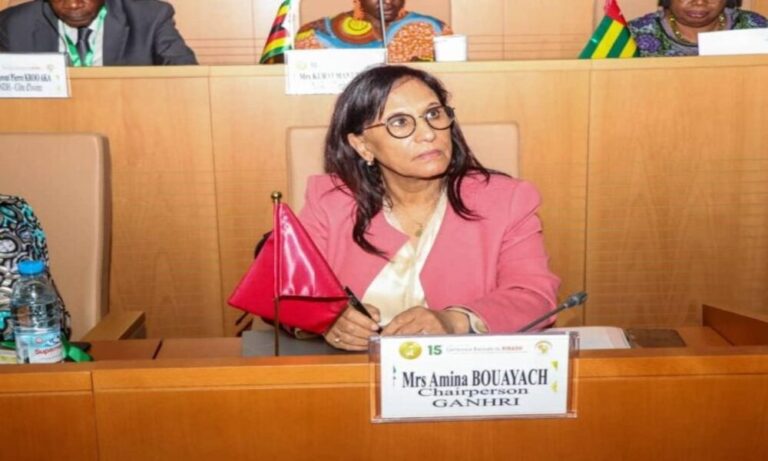
Amina Bouayach, President of the Global Alliance of National Human Rights Institutions (GANHRI), has issued a powerful call for the reinforcement of human rights mechanisms across Africa.

Speaking at the African Network of National Human Rights Institutions (ANNHRI) conference in Yaoundé, Bouayach warned that the continent’s legal frameworks are under unprecedented strain from a “triple threat” of security instability, climate change, and health crises. As the head of Morocco’s National Human Rights Council (CNDH), she emphasized that these overlapping emergencies are systematically eroding the rule of law and the capacity of states to meet their international obligations.

Bouayach highlighted a concerning global decline in multilateralism, noting that human rights are increasingly being sidelined in international discourse. She argued that international treaties and regional African mechanisms must be viewed as complementary rather than competing forces. According to her vision, while international laws provide the global benchmark, regional bodies are essential for adapting those standards to local African realities. She stressed that bridging the gap between high-level commitments and national legislation is the only way to restore citizen trust in state institutions.

The address identified several critical “blind spots” in the current continental approach, specifically pointing to the limited use of African legal mechanisms and the persistent barriers to justice for the general population. Bouayach cited the devastating conflict in Sudan—where access to basic healthcare and food has collapsed—and the chronic insecurity in Somalia as prime examples of how state fragility directly translates into human rights violations. She noted that recognizing these failures is not an admission of weakness but a necessary act of “clear-sightedness” required to move toward genuine reform.

To combat these trends, Bouayach urged African states to fully align their national institutions with the Paris Principles, the international gold standard for institutional independence and effectiveness. She concluded by calling for a surge in resources and guaranteed autonomy for human rights defenders, asserting that the rule of law must remain the non-negotiable pillar of Africa’s long-term stability and economic development.

https://apanews.net/bouayach-urges-stronger-human-rights-protection-across-africa/
2025 Mandela Prize by UN to Brenda Reynolds and Kennedy Odede

May 30, 2025
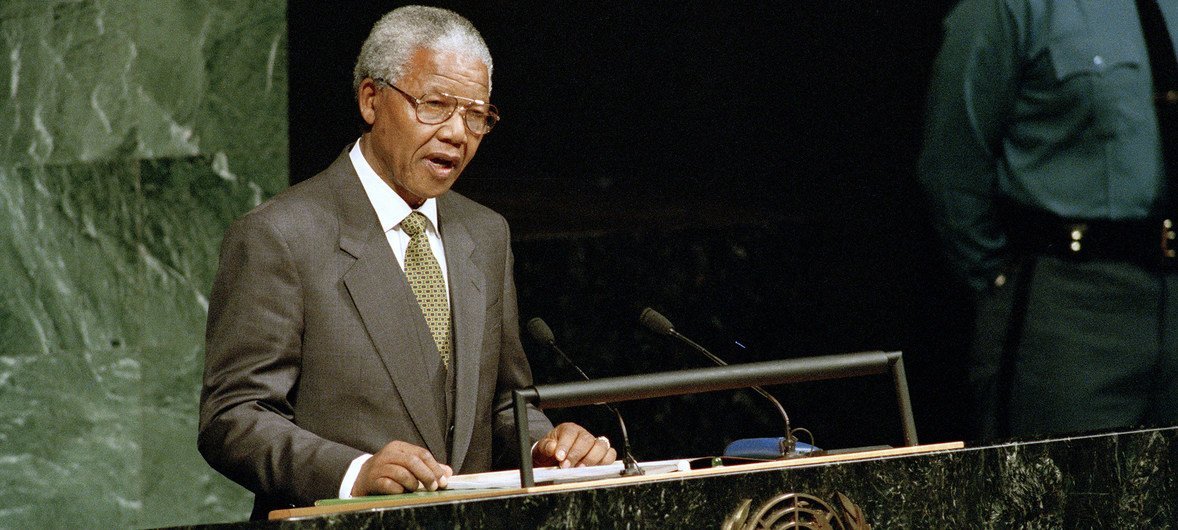
President Nelson Mandela addresses the 49th session of the General Assembly October 1994.

UN Photo/Evan Schneider President Nelson Mandela addresses the 49th session of the General Assembly October 1994.

An Indigenous social worker from Canada and a social entrepreneur from Kenya are the laureates of the 2025 Nelson Rolihlahla Mandela Prize, the United Nations announced on28 May 2025.

Secretary-General António Guterres will present the award to Brenda Reynolds and Kennedy Odede on 18 July, Nelson Mandela International Day. “This year’s Mandela prize winners embody the spirit of unity and possibility – reminding us how we all have the power to shape stronger communities and a better world,” said Mr. Guterres.

For more on this award and its laureates, see: https://www.trueheroesfilms.org/thedigest/awards/94844340-ca82-11ea-9aff-fdc6b476d5fd

Brenda Reynolds

A Status Treaty member of the Fishing Lake Saulteaux First Nation in Saskatchewan, Canada, Brenda Reynolds has spent decades advancing Indigenous rights, mental health, and trauma-informed care. In 1988, she supported 17 teenage girls in the first residential school sexual abuse case in Saskatchewan. Later, she became a special adviser to the Truth and Reconciliation Commission (TRC), helping shape survivor support and trauma responses. She is most recognised for her key role in Canada’s court-ordered Indian Residential Schools Settlement Agreement and her subsequent development of the Indian Residential School Resolution Health Support Program—a national initiative offering culturally grounded mental health care for survivors and families. In 2023, she was invited by the UN High Commissioner for Human Rights and the European Union to share her expertise on trauma and cultural genocide.

Kennedy Odede

Living in Kenya’s Kibera Slum for 23 years, Kennedy Odede went from living on the street at 10 years old to global recognition when he was named one of TIME magazine’s 2024 100 Most Influential People. His journey began with a small act: saving his meagre factory earnings to buy a soccer ball and bring his community together. That spark grew into Shining Hope for Communities (SHOFCO), a grassroots movement he now leads as CEO. SHOFCO operates in 68 locations across Kenya, empowering local groups and delivering vital services to over 2.4 million people every year. Mr. Odede is also a New York Times bestselling co-author and holds roles with USAID, the World Economic Forum, the Obama Foundation, and the Clinton Global Initiative.

——-

Also interesting to note that according to the Sahara Press Service of 29 May 2025 an unexpected and high-profile controversy led to the elimination of Moroccan nominee Amina Bouayach President of CNDH from the shortlist. Bouayach’s candidacy sparked a wave of international protest, with letters, petitions, and statements of condemnation sent to the selection committee from both Sahrawi organizations and Moroccan human rights defenders, who denounced the nomination as a betrayal of Mandela’s legacy.

The opposition was led by victims of human rights abuses—Sahrawis, Rifians, journalists, and former political prisoners—who expressed deep outrage that a figure associated with the whitewashing of Morocco’s ongoing violations could be considered for a prestigious prize meant to honor defenders of dignity and freedom.

In a series of forceful statements, the Sahrawi National Council and the Sahrawi Human Rights Commission described Bouayach’s nomination as “an insult” to Mandela and accused her of legitimizing repression in Western Sahara and within Morocco. Notably, Moroccan activists also voiced rare public criticism, calling the nomination a distortion of both the United Nations’ credibility and Mandela’s ideals…

Her leadership at the Moroccan National Human Rights Council has been, and still is marked not by independent advocacy, but by efforts to legitimize state atrocities even as reports of abuses against Sahrawis, Rifians, journalists, and peaceful dissidents have continued to mount. ..

According to sources close to the selection process, the committee was “taken aback” by the level and breadth of resistance, especially the coordinated objections from across the political and geographic spectrum. This pressure ultimately led to Bouayach’s exclusion from consideration.

https://news.un.org/en/story/2025/05/1163791

https://www.spsrasd.info/en/2025/05/29/10019.html