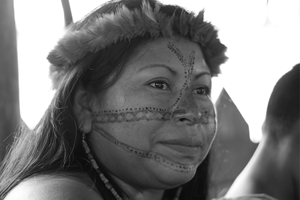
Posts Tagged ‘Alessandra Korap Munduruku’

Human rights defenders in Brazil disappointed by Lula and Mary Lawlor agrees with them

April 24, 2024

On 19 April 2024 – Indigenous Peoples Day in Brazil – tribal leaders and activists used the occasion to criticize government of Brazilian President Luiz Inácio Lula da Silva for falling short on promises to safeguard native land rights.

This is revolting for us Indigenous peoples to have had so much faith in the government’s commitments to our rights and the demarcation of our territories,” Alessandra Korap Munduruku, a member of the Munduruku people and a 2023 winner of the prestigious Goldman Environmental Prize, told Amazon Watch in a statement published Friday.

We hear all of these discussions about environmental and climate protection, but without support for Indigenous peoples on the front lines, suffering serious attacks and threats. Lula cannot speak about fighting climate change without fulfilling his duty to demarcate our lands,” she added.

On the same day United Nations Special Rapporteur on the situation of human rights defenders, Mary Lawlor said that Brazil needs to prioritise the demarcation and titling of land – the root cause of most attacks against human rights defenders in the country.

Human rights defenders are under extreme threat in Brazil. The Federal Government knows this but has so far failed to put the structures in place to provide them with better protection and tackle the root causes of the risks they face,” said Mary Lawlor, in a statement following an official visit to the country.

Brazil’s Federal Government recognises human rights defenders and their work, and understands the risks they face, the expert noted. However, when human rights defenders challenge structures of power that impose and reinforce injustice, they are violently attacked and face an extremely high level of risks, she said. “Again and again during my visit I heard from defenders who had survived assassination attempts, who had been shot at, had their houses surrounded, had death threats delivered to their door. I heard from defenders whose work had been criminalised,” Lawlor said.

“The defenders most at risk in Brazil are indigenous and quilombola people and members of other traditional communities. In many cases, perpetrators of the attacks are known. Yet, there is rampant impunity for these crimes,” the expert said.

The UN expert said business and markets play a key role as drivers of conflicts, putting human rights defenders at risk. “The demarcation and titling of indigenous, quilombola and other traditional peoples’ land, as well as the revision of the legality of all existing concessions given to companies must be prioritised,” she said.

Lawlor said that in urban areas, human rights defenders were also being attacked, defamed and heavily criminalised, specifically black women human rights defenders, journalists, popular communicators and lawyers, and social and cultural workers.

“The conflation of human rights defenders with criminals by local authorities – in particular defenders who are part of social movements and supporting the most vulnerable in society – is a clear problem and must end,” the expert said.

A protection programme to address situations of risk for human rights defenders has been in place in Brazil for some time. However, Lawlor said it was currently unfit for purpose and needs radical reform and expansion. Lawlor applauded the Federal Government for re-opening the door to human rights defenders and civil society in the design of policy that affects them and encouraged authorities to not abandon these efforts.

The Federal Government needs to match the courage of human rights defenders in the country – and it must do so now,” Lawlor said.

On 22 April 2024 Maria Laura Canineu HRW’s Deputy Director, Environment and Human Rights, said she wanted to use this quilombolaas an opportunity to celebrate the work of the courageous people who put themselves at risk fighting for a world in which people and the planet can thrive. “I personally would like to honor Osvalinda Marcelino Alves Pereira. Sadly, she passed away from a long-standing illness just over a week ago.”

https://reliefweb.int/report/brazil/united-nations-special-rapporteur-situation-human-rights-defenders-mary-lawlor-brasilia-19-april-2024-enpt

Download Report (PDF | 213.1 KB | Statement – English version)

https://www.commondreams.org/news/lula-indigenous-rights

https://www.hrw.org/news/2024/04/22/earth-day-homage-beloved-forest-defender
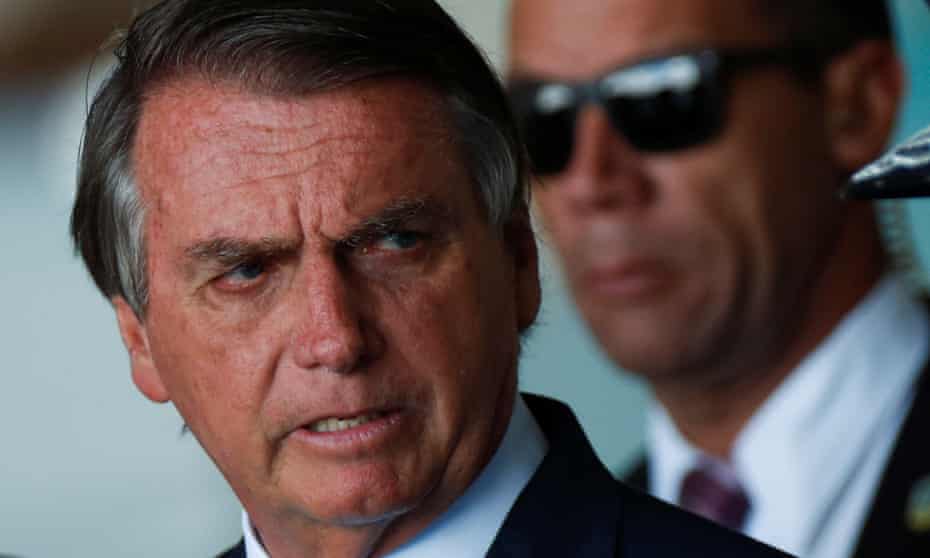
Bolsonaro’s “indigenous medal” is giving awards a bad name.

March 26, 2022
Jair Bolsonaro

Indigenous leaders said Jair Bolsonaro had spent three years promoting legislation that would open their territories to commercial development. Photograph: Adriano Machado/Reuters

Tom Phillips on 17 March 2022 reported how the Brazilian Government honours a president who activists accuse of undermining Indigenous protections.

Brazilian activists are outraged after Jair Bolsonaro – who has been accused of spearheading a cataclysmic attack on Indigenous rights – was honoured by his own government for his supposedly “altruistic” efforts to protect Indigenous lives.

Bolsonaro was granted the Medal of Indigenous Merit on Wednesday in recognition of what the justice ministry called his attempts to defend Indigenous communities in the South American country.

The same honour was bestowed upon key Bolsonaro allies, including his health, defence and agriculture ministers and the hardline institutional security chief, Augusto Heleno, who has accused Indigenous activists of committing crimes against the state by criticising the government’s policies overseas.

Indigenous leaders reacted to the award with disbelief and exasperation, noting how Brazil’s far-right president had spent three years undermining its Indigenous and environmental protection agencies, Funai and Ibama, and promoting legislation that would open Indigenous territories to commercial development.

The Articulation of Indigenous Peoples of Brazil criticised the government’s “contemptuous gesture”. “They want to destroy us at all costs and, as if that wasn’t enough, they now want to pay tribute to themselves in our name?” the group said, claiming Bolsonaro deserved only “the medal of Indigenous genocide”.

Alessandra Korap, an activist from the Amazon’s Munduruku people, said Bolsonaro needed to be arrested, not honoured “for all the destruction he has inflicted on Indigenous people and the forest”. [see also: https://humanrightsdefenders.blog/2020/10/14/brazilian-alessandra-korap-munduruku-wins-2020-robert-f-kennedy-human-rights-award/]

“Now he wants to use the Ukraine war [as justification] for allowing mining, oil and gas exploration, hydroelectric dams and soy plantations on Indigenous lands,” Korap added, in reference to recent moves to fast-track draft legislation allowing such activities.

Alessandro Molon, the lower house leader of Brazil’s opposition, urged Congress to strip Bolsonaro of the medal. “It’s a mockery that the same government that is trying to legalise mining on Indigenous lands – endangering the existence of these utterly persecuted and mistreated people – has the nerve to award itself medals of ‘merit’ for all of the harm it has caused over the past three years,” Molon told the magazine Veja.

“If Congress doesn’t overrule this absurdity it will be associating itself with this unprecedented assault on Indigenous people,” Molon said.

https://www.theguardian.com/world/2022/mar/17/contemptuous-anger-in-brazil-as-bolsonaro-given-indigenous-merit-medal

Brazilian Alessandra Korap Munduruku Wins 2020 Robert F. Kennedy Human Rights Award

October 14, 2020

Robert F. Kennedy Human Rights has named Alessandra Korap Munduruku the winner of its 2020 Human Rights Award for her work defending the culture, livelihoods, and rights of Indigenous peoples in Brazil.

Indigenous peoples, including Alessandra’s Munduruku community, have faced tremendous challenges in Brazil in recent years—from gold miners and loggers illegally invading and exploiting Indigenous territories; to widespread fires in the Amazon; and an increased risk to the coronavirus; not to mention a combative president who’s proactively removed protections for Indigenous tribes and insulted them on numerous occasions.

As one of the key leaders and organizers of the Munduruku people, Alessandra has fought to stop construction projects and illegal mining that are infringing upon Munduruku territory, garnering international attention and support. She’s advocated for the demarcation of Indigenous lands and for Indigenous communities to be consulted on decisions that affect their territories. Alessandra has also played an important role in advancing the leadership of women in the Munduruku community and among other Indigenous tribes in Brazil through her involvement in the Wakoborûn Indigenous Women’s Association and the Pariri Indigenous Association. 

I’m humbled to be this year’s Robert F. Kennedy Human Rights Award winner,” said Alessandra Korap Munduruku. “To have the additional backing and support of Kerry Kennedy and her entire organization, especially during the pandemic, will make all the difference as we continue to fight for our rights, including the demarcation of our lands to ensure that Indigenous peoples have their autonomy, and for the fight of women who are also the strength of the resistance.

Throughout history, Indigenous peoples, including the Munduruku, have repeatedly been oppressed, silenced, and subjected to horrific human rights abuses,” said Kerry Kennedy, president of Robert F. Kennedy Human Rights. “Alessandra has heroically faced intimidation and violence for defending Indigenous rights across Brazil—including the ability to oppose projects and developments that affect her peoples and their livelihoods. She is a champion of women’s rights, Indigenous rights, and the foundational right of all human rights—civic space. Civic space protects the right to dissent, to advocate and to defend human rights, free of government reprisal. It is the keystone of a functioning democracy.”

Alessandra will be honored at a virtual ceremony on Thursday, October 22, at 6:00pm EDT. The event is free and open to the public. You can register here

Kerry Kennedy will present the award, followed by a keynote address from former U.S. Secretary of State John Kerry on the countless threats and challenges Indigenous peoples face around the world. Andrew Revkin, director of Columbia University’s Earth Institute, will then moderate a discussion on the pathways forward for Indigenous peoples in Brazil with an esteemed panel of experts:

  • Juarez Saw Munduruku, Chief of the Sawré Muybu village in Brazil 
  • Maria Leusa Cosme Kaba, a Munduruku women’s leader
  • Francisco Calí Tzay, UN Special Rapporteur on the Rights of Indigenous Peoples
  • Sebastião Salgado, Award-winning French-Brazilian documentary photographer 
  • Antonia Urrejola Noguera, Rapporteur on the Rights of Indigenous Peoples and Commissioner of the Inter-American Commission on Human Rights
  • Christian Poirier, Program Director at Amazon Watch 
  • For more on the Robert F. Kennedy Human Rights award, see: https://www.trueheroesfilms.org/thedigest/award/69FD28C0-FE07-4D28-A5E2-2C8077584068

See also: https://humanrightsdefenders.blog/2020/07/29/rfks-ripple-of-hope-award-2020-to-kaepernick-fauci-and-other-us-leaders/

https://www.globenewswire.com/news-release/2020/10/12/2106955/0/en/Alessandra-Korap-Munduruku-Wins-2020-Robert-F-Kennedy-Human-Rights-Award-for-Her-Work-Protecting-Indigenous-Peoples-in-Brazil.html