Mr Modi’s critics say that the law, which was once used by Britain to target independence hero Mahatma Gandhi, has been abused by his government against many journalists, activists, and students. Section 124A of the Indian penal code gives wide-ranging powers to the police to arrest people, who can even face life imprisonment, for an act or speech that “brings or attempts to bring into hatred or contempt, or excites or attempts to excite disaffection towards the government”.
India’s official crime data says 236 people faced sedition charges between 2018 and 2020. India sparked global outrage last year after 22-year-old climate change activist Disha Ravi was arrested for sedition for allegedly creating a “toolkit” to aid anti-government farmer protests.
“The rigours of Section 124A (are) not in tune with the current social milieu, and was intended for a time when this country was under the colonial regime,” India’s chief justice N V Ramana, part of a three-judge bench hearing a petition against the law, said. Mr Ramana asked the government not to file any new sedition cases and pause ongoing sedition investigations.
“All pending trials, appeals and proceedings” under sedition, the court said, “be kept in abeyance” until the “re-examination of the provision is complete“.
The government had said Monday that it had decided to “re-examine and reconsider” the law but it remained in force. The top court also urged people jailed for sedition to approach local courts for bail.
Amnesty International welcomed the Supreme Court’s order “For far too long, authorities have misused the sedition law to harass, intimidate, and persecute human rights defenders, activists, journalists, students, filmmakers, singers, actors, and writers for peacefully exercising their right to freedom of expression,” Aakar Patel, Chair of Amnesty International India’s Board, said. “Sedition has been used as a tool of political repression by successive governmens”i
Nagpur-based lawyer Nihalsingh Rathod, who represents many accused in the Elgar Parishad case said the legislature should have re-examined the relevance of sedition a long time ago. The Supreme Court’s interim order was an important step in rights jurisprudence, he said.
“It won’t bring complete respite as no state invokes an isolated provision. In present cases too they invoke many provisions, including UAPA. But still, it brings hope that the process of looking at sedition and jurisprudence around it is being re-examined. It offers some hope that sedition law will undergo some churn that has never happened,” he said…
Ravindran Daniel, in Open Global Rights of 10 November 2020 published a piece that should interest anybody who wrestles with the issue of how to ‘decentralise’ the international human rights movement. In “What are the implications of International Human Rights NGOs moving to the South?” Daniel – who is a human rights lawyer from India, served as director of the Human Rights Division with the UN peacekeeping missions in East Timor, Libya and the Sudan and established the Asian Forum for Human Rights and Development – takes the recent closure of AI India as the starting point for a wider discussion of the structural problems that come up in trying to realise the ‘democratization of the global human rights movement”. [see also: https://humanrightsdefenders.blog/2020/09/29/amnesty-feels-forced-to-shut-sown-its-india-office-amidst-govenment-pressure/]
..The closure of Amnesty International’s India office raises questions about AI’s global strategy and the democratization of the global human rights movement. AI’s India office was part of the AI’s 2010 Global Transition Program (GTP) which aimed at restructuring the organization by reducing its London office operations and transferring them to regional hubs in various parts of the world. New forms of national offices were set up in India, Brazil, South Africa, Kenya, Nigeria, and Indonesia. The aim was also to make AI a truly global movement and raise funds from the Global South and not depend entirely on funds from the Global North. Donors such as the Ford Foundation and the Open Society Foundation funded AI’s move to the South which was seen as strengthening mobilization from local to international levels and increased contact with human rights defenders and civil society actors.
However, it also raised some questions for both AI and the global human rights movement.
When opening its office in India in 2012, AI may not have foreseen the assumption of power by an illiberal government in 2014; although it must have known the risks involved in other countries. When AI rolled out its GTP program in 2010, was it unrealistically optimistic, particularly when the global support for human rights in the West was rapidly declining? The optimism about emerging powers such as India, Brazil, and South Africa had waned and several illiberal governments had become powerful in the global system. It could not have waited for an opportune time since governments of various hues always challenge human rights organizations to function freely. The fact remains that human rights offices, national or international, face reprisals by governments and AI should have foreseen it when it established its India office under the GTP program. The question remains: was the cost including the consequences for those associated with AI India worth the risk?
However, the question is: given its tradition of safeguarding its members from bias and reprisals, what steps did it take to prevent reprisals for its members and supporters of national offices? Since 2001, AI abandoned its “own country rule” under which AI members were barred from working on cases in their own countries. It was a self-imposed limitation to safeguard members against potential problems from their own governments but also to stress the importance of solidarity in human rights work.
The closure of the Indian office raises the value of “own country rule” which would have possibly prevented the Indian government from taking the extraordinary step of closing the AI’s office. The Indian Government is alleging money laundering, which would entail conducting investigations against all those who contributed to AI India putting a large number of its supporters at risk.
Was the cost including the consequences for those associated with AI India worth the risk?
Moreover, the aim of the “own country rule” was to prevent AI’s local chapters from becoming just another local human rights organization with international links. In the case of the AI India office, its links to its parent organization seemed to have impeded its functioning. For example, in November 2019, Indian police raided the AI India office after the parent organization testified before the US Congress on the situation in Jammu and Kashmir.
The closure of the AI’s India office has implications for the global human rights movement as well. An evaluation of the Ford Foundation’s Strengthening Human Rights Worldwide Global Initiative (SHRW), under which the foundation funded AI to move to the South, raised the following issues: how to differentiate between the roles played by national and international NGOs; if these roles could be construed as the imperial expansion of Northern-based groups?; if such moves help or reduce the voice of local groups and communities;and if international NGOs have an advantage over national NGOs in garnering a larger share of resources due to a concentration of “cultural capital” (“knowledge and access to global governance institutions”) among NGOs based in the North?
The ecology of the human rights movement began changing in the 80s and the SHRW review captures it. In this changed context, AI’s efforts to be closer to the ground happened at an ill-advised time when strong NGOs had emerged in the South and were increasingly challenging the traditional human rights ecology. While based in the North, AI was functioning as a global movement with some of the corresponding limitations, such as authoritarian governments accusing it of being a Western organization. AI, instead of building from its strength, seemed to have pursued a naïve goal of expanding in the field at a wrong time for the wrong reasons.
Nevertheless, the global human rights movement must condemn the Indian government’s actions against the AI India office. It must campaign for withdrawing all the cases and restoring the office. It should also examine the lessons learned from democratizing the movement in the last two decades, including strengthening the role and voices of NGOs in the South. AI on its part should re-examine its GTP’s assumptions considering the developments of the last two decades. A 2017 evaluation of the GTP commissioned by AI recommended the need for a “new narrative” that “…goes beyond moving closer to the ground, beyond the distribution of Amnesty International Secretariat (IS) and to the distribution of Amnesty as a movement… (making all) regions vibrant communities for public campaigning”.
On 29 September 2020, it was announced that Amnesty International has shut down its India operations, alleging ‘a ‘witch-hunt’ by the Government
Amnesty India shuts operations
The complete freezing of Amnesty International India’s bank accounts by the Government of India which it came to know on 10 September 2020, brings all the work being done by the organization to a grinding halt. The organisation has been compelled to let go of its staff in India and pause all its ongoing campaign and research work. This is latest in the incessant witch-hunt of human rights organizations by the Government of India over unfounded and motivated allegations, Amnesty International India said today. See below the CHRONOLOGY OF ATTACKS AND HARASSMENT OF AI INDIA, starting in October 2018:
“The continuing crackdown on Amnesty International India over the last two years and the complete freezing of bank accounts is not accidental. The constant harassment by government agencies including the Enforcement Directorate is a result of our unequivocal calls for transparency in the government, more recently for accountability of the Delhi police and the Government of India regarding the grave human rights violations in the Delhi riots and Jammu & Kashmir. For a movement that has done nothing but raises its voices against injustice, this latest attack is akin to freezing dissent,” said Avinash Kumar, Executive Director of Amnesty International India.
Amnesty International India stands in full compliance with all applicable Indian and international laws. For human rights work in India, it operates through a distinct model of raising funds domestically. More than four million Indians have supported Amnesty International India’s work in the last eight years and around 100,000 Indians have made financial contributions. These contributions evidently cannot have any relation with the Foreign Contribution (Regulation) Act, 2010. The fact that the Government is now portraying this lawful fundraising model as money-laundering is evidence that the overbroad legal framework is maliciously activated when human rights activists and groups challenge the government’s grave inactions and excesses.
The attacks on Amnesty International India and other outspoken human rights organizations, activists and human rights defenders is only an extension of the various repressive policies and sustained assault by the government on those who speak truth to power. “Treating human rights organisations like criminal enterprises and dissenting individuals as criminals without any credible evidence is a deliberate attempt by the Enforcement Directorate and Government of India to stoke a climate of fear and dismantle the critical voices in India. It reeks of fear and repression, ignores the human cost to this crackdown particularly during a pandemic and violates people’s basic rights to freedom of speech and expression, assembly, and association guaranteed by the Indian Constitution and international human rights law. Instead, as a global power and a member of the United Nations Human Rights Council, India must fearlessly welcome calls for accountability and justice,” said Avinash Kumar.
BACKGROUND: CHRONOLOGY OF ATTACKS AND HARASSMENT OF AMNESTY INTERNATIONAL INDIA:
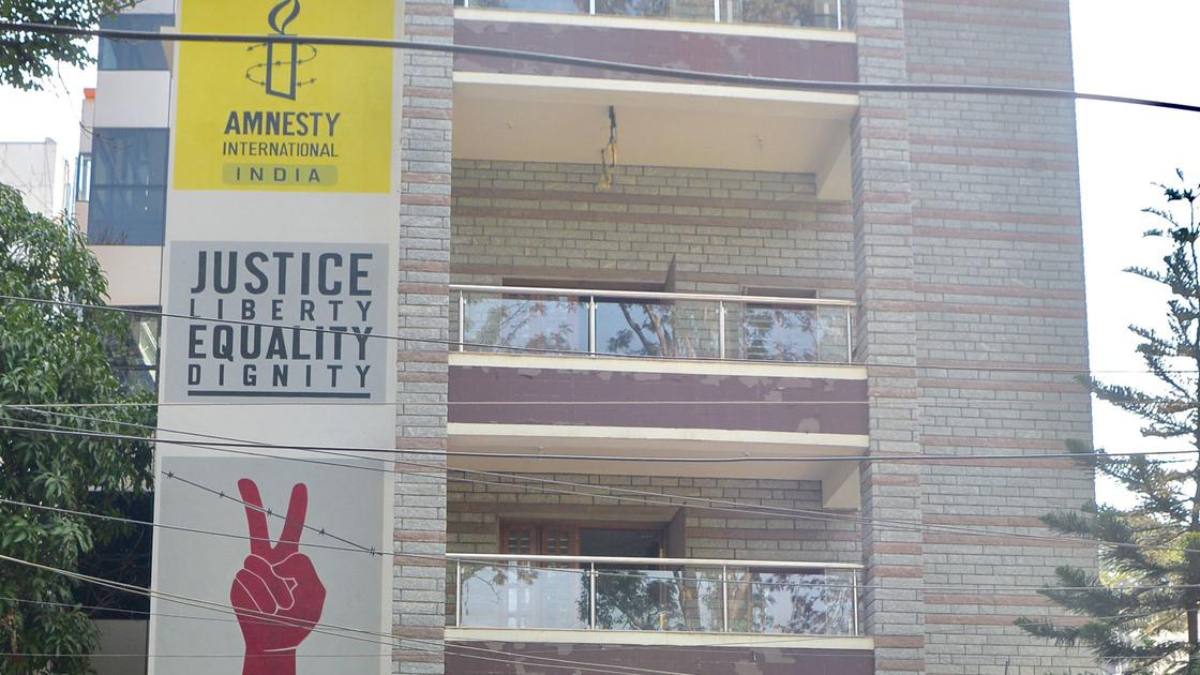
On 25 October 2018, Amnesty International India endured a 10-hour-long raid as a group of officers from the Enforcement Directorate (ED), a financial investigation agency under the Ministry of Finance, entered its premises and locked the gates behind them. Most of the information and documents that were demanded during the search were already available in the public domain or filed with the relevant government authorities. The residence of a Director was also raided.
Immediately after the raid, the bank accounts were also frozen by the ED. As a result, Amnesty International India was forced to let go of a number of its staff, adversely affecting its work in India including with the marginalised communities. Despite the ongoing investigations and before the framing of charges, the Government of India started a smear campaign against Amnesty International India in the country through selective leaking of documents gathered by the ED, to government-aligned media outlets. This resulted in a malicious media trial against the organization.
In early 2019, the Department of Income Tax started sending investigative letters to more than 30 small regular donors. Apparently, the department did not find any irregularities but the process adversely affected the fundraising campaigns of Amnesty International India.
In June 2019, Amnesty International India was denied permission to hold the press conference launch in Srinagar to release its third ‘Lawless Law’ report on the misuse and abuse of Public Safety Act in Jammu and Kashmir. It was forced to digitally release it.
On 22 October 2019, Amnesty International testified at the US Congressional hearing on the situation of human rights in South Asia with a specific focus on Jammu and Kashmir since the unilateral abrogation of Article 370 of the Constitution of India.
On 15 November 2019, two weeks after the testimony and amid rumours of impending arrests of the organization’s top officials, the offices of Amnesty International India and the residence of one of its directors were raided again by the CBI. The raids were conducted on the basis of a First Information Report filed by the Ministry of Home Affairs over unsubstantiated allegations of suspected violations of Foreign Contribution Regulation Act. It suggested investigations be launched under other laws like the Prevention of Money Laundering Act.
On 13 April 2020, Amnesty International India called on the Uttar Pradesh Government to stop its intimidation of journalists through use of repressive laws during a pandemic. On 15 April 2020, the Cyber Crime Police Station, Lucknow, Uttar Pradesh notified Twitter to furnish information about Amnesty International India’s Twitter account @AIIndia which the organization uses to monitor and analyse developments in international human rights law and Indian constitutional and criminal law related to human rights issues.
On 5 August 2020, marking the first anniversary of the abrogation of Article 370 of the Constitution of India, Amnesty International India released an update on the situation of human rights in Jammu and Kashmir.
On 28 August 2020, marking the six-month anniversary of the riots that took place in North-East Delhi in February 2020, Amnesty International India released an investigative brief on the complicity of Delhi police in the riots which claimed the lives of at least 53 people, mostly from the minority Muslim community.
The release of the two publications has provided fresh impetus to the establishment to harass and intimidate Amnesty International India through its investigative agencies.
On 10 September 2020 Amnesty International India came to know that all its bank accounts were completely frozen by the Enforcement Directorate bringing most of the work of the human rights organization to a grinding halt.
Shemin Joy, for DH News Service, New Delhi, reported on 21 February 2019 that a letter addressed by 3 UN Rapporteurs to the Indian government has now been made public as no reply was received. The letter will now be part of the report to be discussed in UN Human Rights Council as India has not responded to the charges. In the letter, the Special Rapporteurs referred to the raids and searches conducted at the offices of Amnesty International India and Greenpeace India as well as the blocking of foreign funding to these NGOs. ….concern is expressed at the alleged smear campaign against Amnesty International India, in what seems to be an attempt to tarnish the organization’s reputation in the absence of formal charges
“We reaffirm our position that the ability to access foreign funding is an integral part of the right to freedom of association, and reiterate our concerns at the highly detrimental impact of the FCRA, which has been increasingly used to obstruct Indi.reiterate our concerns at the highly detrimental impact of the FCRA, which has been increasingly used to obstruct Indian civil society’s access to international funding,” they said. [see also: https://humanrightsdefenders.blog/2013/11/05/india-should-end-funding-restraints-on-human-rights-defenders-says-hrw/]
The seven-page letter was written by Special Rapporteurs David Kaye (promotion and protection of the right to freedom of opinion and expression), Clement Nyaletsossi Voule (rights to freedom of peaceful assembly and of association) and Michel Forst (situation of human rights defenders) on December 20 last year and had said that they would make public the letter after two months with or without the government’s response.
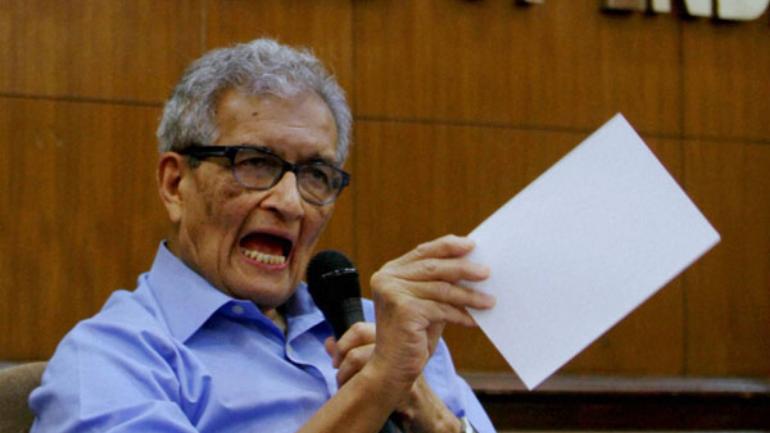
Amartya Sen said that many institutions in the country are under attack. (Photo: PTI)
Nobel laureate Amartya Sen on Sunday 6 January 2019 came out in support of actor Naseeruddin Shah, who recently stoked a controversy with his remark on mob violence and appeared in a video for Amnesty India against alleged government crackdown on NGOs, and said attempts were being made to “disturb” the actor. In a 2.13-minute solidarity video for Amnesty, Shah had said on 4 January that those who demand rights are being locked up. [for example: https://humanrightsdefenders.blog/2018/10/07/india-attacks-on-human-rights-defenders-abound-under-unlawful-activities-prevention-act/ ]
On being asked about the actor’s comments, Sen said, “We must protest against such attempts to disturb the actor. What has been happening (in the country) is objectionable. It should stop.” The 85-year-old economist Amartya Sen said that many institutions in the country are under attack, and their freedom is being encroached. “Even journalists are facing harassment,” he said.
Further talking about the troll attacks against personalities like Shah, Sen said, “Losing the ability to tolerate others is a serious cause for concern, it points to losing of the ability to think and analyse.”
Under the hashtag #AbkiBaarManavAdhikaar, Amnesty India had claimed that India has witnessed a massive crackdown on freedom of expression and human rights defenders. In a solidarity message in Urdu, Shah had said, “Artistes, actors, scholars, poets are all being stifled. Journalists too are being silenced.” “In the name of religion, walls of hatred are being erected. Innocents are being killed. The country is awash with horrific hatred and cruelty“. Last month, the 68-year-old also said that the death of a cow had acquired more significance than that of a police officer in the country. He was speaking in the wake of a mob violence that broke out in Uttar Pradesh’s Bulandshahr on December 3 over alleged cow slaughter in the Mahaw village. The violence led to the death of two men, including a police inspector.
The National Award-winning actor’s visit to a literary fest in December was cancelled following protests by Hindu outfits over his comments on mob violence.
 Hans Thoolen on Human Rights Defenders and their awards