Salvino Oliveira was honored as a 2025 Young Activist Summit Laureate. | Courtesy of Jefferson Teófilo
On 22 December 2025, Global Citizen published the story of how at 27, Salvino Oliveira went from being a street vendor in Rio’s Cidade de Deus to a city councilor leading education reform. This was followed by him starting his first social project: making tuition free for poor children at 15 years old. In recognition of his efforts towards making education more accessible, Oliveira has been honored as a 2025 Young Activist Summit Laureate. Here, Oliveira shares how education transformed his life, and why he’s committed to making that transformation accessible to every young person in Brazil’s favelas.
My name is Salvino Oliveira, and I am everything I’ve been.
I say this because my story begins in a tiny house in Cidade de Deus, meaning City of God, a favela in Rio de Janeiro. At 13, I started working to help my family survive: selling water bottles at traffic lights, candy on buses, working as a street vendor, upholsterer, construction helper — anything honest that could put food on the table.
But Cidade de Deus is more than poverty. It’s the Rio neighborhood with the most public squares, making it a natural place for culture, leisure, and community gathering. It’s the birthplace of funk carioca — the soundtrack of favela resistance and joy. It’s also home to Olympic athletes and artists. These public spaces and that cultural richness shaped who I became, the friends I made, my first loves, the things I believe in.
Then I got lucky. I was selected by lottery to study at Colégio Pedro II, one of Brazil’s most prestigious tuition-free public schools. In Brazil, elite families typically send their children to private schools, while public schools serve the poor; a few exceptional public institutions, like Pedro II, offer quality education through competitive lottery systems. That education changed everything. It opened a door that seemed permanently locked for someone from my background. At 15, even while working and living with gun violence all around me, I understood that if this access had reached me, I had a responsibility to give it back.
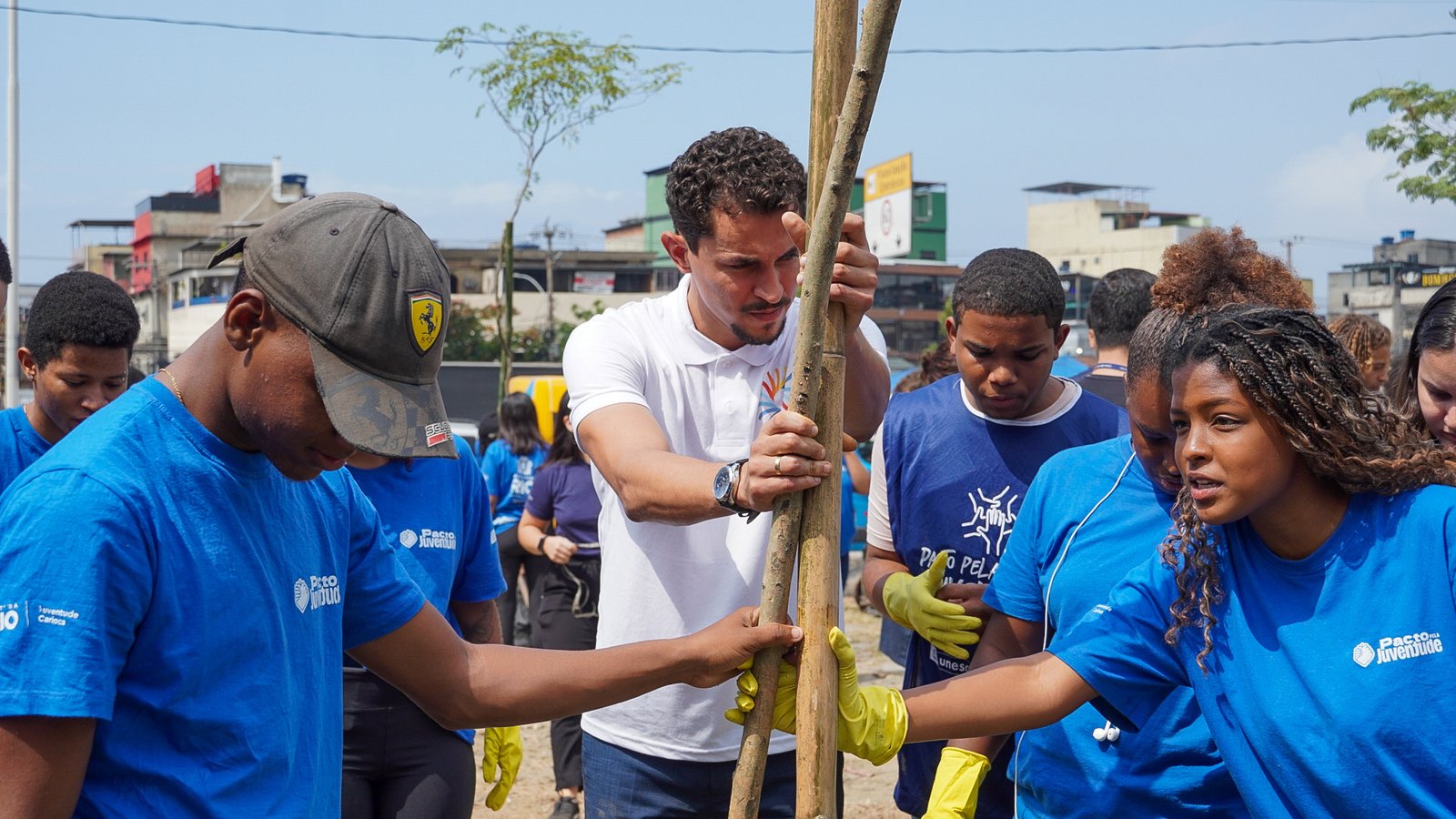
At 15, I created my first social project: free tutoring for children in Cidade de Deus.
When I entered Brazil’s federal university system to study Public Administration at Universidade Federal do Rio de Janeiro (UFRJ), a tuition-free institution, like all public universities in Brazil, that social project grew into AfroEducando (later renamed Mais Nós), a community prep course for university entrance exams. Within one year, we had 22 units across Rio’s metropolitan region, all volunteer-run, helping first-generation Black students from favelas access higher education.
When the “social bug” bites you, there’s no going back — and so the projects continued. I co-founded Projeto Manivela to train community leaders to engage with the government and turn demands into policies. Then came PerifaConnection, a media platform where young people from favelas across Brazil write columns in major national newspapers about politics, economics, culture, climate, and human rights. The idea was simple and radical: we refuse to let other people tell our story for us. Mainstream Brazilian media have historically portrayed favelas primarily through the lens of crime and poverty. Today, favela youth occupy editorial space in national media, changing how Brazil sees its peripheries.
I became an activist in 2018 during the federal military intervention in Rio’s security forces. Working at the Public Security Observatory, I saw firsthand how policies treated favelas like war zones, with heavily armed police operations causing civilian casualties. As I became more visible in my community, friends warned me: “Be careful, you’re an activist now. This can put you at risk.” That’s when I understood that fighting for education and rights in Rio means challenging power structures involving politics, money, and organized crime that often operate in contested urban territories.
Kyra Dupont for Geneva Solutions News of 20 November 2020 interviewed two environmental defenders: Vanessa Nakate, a 24-year-old Ugandan and and Solar Impulse founder Piccard to see how their actions resonated.
The Young Activists Summit (YAS) taking place online today aims to shine a spotlight on young activists who are advancing climate action – but also foster greater dialogue between generations. Young activists have become the face of today’s climate crisis. But the fight did not start with Generation Z – nor are they the only ones affected by the realities of global warming. The Young Activists Summit, hosted in Geneva, will give young people a platform to speak up on climate issues, while at the same time encouraging dialogue with an older generation of climate influencers, including Solar Impulse founder Bertrand Piccard.
Roots of a fight. Vanessa Nakate grew up in Kampala in a middle-class family inspired by a father trader in solar batteries and involved in community work as a member of the Rotary Club. “Like my father, I wanted to help out those in my community, find a way to change their lives.” As she was looking for a meaningful cause to dedicate herself, the student in business administration discovered climate change.
“I had already seen floods, landslides, droughts but I had never connected them to climate change because in schools in Uganda this is something we do not worry about: it either belongs to the past, or to the future. When I started reading about it, I grew to understand that this is the current threat humanity faces right now. I decided that I had to take action and be part of the climate movement.”
Like Nakate, Piccard – the son of oceanographer Jacques Piccard – was also inspired by family members. While studying at medical school (he became psychiatrist) he started fighting for cleaner aviation and ultralight airplanes.
“I was horrified by how human beings could pollute and all the disrespectful way of treating the environment.”
The power of youth. Worried by the unusually high temperatures hitting Uganda, Nakate began protesting against climate inaction in front of Ugandan parliament in 2019. She also staged hunger strikes every Friday for three months. It did not have much impact nor did it attract much attention being the sole protester outside the government gates. But an activist was born. Eventually, other young Ugandans started responding to her calls on social media.
For Piccard too, beginnings were hard. To his great surprise, his fiercest opponents were the ecologists who did not want cleaner aviation, only fewer planes. It took a good 35 years to win his case. Today, he is respected for realising the impossible: he is the visionary initiator of Solar Impulse, the first zero-fuel aircraft with perpetual autonomy. Thanks to his round-the-world flight, the “explorer for sustainability” was able to launch the Solar Impulse Foundation and its 1,000 solutions to protect the environment in a profitable way. He is now listened to by chiefs of state and respected institutions like the European Commission or the United Nations.
Swiss psychiatrist and pilot Bertrand Piccard receives the Knight of the Legion d’Honneur insignia from French President François Hollande. (Credit: Keystone / Etienne Laurent)
Injustice as a driving force. Nakate’s energy comes from her desire to end the injustice afflicting her country and the African continent in general. In Uganda, 90 per cent of the population depends on agriculture for their survival, “a matter of life and death”.
This is why she is not afraid to tell the truth and speak up in front of decision-makers. Convinced young people can make a difference, she founded Youth for Future Africa and the Rise Up Movement Africa before joining the ranks of a handful of activists at the UN climate summit, COP25, in Madrid in December 2019 where she met Greta Thunberg. She was also invited by Arctic Basecamp in Davos where she co-wrote a letter to the participants of the World Economic Forum (WEF).
Climate activists Isabelle Axelsson, Loukina Tille, Vanessa Nakate, Greta Thunberg, and Luisa Neubaue, from left, arrive for a news conference in Davos on 24 January 2020. (Credit: Keystone / Markus Schreiber)
Thousands of young people mobilised for climate change, a powerful grassroots movement that did not exist in the same way when Piccard started to voice his concerns.
“They are very fortunate to be such a big group with such a loud voice. When I was their age, I was very lonely and not a lot of people were speaking about these climate issues. It gives us strength. It gives power. People listen to them. But it also gives them responsibility.”
The keys to sucess. In order for youth aspirations to bear fruit, their message must be practical and concrete with very targeted requests, says Piccard. Development aid should help incentivise developing countries to be cleaner, more efficient and sustainable so donors and investors know that they are not losing their money.
“To say they want to fight climate change is too vague (…) By being practical and voicing specific and understandable claims, they will have a much more positive outcome than if they just protest and say “we are paying the cost of rich countries”.”
Refusing economic growth is purely idealistic, according to Piccard. Its reduction would lead to social chaos, the bankruptcy of thousands of companies and the unemployment of millions of people. The decision-makers must find an advantage in investing in developing countries. Solidarity, yes, but with good leverage.
“To fight poverty in developing countries, you need to localize the production of energy and give energy access to everybody. And you can only do that with renewable energies. If you put solar energy in a village in Uganda, it will create a local economy. People who have solar energy will sell the electricity to people charging their phones, doing business, pumps for irrigation. They will store it in batteries and sell the electricity further…”
Nakate says she is fighting for the fact that the impacts of climate change are not borne equally or fairly between rich and poor, women and men, and older and younger generations. Many victims of climate change have disproportionately low responsibility for causing the emissions responsible for global warming. Meanwhile the $1bn promised by the Green Climate Fund is still underfunded. A balance still needs to be found between the young activist’s call for climate justice and proper use of funds seniors like Piccard insist on.
The power of education. Well aware of the interactions between climate and social justice, Nakate started to work on the Green Schools Project, a renewable energy initiative which aims to transition schools to solar energy and install eco-friendly stoves. This way, she hopes to bring transition to renewable energy in rural schools and give them access to electricity and a better education.
“I never had the opportunity to learn about it, to understand the danger that our planet is facing. If you know that you are in a burning house, you will do everything you can to stop the fire. So, I believe in creating awareness, and this awareness only comes through education.”
Nakate especially believes in educating girls, the number six tool to fight the climate crisis on the list of the DrawDown project.
“There are a lot of different technologies to move towards sustainability but most of them need so much funding. Educating girls is something we can do right now. When you educate these girls from the most affected communities, it also benefits their families and cascades into their communities. They will make better decisions in their lives, have fewer children, survive the risk of hunger, resist school drop-outs, know how to build resilience. They are tomorrow’s leaders, tomorrow’s campaigners, tomorrow’s scientists who will make the best decisions for their countries.”
“Women leaders make the best decisions for their countries. We need more girls in decision-making positions,” says Nakate (Credit: Ronald Meyna)
Africa’s contribution to the world’s greenhouse gas emissions is less than four per cent of the total. But despite being one of the lowest emitters, it is the continent most vulnerable to the impacts of climate change. Yes, those who are the least responsible are suffering the most and yes, it comes as an injustice, says Nakate. But like Piccard in his own time, she resorted to take control of her own destiny.
“We cannot lay back and feel comfortable because our emissions are limited. If we do not speak up for ourselves, we will continue experiencing direct impacts of climate change.”


 Hans Thoolen on Human Rights Defenders and their awards