Posts Tagged ‘Suaram’

NGOs call on Malaysian authorities to stop intimidating human rights defenders

November 16, 2025

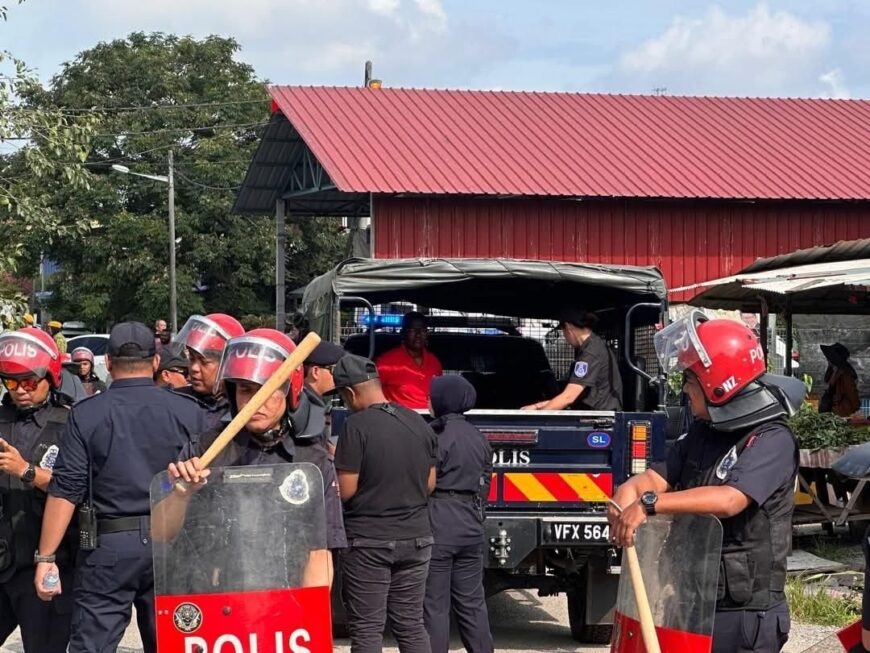
Malaysia: Authorities must stop intimidating human rights defenders - Civic Space

Photo credit: PSM

On 14 November 2025, ARTICLE 19 and the Centre for Independent Journalism (CIJ) expressed alarm about the arrests of and use of force against human rights defenders and residents who attempted to prevent the demolition of houses in Kampung Jalan Papan, which began on 11 November in the Malaysian state of Selangor. We call on the authorities to immediately release human rights defenders and end investigations into their activities. 

On 14 November, two  human rights defenders and seven local residents were arrested under Section 186 of Malaysia’s Penal Code for allegedly obstructing public servants from discharging their duties – a clause that carries a penalty of up to two years’ imprisonment and/or a maximum fine of RM10,000 (approximately USD 2,410). The two activists are Yee Shan from Parti Sosialis Malaysia (PSM) and Jernell Tan from the human rights organisation SUARAM. The seven local residents are Than Bee Hooi, Than Kim Kim, Lim Wee Chun, Ser Li Fang, Lim Eng Hui, Teoh Ah Guat, and Ng Ban Ping. 

This follows previous arrests earlier in the week. On 13 November, 10 people were arrested, also under Section 186 of the Penal Code: PSM Secretary-General Sivaranjani Manickam, PSM National Treasurer Soh Sook Hwa, PSM activist Aein Aneera Anuar, PSM activist Ramasamy Karupan, PSM activist Tan Ka Wei, PSM activist Hridhay Praveen, activist Wong Kueng Hui from the non-governmental organisation Mandiri, local resident Tang Bing Ai, and activist Fakrurrazzi Khairur Rijal from the advocacy group Himpunan Advokasi Rakyat Malaysia. They were  detained at the Pandamaran and Pelabuhan Klang police stations and later released on 14 November .  

On 12 November, Deputy Chairperson of PSM Arutchelvan Subramaniam, also known as Arul, activist M. Mythreyar, and M. Logesvaran, a representative for the residents affected by the demolition, were arrested under Section 186 of the Penal Code.  They were remanded one day before release on 13 November under police bail.  

‘This is a blatant attack against human rights defenders who dare speak out on behalf of local communities living in a climate where forced evictions and development pressures are being used to displace long-time residents. The arbitrary arrests of the activists highlight the risks faced by human rights defenders advocating housing rights. These actions seem intended to intimidate others and discourage efforts to stop forced evictions,’ said Nalini Elumalai, Senior Malaysia Programme Officer at ARTICLE 19. ‘Using such forms of intimidation to silence human rights defenders and the residents not only threatens their safety but also undermines the ability of communities to assert their right to adequate housing and partake in meaningful decisions that affect their lives.’

This case stems from a 1995 agreement between the Selangor government and private limited company TPPT, under which affected families were to be given homes after the state government transferred 95 acres of land to the company. More than 30 years on, the residents have yet to receive their promised homes. Residents,  known as Kampung Papan settlers, have lived in the area for decades, since 1939 – before Malaysia’s independence from the British in 1957. Despite a court ruling allowing the eviction, the Selangor government has said that demolition work should only be limited to vacant houses and business premises. Despite this promise, demolition work began on 10 November and as of 13 November, at least 15 occupied houses had been demolished. Residents of 44 out of 83 homes have obtained an interim injunction against the demolition. 

The authorities’ actions violate the United Nation’s Declaration on Human Rights Defenders and other related resolutions, including General Assembly resolution 70/161 on human rights defenders in the context of the Declaration on the Right and Responsibility of Individuals, Groups and Organs of Society to Promote and Protect Universally Recognized Human Rights and Fundamental Freedoms. Among other things, the resolution urged States to ensure the rights and safety of human rights defenders in exercising their rights to freedom of expression, peaceful assembly, and association.

https://www.article19.org/resources/malaysia-authorities-must-stop-intimidating-human-rights-defenders/

Malaysia and the EU: NGOs ask for more forthright action

November 25, 2014

An “Advocacy Note” published in November 2014 by FIDH and SUARAM addresses the whole specter of human rights in Malaysia and how the EU should respond. Here are the parts that specifically concern human rights defenders:

FIDH and SUARAM draw the EU’s attention towards the following human rights challenges and call on Brussels to work with Malaysian civil society on the proposed solutions.

1. Publicly challenging Malaysia’s records on human rights

2. Addressing the impacts business activities on human rights

3. Using Treaties’ negotiations to obtain genuine human rights commitments

4. Supporting civil society activities

FIDH and SUARAM believe that the EU has overall been supportive of the work of human rights NGOs in Malaysia. The EU Delegation and Member States’ missions regularly meet with civil society and human rights activists, bilaterally or through the EU’s Human Rights Working Group, to discuss issues such as women’s rights, the elimination of racial discrimination, and freedom of expression. The EU Delegation maintains regular exchanges with NGOs, sends observers to trials against human rights defenders, and promotes the content of the EU Guidelines on Human Rights Defenders.

In recent years, the EU has provided financial support to NGOs working in the field of women’s and children’s rights, non-discrimination, freedom of the media, and indigenous people. With the current reduction of staff in the EU Delegation [7], civil society will now have to turn to Global Calls for Proposals to find support for its activities rather than seeking financial support directly at Delegation level through Country Based Support Schemes (CBSS). FIDH and SUARAM fear that such a change may have consequences on the effectiveness and sustainability of civil society activities. Many NGOs may not have the capacity to respond to the Calls for Proposals or to absorb the important amount of finance offered in calls designed for large- rather than middle-sized projects. It is therefore important for the EU to find alternative ways to support civil society beyond small emergency grants, for example in the form of funds at the regional level or sub-grants to local NGOs.

The EU must also step up its political support to civil society. The EU must push for the amendment of the 1966 Societies Act, which offers no judicial remedy to an association whose registration has been suspended or refused by the authorities. The EU must ensure that FTA provides for a genuine enabling environment for civil society.

Failure to do so would create a democratic gap in terms of monitoring of the agreement. The negotiation process should be an opportunity to hold tripartite discussions between the EU, Malaysian authorities, and civil society. The EU should offer technical advice to Malaysian authorities to reform the Societies Act and ensure the new version complies with international standards.

The fact that Malaysian authorities continue to criminalise peaceful assembly after the Court of Appeals declared a section of the Peaceful Assembly Act as unconstitutional is proof of the political will to repress peaceful assembly. This issue should be addressed by the EU at the highest levels of the political dialogue. The EU should also address the issue of recent calls made by Malaysian government officials to adopt legislation similar to the Indian Foreign Agents Registration Act, which would provide a legal basis for monitoring of foreign funds to civil society organisations.

Recommendations

FIDH and SUARAM call on the EU and its Members States to (inter alia):

• Demand the immediate release of individuals convicted for political reasons, notably under the Sedition Act.

• Establish a human rights roadmap in cooperation with Malaysian authorities and civil society, in order to achieve tangible results before the FTA are agreed.

• Ensure that human rights are included in the negotiations and the structure of the future Free Trade Agreement (FTA) with Malaysia. 

• Place the support for civil society, human rights defenders, local communities, and indigenous peoples at the centre of their interactions with Malaysia. EU and its Members States must:
— Urge the Malaysian authorities to ensure that all citizens’ human rights, including the rights to freedom of expression and assembly are respected;
— Press Malaysian authorities to amend the Societies Act to bring it in line with international standards, and provide technical support to that effect;
— Press for effective and immediate investigation into serious cases of human rights violations, and the formation of an Independent Police Complaint and Misconduct Commission (IPCMC) to investigate allegations of torture and deaths in police custody;
— Demand that Malaysian authorities set a date for the country visit of the UN Special Rapporteur (UNSR) on Freedom of Assembly and Association and extend an invitation to the UNSR on the rights of Indigenous Peoples and the UNSR on Freedom of Religion;
— Organize a civil society seminar before the EU-Malaysia human rights and political dialogues;
— Include civil society in sectoral discussions and in the negotiation process of the FTA;
— Propose alternatives to make up for the end of Country Based Support Schemes in order to ensure financial support to the work of human rights NGO.

Encourage Malaysian authorities and companies to adopt binding regulations and a business investment framework to prevent human rights violations by economic operators and ensure accountability in the case abuses take place. Regulations must be in line with international human rights standards, including the UN Guiding Principles on Business and Human Rights.

• Prepare a strategy on business and human rights that ensures that current and future investments by EU-based companies do not negatively affect human rights in Malaysia. This strategy, to be designed with Malaysian authorities, companies, and civil society, should aim at setting up binding regulatory measures corresponding in line with international standards.

• Work with Malaysian authorities to ensure that their development plans do not negatively affect human rights.

Advocacy Note: A committed but too shy EU support to human ….

Call for more moderate Muslim voices in Malaysia’s human rights debate

November 18, 2013

An interesting example of how human rights defenders should tackle the pernicious issue of islamic opposition to human rights progress comes from Malaysia:

According to Bar Council member Andrew Khoo, Muslim-majority countries were among those which have asked Malaysia to obey international human rights standards in the United Nations’ Universal Periodic Review (UPR) last month. “These are not Western, European-centric recommendations… For anyone to attempt to say this is a Western agenda, sorry you’re barking up the wrong tree,” said Khoo, who is the co-chairman of the Bar Council’s Human Rights Committee.  Read the rest of this entry »

Malaysian NGO Suaram notes culture of impunity, intolerance, and missing reforms

October 1, 2013

On 26 September the NGO Suaram released its “Malaysia Human Rights Report 2012: Civil and Political Rights” in Kuala Lumpur. The report highlights several key trends in human rights in 2012, including:

1 the increasingly serious and repeated cases of abuses of power by the police and law enforcement agencies with impunity;

2 the heightened intolerance towards dissent; and

3 the government’s cosmetic approach to reform and compliance with human rights standards.

Suaram’s 2012 report is launched to honour human rights defenders in Malaysia and the Special Rapporteur on Freedom of Assembly and of Association, Maina Kiai in his foreword writes: “This annual report is a critical tool to support civil society actors in their effort to advocate and contribute to strengthened implementation of human rights. Its continued publication is vital to a vibrant democracy in Malaysia”.

via Putrajaya tarnished by culture of impunity, intolerance, and missing reforms — Suaram | What You Think | The Malay Mail Online.

Cynthia Gabriel, HRD working for Suaram, harassed in Malaysia

August 20, 2013


Cynthia-Gabriel

The Observatory for the Protection of Human Rights Defenders, a joint programme of the World Organisation Against Torture (OMCT) and the International Federation for Human Rights (FIDH), draw attention to the following situation in Malaysia.

According to the information received, on 7 August 2013, at 3.00pm, Cynthia Gabriel,  Read the rest of this entry »

Malaysian NGO uses UN review to accuse government of harassing human rights defenders

March 17, 2013


UN-human-rights-council

In the lead up to the Malaysia’s Universal Periodic Review, a delegation from Suaram (Suara Inisiatif Sdn Bhd) under the accreditation of Aliran (Persatuan Aliran Kesedaran Negara) attended the United Nations Human Rights Council in Geneva last week.  The group submitted an oral statement as part of the Interactive Dialogue on the Situation of Human Rights Defenders urging the Malaysian Government to allow the Special Rapporteur Ms Margaret Sekaggya to carry out an independent inquiry. The statement touched on the intensified threats against Bersih steering committee members, native rights defenders in East Malaysia, Lynas activists and the ongoing harassment and intimidation against Suaram.

The group also submitted an oral statement as part of the Interactive Dialogue on Freedom of Religion or Belief.  The statement highlighted a number of cases where freedom of religion was not respected, in relation to the ability of individuals to decide which faith they wished to practice. It highlighted how children in Malaysia are often exposed to religious instruction against their will, citing the example of the Orang Asli children who were slapped by a teacher at a school in 2012 for not reciting the doa (Islamic prayer). It also covered the controversial “Allah” issue and the bureaucratic obstructions that non-Muslims often face when constructing a place of worship in Malaysia.

The ongoing persecution and harassment of Malaysia’s human rights defenders is a blatantly obvious example as is ignoring the rights of minorities and indigenous people stated Suaram. http://aliran.com/11976.html