Posts Tagged ‘rating’

CIVICUS Monitor Watchlist of March 2026 is out

March 28, 2026
GlobalAnnouncement.March2026 1

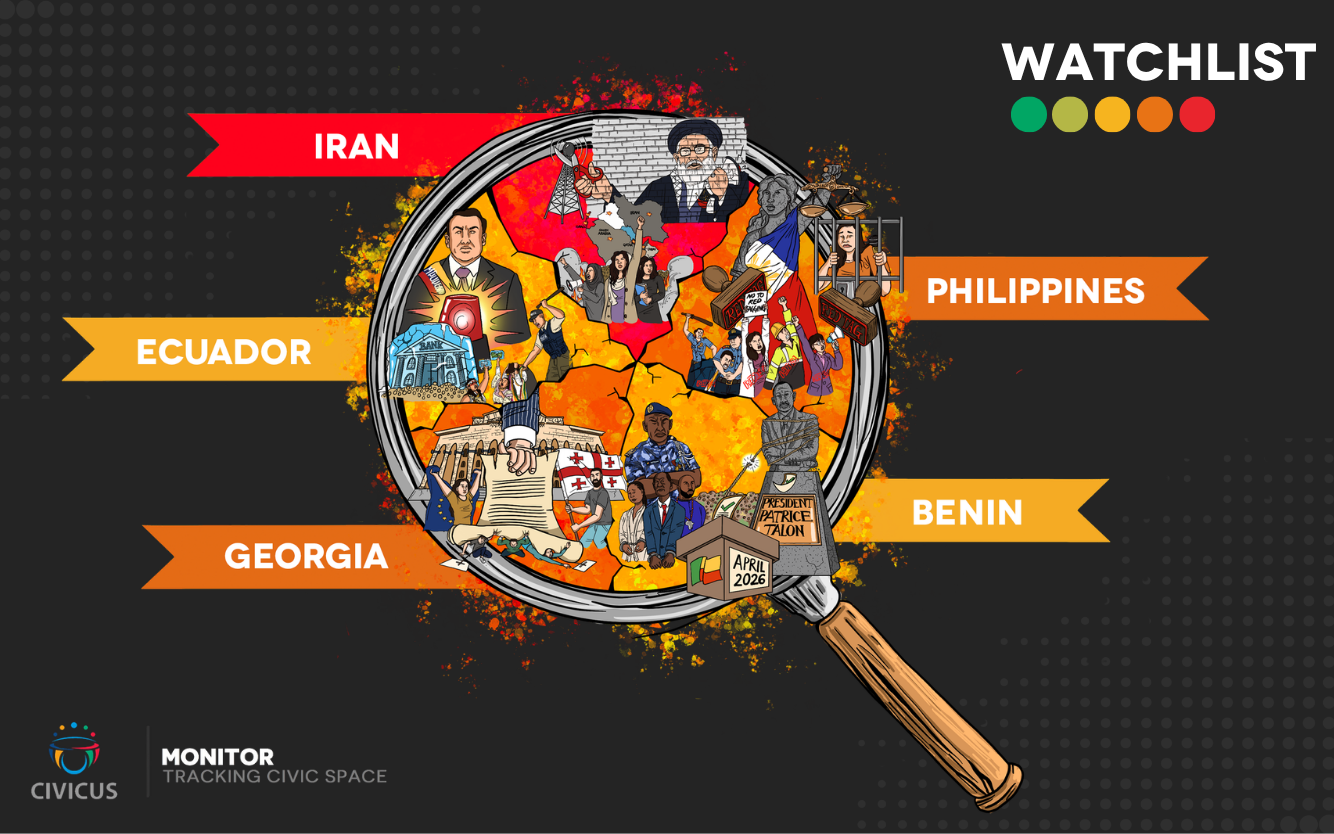
The March 2026 Watchlist from the CIVICUS Monitor highlights five countries where civic freedoms are deteriorating at an alarming pace: Ecuador, Georgia, Iran, the Philippines and Benin. Each faces escalating restrictions on fundamental rights, including freedoms of expression, association and peaceful assembly. The Watchlist draws on research findings, partner input and testimony from activists on the ground, and signals where urgent international attention is needed.

CIVICUS MONITOR CIVIC SPACE RATINGS:

 OPENNARROWEDOBSTRUCTEDREPRESSEDCLOSED

Ecuador
Civic space rating: Obstructed 
Ecuador’s government has increasingly relied on militarised security measures, invoking an “internal armed conflict” to justify exceptional powers. Indigenous-led protests in 2025 were met with lethal force, arbitrary detentions and internet disruptions. Environmental and Indigenous leaders face criminalisation, with more than 200 social leaders investigated or prosecuted. A 2025 law has expanded state control over civil society organisations, enabling account freezes and burdensome reporting. Journalists face killings, attacks and suspensions of media outlets, all unfolding amid a broader erosion of judicial independence.

See full country announcement

Georgia
Civic space rating: Repressed
Georgia has seen a dramatic decline in civic space, marked by mass protests since late 2024 and heavy-handed police responses. Hundreds have been detained, tortured or investigated. New laws restrict protests, impose “foreign agent” requirements on civil society and media, and threaten criminal penalties for receiving foreign funding. Opposition parties and leaders face politically motivated charges, and new rules bar many civil society actors from political participation for years.

See full country announcement

Iran
Civic space rating: Closed
Iran’s civic space, already severely restricted, has worsened following mass protests over economic and political grievances. Security forces killed thousands of protesters in January 2026 during a nationwide internet blackout, and tens of thousands were arrested. After regional airstrikes in February 2026, authorities imposed another shutdown and intensified censorship. Journalists and activists face extreme risk, and some detainees now face the death penalty. Despite repression, demonstrations continue following the death of the Supreme Leader.

See full country announcement

The Philippines
Civic space rating: Repressed
Civic space in the Philippines remains under pressure, with police violence and mass arrests during anti-corruption protests in 2025. Dozens of protesters face sedition charges under cybercrime laws. Human rights defenders are frequently targeted, including through fabricated terrorism-financing cases. Red-tagging—accusing critics of communist links—remains widespread. Journalists also face prosecution, including the conviction of reporter Frenchie Mae Cumpio after years of pre-trial detention.

See full country announcement

Benin
Civic space rating: Obstructed 
Benin approaches its April 2026 presidential election with shrinking democratic space. Strict electoral rules have limited the field to two approved candidates, and the January 2026 legislative elections produced a parliament without opposition representation. Authorities increasingly use the Digital Code to prosecute journalists and critics, while media outlets face suspensions and mandatory government messaging. Protests are routinely banned or dispersed, and fear of reprisals has led to widespread self-censorship.

See full country announcement

https://www.civicus.org/index.php/media-resources/news/8201-civicus-monitor-watchlist-march-2026
Annual reports 2019: CIVICUS Global Report

December 27, 2019

The end of a year usually means looking back and many human rights NGOs issue reports of this kind. Here is the first by CIVICUS, through its Monitor:

Civic space – space for civil society – is the bedrock of any open and democratic society. When civic space is open, citizens and civil society organisations (CSOs) are able to organise, participate and communicate without hindrance. When people are free to participate, they are able to claim their rights and influence the political and social structures around them. This can only happen when a state holds by its duty to protect its citizens and respectsand facilitates their fundamental rights to associate, assemble peacefully and freely express their views andopinions. These are the three key rights that civil society depends upon.

The CIVICUS Monitor analyses the extent to which these three civil society rights are being respected and upheld, and the degree to which states areprotecting civil society. In an attempt to capture these dynamics on a global scale, over 20 organisations from around the world have joined forces on the CIVICUS Monitor to provide an evidence base for action to improve civic space. In order to draw comparisons at the global level and track trends over time, the CIVICUS Monitor produces civic space ratings for 196 countries. Each country’s civic space is rated in one of five categories – open, narrowed, obstructed, repressed, or closed – based on a methodology that combines several sources of data on the freedoms of association, peaceful assembly and expression. Civic space updates from our research partners contain qualitative, narrative information related to the situation for civil society in a country. This qualitative information is directed by a set of guiding questions and the resulting data is gathered from a variety of primary and secondary sources. In many cases, country-specific updates have come directly from national civil society themselves. (Methodology: In countries where it does not have a research partner, the CIVICUS Monitor relies on a variety of other sources produced at the national, regional and international levels to arrive at country ratings. These civic space updates are then triangulated, verified and tagged by the CIVICUS team. Together, the research partners posted 536 civic space updates from 1 October 2018 to 11 November 2019 which form the basis for the analysis presented in this report. For the time period assessed, these civic space updates cover 153 countries. This report analyses trends and developments since its previous report, published in November 2018. As well as global-level trends, it analyses trends in five regions: Africa, Americas, Asia and the Pacific, Europe and Central Asia and Middle East and North Africa (MENA).

Following an update of ratings in November 2019, the CIVICUS Monitor continues to tell a worrying story. The data shows that there are 24 countries with closed civic space, 38 countries with repressed space and 49 with obstructed space. Just 43 countries receive an open rating, and 42 countries are rated narrowed. Since our previous report, published in November 2018, space for activism has reduced: only three per cent of the world’s population now live in countries with open civic space. Nine countries have changed their civic space rating since our November 2018 update: two have improved their ratings, while seven have worsened. This indicates that repression of peaceful civic activism continues to be a widespread crisis for civil society in most parts of the world. Worrying signs for civic space continue to be seen in Asia, where two countries, Brunei and India, dropped their rating from obstructed to repressed. Given the size and global role of India, the decline in the quality of its civic space must be of particular concern. One country in the Pacific – Australia – dropped from an open to narrowed rating, partially due to increased restrictions on the freedom of expression and government surveillance

See also: https://humanrightsdefenders.blog/2018/12/06/20-human-rights-defenders-under-attack-one-for-each-year-of-the-declaration/

Click to access GlobalReport2019.pdf