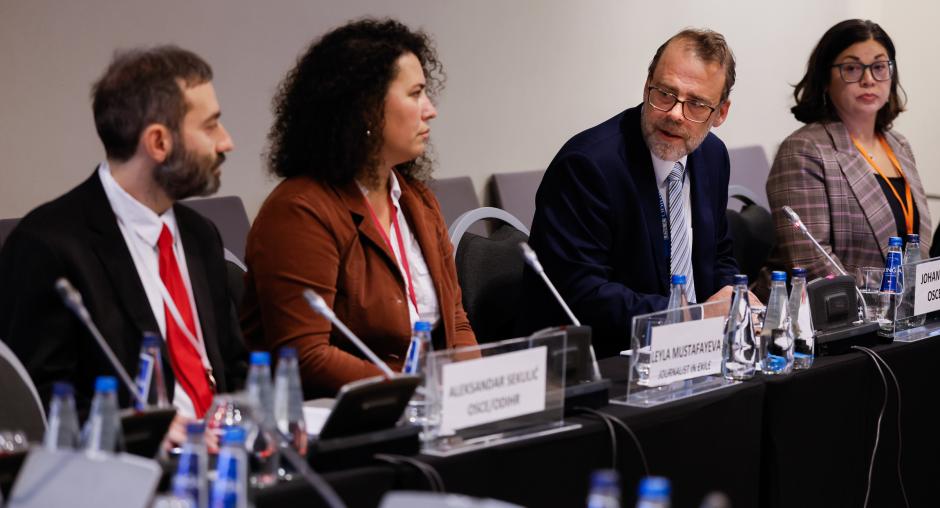
Panelists discussing the need for stronger protection for human rights defenders in exile. Warsaw, 16 October 2025 (OSCE/Piotr Dziubak) Photo details
As civil society space shrinks and attacks against activists increase in many places, a growing number of human rights defenders are being forced into exile as they seek a safe environment to continue their work freely and securely. This was the focus of an event organized by the OSCE Office for Democratic Institutions and Human Rights (ODIHR), Araminta, and the World Organisation Against Torture at the Warsaw Human Dimension Conference on 16 October 2025.
“Human rights defenders face inherent risks in their work, and relocating does not address all their needs. Adopting robust safeguarding mechanisms is essential to ensure minimum standards for mobility and a safe environment for defenders in exile,“ said Jennifer Gaspar, Araminta Managing Director.
While defenders in exile play a crucial role in promoting human rights, they face serious challenges, from urgent personal and legal issues to long-term barriers such as legal insecurity, restricted mobility and limited opportunities to continue their work. Participants discussed the need to establish minimum standards to protect human rights defenders in exile in the OSCE region, as well as EU legislation to ensure stronger legal and practical safeguards for them, participants discussed.
The discussion drew on both institutional perspectives and the lived experiences of exiled defenders, highlighting the need for coordinated action and policy tools to address these gaps. Participants emphasized that ensuring human rights defenders can continue their work in safety is vital to protect human rights and promote democratic values across the OSCE region and beyond.
Malta is still struggling to adequately protect human rights defenders, including journalists, according to a new OSCE review published on 2 September 2025.
While some progress has been noted, the report warns that legal pressure, rhetoric used and a lack of meaningful reforms continue to erode fundamental freedoms. The assessment by the OSCE’s Office for Democratic Institutions and Human Rights (ODIHR) follows a fact-finding mission to Malta in March 2023.
ODIHR noted “concerning instances of disparaging rhetoric and smearing remarks used by political actors, including politicians and other persons of authority” in relation to activists in various areas and journalists Those working on corruption, migration, environmental issues, and sexual and reproductive rights were identified as frequent targets. Interviewees described harassment, threats and intimidation, often extending to their families.
Women activists reported sexist abuse, including being spat on or confronted physically.
Interviewees told ODIHR that their work was often portrayed as partisan political activity. The assessment also noted attempts to damage reputations, harm employment prospects and label defenders as enemies, traitors or political opponents.
The report connects this hostile environment to the 2021 public inquiry into journalist Daphne Caruana Galizia’s assassination, which found that state inaction and vilification of journalists fostered a “climate of impunity.” Two years later, ODIHR says many recommendations remain unfulfilled, particularly on media freedom and journalist safety.
The OSCE heard accounts of online trolling, social media threats, spoofing campaigns, threatening phone calls, and verbal abuse of family members.
ODIHR also found that Maltese journalists continue to receive threatening letters from local and international law firms, sometimes prompting article removals due to fear of high legal costs.
Although defamation was decriminalised in 2018, gaps in the law remain, and proposed anti-SLAPP reforms have been criticised as inadequate.
Freedom of expression and access to information also face obstacles. Journalists spoke of costly and lengthy efforts to secure public records, while whistle-blower protections are seen as weak due to fears of reprisals.
The report calls for a public review of Malta’s Freedom of Information Act, the release of a government-commissioned evaluation, and new legislative proposals to improve transparency and accountability.
Civil society activists also described intimidation around protests, including court rulings against authorities for repeatedly removing banners and memorials related to Caruana Galizia.
ODIHR acknowledged political support for LGBTI rights, with NGOs in this sector receiving strong public backing and engagement from officials. Freedom of assembly was generally upheld, and some NGOs received benefits through tax incentives and secondments. Nonetheless, ODIHR concludes that Malta must urgently rebuild trust and ensure a safer environment for rights defenders.
Key recommendations include public recognition of their work, stronger police protection protocols, robust anti-SLAPP legislation, improved transparency measures, and genuine consultation on media reforms. “Baseless lawsuits, threats and smear campaigns not only endanger individuals but weaken democracy itself,” the report warns.
ODIHR said it is ready to support Malta in implementing reforms but emphasised that political commitment is vital.
The Finnish Ministry for Foreign Affairs published on 25 July 2025:
The Finnish OSCE Chairpersonship will organise a conference on 31 July 2025 to mark the 50th anniversary of the Helsinki Final Act. The conference will pay tribute to the legacy of the Conference on Security and Co-operation in Europe (CSCE) in Helsinki in 1975 and highlight the role of civil society in advancing OSCE’s principles and commitments. Helsinki+50 Fund will be launched as part of the Conference to support the OSCE’s operational capacity.
This year marks the 50th anniversary of the Helsinki Final Act signed in 1975, and its content is now more topical than ever before. The Final Act was a turning point for Europe’s security. As a result, 35 states – including those on the opposing sides of the Cold War – committed to following common principles that laid the foundation for the European security architecture…
The event at Finlandia Hall will be opened by Minister Valtonen, and High-Level Keynotes will be delivered by President of the Republic of Finland Alexander Stubb, OSCE Secretary-General Feridun H. Sinirlioğlu and UN High Commissioner for Human Rights Volker Türk.President of Ukraine Volodymyr Zelenskyy will speak at the conference via remote connection. UN Secretary-General António Guterres will send a video message.
“The Helsinki Principles are a reminder of what we can achieve through cooperation and trust – and what is at stake if we fail to defend them. Now, more than ever, these principles need their defenders,” Minister for Foreign Affairs Valtonen says.
The Helsinki+50 Fund will be launched as part of the Conference. The fund aims to enhance the channelling of voluntary funding to support work in line with the OSCE’s principles and commitments, and to strengthen the link between donors andthe OSCE.The fund will supplement OSCE’s budget, not replace it.
Experts and representatives of civil society shared their assessments of the needs of human rights defenders in exile at an ODIHR event that took place in the margins of the 2023 Warsaw Human Dimension Conference. 6 October 2023. (OSCE/Piotr Dziubak) Photo details
The situation of human rights defenders forced to work outside their countries to avoid danger or persecution at home was the topic of an event organized by the OSCE Office for Democratic Institutions and Human rights (ODIHR) on 5 October 2023 in the margins of the Warsaw Human Dimension Conference.[see:https://humanrightsdefenders.blog/2023/10/03/osce-leaders-speak-the-right-language-about-hrds/ ]
“Human rights defenders play a legitimate and important role in our societies,” said Andrew Gardner, ODIHR’s Deputy Head of the Human Rights Department. “It is essential that they can operate in a free and safe environment when this does not exist in their own countries.”
Experts and representatives of civil society, some who had themselves relocated to safer countries, shared their assessments of the needs of human rights defenders in exile, including rapid access to safe third countries, overall safety and a secure legal status, and their ability to continue their human rights work.
Participants stressed the importance of being able to form associations, seek and receive funding and travel as part of their human rights work. They also discussed the impact of being uprooted on human rights defenders’ well-being.
“Defenders are determined to continue their human rights work,” said Tamar Beria of the International Partnership for Human Rights (IPHR). “But states and donor organizations must do more to make this work viable in the long term by tackling pervasive issues such as visa access, inflexible funding and a lack of institutional support.”
Participants stressed that decision-makers must address protection gaps which exist for exiled human rights defenders and ensure the fulfilment of their fundamental rights and freedoms.
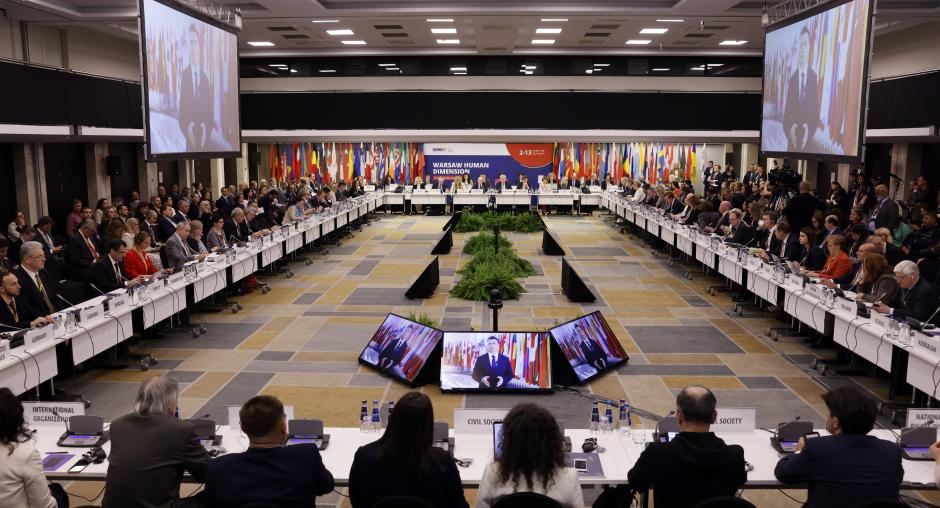
Warsaw Human Dimension Conference, Opening Plenary. 2 October 2023. (OSCE/Piotr Dziubak)
On 2 October 2023 the main message from OSCE leaders at the opening of the ten-day Warsaw Human Dimension Conference was that “at the heart of any human rights movement is the fundamental belief that every individual, regardless of their background or circumstances, possesses inherent rights and dignity.”
The OSCE’s work to achieve sustainable security throughout the 57 states of the region is only possible on the basis of democracy, human rights, and the rule of law, and in co-operation with civil society. But the work of civil society activists, whose determination to shed light on human rights abuses is so important for their societies to develop and flourish, is becoming more dangerous in the many places in which they are treated not as partners but as a political and security risk.
“The brave work of civil society activists and human rights defenders lies at the very heart of our democracies,” said ODIHR Director Matteo Mecacci. “At the OSCE we are deeply grateful for their courageous work, especially in fragile humanitarian situations resulting from conflicts across our region. We continue to learn from their experience, and we look forward to hearing proposals to improve respect for human rights, as well as their ideas for a better future. In this way, we create a unique platform for genuine dialogue between national authorities and civil society across the entire region.”
“In every region of the OSCE I have heard civil society views on how to respond to the challenges we face. Your views have helped to inform our approach in Vienna, and to guide the work of our field missions. All of our work in the Secretariat and field missions is done based on a human rights centred approach, and the OSCE is committed to working with civil society every step of the way as we advance our efforts in the human dimension. The human dimension is fundamental to the OSCE comprehensive concept of security,” OSCE Secretary General Helga Maria Schmid said.
“Media freedom is deeply rooted in the concept and principles of democracy. It is what enables and sustains democratic societies – by providing people with the information they need to be free and self-determined. Quality information and a shared sense of reality are a prerequisite for all citizens to be able to express their will and positions, to take control of their lives, to be part of the glue that holds our societies together. There can be no democracy without media freedom, as much as there can be no security without media freedom,” said Teresa Ribeiro, OSCE Representative on Freedom of the Media.
The full programme and other information about the Warsaw Human Dimension Conference are available here.
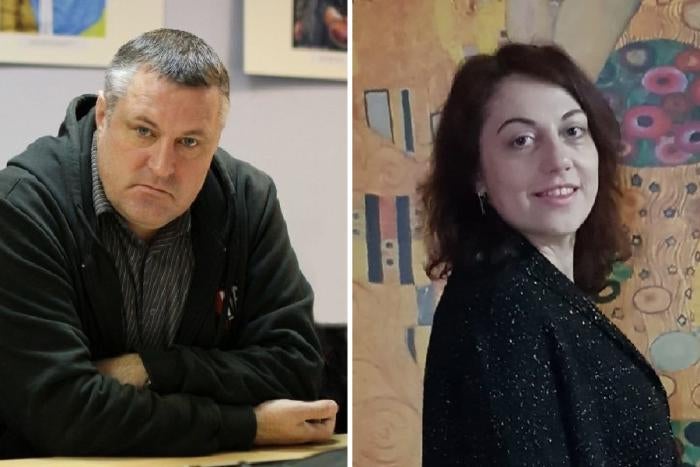
On Wednesday, November 3, the Centraĺny District Court in Homieĺ delivered the verdict in the politically motivated criminal case against two human rights defenders with the Homieĺ branch of Viasna, a leading Belarusian human rights group. The court sentenced the head of Viasna’s Homieĺ office Leanid Sudalenka and Viasna’s volunteer Tatsiana Lasitsa to three and two and a half years in prison, respectively.
18 international and Belarusian organizations call on Belarusian authorities to immediately annul the outrageous verdict and drop all charges against Sudalenka and Lasitsa, as well as five other members of Viasna who are currently in jail on politically motivated charges.
“Politically motivated prosecutions of Viasna members and volunteers are part of the ‘purge’ of Belarusian civil society declared by Aliaksandr Lukashenka and his government. Belarusian authorities’ targeting of Viasna in particular is no doubt designed to punish the organization for its outstanding and courageous human rights work over the course of 25 years.”
On October 14, the prosecutor’s office requested three years’ imprisonment for Sudalenka and Lasitsa on charges of “organizing, financing, training, and preparation of actions grossly violating public order and financing such activities.” The charges were backed by absurd “evidence,” such as Sudalenka’s Facebook post offering to buy firewood for the family of someone accused of “mass rioting” in connection with the peaceful protests of 2020.
Sudalenka and Lasitsa have been in pretrial detention for over nine months, having been arrested on January 18 and 21, respectively. Their trial began in early September and was held behind closed doors.
On January 18, authorities also detained Viasna’s volunteer Maryia Tarasenka in connection to Sudalenka and Lasitsa’s case. She was released under her own recognizance three days after the arrest. Tarasenka left Belarus after prosecutor’s office requested two and a half years imprisonment for her in October.
The other five Viasna members currently behind bars on politically motivated criminal charges are Ales Bialiatski, the founder and chairman of Viasna, Valiantsin Stefanovic, Viasna deputy chairman, Uladzimir Labkovich, a lawyer and coordinator of the group’s campaign “Human rights defenders for free elections,” Marfa Rabkova, coordinator of Viasna’s network of volunteers, and Andrei Chapyuk, a volunteer for Viasna in Minsk.
Around 100 Viasna human rights defenders and volunteers, as well as their family members, have also been interrogated and designated witnesses in criminal cases against their colleagues. At least seven have been designated suspects.
Belarusian law enforcement continues regular interrogations in connection with the criminal cases against Viasna employees, including activists of other civil groups and initiatives.
On September 17, 23 international and Belarusian human rights groups launched a campaign #FreeViasna, demanding the immediate release of the jailed Viasna human rights defenders. We continue calling on the Belarusian authorities to:
Fully abide by their international human rights obligations as a party to the International Covenant on Civil and Political Rights to respect the rights to freedom of association, peaceful assembly, and expression of all people in Belarus.
Fully respect the work of human rights defenders and lawyers and ensure that everyone can complain without fear of retaliation about actions and policies of individual officials and governmental agencies.
In line with these obligations, release Tatsiana Lasitsa, Leanid Sudalenka, Ales Bialatski, Valiantsin Stefanovic, Uladzimir Labkovich, Marfa Rabkova and Andrei Chapyuk immediately, drop all charges against Viasna staff and volunteers, including Maryia Tarasenka, and other human rights defenders, and ensure their right to a remedy for arbitrary detention and malicious prosecution.
Also woth mentioning is that on 4 November 2021 in response to the Belarusian authorities’ failure to respond satisfactorily to the 5 November 2020 Moscow Mechanism report, 35 OSCE states invoked the Vienna (Human Dimension) Mechanism and Belarus’ commitments under that Mechanism.
Signed:
Amnesty International
Article 19
Barys Zvozskau Belarusian Human Rights House
Belarusian Helsinki Committee
Center for Civil Liberties
Civil Rights Defenders
FIDH, within the framework of the Observatory for the Protection of Human Rights Defenders
Front Line Defenders
Helsinki Foundation for Human Rights
Human Rights Center Viasna
Human Rights House Foundation
Human Rights Watch
International Partnership for Human Rights
Libereco – Partnership for Human Rights
Norwegian Helsinki Committee
Östgruppen – Swedish Initiative for Democracy and Human Rights
Right Livelihood
World Organisation Against Torture (OMCT), within the framework of the Observatory for the Protection of Human Rights Defenders
On 10 December 2020, Human Rights Day, the OSCE Office for Democratic Institutions and Human Rights (ODIHR) issued a statement “The brave people strengthening human rights in 2020 will lead us out of adversity“. A bit belatedly. I reproduce here OSCE paying “tribute to human rights defenders and many organizations across the OSCE region that have protected our rights throughout the Covid-19 pandemic, and will have a key role to play if the global recovery is to put respect for human rights at its core“
OSCE states have long recognized the important role played by human rights defenders in ensuring full respect for human rights, fundamental freedoms, democracy and the rule of law. Throughout the pandemic, numerous organizations, initiatives and activists have worked hard to lessen the suffering caused by the health crisis. They have exposed gaps in responses to the health emergency and drawn attention to the undermining of human rights standards and democratic values in the name of public safety.
As public emergencies were introduced across the OSCE region and human rights and freedoms of millions of people were restricted, national human rights institutions (NHRIs) as well as civil society organizations were swift to hold accountable those states that were using vaguely defined regulations to bypass human rights obligations and lower standards. In addition to their regular monitoring activities, NHRIs were often quick and resourceful in developing solutions and disseminating key information to the public when it was needed.
A spirit of dialogue and compromise, the ability to combat systematic inequality and exclusion, and the will to overcome ever-deepening polarization, are hard to imagine without a strong and vibrant civil society. But in many places across the OSCE region, pressure on civic space is increasing. This takes many forms, from legislation restricting the activities of civil society to smear campaigns against human rights defenders and journalists.
Despite their commitment – or because of it – many courageous human rights defenders across the OSCE region have been the brunt of attacks in 2020. They have faced threats and intimidation, frequently initiated by national authorities, as well as funding cuts and risks to their data security and privacy.
Today, ODIHR wants to thank all those brave people across the OSCE region who are committed to safeguarding the human rights of us all. The Office will continue to support and work with them towards this ultimate goal.
Belarussian Human Rights CentreViasna(‘Spring’) has received the 2020 Democracy Defender Award of the OSCE. The award honours a person or group for exceptional contributions to the promotion of democracy and the defense of human rights in the spirit of Helsinki Final Act principles and other OSCE commitments. It was established in 2016 to recognize the contribution civil society makes to defending and promoting democracy. Earlier, the award was received by the Russian movement “Golos”, the Serbian non-governmental organization CRTA, and the Ukrainian activist Oleksandra Matviychuk. “Human Rights Centre Viasna receives the award this year for its mission of defending human rights in Belarus and building a just, free and democratic society for all its citizens,” the OSCE statement reads.
According to Viasna Chairman Ales Bialiatski[https://humanrightsdefenders.blog/2014/06/22/good-news-ales-bialiatski-belarus-best-known-human-rights-defender-freed-from-prison/], the award is a clear signal to the Belarusian authorities as an incentive to serious reforms in the field of human rights and a substantial improvement of the situation with the rights and freedoms of Belarusian citizens. “..The repressions against the Belarusian human rights defenders will not stop our work in support of democracy and human rights in our country. We are grateful to the OSCE member countries that nominated HRC Viasna. We believe that the courageous and persistent efforts by human rights defenders in the OSCE region, in spite of the obstacles, will help make our world a better place,” he stressed.
Active from 1996, the organisation was founded on the principle of respect for human rights, and its main goal is to contribute to the development of civil society in Belarus. HRC Viasna conducts research on the state of civil society and rule of law in Belarus, with the aim of improving implementation of human rights obligations and commitments, the OSCE notes.
On 10 May 2019 the Fundamental Rights Agency (FRA) reported that from 7 to 8 May, representatives from intergovernmental organisations and EU institutions responsible for cooperation with civil society and for supporting human rights defenders in Europe and Central Asia met in Warsaw at the invitation of the FRA and the OSCE Office of Democratic Institutions and Human Rights (ODIHR). Others represented at the meeting were the Council of Europe, European Commission, European External Action Service, European Asylum Support Office (EASO), OSCE Chairmanship in Office, OSCE Representative for Freedom of the Media, the OHCHR Geneva and Brussels office, UNDP, UN Women, and the World Bank.
The press release did not elaborate what was discussed or achieved but only that “It served to establish ongoing, practical information exchanges to facilitate further cooperation between these organisations in supporting human rights defenders.”
The OSCE Office for Democratic Institutions and Human Rights(ODIHR) is pleased to offer a five-day training event on human rights monitoring and safety and security for human rights defenders (HRDs) working in three thematic areas: 1) human rights of Roma and Sinti, 2) human rights of people of African descent, and 3) environmental protection issues.
The objective of the training event is to enable human rights defenders (HRDs) to independently carry out quality and objective human rights monitoring activities in a safe and secure manner and taking into account relevant gender considerations. The event will take place in Montenegro from 27 to 31 May 2019, and will cover the human rights monitoring cycle and principles; physical safety and security of human rights monitors; and digital security, including secure information management. The language of the event will be English. The training will be based on interactive learning methods and requires a high level of active participation by all participants. During group exercises, participants will be divided based on their field of work/interest and coached by a senior professional expert. ODIHR will select up to eight participants per group.
The size of the entire group will be limited to 25 participants, selected according to the following criteria:
• Citizenship or residence in one of the OSCE participating States;
• Involvement as a human rights defender in one of the specified fields: environmental protection, human rights of Roma and Sinti, or human rights of people of African descent;
• Limited or no experience on human rights monitoring and reporting;
• No or limited previous training in safety and security (including digital security);
• Relevance of the training for future human rights activities in OSCE the region;
• Computer literacy;
• Fluency in English.
The OSCE/ODIHR recognizes as a human rights defender any person promoting and striving for the realization of human rights regardless of profession, age or other status. Human rights defenders carry out their human rights activities individually or jointly with others, as part of an informal group or as a non-governmental organization (NGO), and act in a voluntary capacity or professionally. ..The workshop is designed for activists with limited or no skills who can benefit fully from receiving the training. Accommodation and travel for the selected human rights defenders to attend the event will be covered by ODIHR.
Deadline for submission: 29th March 2019. If you have any questions about the content or the selection procedure of the training, please do not hesitate to contact David Mark david.mark@odihr.pl and Marine Constant at marine.constant@odihr.pl.




 Hans Thoolen on Human Rights Defenders and their awards