Amnesty International UK runs a successful series of (national) media awards. Amnesty’s Media Awards, which have been running annually since 1992, celebrate excellence in human rights journalism and applaud the courage and determination of journalists who often put their lives on the line to report on vital human rights issues. Kate Allen, Director of Amnesty International UK, said at the 3 April 2019 ceremony: “Media work is vitally important for Amnesty and everything we do. This evening we’ve seen some brilliant journalism that has had enormous human rights impact…Without a free press, it’s extremely difficult to expose wrong-doing and hold leaders to account. But even here in the UK we’re seeing it being threatened – especially with the sinister arrest of Trevor Birney and Barry McCaffrey in Northern Ireland last year…That’s why our awards are about congratulating the achievements of the media and championing its role in creating a fairer, more open world.” The awards, hosted by Channel 4 News presenter Cathy Newman, held a moment of silence for the approximately 90 journalists imprisoned last year for doing their jobs. Canada and the USA are undertaking similar events.
The winners of the 2019 AI UK Media Awards include:
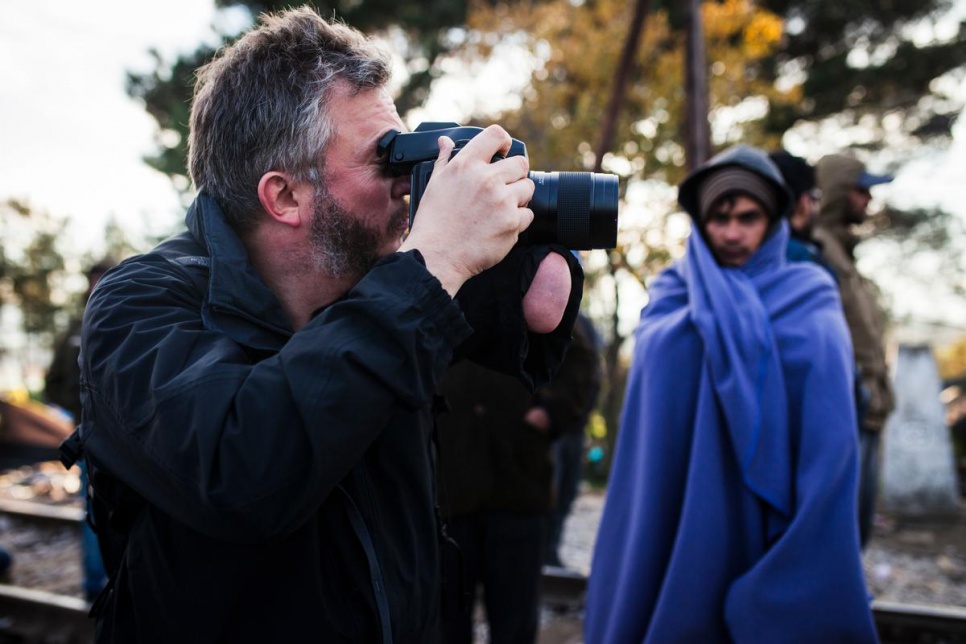
Humanitarian photographer Giles Duley won a Media Award for his powerful series depicting the plight and resilience of Congolese female refugees in Angola. His photo essay, “We Are Here Because We Are Strong”, was commissioned by UNHCR and published in Humanity magazine. The subjects of his project were forced to flee the Kasai region of Democratic Republic of the Congo after violence erupted in March 2017, triggering massive displacement.
The full Media Awards 2019 shortlist can be found here.
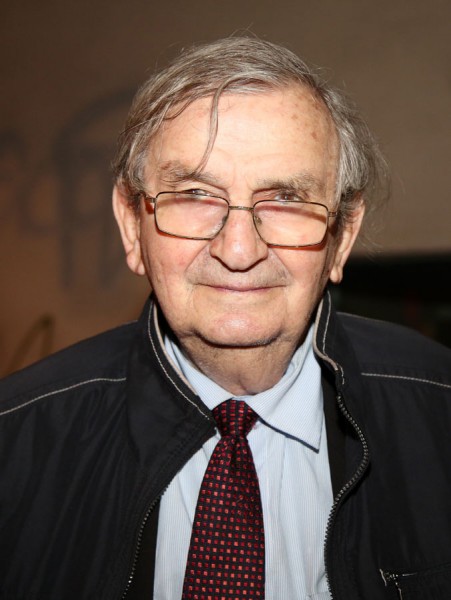
Silvana Meixner is the head of the ORF minority editorial office (Minderheitenredaktion) and presenter of the magazine “Heimat Fremde Heimat”. In the spirit of the late Ari Rath, she is honoured as a journalist who has rendered outstanding service in her work to critical reporting on flight, expulsion and asylum, committed to the protection of human rights. Silvana Meixner was born on March 16, 1958 in Split, Croatia; she lives in Vienna since 1986. After graduating from high school, she studied sociology and pedagogy in Zadar. Since 1988 she has been working for the Austrian Broadcasting Corporation (Österreichischer Rundfunk), where she was involved in setting up the minority editorial office. On 3 December 1993 Silvana Meixner, who moderated the television programme Heimat, fremde Heimat together with Lakis Iordanopoulos, was injured by a letter bomb from Franz Fuchs. She continued her journalistic work for refugees, ethnic minorities and human rights.
In the first of a two-part series on media repression and “fake news” in Morocco – written in collaboration with Access Now – Global Voices tells on 4 April 2019 how jailed human rights activist Nasser Zefzafi was smeared by Moroccan pro-government media.
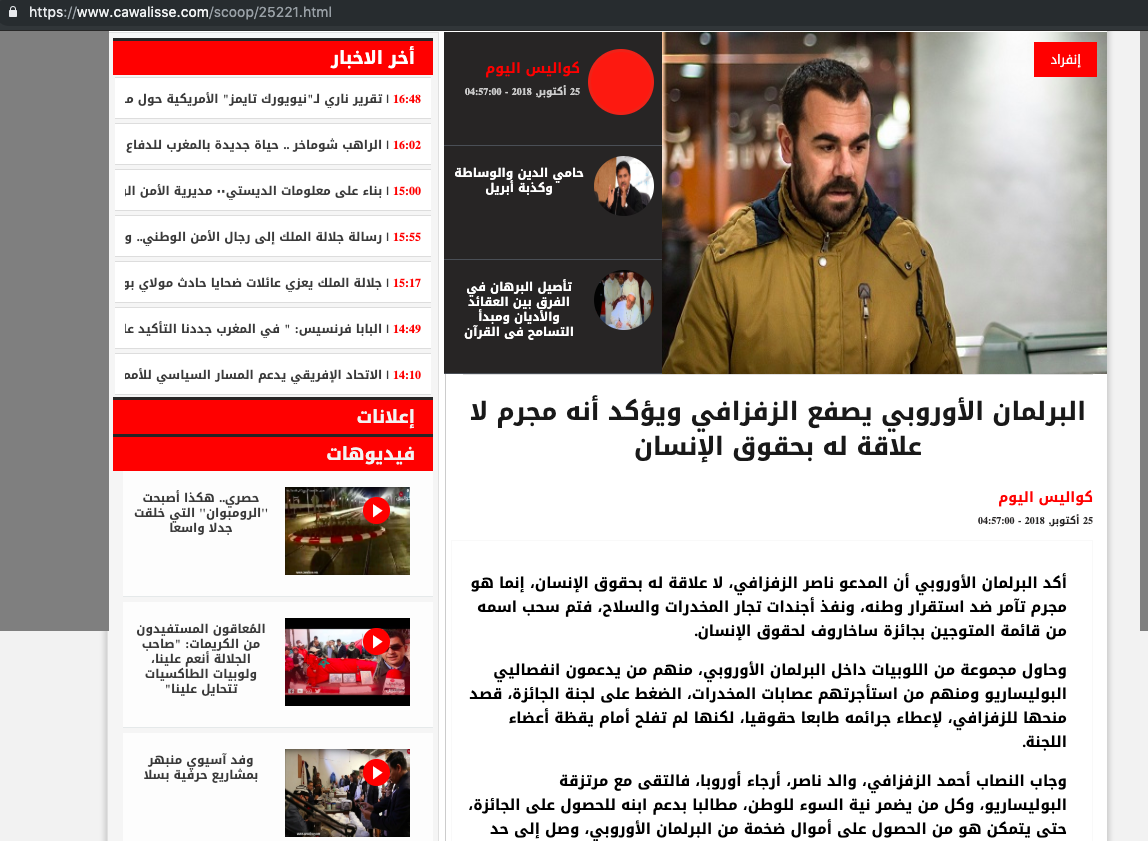
Zefazfi is currently serving a 20-year prison term for his role as a leader in the Hirak protests. … Zefzafi made it to the list of three finalists for the Sakharov Prize, but did not win. It was instead awarded to Ukrainian film director and writer Oleg Sentsov. Following the announcement of the winner on 25 October, Moroccan news site Cawalisse published a fabricated story alleging that the European Parliament “withdrew Zefzafi’s name from the list of winners’’ because he is a “criminal who has no link to human rights.”
Screenshot of the fabricated Cawalisse story alleging that the European Parliament deemed Zefzafi a ”criminal’.
The article (which does not list an author!) states that “a group of lobbies from within the European Parliament, including those that support Polisario separatists and those hired by drug gangs, pressured the prize’s committee to award it to Zefzafi and give his crimes the label of protecting rights.” The story is completely false. It is based on fabricated facts and conspiracy theories. The European Parliament never maintained that Zefzafi was a criminal, nor did they withdraw his name “from the list of winners.” He was simply not chosen to win the prize. In fact, there was no “list of winners” in the first place, but only one winner, Oleg Sentsov…
You can follow them on social media: @newhumanitarian on Twitter, Facebook, Instagram and LinkedIn. It celebrated the name change with the world premiere of “The New Humanitarian”, a short play by South African playwright Mike van Graan; an interactive discussion with our editors; and an introduction to the new president of our board of directors.
Reuters reports that on Monday 4 March 2019 Egypt released photojournalist Mahmoud Abu Zeid, also known as Shawkan who spent more than five years in jail after covering a 2013 sit-in that ended with security forces killing hundreds of protesters. “I can’t describe how I feel … I am free,” he told Reuters by phone after being released at dawn on Monday. [see also: https://humanrightsdefenders.blog/2018/05/04/world-press-freedom-day-a-good-time-for-honoring-journalists/]
Shawkan was released because he had served out his term before being sentenced. But he must still spend his nights for the next five years at a police station, a penalty he said he would challenge. He vowed to continue with his work, saying: “All journalists are at risk of being arrested or killed while doing their work. I am not the first and I will not be the last.”
(Shawkan was charged with belonging to a banned group and possessing firearms. He was sentenced to five years in prison last September in a mass trial which saw 75 people sentenced to death and more than 600 others to jail terms. Shawkan denied the charges against him, saying he was simply providing freelance coverage of the protest for a British-based photo agency.)
Last Wednesday, 13 February 2019, Abdul Aziz Muhamatwas awarded the 2019 Martin Ennals Award for human rights defender in Geneva. Some time earlier Behrouz Boochani was awarded the Australian Victorian Prize for Literature. What they have in common is that they are detained – for almost 6 years – on Manus Island under Australia’s off-shore refugee policy. Their stories testify to the cruelty of this regime and the humanitarian deficiency of a country that claims a strong liberal tradition and is itself a nation based on immigration. Successive governments have defended this policy as necessary to stop trafficking although it is hard to see how forced stays of such length would attract anybody except the most desperate refugees. And anyway even those recognized as refugees would not be allowed to settle in Australia!
Aziz’ impassioned acceptance speech in Geneva, spoke of the solidarity he feels for his fellow detainees in the face of daily humiliating and degrading treatment. Therefore he vowed to return to his detention centre in the Pacific, return to be a number (“On the island, officials refer to me as QNK002. I have no identity other than that number“). See:
Published every year since 2002 by Reporters Without Borders (RSF), the World Press Freedom Index is an advocacy tool. The Index is a point of reference that is quoted by media throughout the world and is used by diplomats and international entities such as the United Nations and the World Bank.
The Index ranks 180 countries and regions according to the level of freedom available to journalists. (It is a snapshot of the media freedom situation based on an evaluation of pluralism, independence of the media, quality of legislative framework and safety of journalists in each country and region. It does not rank public policies even if governments obviously have a major impact on their country’s ranking. Nor is it an indicator of the quality of journalism in each country or region.)
THE PRESS FREEDOM MAP, which is distributed in print and digital versions, offers a visual overview of the situation in each country and region in the Index. The colour categories are assigned as follows: good (white), fairly good (yellow), problematic (orange), bad (red) and very bad (black).
On 8 January 2019 the Hong Kong Free Press reports that Swedish human rights defender Peter Dahlin has filed a complaint with the British telecommunications regulator against Chinese state media China Central Television (CCTV) for contravening the broadcasting code and violating the Human Rights Act. In his complaint to the Office of Communications (Ofcom) yesterday, Dahlin – who is director of human rights NGO Safeguard Defenders – cited his own appearance on Chinese state television in 2016. [see: https://humanrightsdefenders.blog/2018/04/12/how-china-extracts-televised-confessions-from-human-rights-defenders/]
China Central Television Building in Beijing. Photo: Wikimedia Commons.
Dahlin said in his complaint that the production and airing of his televised “confession” violates a significant part of the privacy and fairness provisions of the broadcasting code, since no consent was given. He added that all statements made during his appearance were done so under duress and were pre-written for him: “I was given a paper with prepared questions and answers, and told to memorise,” he said. “I, like many victims who have later spoken out, was never told or informed, that this was to be a public TV recording, but that it was for internal use only.”….
The complaint stated that CCTV violated paragraph 6 of the Human Rights Act, which governs the acts of public authorities, by denying Dahlin the right to a fair trial. It also states that CCTV violated article 8 of the act, which protects the right to privacy. The complaint also said that CCTV knowingly produced “lies and [the] intentional distortion of facts…” with the help of the Ministry of State Security in China.
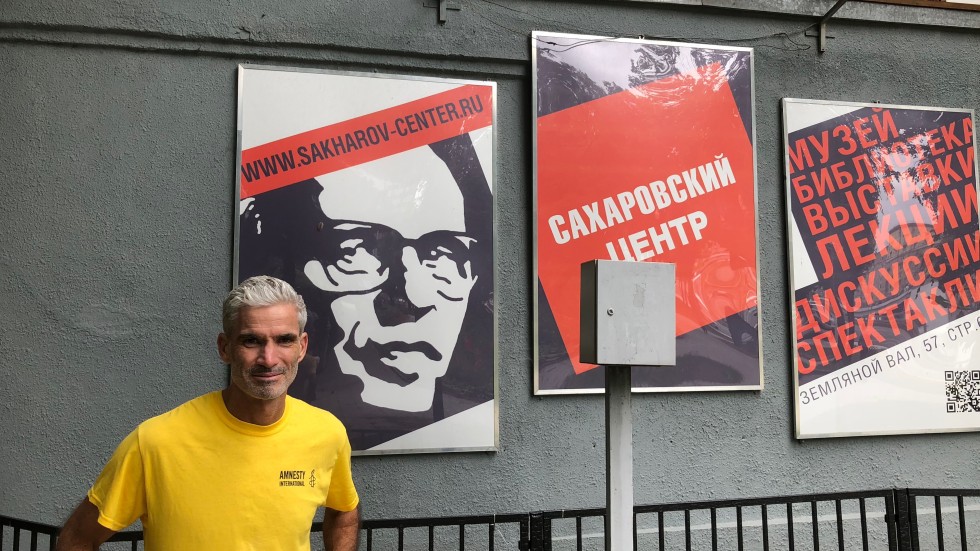
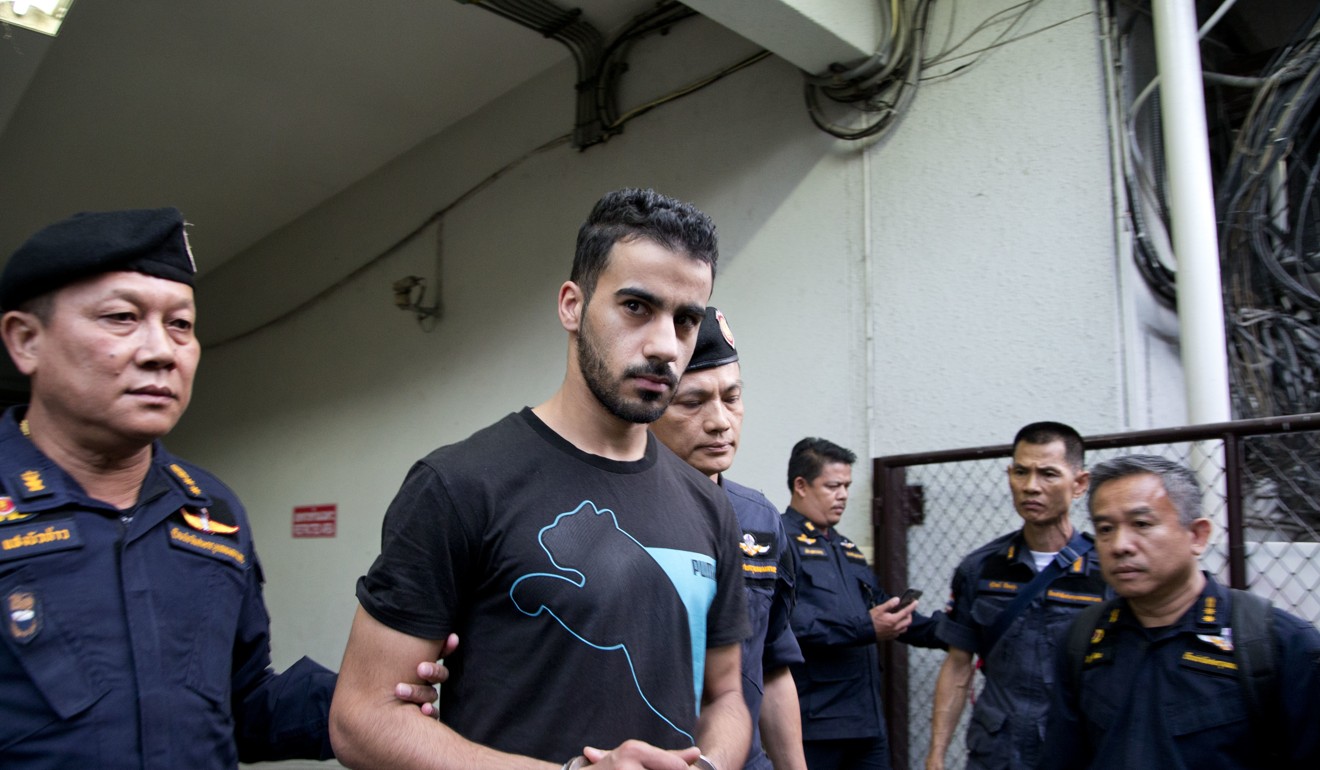
Football’s power to fight injustice motivates Craig Foster. The former Socceroos captain who played for Hong Kong’s Ernest Borel in the early ’90s is a broadcaster in Australia and also works for Amnesty International as a human rights and refugee ambassador. He is among the most vocal of activists in calling out human rights transgressions in football and sport and is one of the many prominent figures fighting for the release of Bahrain’s Hakeem al-Araibi, an Australia-based refugee footballer who is in a Thai jail awaiting extradition to his home country where he fears torture and persecution. [For some of my other posts on football and human rights, see: https://humanrightsdefenders.blog/tag/football/]
On Tuesday, 01 January, 2019, Nazvi Careem wrote a long piece about Craig Foster’s work and dedication:
And if he ever doubted just how powerful this sport can be, he only needs to recall the heartbreaking words of a young African refugee who had lost everything – fleeing his war-torn homeland after his parents, sibling and other members of his family were killed. “He was involved in a football programme over a period of time. He was very, very quiet and said very little,” said Foster. “He was in a new country and was experiencing psychological difficulties, which is totally understandable. “When he was asked why he liked the programme, he simply said: ‘The only thing that still exists in my life is football. It is the only thing that hasn’t been taken away from me’. And he was crying when he said it.
…Since retiring as a player in 2002, Foster became involved in social issues related to football, working with disadvantaged, minority and indigenous communities in a variety of programmes. “I’m just finishing my law degree, which has given me some further insight into the challenges of human rights and international refugee law. I feel strongly about these issues and in football, we are at an advantage because we are the most diverse, multicultural community in Australia.
…..Foster, who played for Portsmouth and Crystal Palace in England and also had a stint in Singapore, said he felt an obligation to give something back to the sport. As an ex-player and a broadcaster with the SBS organisation in Australia, Foster is in an ideal position to reach out to the masses. At the same time, he puts his contribution to social issues in perspective, admitting that he is in a position of comfort compared with activists whose lives are on the line in their efforts to effect change.
“Of course, you can’t fight every battle, but there are key ones which take a huge amount time. But the people I have immense respect for are the human rights defenders in their countries….In Australia we have serious human rights issues, with indigenous Australians and also in terms of refugees and arrivals.
(This article appeared in the South China Morning Post print edition as: using football to fight injustice)
As the Universal Declaration of Human Rights turns 70 – is it time for a new approach? asks Barbara von Ow-Freytag, Journalist, political scientist and adviser, Prague Civil Society Centre, in the World Economic Forum.This piece is certainly worth reading as a whole. It is close to my heart in that it stresses the need to have a hard look at how young human rights defenders focus their energy where they can achieve real, concrete change within their own communities. Their campaigns are grassroots-led and use local languages and issues their communities understand. They often use technology and creative formats, with a heavy dose of visual and artistic elements. Where the international scene seems to stagnate and even backpedal, better use of communication skills and tools (such as images) are certainly part of the answer:
As the Universal Declaration of Human Rights turns 70, a new generation of human rights defenders are reinventing themselves to fight for old rights amid a new world order. Based not on declarations, charters and international bodies, but on the values which underpin them – justice, fairness, equality – they shun the language of their predecessors while embracing the same struggle…However, in the new realities of the 21st century, the mechanisms to promote human rights that grew out of the Universal Declaration are showing their age. Authoritarianism is on the rise across the world, with popular leaders cracking down on human rights defenders.
Freedom House found 2018 was the 12th consecutive year that the world became less free. Civicus, which specifically monitors the conditions for civil society activists and human rights defenders, found civil society was “under attack” in more countries than it wasn’t, with all post-Soviet countries (except Georgia) ranging between “obstructed” and “closed”.
Image: Freedom House
Troublingly, both the willingness and the ability of Western bastions of human rights are also on the wane. Inside the EU, talk of illiberal democracy gains traction, and internal crises divert attention away from the global stage. Perhaps unsurprisingly, throughout Eastern Europe and the former Soviet Union, younger activists and civil society are giving up on western governments and international organizations to advocate on their behalf. Pavel Chikov, director of the Agora group, said recently that, “Russian human rights groups no longer have a role model,” calling the liberal human rights agenda “obsolete”.
Growing disillusionment has led many rights groups to shift away from appealing to outsiders for support. Younger campaigners no longer frame their work in the traditional language of human rights, and many do not even consider themselves human rights defenders. Instead of referring to international agreements violated, they focus on solving practical problems, or creating their own opportunities to advance values of equality, justice and fairness.
Formats too have changed. Throughout the region, tools used by civil society to raise social consciousness are becoming diverse, dynamic and smart. Instead of one-person legal tour de forces, genuinely grassroots, tech-powered, peer-to-peer or horizontal networks are proving effective. Media, music, art, film, innovative street protests, urbanism and online initiatives focused on local communities are coming to replace petitions and international advocacy.
Team 29, an association of Russian human rights lawyers and journalists, is among the most successful of this new generation. It has repositioned itself as part-legal aid provider, part-media outlet. Its website offers a new mix of news on ongoing trials, animated online handbooks for protesters, videos on torture and a new interactive game telling young people how to behave if they are detained by police.
What may look like PR-friendly add-ons are actually core to their operation. Anastasia Andreeva, the team’s media expert, says: “Before, we consulted some 30 clients, now we reach tens of thousands of people.”
Azerbaijani activist Emin Milli also embodies this journey of wider civil society – turning away from the international towards local solutions. In the early 2000s, he was a traditional human rights defender, successfully using international mechanisms, such as the Council of Europe to assist political prisoners.
The key to Meydan’s success is its accessibility. Milli says: “We do stories about ordinary people. Real Azeris who have everyday problems.” Through its smart coverage, investigating and highlighting how injustice affects these ordinary people, and not referring to UN-enshrined rights and responsibilities, Meydan is “giving a voice to people who fight for women’s rights, people who fight for political rights, for civil liberties, and everybody who feels they are voiceless”.
Music, too, is increasingly being used as a vehicle to realize human rights. Though he might shun the label, Azeri rapper Jamal Ali is perhaps one of the country’s most well-known “human rights defenders”. His songs about injustice and corruption regularly go viral, raising national and international awareness in the same way a statement at the UN General Assembly might have done three decades ago.
In a 2017 hit, he highlighted how two young men had been tortured by police and faced 10 years in prison for spraying graffiti on a statue of former president Heydar Aliyev. In response, the regime arrested Ali’s mother, demanding that he remove the video from YouTube, only to ensure that Ali’s song went even more viral among Azeri youngsters.
Gender equality and women’s rights is also being advanced through unexpected new champions. In Kyrgyzstan, 20-year-old singer Zere Asylbek sparked a feminist shockwave earlier this year with her video Kyz (“Girl”). “Don’t tell me what to wear, don’t tell me how to behave,” she sings, bearing her top to reveal her bra. Seen by millions, the Kyrgyz-language feminist anthem has set off a new #MeToo debate in the Central Asian country, where many young women are still abducted, raped and forced to marry.
In the wake of the video, a first “feminist bar” is about to open in Bishkek. Other feminist videos have been used to directly address the issue of bride-kidnapping, with animated cartoons being used as part of local campaigns to change mindsets in a conservative society.
Perhaps most excitingly, an all-female team of 18 to 20-year-olds is building the country’s first micro-satellite. “Girls taking us into space is the best message against sexism,” says Bektour Iskender, whose news site Kloop initiated the project. He says the girls’ project has a deep social mission, promoting national pride and the country’s return to advanced technological development.
These examples – and countless more – show that civic groups see no value in lobbying an increasingly disinterested West and sluggish international organizations. Instead they focus their energy where they can achieve real, concrete change within their own communities. Their campaigns are grassroots-led and use local languages and issues their communities understand. They target specific audiences, often using technology and creative formats, with a heavy dose of visual and artistic elements.
Addressing discrimination, environmental protection, corruption, health issues, women’s rights, they speak not about the failure of their states to abide by international accords, but about common dignity and life opportunities, addressing people on a direct human level.
Clearly, the values of the Universal Declaration of Human Rights are still valid, but their approach and the packaging have changed. “We all want to change the world,” says Sergey Karpov of the Russian online media and philanthropic platform Takie Dela. “Today communications are the best way”.







 Hans Thoolen on Human Rights Defenders and their awards