Posts Tagged ‘Maya Wang’

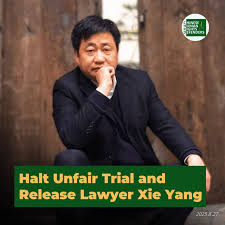
Human rights lawyer Xie Yang sentenced to five years in prison in China

March 25, 2026

A court in China sentenced the prominent human rights lawyer Xie Yang to five years in prison on March 23, 2026, on politically motivated charges of “inciting subversion of state power,” Human Rights Watch said on 24 March 2026. The Chinese government should immediately quash the conviction, which followed serious procedural violations and years of persecution, and free Xie unconditionally

The Changsha Intermediate People’s Court cited several of Xie’s WeChat posts as the basis for the verdict, Xie’s former wife, Chen Guiqiu, posted on social media. The court also ordered the confiscation of 100,000 yuan (US$14,500).

“The Chinese authorities’ prosecution of Xie Yang and the court’s harsh sentence reflects Beijing’s utter contempt for the rule of law,” said Maya Wangdeputy Asia director at Human Rights Watch. “This case not only aimed to persecute a brave human rights lawyer like Xie, but to intimidate all lawyers seeking to protect Chinese people’s rights.”

The legal proceedings against Xie were marred by serious violations of due process protections, Chen said. The authorities extended his pretrial detention 13 times for a total of over four years and barred his lawyers from participating in his hearings. Xie’s October 2025 trial was held in secret, police only told his family afterward. [see also https://humanrightsdefenders.blog/2025/02/11/joint-civil-society-statement-on-the-fifth-anniversary-of-the-xiamen-gathering-crackdown/]

Xie’s trial violated the right to a fair trial by an independent and impartial court as provided under international human rights law, Human Rights Watch said. In addition, the proceedings violated China’s Criminal Procedural Law, which guarantees a right to a defense (articles 33-35), public trial hearings (article 188), and time limits for a criminal investigation. With time served, Xie’s sentence is expected to go to January 2027.

The United Nations Working Group on Arbitrary Detention has recognized Xie’s detention as arbitrary and called for his immediate release. 

Xie, 54, from Changsha, Hunan province, began practicing law in 2011. He has defended activists and victims of rights abuses in politically sensitive cases, including cases of religious persecution and land rights disputes. 

Xie has faced repeated retaliation for his work. In July 2015, during the nationwide arrests of human rights lawyers known as the “709 crackdown,” Xie was tortured and subjected to enforced disappearance, convicted of “inciting subversion,” and imprisoned until 2017. 

The authorities detained him again in January 2022 after he pressed for the release of a young teacher who had been forcibly committed to a psychiatric facility for criticizing censorship in education. Police raided Xie’s home, tortured him in custody, and held him on charges of “inciting subversion” and “picking quarrels and provoking trouble,” said the US-based Chinese Human Rights Defenders. 

“Foreign governments should continue to speak out for human rights lawyers like Xie Yang because this kind of support is most important when the circumstances are so dire,” Wang said. “Vocal international support could improve Xie’s treatment, and crucially, help give him and others in China the strength to persevere.”

https://www.arabnews.com/node/2637445/world

https://www.hrw.org/news/2026/03/23/china-prominent-rights-lawyer-sentenced-to-5-years

NGOs condemn arbitrary arrest of pro-democracy activists in Hong Kong

May 15, 2022

NOGs (such as Human Rights Watch and the Human Rights Foundation) have condemned the arrest of Cardinal Joseph Zen, as well as the lawyer Joseph Zen, the singer Denise Ho and the scholar Hui Po-Keung, for having maintained contacts with foreign forces in Hong Kong.

HRW Senior China researcher Maya Wang, said that “the arrest of a 90-year-old cardinal is the latest example of the city’s human rights freefall in recent years.

The four, along with former lawmaker Cyd Ho, who is already in jail, were part of the 612 Humanitarian Aid Fund, which provided medical, legal and psychological help to protesters arrested during the 2019 pro-democracy protests in Hong Kong. Kong.

Denise Ho, Margaret Ng, and others affiliated with Stand News, an independent pro-democracy online publication, were previously arrested by national security police in December 2021 under allegations of publishing “seditious” and “inflammatory” materials. Denise Ho formerly served on the board of Stand News, but stepped down in November 2021. Meanwhile, the 612 Humanitarian Support Fund ceased operations in October 2021 after national security police and Chinese state-backed media requested information on its beneficiaries and donors.

Maya Wang has specified that Hong Kong has “long been a regional leader in openness and respect for the rule of law, but now competes for the first places in Asia for repression and political prisoners.”

The people of Hong Kong have been unequivocal in their demand for human rights, and governments around the world should be unequivocal in their response to that call,” concluded the HRW researcher.

https://mailchi.mp/hrf.org/hong-kong-hrf-condemns-arbitrary-arrest-of-denise-ho-and-colleagues?e=f80cec329e

China’s new foreign NGO law bound to make things worse for ‘sensitive’ human rights defenders

April 8, 2015

Maya Wang (twitter @wang_maya), a China researcher at Human Rights Watch, published on 8 April 2105 an interesting post under the title “China’s new foreign NGO law will help silence critics“.

Photo courtesy of Flickr user Willem Velthoven.

Some years back I participated in an interesting meeting with Chinese academics in Beijing about exactly this issue of the status of NGOs in China. The meeting resulted in a book ‘NGOs in China and Europe’ (exceptionally also published in Chinese!) edited by Yuwen Li and published by Ashgate in 2011 (ISBN: 978-1-4094-1959-4). Although almost all participants agreed that the current regime for establishing associations is too cumbersome and too heavy-handed for Chinese civil society to flourish, the Government made clear that its main concern remained with what Maya calls ‘sensitive’ NGOs. Those working on issue that are even faintly related to human rights or smack of possible activism, especially when funded from abroad, are seen as a danger and should be subject tot maximum control. That seems to be born out by the draft of the long-awaited ‘Foreign NGOs Administration Law’, likely to be adopted this year and of which Human Rights Watch obtained a copy.

As Maya states, it has never been easy to run an independent organisation in China. The risks of being arbitrarily shut down or harassed are high, as shown by the arrest on 8 March of five women’s rights activists and a 24 March raid on an NGO that supports their work in Beijing. But the absence of a national law governing NGOs, coupled with differences in attitudes towards NGOs by regional leaders, have afforded some leeway for those with creative strategies. It has been common for ‘sensitive’ NGOs to register as a business to bypass the wary eyes of the state, or not register at all. And over the years, some international funding to these organisations in China has been tolerated.


Especially ‘sensitive’ NGOs have been unable to access domestic funding sources because they are not legally registered as a nonprofit and anyway those who did want to fund would receive official harassment. The new Foreign NGOs Administration Law is bound to end the funding lifeline that allowed more outspoken NGOs to operate.

The draft law is likely to significantly tighten the Government’s control over civil society says Maya: “If approved, the Ministry of Public Security (not the Ministry of Civil Affairs) will now have the power to supervise and approve registration of foreign NGOs. That ‘supervision’ can entail entering the premises of the foreign NGO at any point, questioning its staff, and copying or seizing any document, all tactics more commonly reserved for a criminal investigation. Foreign NGOs will have to submit for approval annual work plans and funding allocations, and will be prohibited from engaging in a range of peaceful activities, from raising funds or accepting donations in-country to recruiting volunteers or trying to recruit members ‘directly or indirectly.’” Violations of these prescriptions mean that an NGO’s representative in China would be liable to punishments, including a 15-day detention.

“The draft law is another step towards the Chinese Government’s ‘differentiated management’ model of NGOs, in which domestic groups working on issues approved by the state, such as charities for people with disabilities, can register easily and are considered for increased state funding and support.  But those engaged on rights or lobbying are stifled. The draft explicitly prohibits activities that ‘endanger…national security, unity and solidarity’ or that ‘go against China’s social morality’. These are vague terms, but ones frequently used to silence peaceful government critics and activists.”

China’s new foreign NGO law will help silence critics.