Laila Alawa in a post on PolicyMic of 13 December puts a good question: should award givers not take care in selecting the one who hands out the award? She does not mince her words in stating that Queen Noor of Jordan was the wrong choice by the Thomson Reuters Foundation as she does not uphold the qualities that this foundation wants to reward. Read the rest of this entry »
Posts Tagged ‘Libya’
Queen Noor of Jordan not the right choice to present human rights awards
December 14, 2013Euro-Mediterranean Foundation Supporting Human Rights Defenders focus on Syria, Algeria, Tunisia and Egypt in 2012 report
October 15, 2013
Almost three years after the onset of its “Revolutions”, the Arab region continues to bear stark contrasts within its democratic track. Whereas a new era has been instigated and elections have been held in five countries Tunisia, Morocco, Egypt, Libya and Algeria, major violations of human rights persist on multiple levels and by different actors including non-governmental players. On 8 October The Euro-Mediterranean Foundation of Support to Human Rights Defenders (EMHRF) released its Annual report on 2012. Driss El Yazami, President of the EMHRF, notes that “an irreversible process is ongoing and involves emancipating countries from authoritarianism and political despotism. The Arab people have entered a new and decisive era for the future of democracy and human rights. Beyond the complexity of this transition, the initiated process is strongly influenced by the strengthened role played by human rights defenders. They are key players in overcoming new challenges and working peacefully towards the realization of a democratic and citizen-driven model for living together.”
The civil society movement continues to prove to be extremely dynamic and effective in guaranteeing respect for fundamental freedoms and preventing any appropriation of the newly acquired freedoms. Nonetheless, this movement is weakened by significant threats, shortages in human and financial resources and difficulties in joining forces. Particular attention was paid to Syria, Algeria, Tunisia and Egypt.
This report is available in Arabic, English and French.
http://www.emhrf.org/en/activityreports.php <http://www.emhrf.org/en/activityreports.php>
Human Rights Defenders from Russia, US, Libya, Chad named for Alison des Forges Award
August 29, 2013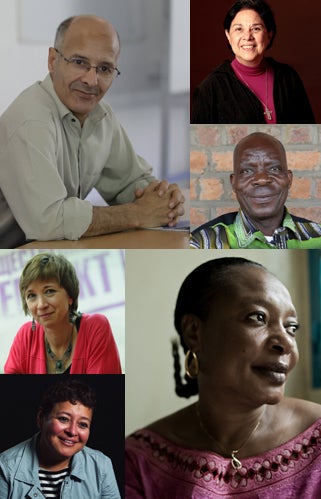
Clockwise: Hassan al-Amin, Consuelo Morales, Natalia Taubina, Jacqueline Moudeïna, Alina Diaz, and Abbé Benoît Kinalegu.
On 28 August Human Rights Watch announced the 2013 recipients of its Alison Des Forges Award for Extraordinary Activism: Read the rest of this entry »

Gaddafi Human Rights Award resurrected: Mugabe rumored to be Laureate
March 31, 2013The main aim of this blog is to follow events regarding Human Rights Defenders worldwide, but this time I have something of a ‘scoop’: in the process of doing research for an academic article on human rights awards I came across the Al-Gaddafi International Prize for Human Rights, which was thought to be defunct since 2011 with the death of the Libyan leader.
Talking to the North-South foundation in Switzerland, which has administered the 250.000$ award from 1988 to 2010, it turns out that Saif al-Islam Gaddafi, son of former leader Muammar Gaddafi, from his jail in western Libya, has decided to resurrect as from 1 April 2013 the Prize in honor of his late father under the name: Gaddafi Award for African Governance.
Disappointed with the support received from the Arab world during the uprising in Libya last year, the resurrected award wants to focus on Africa. The rumor is that the first winner – supposed to be announced only tomorrow! – is rather surprisingly President Robert Mugabe of Zimbabwe. When asked whether this would not lead the award to be seen as encouraging ‘bad governance’, the spokesman for the Foundation, T. (Thomas) Yran, refused to comment on Mugabe being the first winner, but said that the new award wanted to clearly distinguish itself from the Mo Ibrahim Prize for Achievement in African Leadership (http://www.moibrahimfoundation.org) which rewards mostly “lackeys of the capitalist system” and anyway has not been given out for 3 years.

(Photo credit: Wikipedia)
Visual Journalism for Human Rights: the Tim Hetherington award
December 12, 2012
(Photo credit: Wikipedia)
The photojournalist Fernando Moreles has been awarded the second Tim Hetherington Grant, an annual visual journalism award focusing on human rights, Human Rights Watch and World Press Photo announced 0n 11 December 2012. Human Rights Watch and World Press Photo established the grant to honor the legacy of Hetherington, a photojournalist and filmmaker who was killed during fighting in Libya in April 2011. The €20,000 grant was given to Moleres for his project “Waiting for an Opportunity,” in which he is documenting the harsh realities of juvenile justice in Sierra Leone. For more than two decades Moleres, who was born and lives in Spain, has been committed to documenting the plight of the most vulnerable populations and covering issues relating to children and labor, juvenile justice, and refugees. “Fernando Moleres’ moral and emotional commitment to his photographic subjects is clear,” said Carroll Bogert, deputy executive director at Human Rights Watch. “Tim Hetherington would have loved this work and Human Rights Watch is thrilled to support it.”
Related articles:
Fernando Moleres Wins Tim Hetherington Grant (hrw.org)
Tim Hetherington, 1970-2011 (edendale.typepad.com)
Human Rights Watch honors HRDs from Congo, Libya
August 14, 2012(Photo credit: Wikipedia)
Two courageous and tireless advocates for human rights have been selected as recipients of the prestigious Alison Des Forges Award for Extraordinary Activism. Abbé Benoît Kinalegu from the Democratic Republic of Congo and Salah Marghani from Libya are leading voices for justice in their countries, working relentlessly to protect the rights and dignity of others. They will join four other international recipients of the award as they are honored at the Human Rights Watch Voices for Justice Annual Dinners in 15 cities worldwide in November 2012.
The award is named for Dr. Alison Des Forges, senior adviser to Human Rights Watch’s Africa division for almost two decades, who died in a plane crash in New York on February 12, 2009. Des Forges was the world’s leading expert on Rwanda, the 1994 genocide, and its aftermath. Human Rights Watch’s annual award honors her outstanding commitment to, and defense of, human rights. It celebrates the valor of people who put their lives on the line to create a world free from abuse, discrimination, and oppression.
“These human rights defenders have spoken out and helped people who needed protection in some of the most dangerous and difficult situations in the world,” said Kenneth Roth, executive director of Human Rights Watch. “They show that courage and persistence can make a difference even during periods of conflict and violent transition.”
The recipients of Human Rights Watch’s 2012 Alison Des Forges Award for Extraordinary Activism are:
- Abbé Benoît Kinalegu, a Congolese priest and director of the Dungu-Doruma Diocesan Commission for Justice and Peace, who exposes abuses committed by the rebel Lord’s Resistance Army and works to rehabilitate its victims; and
- Salah Marghani, a Libyan human rights activist and lawyer, who has worked to reveal the truth about human rights atrocities under Muammar Gaddafi and abuses still happening.
Recipients of the 2011 award, who will also be touring North America and Europe this year, are:
- Sihem Bensedrine, a Tunisian journalist and activist who heads the Arab Working Group for Media Monitoring and serves as a spokesperson for the National Council for Liberties in Tunisia, traveling to Amsterdam and Geneva;
- Anis Hidayah, executive director of Migrant Care, a leading Indonesian organization working to protect the rights of millions of migrant workers, traveling to Oslo and Zurich;
- Farai Maguwu, director of the Center for Research and Development in eastern Zimbabwe and a leading voice against the abuses taking place in the Marange diamond fields, traveling to London, Munich, and Paris; and
- Consuelo Morales, director of Citizens in Support of Human Rights, based in Monterrey, which brings abuses in Mexico’s “war on drugs” to light, traveling to Chicago, New York and Toronto.
Human Rights Watch staff members work closely with the human rights defenders as part of the organization’s research into some 90 countries around the world. The defenders will be honored at the 2012 Voices for Justice Human Rights Watch Annual Dinners in Amsterdam, Beirut, Chicago, Geneva, London, Los Angeles, Munich, New York, Oslo, Paris, San Francisco, Santa Barbara, Silicon Valley, Toronto, and Zurich.
Awards for Rights Activists from Congo, Libya | Human Rights Watch.
Libya: emerging movement of Human Rights Defenders faces huge challenges and needs support with understanding
November 22, 2011Lutz Oette, from the NGO ‘REDRESS’, published on 22 November 2011 an interesting analysis in openDemocracy, in which he describes the enormous challenges faced by the small number of human rights lawyers in Libya.
Emerging from an enforced time warp, the Libyan population is today confronted with the wreckage of a regime that was based on a barely comprehensible ideology, repression and sheer force. The recent atrocities are a particularly grim episode in a long history etched into the collective memory of Libyans over the last forty-two years. With the focus in the west on Gaddafi’s image as terrorist or madman, or both, there has been little sense or understanding of what life has been like in Libya in all these years. In Libya itself, individuals and groups are now beginning to talk openly about their experiences. This entails having to come to terms with the multiple sufferings and deprivations endured. It also means grappling with the more fundamental question of what these have done to the political and social fabric of the country.
Libya, both its current government and society at large, is at an important crossroads where the past, present and future interlink: how it provides justice for past violations and how it respects the rights of those who currently find themselves on the wrong side will be crucial for the broader task of rebuilding a system in which human rights are better protected. Many Libyans are keenly aware of the importance of getting this process right. From the moment it became possible, several initiatives sprang up in Benghazi, Misrata, Tripoli and elsewhere to document human rights crimes and to develop local justice initiatives. There are also official committees tasked with monitoring detention conditions and human rights.
Organizations such as Lawyers for Justice in Libya (LFJL) are helping build a network of human rights defenders. Their commitment was evident during a recent meeting in which LFJL brought together lawyers from across the country. Many of these lawyers – several of whom have personally suffered torture – have maintained a genuine belief in the rule of law. Little attention has been paid to their important work on the ground. For all the inevitable shortcomings of a nascent human rights movement, it provides the much needed impetus to rebuild a credible legal system.
For now, the lawyers involved are looking for ways of how best to work together to deal with the many pressing problems, not least what to do with members of their own profession who failed to live up to expected standards under the previous regime. This raises vexed questions both about the responsibility of judges, prosecutors and others, and due process for those accused of wrongdoing. These efforts are but one part of the precious process taking place today in which Libyans are seeking to reclaim their society. It is already clear that this process will neither necessarily be smooth nor take place in isolation. There is a need for outside expertise and capacity building, including in questions of human rights protection. Indeed, many Libyans may welcome such an engagement. However, the involvement of international actors is a double-edged sword if experiences in other countries in conflict or post-conflict situations are anything to go by. It is too early to tell how the current transition in Libya will pan out. International actors have an important role sharing experiences and seeking to uphold international standards. However, it is equally critical that they tread carefully when engaging in Libya, particularly in an area as painful and sensitive as human rights.
In my view the author quite rightly points out that international institutions, such as the United Nations or the International Criminal Court, NGOs and donors will undoubtedly take a keen interest in questions of human rights and justice in Libya. …” Yet it is important that they give the fledgling Libyan human rights movement and civil society the space and time needed to develop and to address the issues facing them. There is a risk that international actors – even if only unwittingly – import their own priorities and change the local dynamics. The potential pitfalls are many, such as conflicting objectives, taking an approach that does not reflect the primary concerns of local actors at the time, introducing an element of ‘human rights’ bureaucracy or business, or undermining local networks through recruitment policies.”
This is very much in line with my views on NGOs in transition countries as published in the book and China and NGOs, “The international human rights movement: not perfect, but a lot better than many governments think” Ashgate, ISBN: 978-1-4094-1959-4: “Repression is, in some ways, the binding and mobilising element in a weak civil society. Afterwards, the challenge becomes to find common ground that is based more solidly on human rights philosophy and has a forward-looking element [….] International NGOs – especially those with links to a variety of domestic NGOs – may be helpful in building consensus. What is also subsequently required from NGOs is constructive participation in debating, designing and implementing a host of new regulations, processes and mechanisms, including those relating to democratic governance and the ratification of international human rights standards. International NGOs can bring expertise, funding and pressure, but have to take care that they do not overwhelm the local NGOs.[….] The creation of democratic governance institutions also requires a human rights ‘culture’. Many people in transition countries will not fully understand the human rights discourse.[ ….The] domestic NGOs are often small and weak in the early phases of transition and international NGOs can help with quick access to relevant information, sharing experiences, staff training, visibility and access to donors. However, again, the risk is that this privileges certain NGOs relative to their national counterparts and the ‘foreign’ resources may hamper the feeling of ownership.”
After a history of false hopes and lost opportunities, it is now crucial to support Libyans who take a lead in discussing how best to respond to violations and develop a system that stands the test of time for the right reasons. For the full text see:
Libyan lawyers and human rights: a nascent movement facing a challenge | openDemocracy.
 Hans Thoolen on Human Rights Defenders and their awards