Posts Tagged ‘Iran’

2012 Sacharov award to Iranian HRDs

October 26, 2012

Nasrin Sotoudeh and Jafar Panahi – winners of ...

Nasrin Sotoudeh and Jafar Panahi (Photo credit: European Parliament)

Two Iranian activists, lawyer Nasrin Sotoudeh and film director Jafar Panahi, are this year’s joint winners of the European Parliament Sakharov Prize for Freedom of Thought. They were chosen by President Schulz and political group leaders on Friday morning.

“The award of the Sakharov Prize for Freedom of Thought to the Iranians Nasrin Sotoudeh and Jafar Panahi is a message of solidarity and recognition to a woman and a man who have not been bowed by fear and intimidation and who have decided to put the fate of their country before their own. I sincerely hope they will be able to come in person to Strasbourg to the European Parliament to collect their prize in December”, said President Schulz, announcing the winner after the meeting. He underlined that the unanimity this year was exceptional.

Nasrin Sotoudeh

Nasrin Sotoudeh, born in 1963, is an Iranian lawyer and human rights advocate. She has represented opposition activists imprisoned following Iran’s disputed June 2009 presidential elections, juveniles facing the death penalty, women and prisoners of conscience. She was arrested in September 2010 on charges of spreading propaganda and conspiring to harm state security and has been held in solitary confinement. She was one the 3 nominees of the Martin Ennals Award 2012. Sotoudeh has two children. She recently started a hunger strike in protest against the state’s harassment of her family.

Jafar Panahi

Jafar Panahi, born in 1960, is an Iranian film director, screenwriter and film editor. He first achieved international recognition with his film The White Balloon that won the Caméra d’Or at the 1995 Cannes Film Festival. His films often focus on the hardships faced by children, the impoverished and women in Iran. Mr Panahi was arrested in March 2010 and later sentenced to six years in jail and a 20-year ban on directing any movies or leaving the country. His latest film “This Is Not a Film” was smuggled from Iran to the 2011 Cannes Film Festival on a USB stick hidden inside a cake.

(The two other finalists were Ales Bialiatski and Pussy Riot)

There Are Absolutely No Political Executions in Iran ………..

October 23, 2012

In this excellent blog post, R0ya Boroumand shows the statement by Sadeq Larijani – Head of the Judiciary and Iran official spokesperson on human rights – to be nonsense. Even more she reflects how the death of her own father (stabbed to death in Paris in 1991) has motivated her to continue documenting human rights violations in Iran. And she draws the conclusion that it must have helped:

Perhaps Larijani’s denial of political executions is not meant for the Iranian people or the human rights community, but rather for a poorly informed and supportive constituency outside Iran that is too willing to accept the Islamic Republic’s habit of blaming others for its shortcomings. But we should appreciate Larijani’s unease, even if it is expressed in the form of a blatant lie. The fact that the number of reported executions in Iran has been trending downward — from 817 in 2010 and 652 in 2011 to 385 so far in 2012 — may well have to do with the active presence and reporting of the UN special rapporteurs and others who are focused on safeguarding human rights.

Through my work toward documenting the stories of all the Islamic Republic’s victims, I have found the best answers I can to the questions that obsessed in 1991. I have also found some relief from the consuming anguish and frustration that decades of untold stories and anonymous suffering by thousands of victims and victims’ loved ones have brought in their train.

The painstaking task of documenting thousands of executions to which my colleagues and I have devoted our lives for the past ten years, added to the efforts of other human rights organizations, has helped to protect people who dare to speak up. Perhaps, and in spite of the limited means at our disposal, we have made the regime worry that if it kills them they will not be forgotten, and so stayed the executioner’s hand. Larijani’s absurd claim that “there are absolutely no political executions in Iran” did not make me smile, but it did reinforce my conviction that truth telling is the most effective tool we have to make tyrants uneasy and slower to unleash their violence.”

Roya Boroumand: There Are Absolutely No Political Executions in Iran — A Statement by the Head of Irans Judiciary That Should Not Go Unnoticed.

Punitive measures imposed on detained human rights defender Nasrin Sotoudeh

October 21, 2012
Paris-Geneva, October 19, 2012. The Observatory for the Protection of Human Rights Defenders, a joint programme of the International Federation for Human Rights (FIDH) and the World Organisation Against Torture (OMCT), strongly condemns the harassment faced by Ms. Nasrin Sotoudeh and, more generally, denounces the policy of subjecting jailed human rights defenders to punitive measures in prison.
Since her arbitrary arrest and detention in September 2010, Ms. Nasrin Sotoudeh, a human rights lawyer known for defending juveniles facing death penalty, prisoners of conscience, human rights activists and children victims of abuse and a member of the Defenders of Human Rights Centre (DHRC), who is serving a six-year imprisonment sentence in Evin prison, has been subjected to increasingly restrictive and clearly discriminative and arbitrary conditions of detention.Mrs Sotoudeh was recently honored as the MEA 2012 nominee (see http://www.martinennalsaward.org for a short film on her work).
In recent weeks, Ms. Sotoudeh’s visiting day has been changed from Sunday to Wednesday without any legitimate ground being provided by the prison authorities. In addition to being deprived of face-to-face family visits, the new measure, which contravenes the prison’s rules, has made it more and more difficult for her to receive visits from her family over the past three months. It is also to be recalled that Ms. Sotoudeh has been banned from making phone calls since May 2011.
The Observatory recalls that punitive measures against Ms. Sotoudeh are not new. Previously, Ms. Sotoudeh had been held for long periods in solitary confinement and denied contact with her family and lawyer. She also reportedly suffered acts of torture in prison in order to force her to confess. On July 11, the authorities banned her husband and her 12-year-old daughter from travelling abroad. This case has now been referred to the Islamic Revolution Court (Branch 28), which has summoned them to appear.
To protest against these measures which violate her right to receive unhindered visits by her family, Ms. Sotoudeh started an unlimited hunger strike on October 17, raising further concerns for her physical integrity. It should be recalled that she had already come close to death in 2010 after three dry hunger strikes to protest her conditions of detention and violations of due process during her trial.
“The conditions of detention imposed on Nasrin Sotoudeh are unacceptable and clearly aim at imposing additional punishment on her for her human rights activities”, declared Souhayr Belhassen, FIDH President.
“The punitive measures against Ms. Sotoudeh while in detention once more illustrate the relentless policy of the Iranian authorities to stifle human rights defenders, which should be strongly condemned by the whole international community”, added Gerald Staberock, OMCT Secretary General.
The Observatory firmly denounces the policy of harassment against Ms. Nasrin Sotoudeh, through arbitrary detention, judicial harassment and punitive measures in prison, which only aims at sanctioning her legitimate human rights activities. It also urges the Iranian authorities to immediately and unconditionally release her as well all other imprisoned human rights defenders, and more generally to conform to the United Nations Declaration on Human Rights Defenders, the Universal Declaration of Human Rights and international human rights instruments ratified by Iran.
For further information, please contact:
• FIDH: Arthur Manet / Audrey Couprie: + 33 1 43 55 25 18
• OMCT: Delphine Reculeau : + 41 22 809 49 39


Punitive measures imposed on detained human rights defender must cease : humanrights-ir.org.

Amir, author of Zahras Paradise, talks about his album on YouTube

October 11, 2012

This dates back to March 2012. I missed it and so may have you. It is a excellent interview by Iran specialist Drewery Dyke of of AI with the author Amir. He is an Iranian-American human rights activist, journalist and documentary filmmaker.

Set in the aftermath of Iran’s fraudulent elections of 2009, Zahra’s Paradise is the fictional story of the search for Mehdi, a young protestor who has disappeared in the Islamic Republic’s gulags. Mehdi has vanished in an extrajudicial twilight zone where habeas corpus is suspended. What stops his memory from being obliterated is not the law. It is the grit and guts of a mother who refuses to surrender her son to fate and the tenacity of a brother—a blogger—who fuses culture and technology to explore and explode absence: the void in which Mehdi has vanished.

In conversation with Amir, author of Zahras Paradise – YouTube.

Abdolfattah Soltani awarded IBA Human Rights Award Lawyers for Lawyers

October 10, 2012

Iranian lawyer and human rights defender Abdolfattah Soltani recevied on 5 October the 2012International Bar AssociationHuman Rights Award. The announcement came during the International Bar Association (IBA) Annual Conference taking place in Dublin, Ireland.

Mr Soltani, who co-founded the Defenders of Human Rights Centre (DHRC) with Nobel Peace Prize winner Ms Shirin Ebadi, has worked courageously and determinedly throughout his career to provide pro bono legal counsel to those in need.

As a result of his human rights defence work, Mr Soltani has endured persistent persecution from the Iranian government and has been imprisoned on several occasions. He is currently serving a 13-year prison sentence in Iran that stems from a number of charges including co-founding the DHRC, spreading anti-government propaganda and endangering national security. The imprisonment began on 4 March 2012.

Among Mr Soltani’s high profile cases are:

  • Nasrin Soutoudeh, a journalist and human rights lawyer; 2012 nominee of the MEA
  • Akbar Ghanji a human rights activist, who exposed the involvement of several government officials in the murder of intellectuals and journalists in the 1990s; MEA Laureate of 2006 and
  • Zahra Kazemi, a Canadian-Iranian journalist arrested for taking photographs in front of Evin prison in July 2003. Ms Kazemi died in the same prison several days later.

In addition, Mr Soltani has defended teachers, protesters, other fellow human rights lawyers, political activists, students, and several Baha’I (Iranian minority group) leaders. In many instances other lawyers refused to take on these cases because of the risks involved.


Iran Abdolfattah Soltani awarded with IBA Human Rights Award Lawyers for Lawyers.

Ceremony of the Martin Ennals Award to follow on the internet (2 October, 18h00)

September 27, 2012

Every day all over the world, unsung heroes are risking their lives to call attention to injustice and to fight for human rights. On Tuesday October 2nd, one of them will honored with the Martin Ennals Award. The Martin Ennals Award  is chosen by a Jury of ten leading Human Rights organizations including: Amnesty International, Human Rights Watch, Human Rights First and others (see www.martinennalsaward.org). Thus, this prize represents the expression of the whole Human Rights movement.

The winner will be selected from three nominees, who personalize wider issues in their home countries and allow these issues to be represented through individual cases:

  1. Venerable Sovath Luon: sometimes referred to as the “Multimedia Monk”. He challenges the widespread eviction of poor people from land they have long held but without title, often due to the destruction of records during the Khmer Rouge period.
  2. Nasrin Sotoudeh, an Iranian Lawyer serving a 6 year prison sentence in Iran for “… the offences of “acting against the national security”, “propaganda against the regime” and “membership of Human Rights Defenders Centre” – an organisation presided over by the Nobel peace laureate Shirin Ebadi.
  3. Bahrain Center for Human Rights: Currently high on the world media agenda. Two of the main founders: Abdulhadi al-Khawaja and Nabeel Rajab are serving jail sentences. Zainab al-Khawaja was arrested for demonstrating against the government, while other members are regularly arrested and abused.

The ceremony is hosted by the City of Geneva in Victoria Hall. Short films commissioned by the Martin Ennals Foundation. Those who cannot attend in person may want to follow it on the internet (www.martinennalsaward.org) starting at 18h00 Geneva time.

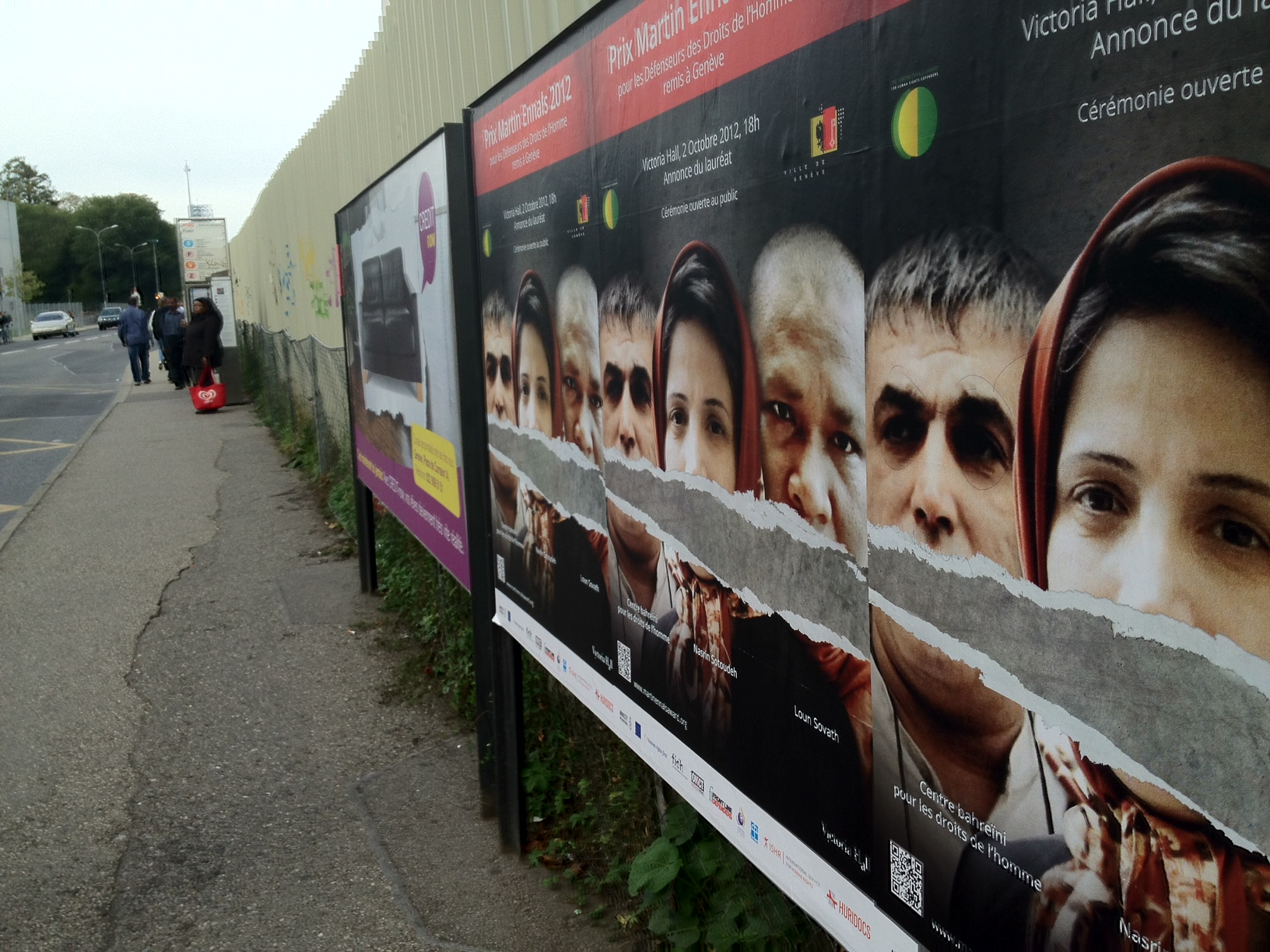
Posters MEA ceremony up in Geneva

September 18, 2012

courtesy Nat Daudrich

Thanks to the partnership with the City of Geneva hundreds of posters are lining the streets of Geneva in anticipation of the ceremony of the Martin Ennals Award for Human Rights Defenders (MEA) on 2 October in the splendid Victoria Hall. The laureate will be announced that evening but all three nominees will be honored and films on their work shown. The nominees are: Luon Sovath (Cambodia), Nasrin Sotoudeh (Iran) and the Bahrain Centre for Human Rights.

UN Secretary General says the right thing in Tehran

September 4, 2012
Ban Ki-moon

Ban Ki-moon (Photo credit: Wikipedia)

On Thursday 30 August, the UN Secretary General, Ban Ki-moon, who was in Tehran for the Non-Aligned Movement called on Iran to release its political prisoners and human rights defenders. This rather exceptional appeal to release “opposition leaders, human rights defenders, journalists and social activists,” was made in a speech to an Iranian diplomatic college last Thursday.  Ban stressed that allowing the Iranian people’s voice to be heard was especially important ahead of the country’s 2013 presidential election, when a successor to President Mahmoud Ahmadinejad is to be chosen. “Restricting freedom of expression and suppressing social activism will only set back development and plant the seeds of instability,” he added.  His comments went without official response from Tehran.

Iran should Immediately release imprisoned Human Rights Defenders

June 19, 2012

Several human rights organizations, including AI, called on Iranian authorities to immediately and unconditionally release Abdolfattaf Soltani, a prominent lawyer and founding member of the Center for Human Rights Defenders (CHRD), an organization co-founded by Nobel Peace Prize laureate Shirin Ebadi

Abdolfattah Soltani was originally sentenced by Branch 28 of the Revolutionary Court to 18 years’ imprisonment to be served in the remote city of Borazjan, some 620 miles south-west of Tehran, which will make it hard for his family to visit him. Soltani was also banned from practicing law for 20 years.

His lawyer and family were informed of the initial sentence March 4. On June 4, his family was informed that Branch 54 of the Appeal Court of Tehran had reduced his sentence to 13 years’ imprisonment and overturned the ban on practicing law for 20 years; the court confirmed that his imprisonment sentence is to be served in the city of Borazjan.

Arrested on September 10, 2011 on charges including “spreading propaganda against the system,” “setting up an illegal opposition group [the CHRD],” and “gathering and colluding with intent to harm national security,” Soltani also faced charges of “accepting an illegal prize and illegal earnings” relating to his acceptance of the Nuremberg International Human Rights Award in 2009.

On at least two occasions since his imprisonment, Soltani was pressured to “confess” on camera, including “confessing” that the center had received funding from foreign sources to encourage a “soft revolution” in Iran – which Soltani denies.

Since the CHRD was forcibly closed in December 2008, Iranian authorities carried out a campaign of prosecution and harsh sentencing against anyone with actual or perceived links to the center. Its members have continued to carry out their work in support of human rights but have faced repeated harassment, intimidation, arrest and imprisonment. Several are currently serving prison sentences in Tehran’s Evin Prison, including Narges Mohammadi  (six-year sentence),  Mohammad Seyfzadeh (a two-year prison sentence), Mohammad Ali Dadkhah (nine years’ imprisonment – currently at liberty, though he may be called to serve his sentence at any time) and MEA 2012 nominee Nasrin Sotoudeh (6-year jail term).

Iran: Immediately Release Imprisoned Human Rights Defenders | Amnesty International USA.

Mohammad Ali Dadkhah sentenced to nine years in jail: Iran does it again!

May 3, 2012

And the virtual ink on my previous post is hardly dry and I come across the case of Mohammed Ali Dadkhah, just but not justly sentenced to 9 year prison. Iran can hardly be surprised that it leads the table of HRDS honored in the context of the Martin Ennals Award for Human Rights Defenders.

A prominent lawyer who worked on the case of a Christian pastor on death row in Iran for apostasy, which made headlines around the world, Dadkhah has been sentenced to nine years in jail. “I have been convicted of acting against the national security, spreading propaganda against the regime and keeping banned books at home,” he said. Iranian authorities have used such vague charges in recent years to incriminate activists and lawyers in recent years. He had also been banned from teaching at universities or practicing law for an extra 10 years.

Dadkhah has represented several political and human rights activists jailed in the aftermath of the country’s 2009 disputed elections. He has also been the lawyer of the 32-year-old Yusuf Naderkhani, whose sentencing to death for apostasy triggered an international outcry.

Other prominent Iranian lawyers have also been sentenced to lengthy prison terms such as Abdolfattah SoltaniNasrin Sotoudeh and recently Narges Mohammadi. Like them, Dadkhah worked for the DHRC of Iranian Nobel Peace laureate Shirin Ebadi who fled the country in 2009.

The Observatory for the Protection of Human Rights Defenders, a joint programme of the International Federation for Human Rights (FIDH) and the World Organisation Against Torture (OMCT) on Thursday condemned the sentencing of Dadkhah as well as the systematic harassment by the state against the DHRC members.

“We fear that the harassment against DHRC and attempts to silence its members will continue exponentially”, says Souhayr Belhassen, the FIDH President.

“The authorities in Iran are doing their utmost to stifle human rights defenders by imposing heavy sentences of imprisonment, exile, and ban on professional practice. All this is aimed at intimidating the whole society into a deadly silence”, adds secretary general of the OMCT, Gerald Staberock.

Iranian lawyer Mohammad Ali Dadkhah sentenced to nine years in jail | World news | guardian.co.uk.