ISHR is launching two new interactive tools to strengthen diplomatic initiatives to support human rights defenders.
one tool designed for diplomats and
the other for defenders;
The resources provide practical guidance on how to enhance diplomatic support for defenders to prevent risks, respond to threats and better protect those working to promote and defend human rights. The tools will be available in English, French and Spanish.
Human rights defenders (HRDs) play a vital role in promoting accountability and advancing justice. Yet defenders around the world increasingly face harassment, criminalisation, surveillance, detention and reprisals because of their work. Diplomatic missions can play an important role in the overall protection strategy for defenders, including by addressing risks, monitoring cases, engaging authorities, or providing emergency support when defenders face serious threats. Some countries or region have adopted specific ‘Diplomatic Guidelines’ on the protection of human rights defenders (HRDs), including Switzerland, Canada, the European Union, Norway, Finland, and the UK.
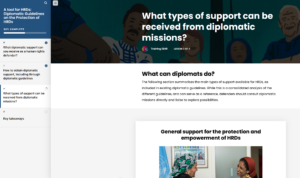
To help strengthen the effective use of diplomatic protection measures, ISHR has developed two new interactive tools aimed at two complementary audiences: diplomats and human rights defenders themselves.
The first tool provides practical guidance for diplomatic and permanent missions on how to better provide quality, consistent and targeted support and protection to defenders including through the implementation of existing ‘diplomatic guidelines’ (40 minutes to complete). It outlines key principles for diplomatic engagement, including applying a “do no harm” approach, consulting closely with defenders, and adopting flexible and context-specific responses. It also highlights forms of diplomatic support, from regular engagement with defenders to trial observation, public advocacy, and emergency measures such as facilitating visas or temporary relocation.
The second tool is designed for human rights defenders and civil society organisations (20 minutes to complete). It is intended to help defenders better leverage diplomatic support by developing understanding of diplomatic guidelines, how they work, and what defenders should consider to safely engage with embassies and diplomatic missions. It also outlines the types of support that may be available, from meetings with diplomats and public advocacy to targeted or emergency assistance in situations of risk.
The content is grounded in the needs and lived experiences of HRDs, as documented by ISHR and other international organisations, and is informed by international human rights norms and standards. It draws in particular from the UN Declaration on Human Rights Defenders and its recent supplement, the Declaration+25.
By enhancing understanding of diplomatic initiatives and making them more accessible, ISHR aims to strengthen collaboration between diplomats and defenders and help ensure that defenders can continue their essential work in safer conditions. We also hope these tools may serve to catalyse action by States that have not yet adopted specific diplomatic guidelines.
The two interactive tools are available on the ISHR Academy in English, French and Spanish.
If you want more information or provide feedback on those initiatives, please contact us at: training@ishr.ch
On 29 October, 2025 Amnesty International came with a report: “Closing the door – How Europe’s Schengen area visa policies fail human rights defenders“. International travel is crucial for human rights defenders (HRDs), and the Schengen area is a key destination, offering many opportunities for human rights advocacy, networking, learning, and for temporary respite for those facing threats and burnout. The importance of mobility for HRDs has been recognized by EU institutions and Schengen states. However, gaps remain between commitments and practice.
HRDs who are nationals of the 104 visa-restricted countries and who are in their vast majority racialized as Black, Asian and/or Muslim, continue to encounter huge barriers in obtaining a visa.
The report brings together real-life cases showing the impact of these obstacles on racialized HRDs, including many examples of visa denials because HRDs were not believed for the purpose of their travel. These experiences occur within a broader context of systemic racism, a legacy of colonial practices that shape visa policies and practices to this day. The report calls on authorities to ensure the full implementation of existing flexible arrangements for HRDs applying for visas, to develop a new visa procedure specifically designed to facilitate the process for HRDs, and to eliminate and prevent racial discrimination in the context of visa policies and processes.
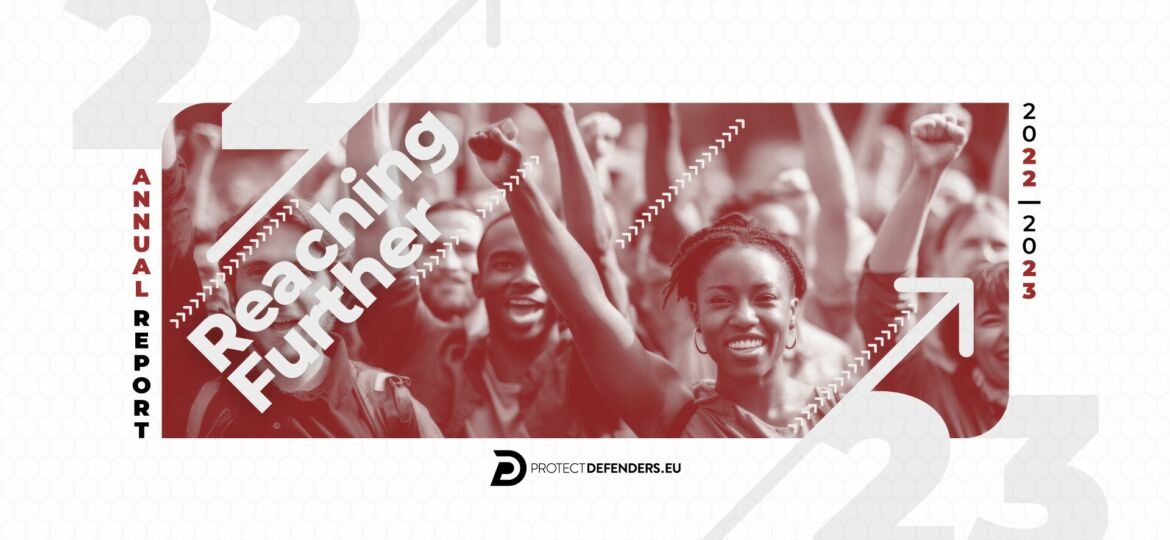
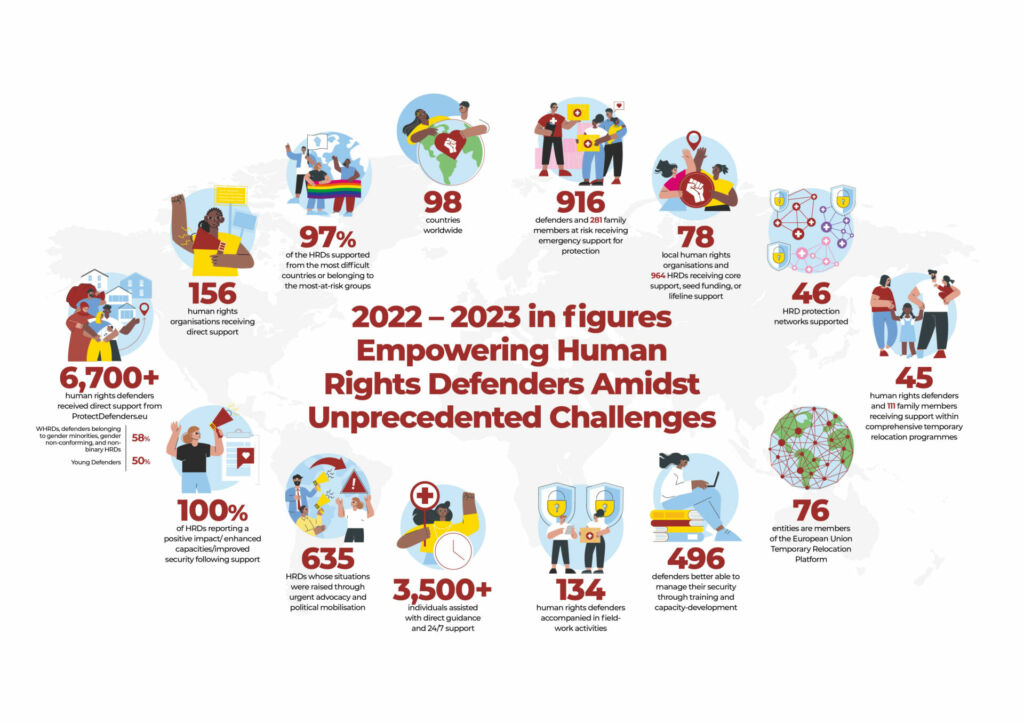
On 25 April 2024, ProtectDefenders.eu, the European Union (EU) Human Rights Defenders Mechanism, presented its comprehensive annual report entitled “REACHING FURTHER,” covering the period November 2022 – October 2023. This report illustrates the support provided and efforts made by ProtectDefenders.eu to support human rights defenders (HRDs) around the world, and especially to reach those who are the most at risk.
In November 2022, ProtectDefenders.eu entered the third phase of its implementation, marking a milestone in its commitment to safeguarding human rights defenders worldwide. Throughout the first year of this new phase, the renewed and consolidated EU HRD Mechanism has provided direct protection, support, and empowerment to over 6,700 at-risk HRDs, with a particular focus on those facing the highest risks. Notably, 50% of beneficiaries were young defenders, and 58% identified as women human rights defenders (WHRDs), trans-male, trans-female, genderqueer, or gender non-conforming individuals.
Despite facing extraordinary challenges amidst protracted crises globally, ProtectDefenders.eu has demonstrated remarkable effectiveness, efficiency, and adaptability in addressing the pressing needs of HRDs. The mechanism has extended support not only to individual defenders but also to their families, communities, and organizations. This comprehensive support, including financial aid, technical assistance, and guidance, has been delivered through collaboration among consortium partners, showcasing flexibility, creativity, and responsiveness in the face of evolving challenges.
ProtectDefenders.eu has actively responded to increased requests for protection support amid protracted crises in various regions, including Belarus, Myanmar, Afghanistan, Nicaragua, Sudan, Tanzania, and beyond. Emergency protection measures have been consistently provided, alongside investments in the capacity and resilience of human rights organisations and communities. The international temporary relocation system supported by ProtectDefenders.eu, including through the Shelter Initiatives program, further exemplifies the mechanism’s commitment to HRD safety.
Through reactive and preventative advocacy efforts, ProtectDefenders.eu has achieved multiple successes globally, pioneering a collective advocacy approach on shared concerns such as international funding for HRDs and EU visas. The enhanced coordination among consortium partners has facilitated continuous improvements and innovation, addressing challenges faced by HRDs and organizations at risk more effectively.
Moreover, significant progress has been made in enhancing outreach efforts to new groups, including young defenders and those with disabilities. Increased collaboration with local actors, context-specific support, and prioritized coordination have extended the impact of ProtectDefenders.eu widely, with 93% of supported organizations not affiliated with consortium partners.
Looking ahead, ProtectDefenders.eu will remain particularly committed to fulfilling its protection mandate by addressing comprehensively the unique vulnerabilities and barriers faced by HRDs with disabilities. The EU HRD mechanism will actively engage in finding innovative solutions to ensure their protection, inclusion, and access to resources.
On 31 January 2024 several NGOs – including HRW and AI -came out in support of a bill in the US Senate. Senator Ben Cardin introduced the Human Rights Defenders Protection Act of 2024, which aims to protect individuals abroad “who face reprisals for defending human rights and democracy.” The law, if enacted, would strengthen the US government’s ability to “prevent, mitigate, and respond” to such cases.
Senator Cardin said this legislation “will help elevate, guide, and enhance US efforts to support these courageous individuals globally at a time when their efforts are more important than ever.”
HRW said: The bill would integrate support for rights defenders into various US policies and programs and encourage engagement with the private sector. It aims to improve assistance for rights defenders living in exile from their home countries and strengthen US tools to hold perpetrators of rights abuses accountable.Human Rights Watch has long documented the risks, threats, and attacks that rights defenders across the globe face. In Rwanda, for example, the government for many years has targeted with impunity rights defenders at home and extended its repression beyond its borders to silence Rwandan critics living abroad. Last December, the Emirati government brought new charges under its counterterrorism law against 87 activists and dissidents, including imprisoned rights defender Ahmed Mansoor.
The proposed legislation would create a new US visa for rights defenders who face a “credible fear of an urgent threat,” allowing those who qualify to reach safety before they are detained or harmed. It would also increase the number of US government personnel dedicated to democracy and human rights issues in the federal government and at embassies in countries with a high risk of rights abuses.
Andrew Fandino, Advocacy Director for the Individuals at Risk Program at Amnesty International USA. stated: “The Human Rights Defenders Protection Act of 2024 is a critical piece of legislation that will help strengthen and improve the U.S. government’s ability to support human rights defenders around the world,” ..“With over 401 human rights defenders killed globally in 2022 alone, now more than ever, human rights defenders need this additional support and protection.”
If passed, the legislation would require the US government to establish a “Global Strategy for Human Rights Defenders.” The strategy would survey current tools and resources to support human rights, identify how the government would prioritize and bolster protections for rights defenders, and establish specific goals for implementing the legislation’s policy objectives. This would link to the existing EU Guidelines on Human Rights Defenders (2008), and the OSCE Guidelines on the Protection of Human Rights Defenders (2014) and those of a small group of European countries.
An initiative of ProtectDefenders.eu, the EU Human Rights Defenders Mechanism implemented by international civil society
Human rights defenders have the right to carry out their legitimate work safely and to access support and protection when they are at risk, especially those who operate in the most difficult contexts. Their right to defend rights has been systematically enshrined by the European Union in its political guidelines, and statements, as well as in its financial programming and external actions. In fact, the European Union is a leading actor in the promotion and protection of human rights in the world and it is regarded by the human rights defenders’ community as an invaluable source of empowerment and legitimacy. [see the call of 2022:https://humanrightsdefenders.blog/2022/09/24/call-for-an-eu-visa-framework-for-at-risk-human-rights-defenders/]
Human rights defenders often carry out their work at great personal risk, and increasingly face killings, attacks, threats, and acts of intimidation because of their peaceful activities, in addition to being subjected to repression, restrictive legislation, and judicial harassment. For these at-risk human rights defenders, the possibility of accessing a visa to a European territory emerges as an essential security and protection tool, which empowers them to carry out their activities in their countries in a more secure and protected way. Visas and multiple-entry visas are widely regarded by the international human rights defenders community as a vital element of a comprehensive security strategy, one that enables defenders to consider the possibility to move in and out of their country in a way that allows them to manage the level of risk that they face as a result of their work, and to continue to work in their communities without forcing them to resort to permanent asylum paths when facing aggravated threats. However, despite political commitments and existing guidelines, the EU and its member states’ stated support for human rights defenders is not consistent with the current EU visa policies and practices, as human rights defenders at risk around the world lack consistent procedures to effectively and predictably access visas for the EU territory.
The community in support of human rights defenders, including the Consortium of organisations implementing the European Union Human Rights Defenders mechanism ProtectDefenders.eu,have systematically noted and documented with great concern the numerous, diverse, and blatant obstacles for defenders to access EU visas. ProtectDefenders.eu – which has supported 45,000+ human rights defenders and civil society organisations to continue their work in the most difficult situations since 2015 – encounters these obstacles also in relation to its daily operations delivering EU-funded programmes of practical support for human rights defenders. Every day, human rights defenders face an array of impediments that hinder their access to this essential security and protection tool, preventing them from accessing safe haven when necessary, as well as from engaging in existing opportunities for rest and respite and temporary relocation programmes, or carrying out essential international advocacy, mobilisation, or networking activities in the EU territory.
This lack of reliable, predictable, and coherent access for human rights defenders to EU visas unnecessarily aggravates the risk, isolation, and vulnerability they face as a result of their work – which is exacerbated for those defenders belonging to particularly threatened groups – such as women human rights defenders, LGBTI rights defenders, or indigenous rights defenders; for those facing spurious criminalisation processes aimed at impeding their mobility, or for those without secure access to basic travel documents. Major crises affecting human rights defenders and massive backlash against civil society notoriously reveal the gap in the effective implementation of the EU political commitments and guidelines related to visas, as recently illustrated by the demand for support from those human rights defenders and civil society members in Afghanistan in need of urgent evacuation. A more predictable, coordinated, and consistent policy on visas for human rights defenders – allowing for flexible and reactive protocols in critical situations, would reportedly have avoided, or at least mitigated the deficiencies of the EU response, or lack thereof.
With the exception of the positive examples of current good practices and initiatives implemented by some Member States, European institutions, or political actors in the EU, the EU as a whole has yet to make a serious effort to mainstream access to at-risk human rights defenders in their visa policies. The current legislative instruments and established practices fail to comply with the consistency required for the Union’s actions enshrined in the EU Treaties and attest to a lack of harmonisation, effort-sharing, and coordination among both the Member States and the European institutions.
ProtectDefenders.eu and the international civil society organisations participating in this initiative are convinced that with political will and clear guidelines, the EU can and should return to its political mandate in favour of human rights and human rights defenders, and lead on the implementation of concrete initiatives, good practises, and policy changes to ensure that at-risk human rights defenders can access European Union visas with guarantees, security, and predictability.
ProtectDefenders.eu and the international civil society organisations participating in this initiative are calling on all European Union actors to urgently implement all appropriate measures at all levels to develop and promote an enabling framework for human rights defenders to access visas for the EU, one that guarantees predictability, consistency, and protection for those who are most at-risk HRDs.
More specifically, ProtectDefenders.eu and the international civil society organisations participating in this initiative call on the EU stakeholders to:
propose a specific facilitated procedure for human rights defenders within the EU Visa Code, setting common criteria and defining the elements of a facilitated procedure;
include instructions in the EU Visa Handbook on granting facilitations to HRDs and their family members;
work towards amending the legal instruments on visas, particularly the Visa Code,
create an EU Directive to protect Human Rights Defenders (HRDs), outlining ways to support and protect them in accessing and staying in the EU, as well as meeting their support needs to continue their work. The Directive would provide a legal tool to grant HRDs at risk access and stay in the EU for a specified time.; and
introduce amendments to the Temporary Protection Directive that allow temporary protection status in the EU to be granted to defenders at risk.
The European Union Guidelines on human rights defenders were created to help staff in the embassies of EU member states to protect threatened human rights defenders (HRDs). In short they tell EU diplomatic missions to:
Produce periodic reports outlining the broad human rights situation, noting specific cases of concern.
Take urgent local action when needed and make recommendations for further EU involvement.
Prepare local strategies in co-ordination with HRDs, with special attention given to the protection of women defenders.
Organise regular meetings between HRDs and missions diplomats
Maintain contact with HRDs through receiving them in the missions and visiting their areas of work.
Publicly recognise HRDs and their work through use of traditional and new-media methods of communication.
Visit, where appropriate, HRDs in custody or under house arrest and attend trials as observers.
Raise specific cases with third country governments.
Involve HRDs in the preparation, follow-up and assessment of human rights discussions with third country governments.
Provide measures for swift assistance of HRDs in danger, including the issuing of emergency visas and the offer of temporary shelter in EU member states.
Provide access to financial support where necessary.
Urgent local action can be organised through “local working groups”, of which HRDs should be members.Integral to the Guidelines is a duty to “proactively” support human rights defenders on the world stage through political dialogue and promotion of the UN Human Rights Council and its Special Rapporteurs. When, for example, the EU President, High Representative for Foreign Affairs or other relevant official visits a country with human rights issues they should seek to meet with HRDs wherever possible and reflect any concerns in their discussions with third country governments.
This is not news but at the beginning of the new year it is good to have a reminder AND REMIND THE EU DIPLOMATIC REPRESENTATIVES of all this laid down in 20 short paragraphs; for full text see: http://www.consilium.europa.eu/uedocs/cmsUpload/GuidelinesDefenders.pdf




 Hans Thoolen on Human Rights Defenders and their awards