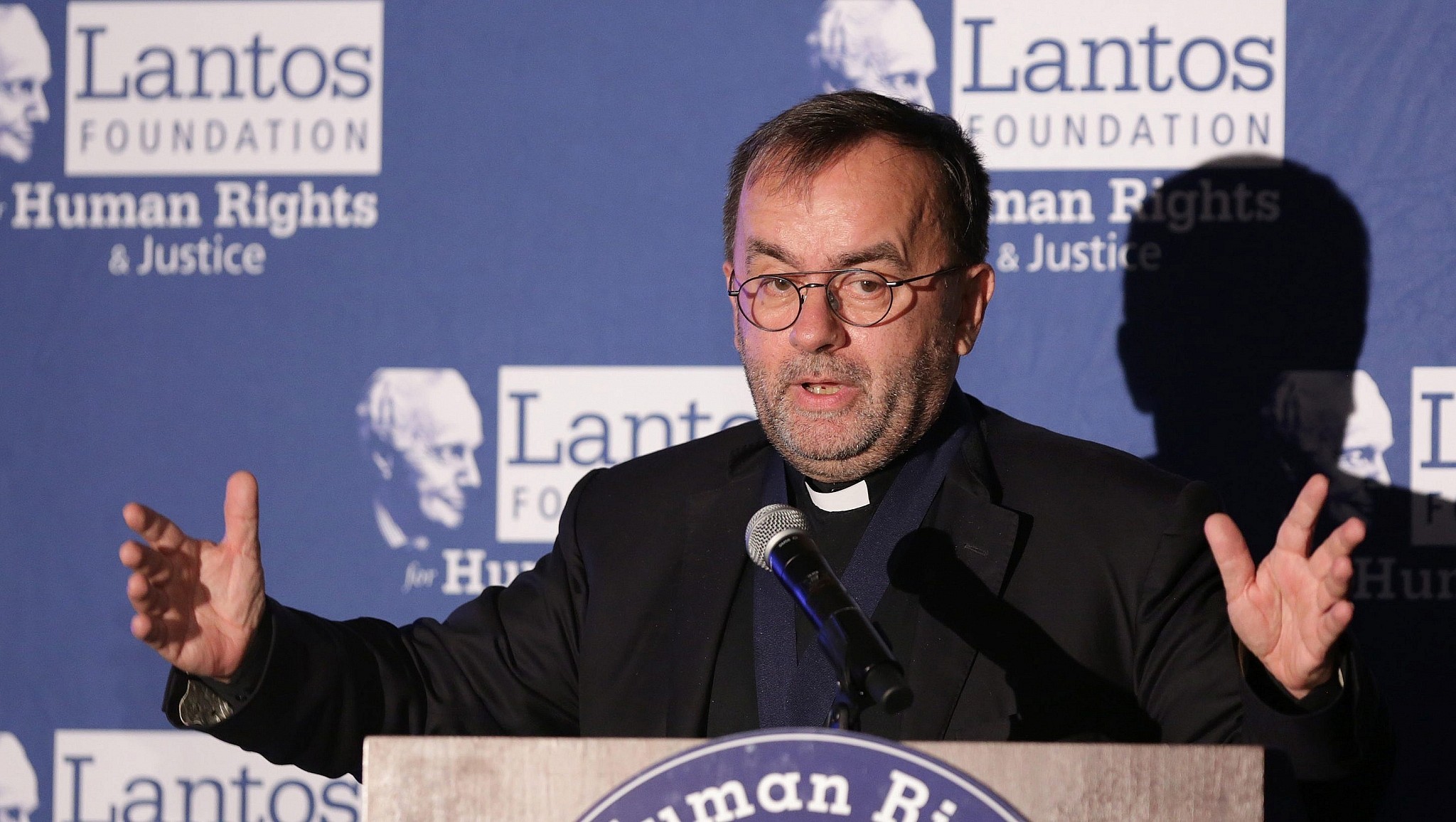
Father Patrick Desbois speaks after being awarded the Lantos Human Rights Prize on Capitol Hill in Washington, DC, on October 26, 2017. (Chris Kleponis)
Father Patrick Desbois, a Roman Catholic clergyman, whose work has uncovered millions of previously unknown victims of the Nazi genocide was awarded the Lantos Foundation’s Human Rights Prize. The Lantos Human Rights Prize is an annual award given by the Lantos Foundation for Human Rights and Justice, an organization founded by Tom and Annette Lantos, who were both Holocaust survivors. For more on the award see: http://trueheroesfilms.org/thedigest/awards/lantos-human-rights-prize.
Father Patrick Desbois, who teaches at Georgetown University’s Program for Jewish Civilization, was recognized during a reception on Capitol Hill as a “vital voice standing up for the values of decency, dignity, freedom, and justice.” His scholarly reportage on the Holocaust has focused on the Jews who were killed by mass shootings by Nazi units in Russia, Ukraine, Belarus, Poland, Moldova and Romania between 1941 and 1944. In 2004, Desbois founded Yahad-In Unum, a French organization whose sole mission was to locate the mass graves of Jewish victims from Nazi paramilitary death squads. These regiments were responsible for the mass killings of Jews, often by shooting and primarily in the former Soviet Union.
His first book, “Holocaust by Bullets: A Priest’s Journey to Uncover the Truth behind the Murder of 1.5 Million Jews,” was based on that work and the culmination of its discoveries. Desbois has another book — a memoir on his life as an anti-genocide activist and Holocaust scholar — due for publication in 2018.
Liberal International (LI) – the global federation of liberal parties – is giving its Prize for Freedom to Senator Leila de Lima, whom the organization described as a “political prisoner” and a critic of authoritarian President Rodrigo Duterte. In its news release of Tuesday, 30 October 2017, the LI said “Politicians from around the world voted to award Liberal International’s highest human rights honor – the Prize for Freedom – to imprisoned Philippines political prisoner, Senator Leila de Lima,” it said. “Senator De Lima, a vocal and ardent critic [of] the Philippines authoritarian president Rodrigo Duterte’s so-called ‘war of drugs’, has been held in pre-trial detention on politically motivated charges since February 2017” .
De Lima is presently detained at the Philippine National Police’s (PNP), Quezon City over allegations that she was involved in the illegal drug trade inside that national penitentiary during her stint as Justice secretary. De Lima has repeatedly denied the charges against her, saying she is a victim of political persecution.
On 30 October, Trevor Marshallsea of AP reported from Sydney that this award has put also the spotlights Australia’s racial issues:
The Associated Press – in this 26 January, 2017 file photo Aboriginal activists carry a banner during an Australia Day protest in Adelaide, Australia. The awarding of the Sydney Peace Prize to Black Lives Matter for its work on American race issues is being hailed but Australian activists say such issues need to be addressed at home as well. (Tim Dornin/AAP Image via AP)
Patrisse Cullors, one of the group’s co-founders, welcomed the award “in solidarity with the organizations and organizers of Australia who had and still have faced oppression.” The social media hashtag with which it shares its name began after neighborhood watch volunteer George Zimmerman was acquitted of killing unarmed teenager Trayvon Martin in Florida in 2013. It gained traction when a police officer fatally shot another unarmed black man, Michael Brown, in Ferguson, Missouri the following year, sparking protests.
The National Assembly in Venezuela was nominated for the award by the center-right European People’s Party (EPP) parliamentary grouping along with the Alliance of Liberals and Democrats for Europe (ALDE group). MEP Jose Ignacio Salafranca said “they are brave people who, despite being beaten or imprisoned, are not afraid and do not give up, but fight for their freedom and for their dignity.” Fellow MEP Guy Verhofstadt said the award supported “the fight of democratic forces in favor of a democratic Venezuela and against the Maduro regime.”
Columbia University has opened 2018 prize nominations for judicial services and legal decisions supporting freedom of expression. What is a bit special about these awards is that they go to ‘court rulings” and “legal services” in the area of freedom of expression.
The Global Freedom of Expression initiative at Columbia University in New York City has opened nominations for its 2018 global prizes, which recognize judicial decisions and legal services strengthening freedom of expression through the promotion of international standards.
The initiative “seeks to advance understanding of the international and national norms and institutions that best protect the free flow of information and expression in an inter-connected global community with major common challenges to address.” It awards the Global Freedom of Expression Prizes, which began in 2014, every two years. “We believe that at a time when freedom of expression is threatened at a global level, there is a particular need to celebrate the victories in defense of this fundamental right”. Individuals and organizations, particularly jurists, academics and non-governmental organizations dedicated to freedom of expression, are invited to nominate court decisions or legal services from anywhere around the globe that “have had a recognizable impact on freedom of expression.” There will be separate prizes for “Court decision” and “Legal Service.” In the Legal Service Category, the awards will consider legal briefs, amicus briefs, academic or other publications.
Nominations will close Jan. 31, 2018 and winners will be announced March 13. Forms are available in both English and Spanish.
Members of the Awards Committee are: Lee C. Bollinger, President of Columbia University; Catalina Botero, former Special Rapporteur for Freedom of Expression of the Inter American Commission on Human Rights of the Organization of American States; Nicolas Bratza, former President of the European Court of Human Rights; Lydia Cacho, journalist, human rights defender and author; Agnes Callamard, Director of the Columbia Global Freedom of Expression initiative; Sarah Cleveland, Louis Henkin Professor of Human and Constitutional Rights and member of the UN Human Rights Committee; and Irene Khan, Director-General of the International Development Law Organization.
Alfredo Romero from Venezuela is the winner of the 2017 Robert F. Kennedy Human Rights Award [see: https://humanrightsdefenders.blog/tag/alfredo-romero/]. The ceremony will take place on THURSDAY, 16 NOVEMBER 2017 in theKennedy Caucus Room | Russell Senate Office Building| Washington, D.C. Questions can be directed to bethany@taylormadeexperience.com or 412-335-9434.
Alfredo Romerowas born in Caracas, Venezuela, and is the Executive Director of human rights organization Foro Penal Venezolano (FPV). FPV was founded in 2005 by Alfredo Romero and three other lawyers to provide pro bono legal assistance to victims of arbitrary detention, due process violations or other human rights violations, including torture or cruel and inhuman treatment. Under Alfredo’s leadership, over 200 lawyers and 1,700 volunteers across the country are providing assistance to victims of human rights violations and their families. To date, FPV has provided assistance to more than 4,000 people.
In addition to his role as Executive Director of FPV, Alfredo was until recently a Fellow with the Carr Center For Human Rights Policy at Harvard’s Kennedy School of Government. He is also currently a partner at Himiob, Romero & Asociados law firm and has been a professor at the Central University of Venezuela and the Andrés Bello Catholic University. Alfredo obtained his Law Degree from the Andrés Bello Catholic University in 1991, and has an M.A in Latin American Studies from Georgetown University (1994) and an LL.M. from the London School of Economics (1997). He is married and is the father of two kids. A marathon runner and an accomplished musician, Alfredo has composed several songs dedicated to the Venezuelan people and to the political prisoners in his country.
Turkish judge Murat Arslan, who was head of the Association for the Union of Judges and Prosecutors (YARSAV).
The Vaclav Havel Human Rights Prize, named after the dissident playwright who later became Czech president, is given by the Parliamentary Assembly of the Council of Europe (PACE). On Monday 16 October the prize awarded to the Turkish judge Murat Arslan, who was head of the Association for the Union of Judges and Prosecutors (YARSAV). Arslan was arrested in October 2016 on suspicion of links to Gulen who Ankara blames for the failed coup aimed at ousting President Recep Tayyip Erdogan.
The PACE described Arslan as a “staunch supporter of the independence of the judiciary.” But the Turkish foreign ministry said in a statement that it “is wrong and unacceptable to award the prize … to a person who is a member of Feto terrorist organisation“. “While the judicial process is underway, presenting a terrorism suspect as a human rights defender is a betrayal of the ideals of democracy and human rights,” it said. For more on the award see: http://trueheroesfilms.org/thedigest/awards/vaclav-havel-prize-for-human-rights-pace
In his absence, the prize was received by a representative of the European Magistrates for Democracy and Freedom group (Medel) which had nominated him. In a message from jail, Arslan told the ceremony that Turkey had “learnt nothing” from Europe’s 20th century history but “we will not let ourselves be closed up in a wall of fear”. [https://humanrightsdefenders.blog/2017/08/31/finalists-for-pace-vaclav-havel-human-rights-prize-announced/]
Readers of this blog know my special interest in human rights awards. So you will understand my surprise to learn that the Friedrich Ebert Foundation has granted its 2017 Human Rights Award to all South Korean citizens (a total of 17 million!!) who took to the streets to protest against President Park Geun-hye for months and peacefully removed her from power.
Sven Schwersensky, resident representative at Friedrich Ebert Stiftung’s Korea office, talks about the Human Rights Prize during a press briefing Monday (Yonhap)
As Ock Hyun-ju reported in the Korea Herald of 16 October 2017: “The peaceful exercise of democratic participation and in particular the civic right of peaceful assembly are the essential components of democracy,” said Sven Schwersensky, resident representative in Korea. “In our view, the people’s candlelight demonstrations have given the whole world evidence of this important fact….At the time, authoritarianism was on the rise everywhere in the world, even in the western world,” he said, citing the UN special rapporteur Maina Kiai, who addressed the diminishing rights to public assembly and free speech under the former Park administration during his visit to Korea in 2016. “People of Korea showed resistance to authoritarianism.”
The organizing committee for candlelight demonstrations — an association of over 1,500 civic groups, labor unions and student organizations — took the prize on behalf of all Koreans. The committee received 20,000 euros ($23,590) in prize money. How the money will be spent has not been decided yet, it said. The award ceremony will take place in Berlin on 5 December. [see also: https://humanrightsdefenders.blog/2014/11/12/friedrich-ebert-award-goes-to-fartuun-adan-from-somalia/]
On 18 October 2017, Burundi’s most prominent human rights defender, Pierre Claver Mbonimpa, will be awarded the Train Foundation’s 2017 Civil Courage Prize. The Civil Courage Prize recognizes individuals who demonstrate “steadfast resistance to evil at great personal risk.” Mbonimpa has won the prize for his work with the Association for the Protection of Human Rights and Detained Persons (APRODH), an organization that records the abuses committed by Burundi’s authoritarian regime, in its effort to crush dissent and advocates for justice for its victims. Mbonimpa, who currently lives in exile, has earned a reputation as the most vocal advocate pushing the regime to end its violent campaign against its political opponents. In August 2015, he survived an assassination attempt that left him severely wounded. During that same year, both his son and son-in-law were found dead shortly after being arrested during anti-government protests.
Mbonimpa won earlier the 2007 Martin Ennals Award for Human Rights Defenders, the 2015 African Human Rights Defenders Awards and in 2016 the Alison Des Forges Award for Extraordinary Activism (HRW). For more on all these the award see: http://www.trueheroesfilms.org/thedigest
The Jury of the Martin Ennals Award for Human Rights Defenders, the highest accolade in the international human rights moment, has just announced that Mohamed Zaree, a human rights lawyer from Egypt, has been selected as the 2017 Laureate. The announcement was made on 10 October at 18h30, during the annual ceremony in Geneva. You can still follow it through live streaming at this very moment: via: https://www.facebook.com/villegeneve.ch/.
Mohamed Zaree is a human rights activist and legal scholar whose work focuses on human rights advocacy around freedom of expression and association. He is also known for his role as the Egypt Country Director of the Cairo Institute for Human Rights Studies (CIHRS), which works throughout the Arabic speaking world. He assumed this role after government pressure on CIHRS prompted them to relocate their headquarters to Tunis in 2014.
The Egyptian government has been escalating its pressure on the human rights movement. Human rights NGOs and defenders are confronted with a growing wave of threats, harassment, and intimidation, legal and otherwise. Despite this, Zaree continues to lead CIHRS’ research, human rights education, and national advocacy initiatives in Egypt and is shaping the media debate on human rights issues. During this critical period for civil society, he is also leading the Forum of Independent Egyptian Human Rights NGOs, a network aiming to unify human rights groups in advocacy. Zaree’s initiatives have helped NGOs to develop common approaches to human rights issues in Egypt. Within the context of the renewed crackdown on Egyptian human rights organizations, he has become a leading figure in Egypt’s human rights movement. Zaree is currently facing investigation under the “Foreign Funding Case” and is at high risk of prosecution and life imprisonment. The “Foreign Funding Case” highly restricts NGO activities. Despite this, Zaree continues to engage the authorities in dialogue wherever possible, arguing that respect for human rights will increase stability in Egypt. Zaree has been under a travel ban since May 2016.
Martin Ennals Foundation Chair Dick Oosting stated: “Severe restriction of civil society’s space to express itself is what led Mohamed Zaree to advocate for human rights and fight for the freedom of association. He is still paying the price for his courageous acts, and we urge his government to lift the travel ban.”
The unique composition of the Jury of the MEA [a coöperation by 10 global human rights organizations, see www.martinennalsaward.org for more detail] makes this award the most important prize in the human rights world. It is supported by the City of Geneva.
The two other finalists also received Martin Ennals prizes:


 Hans Thoolen on Human Rights Defenders and their awards