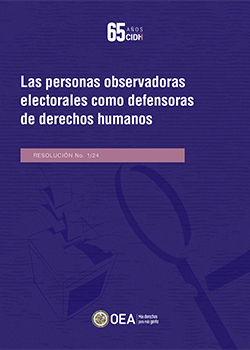
On 23 May 2024 the IACHR Press Office (cidh-prensa@oas.org) informed us that the Inter-American Commission on Human Rights (IACHR) has issued Resolution 01/2024, recognizing national and international election monitors as human rights defenders based on the intrinsic connection between respecting and protecting human rights and defending democracy.
The Commission highlights the important role of election monitors for the defense of democracy and the rule of law. Through their activities, electoral observers stand up for civil and political rights including the rights to freedom of association, assembly, expression, access to information, equality before the law, and non-discrimination, as well as for the rights to a fair trial and to judicial protection.
The activities of election monitors help to protect the rights held in Article XX of the American Declaration of the Rights and Duties of Man and in Article 23 of the American Convention on Human Rights, both of which mention the right to vote and to be elected by universal suffrage in periodic elections.
In the case of national observers, election monitoring is a form of political participation and a way of exercising political rights by looking after, defending, and fostering the principles that should prevail in election processes, including transparency, certainty, legality, fairness, and universal suffrage by secret ballot among a plurality of political options.
The actions of electoral observers ultimately seek to ensure the integrity of election processes and therefore to preserve expressions of citizens’ sovereign will, which is one of the main tenets of representative democracy according to inter-American and international instruments for the protection of human rights.
In its resolution, the Commission acknowledges the importance of electoral observation missions. The IACHR calls on States to enable suitable conditions for independent and impartial election monitoring and to ensure that election monitors can do their work freely, without retaliation of any kind, and enjoy protection from any risks they may face as a result of their efforts.
Greek Orthodox Bishop Seraphim of Piraeus. Two activists were found to have falsely accused him of hate speech by a Greek court on Tuesday. Credit: Ewiki/Wikimedia Commons/ CC BY-SA 3.0
Several newspapers (here Anna Wichmann for GreekReporter of 16 February 2022) commented on the rather surprising ruling by a Greek court that two human rights activists falsely accused a Greek Orthodox bishop of hate speech and sentenced them to year-long prison sentences that were suspended for three years.
Bishop Seraphim, who is the Metropolitan of Piraeus, was acquitted on charges of hate speech. The bishop has made what many believe are both coded and explicit references to antisemitic tropes many times. For example when Greece introduced new legislation to expand rights for gay and lesbian couples in 2015, he claimed that an “international Zionist monster” was behind the bill.
He also claimed that Jews themselves funded and planned the Holocaust and charged that they were the reason for Greece’s financial troubles on Greek television five years ago. After his statement about the Holocaust began to garner controversy, the Greek Orthodox Bishop clarified that it was his own opinion and not that of the Greek Orthodox Church.
These comments were seen as extremely troubling in a country whose once vibrant Jewish community was nearly wiped out during the Holocaust, and antisemitic rhetoric and attacks, usually in the form of vandalism, are still a major problem.
The accused brought a formal complaint against the Bishop in 2017 in which they claimed he fueled hatred and incited violence against Greece’ Jewish minority with his inflammatory statements about Jews and the Holocaust. They also claimed that he had abused his office.
The prosecutor dismissed the activists’ complaint in 2019, but the Bishop decided to file his own motion against the activists for falsely accusing him of hate speech, and the prosecutor subsequently formally charged the accused in November.
Greece passed Law No. 4285/2014 in 2014, which criminalized hate speech — particularly speech which incites violence — and genocide denial. The law reads “Anyone, who publicly incites, provokes, or stirs, either orally or through the press, the Internet, or any other means, acts of violence or hatred against a person or group of persons or a member of such a group defined by reference to race, color, religion, descent or national or ethnic origin, sexual orientation, gender identity, or disability, in a manner that endangers the public order and exposes the life, physical integrity, and freedom of persons defined above to danger, will be punished by imprisonment of from three months to three years and a fine of €5,000 to €20,000.”
Human rights groups around the world paid careful attention to the case; many believed that bringing the activists to trial alone was a sign of an alarming shift of the judicial system’s role in the country as a force against activists.
Amnesty International stated on social media that “The ruling poses a direct threat to the right to freedom of expression and has a chilling effect on human rights defenders advocating against racism and hate speech.”
Andrea Gilbert, one of the accused, who works for the Greek Helsinki Monitor rights group, expressed her outrage at the verdict to The Guardian: “Today’s outrageous verdict is representative of the institutionalized antisemitism that exists in Greece…We have immediately appealed and will fight it all the way.”
Activists and people who work for NGOs argue that the trial epitomizes how difficult it is for them to work in Greece.
“Human rights defenders (in Greece) are consistently targeted for their legitimate work…(They) face different types of attacks, including surveillance, judicial harassment, arbitrary arrests, detentions, ill-treatment, entry bans and expulsions,” the international secretariat of the World Organization Against Torture stated to The Guardian.
Although not included in the activists’ initial complaint of hate speech against Greek Orthodox Bishop Seraphim, he is also known to express what many believe are homophobic sentiments.
He has claimed that homosexuality brings about disease and can be “carcinogenic.” He has also called homosexuality an issue of “psychopathology” rather than sexuality.
In 2021, when Greece was hit with catastrophic wildfires that destroyed vast swaths of land and thousands of houses, Seraphim released a statement in which he hinted that the fires were a punishment for Greece adopting legislation that expanded the rights of gay people, writing:
“With love I would say to our leaders that when they show off the subversion of human ontology and human nature and institutionalize it as a “human right,” despite the fact that it doesn’t have any relationship with human nature, and they view it as a plus on their CV for advancement in their position of authority, they don’t understand that this is hubris, and each instance of hubris requires purification and ‘just repayment.’”
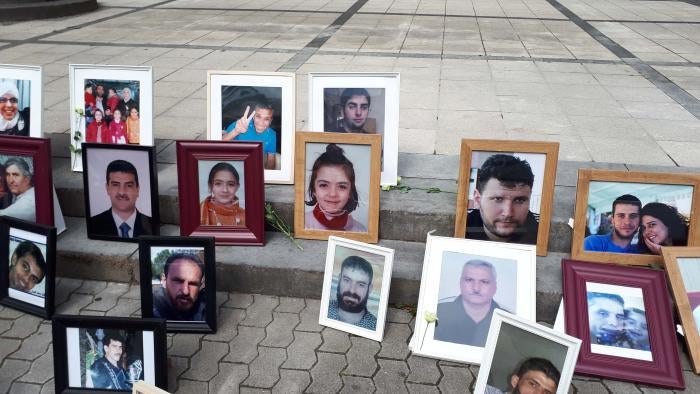
The conviction of a former Syrian intelligence officer for crimes against humanity by a German court is a ground-breaking step toward justice for serious crimes in Syria, Human Rights Watch said today. The judgment is a meaningful moment for civilians who survived torture and sexual abuse in Syria’s prisons.
On January 13, 2022, a German court delivered its judgment in the trial of Anwar R., a former member of Syria’s General Intelligence Directorate, one of the country’s four main intelligence agencies commonly referred to collectively as the mukhabarat. Anwar R. is the most senior former Syrian government official to be convicted for serious crimes in Syria.
German prosecutors accused Anwar R. of overseeing the torture of detainees in his capacity as head of the investigations section at the General Intelligence Directorate’s al-Khatib detention facility in Damascus, also known as “Branch 251.”
The judges found Anwar R. guilty of committing crimes against humanity and sentenced him to life in prison. Following the verdict in the case, Anwar R. has one week to appeal.
“More than 10 years after the violations were committed in Syria, the German court’s verdict is a long-awaited beacon of hope that justice can and will in the end prevail,” said Balkees Jarrah, associate international justice director at Human Rights Watch. “Other countries should follow Germany’s lead, and actively bolster efforts to prosecute serious crimes in Syria.”
Syrian survivors, lawyers, and activists have been central to making this trial a reality, not only pressing for justice but laying the groundwork that makes justice possible, Human Rights Watch said.
More than 80 witnesses testified, including former detainees, former Syrian government employees, German police investigators, and experts in Syrian affairs. The testimony included well-documented accounts of torture and sexual abuse in Branch 251, descriptions of mass graves, and details of Syria’s government policy to violently crack down on peaceful protesters in 2011. Several of the witnesses were able to identify Anwar R. in the courtroom.
One of the major challenges of this trial was witness protection. Several witnesses living in Germany and other European countries cancelled their appearance in court out of fear for their lives and safety, or that of their families. Several witnesses, some who were also victims, testified that they feared a risk to themselves and their families given their role in the trial. German authorities should ensure that witnesses and victims are sufficiently informed about their rights to protective measures, including to appear anonymously before the court.
Tens-of-thousands of people have been detained or disappeared in Syria since 2011, the vast majority by government forces using an extensive network of detention facilities throughout the country. The Syrian government continues to detain and forcibly disappear thousands of people.
Many of those detained have died from torture and horrific detention conditions. Comprehensive justice for these and other unchecked atrocities in Syria has been elusive. Syria is not a member of the International Criminal Court. And in 2014, Russia and China blocked efforts at the United Nations Security Council to give the court a mandate over serious crimes in Syria.
The trial of Anwar R. and Eyad A. is possible because Germany’s laws recognize universal jurisdiction over certain of the most serious crimes under international law. That allows for the investigation and prosecution of these crimes no matter where they were committed and regardless of the nationality of the suspects or victims. Universal jurisdiction remains one of the few viable pathways to justice for crimes committed in Syria.
Germany has several elements in place to allow for the successful investigation and prosecution of grave crimes in Syria. It has above all a comprehensive legal framework, well-functioning specialized war crimes units, and previous experience with prosecuting such crimes. Countries with universal jurisdiction laws should establish specialized war crimes units within law enforcement and prosecution services, and ensure that such units are adequately resourced and staffed.
“Germany’s trial against Anwar R. is a message to the Syrian authorities that no one is beyond the reach of justice,” Jarrah said. “The Koblenz case has shown that with other avenues blocked, national courts can play a critical role in combating impunity.”
On 8 November 2021 media (here Reuters) reported that a U.S. appeals court said Facebook can pursue a lawsuit accusing Israel’s NSO Group of exploiting a bug in its WhatsApp messaging app to install malware allowing the surveillance of 1,400 people, including journalists, human rights activists and dissidents. In a 3-0 decision on Monday, the 9th U.S. Circuit Court of Appeals in San Francisco rejected privately owned NSO’s claim it was immune from being sued because it had acted as a foreign government agent. See also: https://humanrightsdefenders.blog/2021/10/04/big-coalition-urges-un-to-denounce-abuses-facilitated-by-spyware-technologies/
Facebook, now known as Meta Platforms Inc, sued NSO for an injunction and damages in October 2019, accusing it of accessing WhatsApp servers without permission six months earlier to install its Pegasus malware on victims’ mobile devices. NSO has argued that Pegasus helps law enforcement and intelligence agencies fight crime and protect national security.
It was appealing a trial judge’s July 2020 refusal to award it “conduct-based immunity,” a common law doctrine protecting foreign officials acting in their official capacity. Upholding that ruling, Circuit Judge Danielle Forrest said it was an “easy case” because NSO’s mere licensing of Pegasus and offering technical support did not shield it from liability under federal law, which took precedence over common law.
“Whatever NSO’s government customers do with its technology and services does not render NSO an ‘agency or instrumentality of a foreign state,'” Forrest wrote. “Thus, NSO is not entitled to the protection of foreign sovereign immunity.”
The case will return to U.S. District Judge Phyllis Hamilton in Oakland, California.
Asked for comment on the decision, NSO said in an email that its technology helps defend the public against serious crime and terrorism, and that it “stands undeterred in its mission.”
WhatsApp spokesman Joshua Breckman in an email called the decision “an important step in holding NSO accountable for its attacks against journalists, human rights defenders and government leaders.”
Facebook’s case drew support from Microsoft Corp (MSFT.O), Alphabet Inc’s (GOOGL.O) Google and Cisco Systems Corp (CSCO.O), which in a court filing called surveillance technology such as Pegasus “powerful, and dangerous.”
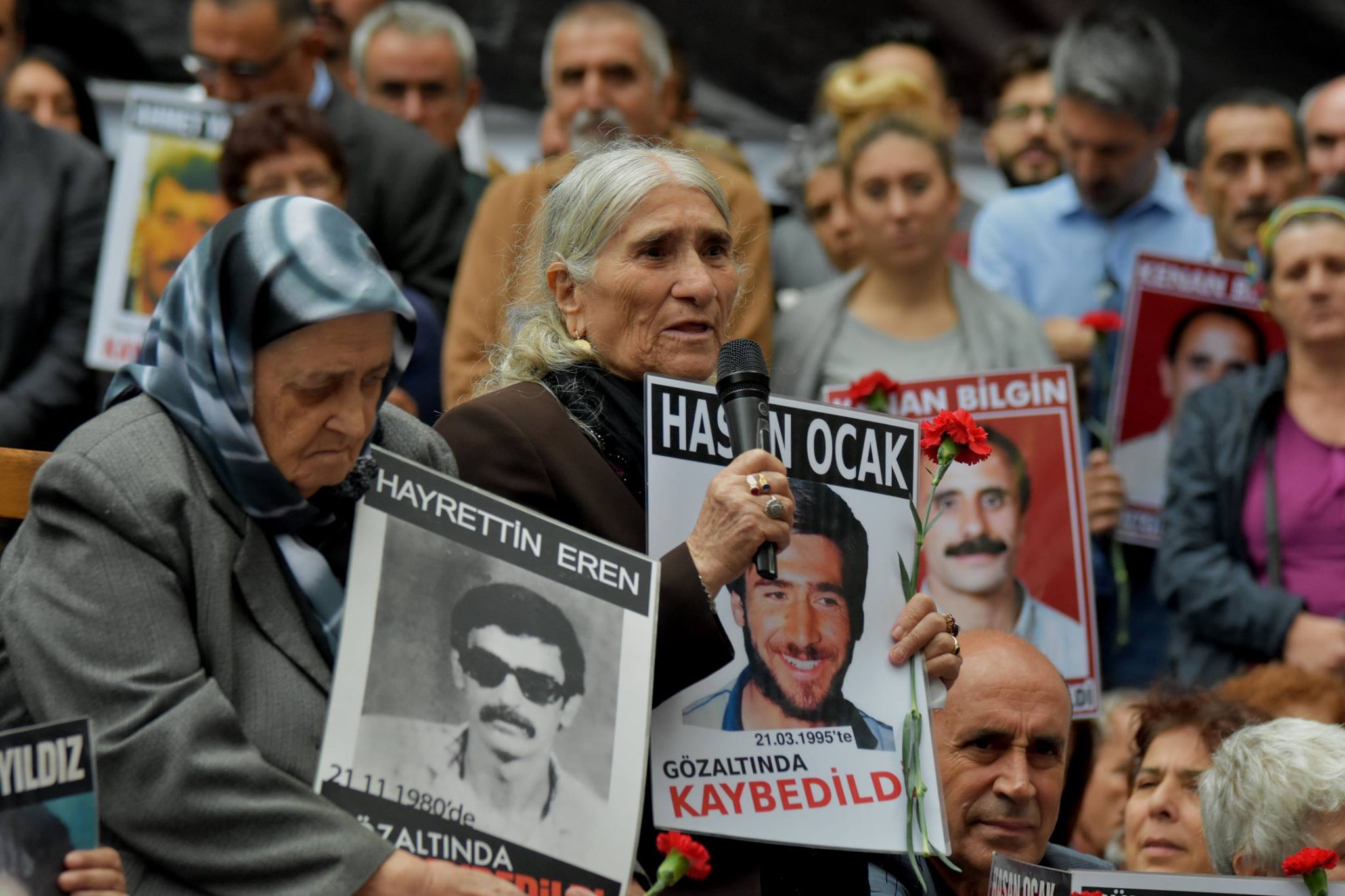
On 12 July 2021, the case against the 46 human rights defenders and activists, which includes the families of the disappeared and supporters continued at the Istanbul 21st Criminal Court of First Instance. They were charged with violating the Law on Assemblies and Demonstrations for “unarmed participation in an unauthorised assembly and refusal to disperse after warnings” (Article 32 of the Law 2911). The case was filed following the violent arrest of the 46 people and one minor by the police during the 700th gathering of the Saturday Mothers/People on 25 August 2018.
On 18 November 2020, an Istanbul court of first instance filed a lawsuit against 46 people who were arrested on 25 August 2018 during the violent police intervention at the 700th gathering of Saturday Mothers/People in Istanbul’s Galatasaray Square.
On 25 August 2018, police forcibly dispersed the Saturday Mothers’ weekly vigil and detained 47 protesters, including families of the victims of enforced disappearances in the 90s. The detained protesters were released from police custody later that day.
About the situation:
On 12 July 2021, the case against the 46 human rights defenders and activists, which includes the families of the disappeared and supporters of Saturday Mothers/People, continued at the Istanbul 21st Criminal Court of First Instance. They were charged with violating the Law on Assemblies and Demonstrations for “unarmed participation in an unauthorised assembly and refusal to disperse after warnings” (Article 32 of the Law 2911). The case was filed following the violent arrest of the 46 people and one minor by the police during the 700th gathering of the Saturday Mothers/People on 25 August 2018.
On 18 November 2020, an Istanbul court of first instance filed a lawsuit against 46 people who were arrested on 25 August 2018 during the violent police intervention at the 700th gathering of Saturday Mothers/People in Istanbul’s Galatasaray Square.
On 25 August 2018, police forcibly dispersed the Saturday Mothers’ weekly vigil and detained 47 protesters, including families of the victims of enforced disappearances in the 90s. The detained protesters were released from police custody later that day.
Cumartesi Anneleri/İnsanları: Saturday Mothers/People is a human rights group, comprised of human rights defenders and families of victims of enforced disappearance in Turkey in the 1990s. They began organising weekly vigils at Galatasaray Square after the detention of Hasan Ocak on 21 March 1995 and the subsequent discovery of his tortured body in a common grave. Human rights defenders and the families of the victims gathered in Galatasaray Square for the first time on 27 May 1995, demanding an end to enforced disappearances, seeking information on the whereabouts of those who have disappeared and justice for the victims. See: https://en.wikipedia.org/wiki/Saturday_Mothers
In the meatime in Malta, two Turkish mothers who were jailed and separated from their young sons for using forged passports have been freed as Court overturned their prison sentence. The women, Rabia Yavuz, 27, and Muzekka Deneri, 29, have been fighting to be reunited with their sons – aged two and four – after being sentenced to six months in prison.
The two women were freed on Friday afternoon after having ear.lier this week filed an appeal against the ‘disproportionate and excessive’ punishment. They admitted to using fake travel documents, saying they could not return to their country because of political persecution. Moreover, the two women, who were separated from their sons, are in the process of applying for asylum.
Lawyers have welcomed the decision by Delhi High Court stating that protesters have the right to criticise the government. They also hailed the Court’s verdict defining the lines between criticism of the government and activities that destabilize the country.
Aneesha Mathur in India Today of 16 June 2021 reports that -with the Delhi High Court rapping the government and Delhi Police over imposing UAPA on activists in connection with the clashes, following the anti-CAA protest – lawyers and jurists have said the verdict was significant since it has tried to define the line between criticism of the government, which is a Constitutional right, and activities that destabilize the country.
Former Supreme court justice Madan B Lokur welcomed the High court verdict.: “The judgment is welcome. It’s about time the courts told the State that draconian laws like the UAPA, NSA, sedition and so on may be used, if at all, very rarely and only if there is clinching evidence. Draconian laws cannot and must not be abused otherwise our braveheart judges will strike down arbitrary actions. The Delhi High Court has opened the door for interference and other High Courts should follow quickly while recognising that human rights are for humans and not the faceless State,”.
Senior advocate Dushyant Dave told India Today TV that the court had “not said anything new but laid down the law on the facts of the case.” Dave also called for “proactive and expeditious” movement from the judiciary on similar cases, and said that the activists “had lost one year of their life,” for no reason.advertisement
“We are the world’s largest democracy. We will not be able to call ourselves a democracy if such laws are used to suppress dissent.” Speaking to India Today TV, Dave said despite “rule of law”, India had “become a police state.”
“Not only is BJP government abusing UAPA, but the Congress government also abused POTA and thousands were put in jail,” said Dave.
Lawyer Vrinda Grover also said the HC verdict was “significant” since there has been indiscriminate use of the law in recent years.
“Over the last few years, we see the police frequently using UAPA and sedition to silence critical citizens’ voices by placing them behind bars under stringent anti-terror law. The High Court has pierced through the indiscriminate use of UAPA by the police and unwarranted labelling of activities as terrorism. The Court has reiterated that non-violent contestation of government policies and laws is a constitutionally protected right to protest. Finally, the court has also reminded that if the speedy trial is not possible they must be granted bail,” said Grover.
He added: “In this context, we must raise the issue of incarceration of 16 human rights defenders in the Bhima Koregaon case under UAPA for almost three years and the trial is yet to commence. The judiciary must intervene and not allow the criminal legal machinery to be used by the State to suppress fundamental freedoms of citizens, otherwise democracy is in peril.”
“Anti-terror laws are made very strict because they are meant to handle terrorism cases. The government must balance the right of the citizens to protest and criticise with the need of the state. But governments tend to treat criticism as sedition and anti-national, which is wrong. The two judges have shown courage in calling this out,” said Senior advocate Geeta Luthra.
Former Law Commission chairman, Justice BS Chauhan said that while the potential for misuse “cannot mean repeal of an act”, there is a “need to define the contours of the law, as the UAPA is a wide provision” as it was meant to combat serious threats.advertisement
“Courts need to define contours of sedition and UAPA otherwise they can cover freedom of speech and expression,” said Chauhan.
Judge Phyllis Hamilton, in her ruling on the cases, stated that she was not convinced by NSO Group’s claims and arguments that it had no hand in targeting WhatsApp users. Moving forward in the trial, the NSO Group might be forced to reveal its clients and make the list public.
The judge also added that even if NSO was operating at the direction of its customer, it still appeared to have a hand in targeting WhatsApp users. As per reports, a WhatsApp spokesperson said the Facebook-owned venture was pleasd with the court’s decision and will now be able to uncover the practices of NSO Group.
Even in the face of criticism from privacy advocates, the company has claimed that law enforcement agencies are facing difficulties due to the proliferation of encrypted messaging apps like WhatsApp.
The law firm King & Spalding has reportedly been hired by the NSO group to represent them. Among the company’s legal team is Rod Rosenstein, Trump administration’s former attorney general. The NSO Group has reportedly had multiple government clients like Saudi Arabia, Mexico, and the United Arab Emirates who have used spyware to target political opponents and human rights, campaigners.
This case has dragged on [see: https://humanrightsdefenders.blog/tag/andy-hall/] but has finally come to a good end thanks to strong international pressure. The Supreme Court’s decision on June 30, 2020 to acquit Andy Hall for criminal defamation and computer crimes offenses was welcome news, finally bringing an end to a seven-year legal battle that represented just how far some companies are willing to go to silence activists who expose modern slavery.
Hall’s case even attracted the attention of UN human rights experts, who criticized the lawsuits brought against him, saying that they were an example of Strategic Lawsuits Against Public Participation (SLAPPs). SLAPPs related to defamation have been increasingly used in recent years in Thailand by companies linked to forced labor and labor rights violations as a means to silence critics. [see also: https://humanrightsdefenders.blog/2020/06/08/defending-defenders-challenging-malicious-lawsuits-in-southeast-asia/]
In response to the Supreme Court’s ruling, Andy Hall said: “I welcome today’s final ruling in this case. But after years of ongoing judicial harassment that has taken a heavy toll on me, my family and my colleagues, the verdict does not feel like a victory. My activism for over a decade in Thailand was intended only to promote and uphold the fundamental rights of millions of migrant workers in the country.
These workers continue to find themselves without a voice in high risk situations of forced labor and subject to systemic human and labor rights violations in global supply chains. I remain open to reconciliation to put an end once and for all to this continued irrational cycle of litigation against me and my colleagues that remain in Thailand.”
Amnesty International will soon (31 May 2020) challenge in a Jerusalem court a travel ban that the Israeli government imposed on its campaigner for Israel and Palestine, Laith Abu Zeyad.
On 26 May 2020 a group of local NGOs (Adalah – The Legal Center for Arab Minority Rights in Israel, B’Tselem, Bimkom – Planners for Planning Rights, Breaking the Silence, Gisha, HaMoked: Center for the Defence of the Individual, Ir Amim, Haqel – In Defense of Human Rights, Human Rights Defenders Fund, Physicians for Human Rights – Israel, The Association for Civil Rights in Israel, The Public Committee Against Torture in Israel Torat Tzedek, Yesh Din, Zazim – Community Action) issued a joint statement against the restrictionon movement of Laith Abu Zeyad, AI’s campaigner for Israel and Palestine: We stand in solidarity with our colleague from Amnesty International, Laith Abu Zeyad, and demand that Israel lift the movement restrictions barring him from leaving the Occupied Territories. His petition against the restrictions imposed upon him will be heard on 31 May 2020. Targeting Abu Zeyad is yet another example of Israel’s increased persecution and punishment of human rights organizations in recent years. This includes preventing international activists and human rights workers from entering the country and forming a ministry that creates blacklists and engages in censorship. Imposing draconian restrictions and denying millions of Palestinians freedom of movement have been a routine part of Israel’s occupation policy for 53 years. Israel comprehensively violates Palestinians’ right to travel abroad, while regarding its citizens’ rights to do so as fundamental. If it looks like political persecution and sounds like political persecution – it is political persecution, and it must stop.
In remarkable solidarity Omar Shakir, Human Rights Watch’ Israel and Palestine Director, wrote about the case in detail:
As a Palestinian from the West Bank, Abu Zeyad must obtain an Israeli-issued permit to enter significant parts of the West Bank under Israeli control, including East Jerusalem, and Israel itself. Yet Palestinians applying for permits face what the Israeli rights group B’Tselem describes as an “arbitrary, entirely non-transparent bureaucratic system.” Most can travel abroad only by land via Jordan through the Israeli-controlled Allenby Crossing. Israeli authorities denied Abu Zeyad a permit in September 2019 to enter occupied East Jerusalem, where he had hoped to accompany his mother, who needed cancer treatment, to a hospital just three kilometers from his home but on the other side of the separation barrier. She died there in December without her son by her side.
In October 2019, Israeli authorities at the Allenby Crossing barred Abu Zeyad from traveling to Jordan to attend a relative’s funeral, citing undisclosed “security reasons,” despite his never having been convicted for a security offense. Authorities provided no further information and designated the evidence as “secret,” meaning even his attorney will not be able to see it in court. And of course, without a permit to enter Jerusalem, Abu Zeyad cannot attend his own court hearing.
New Defense Minister and Alternate Prime Minister Benny Gantz, who warned in his campaign that the previous government’s attacks on independent institutions jeopardized the country’s future, can signal a new direction by lifting Abu Zeyad’s travel ban. He is empowered to do so as he holds the defense portfolio. Israel’s international friends should also find their voice. A government that kicks out a Human Rights Watch director and bans an Amnesty International campaigner from traveling without disclosing the reasons will not hesitate to go after others, much less end systematic rights abuse, unless there is greater global pressure.
WhatsApp logo is seen displayed on a smart phone screen on 11 December 2019 [Ali Balıkçı/Anadolu Agency]
On 30 April, 2020 the Middle East Eye reported that WhatsApp has accused Israeli spyware company NSO Group of being “deeply involved” in carrying out mobile phone hacks of 1,400 of its users, including senior government officials, journalists and human rights defenders. (see also: https://humanrightsdefenders.blog/2019/10/30/nso-accused-of-largest-attack-on-civil-society-through-its-spyware/) The allegation was made in a new court filing over the firm’s role in the long running hacking case which grabbed global attention following the murder of Saudi Journalist Jamal Khashoggi. Software created by the Israeli spyware firm was used to hack the phone of a member of Khashoggi’s inner circle which allowed Saudi security officials to track him. US whistle-blower Edward Snowden said that if the NSO Group had refused to sell its technology to Saudi Arabia, Khashoggi would still be alive. A number of human rights defenders and activists in Morocco were also targeted by the Israeli company, according to research by Amnesty International.
The NSO Group has always maintained its innocence insisting that its spyware is purchased by government clients for the purpose of tracking terrorists and criminals and that it had no independent knowledge of how those clients use its spyware. This claim is contradicted by court documents in WhatsApp’s lawsuit filed last year against the Israeli firm. While bringing the lawsuit, WhatsApp said in a statement that 100 civil society members had been targeted and called it “an unmistakable pattern of abuse”. New documents seen last week indicate that servers controlled by NSO Group and not its government clients, as alleged by the Israeli firm, were an integral part of how the hacks were executed. “NSO used a network of computers to monitor and update Pegasus after it was implanted on users’ devices,” said WhatsApp, “these NSO-controlled computers served as the nerve centre through which NSO controlled its customers’ operation and use of Pegasus [software used to hack computers and phones].”NSO Group is also accused by WhatsApp of gaining “unauthorised access” to its servers by evading the company’s security features.
The same day CYBERSCOOP added that in the ongoing legal battle between Facebook and software surveillance company NSO Group, the social media giant is trying to get NSO Group’s legal counsel dismissed because of an alleged conflict of interest. In a court filing made public this week, Facebook asked a federal judge to disqualify law firm King & Spalding from representing NSO Group because the firm previously represented Facebook-owned WhatsApp in a different, sealed case that is “substantially related” to the NSO Group one. King & Spalding, an Atlanta-based firm with a range of big corporate clients, has denied there is a conflict of interest, according to the filing.“Any attorney defending this suit would love to have insight into how WhatsApp’s platform and systems work,” the court filing states. “And King & Spalding has that insight—because it was once WhatsApp’s counsel.”The dispute with Facebook is one of multiple legal battles currently facing NSO Group. Amnesty International is trying to get an Israeli court to revoke NSO Group’s export license in Israel, citing Pegasus’s alleged role in humans rights abuses. [see: https://humanrightsdefenders.blog/2019/09/17/has-nso-really-changed-its-attitude-with-regard-to-spyware/]https://www.amnesty.org/en/latest/news/2020/06/nso-spyware-used-against-moroccan-journalist/



![WhatsApp logo is seen displayed on a smart phone screen on 11 December 2019 [Ali Balıkçı/Anadolu Agency]](https://i2.wp.com/www.middleeastmonitor.com/wp-content/uploads/2019/12/AA29_6.jpg?resize=1107%2C800&quality=85&strip=all&ssl=1)
 Hans Thoolen on Human Rights Defenders and their awards