Posts Tagged ‘civil disobedience’

New Guidelines on Environmental Protest and Civil Disobedience

October 20, 2025

During October 2025, new guidelines on Environmental Protest and Civil Disobedience were released by Michel Forst, UN Special Rapporteur on Environmental Defenders under the Aarhus Convention

The new guidelines aim to support states, civil society, environmental activists, and legal practitioners in understanding and implementing the rights guaranteed under the Aarhus Convention. The document underscores that individuals and groups have a recognised international right to engage in peaceful environmental demonstrations, even when challenging public or private actors whose practices may harm the environment.

The document outlines five guiding principles to help states ensure that peaceful environmental activism is respected, not repressed:

  1. Address the root causes of the protest: Governments should tackle the real reasons behind environmental protests, such as inaction on environmental protection, lack of transparency, or exclusion from decision-making.
  2. Reject criminalization of defenders: Authorities and media must stop portraying environmental activists as criminals and instead recognize their legitimate role in defending public interests.
  3. Protect civic space: Civil disobedience must not be used as a pretext to restrict fundamental freedoms or limit peaceful public expression.
  4. Ensure human rights–based policing: Law enforcement responses must be lawful, necessary, and proportionate — never arbitrary, excessive, or punitive.
  5. Uphold justice and civic freedom: Courts should avoid rulings or sanctions that discourage peaceful protest or shrink civic space.

Furthermore, the guidelines recognize that some environmental defenders may resort to civil disobedience when legal channels fail, and the guidelines set out conditions under which such acts may be tolerated (e.g., proportionality, non-violence, necessity, public interest). The guidelines stress the need for states to prevent and remediate retaliatory actions against protestors, such as legal harassment, surveillance, excessive use of force, or criminalisation of protest. The text encourages states to review and reform national laws, police protocols, and judicial practices to ensure that protest rights are respected, especially for environmental defenders, and it calls for transparent mechanisms to monitor how protests are handled, report abuses, and hold responsible persons and institutions to account.

The guideline highlights that public authorities (including political figures) should refrain from using language labelling protesters as threats, “eco-terrorists,” or “foreign agents”, and media (especially public or state media) should maintain factual accuracy, avoid derogatory language, and refrain from mischaracterising environmental defenders.

https://unipd-centrodirittiumani.it/en/news/un-rapporteur-michel-forst-issues-new-guidelines-on-environmental-protest-and-civil-disobedience

Guidelines on the Right to Peaceful Environmental Protest and Civil Disobedience – October 2025
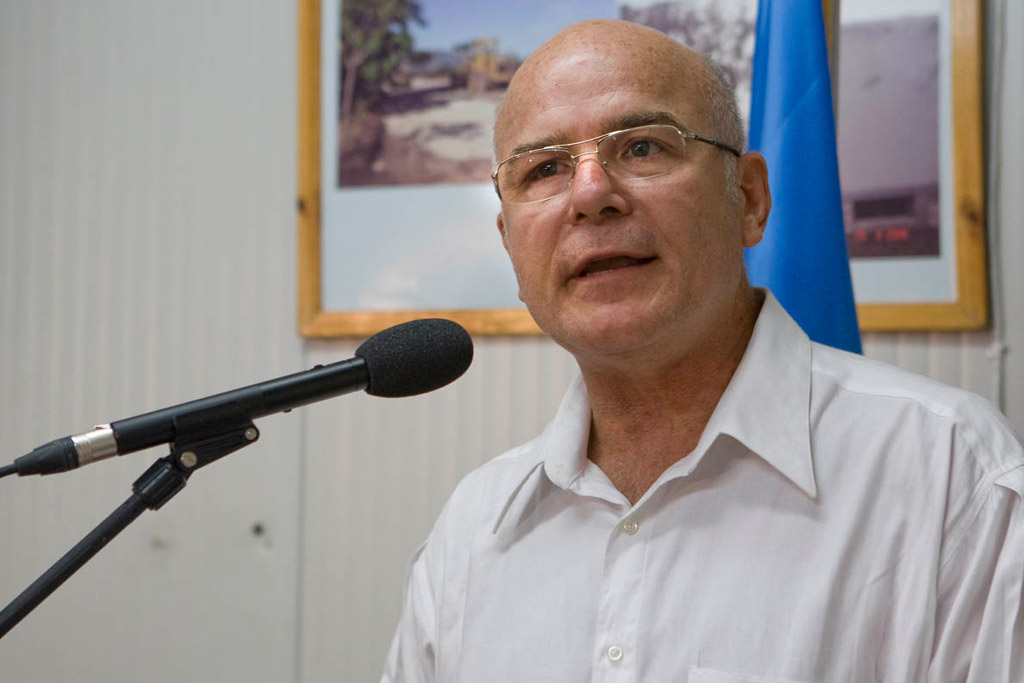
Human Rights Platform at the Gulbenkian Foundation hears Michel Forst worry about treatment of climate defenders

October 4, 2023

The LUSA news agency reported on 3 october that “the UN Special Rapporteur on environmental campaigners, Michel Forst” , said that climate activists are under increasing pressure in Europe, admitting that he was surprised by the violence with which several governments treat them. This is a somewhat misleading title as Michel Forst is the “Special Rapporteur on Environmental Defenders under the Aarhus Convention, Mr. Michel Forst” [see: https://humanrightsdefenders.blog/2022/07/22/aarhus-convention-on-environmental-information-gets-especially-experienced-rapporteur/]

Still, the message is what matters: “Rights defenders as a whole face a number of major challenges and risks in many countries, including in Europe, but those who are currently paying the highest price are precisely environmental activists and people trying to defend their land and the climate,” said Michel Frost in an interview with Lusa.

Forst was in Portugal today to take part in the international conference of the Human Rights Platform, taking place at the Gulbenkian Foundation in Lisbon, and confessed to Lusa that he didn’t understand the reasons behind this increase in pressure.

I don’t understand why, but the fact is that more and more politicians in more countries are comparing people who are actually peaceful demonstrators with violent terrorists,” he said, noting that he sees this “in Spain, the Netherlands, Denmark, the UK, Germany and Switzerland”.

The issue worries him a lot, he recognized, not least because different ways of attacking activists are being used in various countries.

“I toured more than 20 European Union (EU) countries to meet with activists and governments, inviting them to describe the atmosphere they face in their countries, and I can assure you that the situation is becoming very, very, very tense,” he said, pointing out that governments such as those in France or Austria classify these activists as “eco-terrorists or green Taliban”.

Michel Forst explained to Lusa that he is currently working with a group of non-governmental organizations (NGOs) “to try to better understand what is happening in Europe, with a view to guiding EU governments on how to respond to civil disobedience”.

Stressing that civil disobedience is regulated by international human rights law, the UN official said he was alarmed when he met judges from Spain, France and Germany and realized that they “didn’t understand international human rights law at all”.

Activists who engage in civil disobedience “should not be penalized”, but in reality we see that “judges and governments do not comply with international obligations”, Michel Forst pointed out.

For this reason, he explained, his aim for now is to provide documents and guidelines for states to ensure better fulfilment of their international obligations.

“Some states have been very receptive, such as Ireland and Norway, but many others have not,” he denounced, naming the example of the United Kingdom and adding that, in some cases, the police infiltrate groups in order to know what is being prepared and to be able to better control the activists.

“We now have evidence that some [environmental campaigners] have been placed under strict surveillance, with their phones being hacked and their computers being tapped,” he said.

For Michel Forst, environmental campaigners are no different from those who fight for human rights.

“It’s the same thing,” he emphasised, explaining that environmental activists are just gaining more visibility.

“They are using new forms of mobilisation that others haven’t used, like sticking their hands in the ground or handcuffing themselves to a barrier or breaking down doors to cut genetically modified maize,” he listed.

Their growing visibility leads them to face what human rights defenders were already facing, namely the fact that “civic space is shrinking in Europe,” he said, noting that this is not only his assessment, but also that of the Council of Europe and the EU Agency for Fundamental Rights.

And against this, Michel Forst expects only one thing: “A strong reaction from citizens”.

With regard to the authorities, the UN Special Rapporteur also expressed his expectations.

“We need to see the results [of the guidelines that will be issued] and then ask the most receptive.

Amnesty International’s Global Assembly 2019 deserves more attention: big shifts coming up

August 5, 2019

This weekend Amnesty International’s 2019 Global Assembly (GA) took place on the edge of Johannesburg. In a world where all news should be equal, or a world less fixated on Busi Mkhwebane or Donald Trump, global gatherings of human rights activists ought to be headline news. Their debates and decisions should be reported; their accountability structures scrutinised. But the media was visible by its absence. This is what the Daily Maverick of 4 August 2019 wrote and its is worth reading in its totality!:

Amnesty International (AI) is probably the largest international human rights organisation in the world. It has more than eight million members and each of its 69 country sections sent three elected delegates to the GA, one of whom had to be a young person under 25. AI is worth watching because its membership is largely unpaid volunteers, people prepared to get on the streets to realise their hopes for a fairer world. Unlike many other civil society organisations it doesn’t take funding from governments or private corporations. And it’s still hungry for change. But in addition to the GA taking place in South Africa, our country lent some of its most famous sons to the deliberations. The keynote opening address was delivered by Justice Dikgang Moseneke, who movingly recalled how letters from Amnesty International sent to his mother began arriving within a month of the start of his 10-year sojourn on Robben Island. “It was an abiding lesson in global solidarity,” he told delegates, who gave him three standing ovations. He was complemented by seasoned South African activist Kumi Naidoo, who is entering his second year as AI’s secretary-general. Amid the buzz of arriving delegates, last-minute preparations and a pre-conference of its youth members, I persuaded Naidoo to surrender 45 minutes of his time for a short conversation about the challenges AI faces on making itself relevant and ready for some of the greatest challenges humanity has ever faced. Naidoo started our conversation by saying that AI understands that this is a watershed time for human rights activism. He pointed out that the movement is midway through developing a new strategy that aims to help it become “a bigger, bolder and more inclusive human rights movement”. “Bigger” because AI knows it needs numbers to have political clout – it aims to increase its membership to 25 million people in the next few years. “Bolder” because many of the methods activists have used successfully in the past have been tamed. In his address to the assembly, he warned that “Our ability to raise the political cost of human rights violations simply by exposing them and naming them is receding.” He talked of the need for widespread “civil disobedience”. This might come as a shock to many of AI’s traditional members who are more used to writing protest letters. “More inclusive”, because AI’s centre of gravity has to shift south and its demographic has to quickly encompass millions more young people and black people. These are big asks, but Naidoo argues that this is a critical moment for introspection by human rights activists. In the face of galloping climate change, rising populism and “Big Men” leaders with their fingers on weapons of mass destruction, it has to be an introspection on the run. In 2019 and the years ahead we cannot afford a demobilisation of civil society as it takes time out to think. This is because, warns Naidoo, “Humanity is at a critical point. The world in which AI was created in 1961 is now very, very different.” He talks a lot, in this regard, about the climate crisis, about how real the threat of human extinction is becoming. “The Special Report of the UN Intergovernmental Panel on Climate Change in October 2018 said we have 12 years to drastically reduce carbon emissions.” (The report said that to limit climate change to 1.5°C it will be necessary to reduce carbon emissions by 45% globally by 2030). As a result, Naidoo believes, Amnesty now needs “to climatise all our existing work”. Hear, hear, I thought, there’s a lesson for South African civil society there. For example, one pillar of AI’s core business has always been campaigning against the death penalty. And it has done very well. UN Secretary-General Antonio Guterres says that only 23 out of its 193 member states still carry out the death penalty. But now, Naidoo says, “Humanity is facing a mass death penalty as a result of climate change.” Bearing out the importance AI attaches to this “existential threat to civilization” AI’s 2019 Ambassador of Conscience Award has been given to Greta Thunberg and the Fridays for the Future movement. AI hopes it will be handed over by the US politician and activist Alexandria Ocasio-Cortez in Washington during the week of the great climate strike planned for 20 September.

Yet, Naidoo says, “The core DNA of Amnesty – defending human rights defenders – will continue.” The fact that the very notion of human rights is under attack makes them all the more important to defend. Thus, “Whilst last year the United Nations marked the 70th anniversary of the Universal Declaration of Human Rights with the necessary aplomb, if the UN were to try and pass such a declaration today it would not get out of the starting blocks.”

Sadly, with the current crop of leaders like Trump, Modi, Putin, Bolsanero, Johnson we know he’s right. Once again it falls to civil society to stand up and make the case for human rights. But that can’t mean just more of the same. Civil society’s methods, tactics and strategies have to adapt. For example, although AI was formed to protect what are known as first generation rights (exposing torture and the death penalty, supporting prisoners of conscience etc), Naidoo told the conference that it is socio-economic or second generation rights that matter most to billions of people – access to food, health services, basic education or water. And these days it is most often community protests to demand the fulfilment of these rights that leads corrupt and fragile states to unleash new waves of violations on the rights to peaceful assembly, freedom of expression or association. A recent report by Global Witness records the killing of three environmental or land activists a week in 2018. In this context the climate crisis again serves to hammer home the need for change. “If people think human beings currently treat each other badly, you haven’t seen anything yet,” Naidoo muses, echoing conclusions made in a recently published UN report on Climate Change and Human Rights. So in addition to gazing at its DNA, AI also discussed its campaign methods, and it’s here perhaps that it required the deepest introspection: “At best we are winning the battles, but losing the war.” “We have access to power, without influence.” “We have to get out of our silos.”… “The catastrophic error we made at the Rio Earth Summit in 1992 was to frame climate change as an environmental issue.” In fact, it’s an everything issue. Much the same can be said about many of the other fronts on which civil society wages its war for dignity. Health is an education issue. Education is a gender equality issue. Water is a dignity issue. Preventable hunger is a torture issue. Nutrition is a children’s rights issue, and so on. It’s time to rethink how we articulate rights and freedoms. At the end of 45 minutes, a polite young AI staffer ushered us out of the room. Naidoo looked tired even though the day was just beginning. We are living in what philosopher Slavoj Zizek calls “the end-times” and Kumi Naidoo is the captain of one of the few human rights movements that has to find it within itself to pull us back from the brink. And that’s why the Amnesty Global Assembly should have been in the news.

https://www.dailymaverick.co.za/opinionista/2019-08-04-bolder-and-more-inclusive-amnesty-international-holds-global-assembly-in-sa/