Posts Tagged ‘Beirut’

International Day for the Disappeared observed in Beirut by Amnesty

September 4, 2023
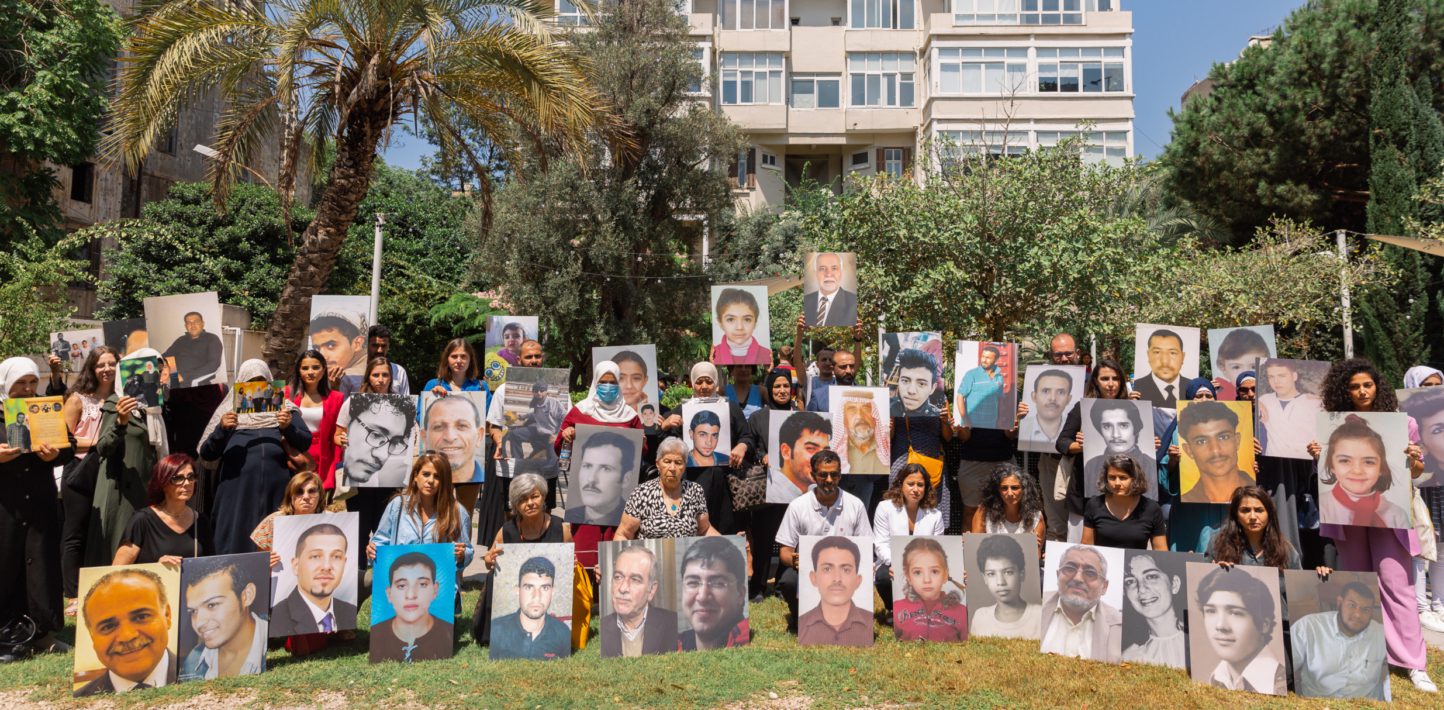
Family members of people who have been forcibly disappeared in the Middle East gather outside venue marking day of the disappeared in Beirut holding photos of their missing loved ones.

On 30 August 2023, Amnesty International reported on that Representatives of the families of people forcibly disappeared in Iraq, Lebanon, Syria and Yemen gathered in Beirut to demand that their governments uphold their rights to truth, justice and reparation, during an event organized by AI to mark the International Day of the Victims of Enforced Disappearances.    

Across the Middle East, both state authorities and non-state actors, such as armed opposition groups, abduct and disappear people as a way to crush dissent, cement their power, and spread terror within societies, largely with impunity.   

While most governments in the region have not yet investigated disappearances nor provided accurate numbers of those missing or disappeared, civil society organizations and UN bodies have published estimated numbers of people abducted and disappeared in each country. These numbers in Iraq, Lebanon, Syria and Yemen, when multiplied by a conservative estimate of the total years these individuals have been missing, suggest that families have spent more than a million years waiting for answers – an agonizing length of time.  

In the face of their governments’ apathy and complicity for the crime of enforced disappearances, the families of the disappeared across the Middle East have led the charge, year after year, in demanding their right to know what happened to their loved ones and to get justice and reparation – often at great personal risk,” said Aya Majzoub, Amnesty International’s Deputy Director for the Middle East and North Africa.   

“Today we honour their perseverance and add our voice to theirs in calling for authorities to take real action to investigate these crimes, hold those suspected of criminal responsibility accountable and ensure these crimes are not committed again.”  

Iraq  

In Iraq, the UN estimates that between 250,000 to 1,000,000 individuals have been disappeared since 1968 – making it one of the countries with the highest number of disappearances in the world. Disappearances are still being carried out today at hands of militias affiliated with the government. Consecutive Iraqi governments have repeatedly failed to take meaningful steps to investigate disappearances or hold those suspected of criminal responsibility to account. Widad Shammari from Iraqi organization Al Haq Foundation for Human Rights, whose son has been missing since 2006, said: “I was a single protester until I met many others who shared my struggle, and we formed a strong coalition who fights for the truth for all the disappeared in the Arab region, not just Iraq.”  

Lebanon    

In Lebanon, the official estimate of those abducted or missing as a result of the 1975-1990 civil war is 17,415. Every year, on 13 April – the anniversary of the start of the Lebanese Civil War – the families of the missing and disappeared gather to mark the beginning of the conflict, repeating the mantra, “Let it be remembered, not repeated.”   

The Lebanese authorities granted amnesty to the perpetrators of crimes that occurred during the civil war, but after years of campaigning, in 2018, the families of the disappeared successfully pressured the government to acknowledge the disappearances that took place. The government also passed a law that established the National Commission for the Missing and Forcibly Disappeared with a mandate to investigate individual cases, locate and exhume mass graves and enable a tracing process.   

However, Wadad Halawani, whose husband was kidnapped in 1982 and who leads the Committee of the Kidnapped and Missing in Lebanon said: “Today, we raise our voice and shout out loud. The National Commission for the Missing and Forcibly Disappeared is 3 years old already. Only two years remain in its mandate. The Commission established a clear strategy for its work, but it cannot carry on without the needed financial and logistical support. The government must provide it with all the needed resources immediately.” 

Syria  

Since 2011, the Syrian authorities have forcibly disappeared tens of thousands of its actual or perceived opponents, including political activists, protestors, human rights defenders, journalists, lawyers, doctors, and humanitarian aid workers, as part of a widespread and systematic attack against the civilian population that amounts to crimes against humanity. Thousands have also gone missing after being detained by armed opposition groups and the so-called Islamic State. Given the Syrian government’s role in orchestrating the campaign of enforced disappearances, there has been total impunity for these crimes in Syria. The families have therefore resorted to international justice mechanisms.  

In a momentous victory for the families, on 29 June 2023, the UN General Assembly voted to establish an international institution dedicated to shedding light on the fate and whereabouts of those missing and disappeared since the start of the armed conflict in Syria.  

Fadwa Mahmoud from Families for Freedom, whose husband and son were disappeared in Syria in 2012 said: “We had big dreams in 2011. But we paid a very heavy price. My husband and son have been disappeared since September 2012… We faced our fears and raised our voice until it reached the United Nations …this [institution] is the product of our labour as the families of the detained…and this is its strength. We are demanding that we have an instrumental role in the institution.”

My husband and son have been disappeared since September 2012… We faced our fears and raised our voice until it reached the United Nations …this [institution] is the product of our labour as the families of the detained…and this is its strength.Fadwa Mahmoud from Families for Freedom, whose husband and son were disappeared in Syria in 2012

Yemen  

In Yemen, human rights organizations have documented 1,547  cases of disappeared and missing people since 2015. All parties to the conflict, including the Huthi de facto authorities and the internationally recognized government forces, are still committing these crimes with impunity at a time when the world’s attention has turned away. Since the Human Rights Council voted in 2021 to end the mandate of the Group of Eminent Experts, following heavy lobbying from Saudi Arabia, efforts to hold all those suspected of criminal responsibility accountable in fair trials and realize victims’ rights to reparations have stalled.   

The Abductees’ Mothers Association in Yemen said: “We were harassed and threatened and beaten-up during demonstrations, but we will not give up and we are determined at ensuring some progress every step of the way. We are not mothers of our own disappeared family members only; we consider ourselves mothers of every single disappeared person in the region and we will continue our fight for the truth for all of them.

See also: https://humanrightsdefenders.blog/2022/09/14/portraits-of-disappeared-defenders-paraded-in-bangkok/

https://www.amnesty.org/en/latest/campaigns/

Lebanon: human rights defenders use graffiti to express hope

January 24, 2020

The blue graffiti reads: “Oh, my wonderful country.” Photo by Nohad Elhajj.

Since the 17th of October 2019, Lebanon has been in the grips of widespread public protests against the social, economic, and political conditions of the country. The protesters are holding the government accountable for degrading living conditions and demanding serious and drastic changes. ….. But something, equally alive, captivates the place: graffiti. Building walls, stone barriers, wooden panels, even the asphalt ground are all covered with graffiti. With their diverse slogans, creative motifs, and direct, uncensored political and social messages, the graffiti artists collectively illustrate the people’s discourse demanding a full-fledged social and political reform.

On 23 January 2020 Nohad Elhajj – a development practitioner and independent researcher – wrote an interesting piece on this aspect in Global Rights, with rich illustrations:

….. reflecting on the present status of human rights and the human rights movement is of utmost need. More importantly, we need to consider questions about the future of those rights and this movement. In his 2019 article, Thomas Coombes offers a new way to address the future of Human Rights with “hope-based communication” [see: https://humanrightsdefenders.blog/2019/05/30/positive-communication-is-the-only-way-forward-for-effective-human-rights-work/]….

Graffiti is defined as “a form of visual communication, usually illegal, involving the unauthorized marking of public space by an individual or group”. The definition by itself poses a duality; would unauthorized marking of public space become positive communication? Would it possibly shift perspectives? Maybe not all, but some graffiti certainly does convey political messages. The question here is not about authority per se but the disruption of this authority. The act itself is intrinsically disruptive and political whether graffiti is acceptable or not. Starting from this understanding, graffiti, as a visual act, then can be leveraged as a participatory and accessible medium to shift public perspectives on human rights issues. Yet, the human rights movement does not only need to shift the public opinion but also to shift the current governance structures, which is beyond the impact of graffiti. The graffiti in Riyad El Soloh Square is a good illustration of this.

Graffiti is not new to the Lebanese society, but revolution graffiti is particular and powerful because of its relevance, the messages it conveys, and the places it occupies to convey these messages. The graffiti artists practiced their right to freedom of expression, of peaceful assembly and association, while communicating, directly and clearly, human rights demands from women rights, LGBTQ rights, economic and social rights to civil and political rights. (Shown in Pictures below).

……
The Lebanese graffiti artists have pushed and merged both boundaries of political participation and art. The graffiti imposes itself on the observer and on the spaces it occupies with wit and audacity. It overwhelms the observer with emotions of anger, despair, longing and revolt but also with hope. Much of this street art offers a thought-provoking mosaic of entangled messages and images. The graffiti above shows a white pigeon (a recurring image) combined with a strong slogan about workers’ rights; this combination conveys that those rights, and other demands, will be achieved in the future.

Similar to that, the graffiti at the beginning of this article offers another perplexing combination. The whole piece can be read as: “Oh my wonderful country, sectarianism burned us”. As much as it articulates a cry of despair with hurt and agony, it also retains the image of a wonderful country before civil war and a political system that has crippled it for the past 45 years. The generation who lived the war is still lamenting it and the following generations were still living in the resulting divisions and sectarianism—up until the 17th of October 2019. Akin to the protests, the graffiti captured a future hope of a country that will regain its glory after necessary social and political change.

The artists’ urge to mark every visible surface around Riad El Soloh square with spray paint and brushes placed them right in the middle of an already contested political and social scene, and it placed the rights discourse in the middle and around this scene. This graffiti proved to be a strong visual expression of all the protesters’ demands and a way to engage the public with it, both inside and outside Lebanon. Through their paint, these graffiti artists created a distinctive, unprecedented, and positive narrative about human rights in Lebanon: a narrative that more and more organizations and activists are now hanging onto.

https://www.openglobalrights.org/graffiti-creates-positive-human-rights-narratives-in-lebanon/


Iran — Can Human Rights Defenders start thinking about a safe return?

November 19, 2013

#Iran-can-activists-return

Things are clearly changing in Iran. It is too early to think that human rights defenders can all safely go back, but the fact that Arseh Sevom – a moderate and informative blog voice on Iran –  devotes a part of today’s post by Peyman Majidzadeh to this question is telling. Here are some excerpts: Read the rest of this entry »

Job opportunity in Beirut for Communication Officer, deadline 7 October

October 2, 2013

Justice without Frontiers (JWF) a secular, nonprofit, NGO in Lebanon seeks a (part-time) Communication Officer whose key responsibilities are:

● To develop and implement an integrated media strategy

● To document the process of preparation of JWF activities

● Deliver high quality local, national (and in some instances international) media coverage for JWF projects.

● Responsible for delivering accurate, timely and compelling information and stories that illustrate and raise the profile of projects implemented by JWF.

● Write & produce content – for the website and external media outlets such as Facebook sub-pages, e-actions, emails, and web pages.

● Monitor and evaluate media coverage generated and to draw lessons to improve coverage.

● Build and maintain excellent relationships with key media players, journalists and broadcasters in Lebanon and regionally and internationally.

● Develop and regularly maintain a national database of media contacts.

● Coordinate the production of IEC materials related to the project: billboard-posters-pamphlets-newsletter-song&hellipetc

● Review and assist in the development of proposals, progress reports, and final reports as per donor requirements

Among the Qualifications and Competencies:

● A Bachelor’s degree in journalism or related field.

● Knowledge of local, national and international media (including press, internet, print)

● Native Arabic and excellent English skills (writing, reading, and correspondence).

● IT skills (Word, Excel, power point&hellip)

To Apply:  submit a cover letter describing your experience what you would bring to the organization, and your salary requirements; along with a CV and contact information for three professional references; and send to: jwficc@yahoo.com; jwf@jwf.org.lb by October 7, 2013.

http://www.jwf.org.lb/about/