Posts Tagged ‘annual report 2023’

Report on four areas where synergies in human rights and anti-crime regimes should be enhanced

December 29, 2023

On 27 Dec 2023 Ana Paula Oliveira posted for Global Initiative on the Report of an interesting topic: the convergences between organized crime and human rights agendas, as well as communities’ responses to mitigate the negative impact of organized crime on human rights over the past year.

The Vienna Declaration and Programme of Action (VDPA), which in 2023 celebrated 30 years since it was adopted….Global issues such as digitization, climate change and conflict pose multiple challenges to human rights. Organized crime cuts across many of these challenges. In this context of reflection on the effectiveness of the human rights framework, the Global Initiative Against Transnational Organized Crime (GI-TOC) has worked to raise awareness of the convergences between organized crime and human rights agendas, as well as communities’ responses to mitigate the negative impact of organized crime on human rights over the past year. In 2023, the topic was selected for the GI-TOC’s Resilience Fund Fellowship. In this context, the Fund organized its first in-person Fellowship meeting with a group of grantees and Fellows to discuss pressing human rights implications of organized crime. The meeting provided a platform for the Fellows to share experiences and current challenges related to the human rights impact of organized crime in their communities.

Building on this work, the GI-TOC, with the support of the Sector Programme on Human Rights of the Deutsche Gesellschaft für Internationale Zusammenarbeit (GIZ) on behalf of the Bundesministerium für wirtschaftliche Zusammenarbeit und Entwicklung (BMZ) and the government of Norway, launched the first institutional report on the issue, ‘Four reasons why organized crime is a human rights issue’ during the 24-hour Organized Crime Conference (OC24). This report draws attention to four areas where synergies in human rights and anti-crime regimes should be enhanced, so that safeguards for human rights are woven into states’ policy responses to transnational organized crime.

As a final 2023 activity and part of the series of follow-up events to celebrate the 30th anniversary of the VDPA (VDPA+30) and the 75th anniversary of the UDHR, the GI-TOC organized a series of events to raise awareness of the intersection between organized crime and human rights in Vienna with the support of the Government of Austria. The programme comprised a two-day expert group meeting held from 29 November to 30 November in Vienna and a public event. The expert group meeting (EGM) brought together experts based in Vienna and selected global experts (comprising academia, non-governmental organizations, and representatives from international and grassroots organizations) from both the human rights and crime prevention fields to discuss the multifaceted interactions between organized crime and human rights. It was designed to spark discussion on organized crime as a global challenge that keeps human rights from being fulfilled, based on our research and evidence on the issues.

During this series of discussions, the GI-TOC also hosted a public panel at the Vienna Diplomatic Academy. This was followed by a reception where participants could engage more informally. This event reflected on high-level principles, community experiences and responses, as well as the dissemination of community tools to respond to organized crime violence through a human rights lens.

This report summarizes the key points discussed in this series of events and proposes a way forward for those who want to pursue further work on the issue.

https://globalinitiative.net/analysis/human-rights-responses-organized-crime/
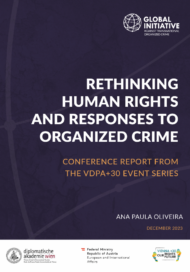
Conference report

CIVICUS 2023: almost one third of humanity now lives in countries with ‘closed’ civic space

December 7, 2023

The CIVICUS Monitor, which tracks freedom of association, peaceful assembly and expression in 198 countries and territories, announced in a new report – “People Power Under Attack 2023” – that almost one third of humanity now lives in countries with ‘closed’ civic space.

This is the highest percentage –30.6% of the world’s population– living in the most restrictive possible environment since CIVICUS Monitor’s first report in 2018. Meanwhile, just 2.1% of people live in ‘open’ countries, where civic space is both free and protected, the lowest percentage yet and almost half the rate of six years ago.

We are witnessing an unprecedented global crackdown on civic space,” said CIVICUS Monitor lead researcher Marianna Belalba Barreto. “The world is nearing a tipping point where repression, already widespread, becomes dominant. Governments and world leaders must work urgently to reverse this downward path before it is too late.

The CIVICUS Monitor rates each country’s civic space conditions based on data collected throughout the year from country-focused civil society activists, regionally-based research teams, international human rights indices and the Monitor’s own in-house experts. The data from these four separate sources are then combined to assign each country a rating as either ‘open,’ ‘narrowed,’ ‘obstructed,’ ‘repressed’ or ‘closed.’

Seven countries saw their ratings drop this year. These include Venezuela and Bangladesh, each now rated ‘closed’ due to intensifications of existing crackdowns on activists, journalists and civil society.

Democratic countries slipped too. Europe’s largest democracy, Germany, fell from ‘open’ to ‘narrowed’ amid protest bans and targeting of environmental activists. Bosnia & Herzegovina also declined to ‘obstructed,’ the twelfth European country downgraded since 2018.

One of 2023’s most dramatic slides occurred in Senegal, once considered among West Africa’s most stable democracies. Senegal entered the ‘repressed’ category amid sustained government persecution of protesters, journalists and opposition ahead of February elections.

“The range of countries where authorities restricted citizen participation in 2023 shows clampdowns are not isolated incidents but are part of a global pattern,” said Belalba. “A global backslide requires a global response. If citizens are not able to freely gather, organise and speak out, the world will not be able to solve inequality, confront the climate crisis and bring an end to war and conflict.”

CIVICUS Monitor data shows that worldwide, authorities target people’s freedom of expression above all else. Half of all documented violations in 2023 targeted free speech, with incidents ranging from a bombing outside a journalist’s house in Indonesia, the arrest of the head of a radio station in Tunisia and police pepper-spraying a reporter covering a protest in the United States.

Our research also reveals that intimidation is the number one tactic to restrict citizen freedoms. Human rights defenders, activists and media experienced intimidation in at least 107 countries. Media in particular bear the brunt, with 64% of incidents targeting journalists.

Despite these alarming trends, People Power Under Attack 2023 highlights areas of progress too. Timor-Leste’s civic space moved up to the second best rating ‘narrowed’ from ‘obstructed,’ reflecting the country’s commitment to fundamental freedoms. Four other countries saw ratings improve, though they remain in ‘repressed’ or ‘obstructed’ zones.

The report also details bright spots where countries made steps toward opening societies. Among these, Fiji repealed a restrictive media law. The Kenyan courts recognised the right of LGBTQI+ people to associate. Even Tajikistan, rated ‘closed,’ created a national human rights strategy with civil society input. Still, these and other improvements remain halting and often disconnected compared to widespread repression.

“These small steps show that even amid unprecedented restrictions, civil society is pushing back,” said Belalba. “These courageous acts of resistance by active citizens and civil society organisations give us hope that the downward trend is not permanent and can be reversed.”

See also: https://humanrightsdefenders.blog/2022/01/18/2021-global-data-report-from-the-civicus-monitor/

To access the full CIVICUS Monitor report, please visit monitor.civicus.org

https://www.rfa.org/english/news/vietnam/vietnam-civicus-report-12072023001010.html

ISHR launches its 2023 Annual Report, highlighting ‘wins’

April 25, 2023

Human rights defenders around the world are coming together in powerful coalitions and turning to international human rights laws and systems to achieve justice and accountability. And while the threats and challenges remain enormous, we’re starting to win! says ISHR in its latest annual report, outlining key impacts during the last year and its vision for 2023 and the years ahead.

Here are just a few examples:  In July 2022, a coalition of more than 1200 NGOs from almost 150 countries secured a win for equality with the renewal of a vital international mechanism to combat violence and discrimination on the grounds of sexual orientation or gender identity. Just a few weeks later, land, environment and indigenous rights defenders secured a win for climate justice with the landmark recognition of the right to a clean, healthy and sustainable environment at the UN General Assembly. Wins for accountability were achieved in April and October when international, regional and national civil society organisations coordinated successful campaigns to suspend Russia from the UN Human Rights Council and establish an independent international expert monitoring mechanism on the human rights situation in the country. International human rights organisations and Uyghur communities came together to score a win against impunity in August by securing the release of a landmark UN Rights Office report on the human rights crisis in Xinjiang, as well as the first ever formal initiative on China at the Human Rights Council just weeks later in September.

See more achievements by visiting the website!
In a recent conversation with Björk, environmental activist Greta Thunberg reflected that hope is not something you feel, but something you do. ‘When people act,’ she said, ‘they create hope’. In 2023, fuelled by indignation and sustained by hope, ISHR’s commitment is to provide solidarity to defenders, contribute to positive momentum and, with your support, achieve even more significant human rights wins!

https://mailchi.mp/ishr/ishrs-human-rights-council-monitor-june-33837?e=d1945ebb90

The 2023 CIVICUS State of Civil Society Report is out

March 30, 2023

On 30 March 2023 the CIVICUS State of Civil Society Report 2023 was published. This is the world as captured by the report:

[for last year’see: https://humanrightsdefenders.blog/2022/06/29/civicus-state-of-civil-society-report-2022/]

Vast-scale human rights abuses are being committed in Ukraine, women’s rights have been trampled on in Afghanistan and LGBTQI+ people’s rights are under assault in Uganda, along with several other African countries. Military rule has been normalised in countries such as MaliMyanmar and Sudan, and democracy undermined by autocratic leaders in El SalvadorIndia and Tunisia, among others. Even supposedly democratic states such as Australia and the UK are undermining the vital right to protest.

But civil society continues to strive to make a crucial difference to people’s lives. It’s the force behind a wave of breakthroughs in respecting abortion rights in Latin America, most recently in Colombia, and in making advances in LGBTQI+ rights in countries as diverse as BarbadosMexico and Switzerland. Mass protests in response to the high cost of living have won concessions on economic policy in countries including Ecuador and Panama, while union organising has gained further momentum in holding big-brand companies such as Amazon and Starbucks to account. Progress on financing for the loss and damage caused by climate change came after extensive civil society advocacy. The events of the past year show that civil society – and the space for civil society to act – are needed more than ever.

Key findings

  • Civil society is playing a key role in responding to conflicts and humanitarian crises – and facing retaliation

Civil society is playing a vital role in conflict and crisis settings – including in conflicts in Ethiopia, Syria and Ukraine – providing essential services, helping and advocating for victims, monitoring human rights and collecting evidence of violations to hold those responsible to account. But for doing this, civil society is coming under attack.

  • Catastrophic global governance failures highlight the urgency of reform

Too often in the face of the conflicts and crises that have marked the world over the past year, platitudes are all international institutions have had to offer. Multilateral institutions have been left exposed by Russia’s invasion of Ukraine. It’s time to take civil society’s proposals to make the United Nations more democratic seriously – starting with the appointment of a civil society champion.

  • People are mobilising in great numbers in response to economic shock – and exposing deeper problems in the process.

As it drove a surge in fuel and food prices, Russia’s war on Ukraine became a key driver of a global cost of living crisis. This triggered a mass wave of protests in at least 133 countries – from Argentina to Indonesia and from Ghana to Kazakhstan – demanding economic justice. Civil society is putting forward progressive economic ideas, connecting with other struggles for rights, including for climate, gender, racial and social justice.

  • The right to protest is under attack – even in longstanding democracies

Many states, unwilling or unable to concede the deeper demands of protests have responded with violence, including in IranSierra Leone and Sri Lanka. The right to protest is under attack all over the world, including when people are mobilising to seek economic justice, democracy, human rights and environmental action. Civil society groups are striving to defend protest rights.

  • Democracy is being eroded in multiple ways – including from within by elected leaders

Economic strife and insecurity are providing fertile ground for the emergence of authoritarian leaders. In more democratic contexts, there are distinct trends of a further embrace of far-right extremism, and of the rejection of incumbency. In volatile conditions, civil society is working to resist regression and keep making the case for inclusive, pluralist and participatory democracy.

  • Disinformation is skewing public discourse, undermining democracy and fuelling hate

Disinformation is being mobilised, particularly in conflicts and during elections, to sow polarisation, normalise extremism and attack rights. Powerful authoritarian states and far-right groups are key sources, and social media companies are doing nothing to challenge a problem that’s good for their business model. Civil society needs to forge a joined-up, multifaceted global effort to counter disinformation.

  • Movements for women’s and LGBTQI+ rights are making gains against the odds

In the face of difficult odds, civil society continues to drive progress on women’s and LGBTQI+ rights. But breakthroughs have made civil society the target of a ferocious backlash. Civil society is working to resist attempts to reverse gains and build public support to ensure that legal changes are backed by shifts in attitudes.

  • Civil society is the major force behind the push for climate action

Civil society continues to be the force sounding the alarm on the triple threat of climate change, pollution and biodiversity loss. Civil society is urging action using every tactic available, from street protest and direct action to litigation and advocacy in national and global arenas. But the power of the fossil fuel lobby remains undimmed and restrictions on climate protests are burgeoning. Civil society is striving to find new ways to communicate the urgent need for action.

  • Civil society is reinventing itself to adapt to a changing world

In the context of pressures on civic space and huge global challenges, civil society is growing, diversifying and widening its repertoire of tactics. Drawing on its special strengths of diversity, adaptability and creativity, civil society continues to evolve. Much of civil society’s radical energy is coming from small, informal groups, often formed and led by women, young people and Indigenous people. There is a need to support and nurture these..

Interviews For more information or to arrange an interview, please contact: media@civicus.org 

https://www.civicus.org/index.php/media-resources/news/6339-civil-society-in-a-world-of-crisis-2023-civicus-state-of-civil-society-report