Human Rights Watch Uploaded on this video some time back on 20 April 2011, but I had missed it. Insiders will recognize the face and voice of Reed Brody, who has made chasing dictators (such as Baby Doc and Hissene Habré (see below) his life’s vocation.Read the rest of this entry »
Human rights defenders Messrs He Jun Ling, Gao Yue Qiang, Liu Xiangying, and Wang Xian Jie will go on a joint trial from 4 to 8 March 2013, reports Front Line Defenders.He Jun Ling, Gao Yue Qiang Liu Xiangying, and Wang Xian Jie are human rights defenders who were employed by the state controlled public transport operator SMRT Ltd. More than 100 mainland Chinese bus drivers refused to report for duty on the 26th of November 2012. It took some time for authorities to label the stoppage an ‘illegal strike’. Once that happened, things moved quickly. 29 drivers accused of participating in the action were swiftly rounded up and deported. Five men were also arrested. One has already been tried, jailed and sent back home. The others – He Jun Ling, Gao Yue Qiang, Liu Xiang Ying and Wang Xian Jie – are waiting for their cases to be heard. They are currently facing charges of inciting an illegal strike among bus drivers, and could be sentenced to a fine of 2,000 Singapore dollars (approx €1,250), a 12-month prison sentence or both.He Jun Ling and Liu Xiangying revealed last week that were assaulted by police officials while they were held in custody in December 2012. According to the information received, He Jun Ling was interrogated from 5am to 1pm, during which time he was locked in a small room, handcuffed, and beaten in the stomach. Liu Xiangying reported that an official threatened him, stating that “they can dig a hole and bury him. No one will be able to find him.” He was also handcuffed to a chair and beaten in his neck and the left side of his body. Read the rest of this entry »
Mr. Khalil Maatouk is a human rights lawyer who has defended numerous prisoners of conscience before Syrian courts. He was arrested with a friend by armed men on October 2, 2012 (!!) at a checkpoint in Sahnaya (in the countryside outside of Damascus). Since then, 139 days later, no further information could be obtained regarding his situation and whereabouts. Neither of the men has been seen since, although even the already extensive period of legal custody of 60 days elapsed. Despite repeated requests by his relatives and lawyers, the Syrian authorities have failed to provide information on Mr. Khalil Maatouk’s fate and whereabouts and did not allow him to contact his family and lawyers. While two witnesses claimed having seen Mr. Maatouk in a detention centre, the judicial authorities have recently denied holding him in custody.
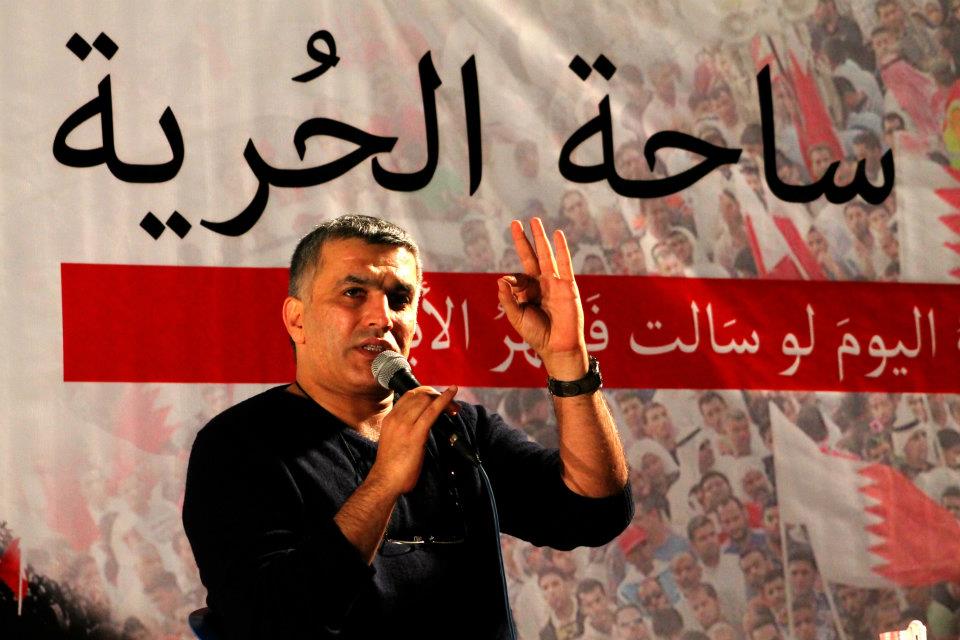
The Observatory for the Protection of Human Rights Defenders, a joint programme of the International Federation for Human Rights (FIDH) and the World Organisation Against Torture (OMCT), published on 14 February 2013 a report, which presents the findings of a judicial observation mission conducted on the trial in appeal of prominent human rights defender Nabeel Rajab. The report concludes that a series of violations of the right to fair trial marred the judicial process and that Nabeel Rajab is suffering judicial harassment (and was sentenced to 2 years imprisonment) for merely advocating for and exercising the right to peaceful assembly in Bahrain. The report is available in English and Arabic.
Nabeel Rajab is President of the Bahrain Centre for Human Rights (BCHR) and Director of the Gulf Centre for Human Rights (GCHR), Deputy Secretary General of FIDH, and the BCHR was 2012 nominee for the MEA. Read the rest of this entry »
On 15 February 2013 News.az (an Azeri news agency) distributed under the title “Western human rights defenders’ silence shows double standards” a bit of a rambling attack on western-based international organizations and human rights defenders for using double standards by being quickly critical of repression of journalists in the ‘new democracies’ such as Azerbaijan and being silent with regard to similar repression in western Europe.
The 15 February piece is mostly based on an interview with Eynulla Fatullayev, editor of the website Haqqin.az, who stated that the case of journalists from News of the World is a high-profile case, and certainly should be considered in the plane of restrictions on the rights of journalists to work freely. What the article does not state is that on 22 January of this year Amnesty International has announced the termination of its collaboration with Eynulla Fatullayev, a former prisoner of conscience, and head of the Public Association for Human Rights in Azerbaijan. Amnesty International believes that Fatullayev, and in particular, his site Haqqin.az, is used by the Government of Azerbaijan to discredit European criticism of human rights violations in Azerbaijan. In 2011 Amnesty International had issued a “mass tweet” on Fatullayev’s behalf; Fatullayev attributed his release inter alia to the work of Amnesty International activists.
In the interview Eynulla Fatullayev states among others the following:“I am more than sure that if a similar event occurred in Azerbaijan or in another state, located in the zone of the new democracies, it would be followed by statements by most international organizations condemning the policy of the authorities to the persecution of media. Why in the case of the United Kingdom or other EU countries, all these organizations remain strangely silent?” Read the rest of this entry »
More than two months after his arrest, the whereabouts of human rights defender and religious leader Imam Baba Leigh continues to remain unknown. Imam Baba Leigh was taken from his home on 3 December 2012 by two men believed to be part of the Gambia‘s National Intelligence Agency. Imam Baba Leigh is a religious leader and an active human rights defender. He serves as a religious advisor for The Gambia Committee on Traditional Practices (GAMCOTRAP), an organisation working in the area of sexual and reproductive health and the rights of women and children. He is known as an outspoken campaigner who has aptly used his religious status to advocate for human rights and social reform. Read the rest of this entry »
The recent killing of Dalit human rights defender Mr Chandra Kant Gaikwad shows that a democratic system is not enough to guarantee a peaceful progressive development. If the leaders of the victims are not protected and the powerful feel free to kill with impunity, this is what happens according to a report by Front Line…….
reported that on 13 February 2013, three pellets were fired at the vehicle of Father Alberto Franco, a prominent human rights defender and Executive Secretary of the Comisión Intereclesial de Justicia y Paz – CIJP (Inter-Church Commission for Justice and Peace). The CIJP is a church-based human rights organisation working to expose human rights violations committed by state security forces and paramilitary groups in conflict regions in Colombia. The attack follows acts of surveillance and intimidation of Father Alberto Franco during recent weeks and coincides with the hearing of the case “Operation Genesis”, a joint military and paramilitary operation which resulted in the killing and forced disappearance of many civilians; a case which the CIJP has provided key evidence for. Read the rest of this entry »
reports that a new hearing on the case of human rights defender Bahtyar Mamedov is scheduled to start on 14 February 2013 at the Court of Grave Crimes in Baku. The human rights defender has been detained since 30 December 2011 on charges of “swindle” and “extortion accompanied by violence”. The trial under the charges of swindle has been ongoing since April 2012, despite a reported lack of evidence to support the case.
Bahtyar Mamedov is a defender of property rights and the legal representative of Baku inhabitants whose houses have been demolished. Bahtyar Mamedov subsequently discovered fraud with money due to be paid as compensation, allegedly involving a military unit commander, Shahin Sultanov. Bahtyar Mamedov was then accused himself of an alleged attempt on his part to extort money from Shahin Sultanov, which he strongly denies. During the initial three-month period ordered by the Court of Grave Crimes to investigate the charges of “extortion accompanied by violence”, no evidence was found to support the charges, yet the case was not closed. The prosecution subsequently opened a second case against Bahtyar Mamedov on charges of fraud. Until 5 November 2012, Shahin Sultanov, the alleged victim of the fraud, had not been questioned by the investigative team and did not respond to the summons to appear before the court. On 15 October 2012, he sent a declaration stating that he did not know Bahtyar Mamedov and that he had lodged a complaint against him according to information received from third persons, and that he has nothing against Bahtyar Mamedov.
Human Rights Watch issues a video and press release concerning a series of death threats made over the last four months to two lawyers who represent clients accused of homosexual conduct. Human Rights Watch on 13 February 2013 sent an open letter to President Paul Biya. Read the rest of this entry »
 Read the rest of this entry »

 The 15 February piece is mostly based on an interview with Eynulla Fatullayev, editor of the website Haqqin.az, who stated that the case of journalists from News of the World is a high-profile case, and certainly should be considered in the plane of restrictions on the rights of journalists to work freely. What the article does not state is that on 22 January of this year Amnesty International has announced the termination of its collaboration with Eynulla Fatullayev, a former prisoner of conscience, and head of the Public Association for Human Rights in Azerbaijan. Amnesty International believes that Fatullayev, and in particular, his site Haqqin.az, is used by the Government of Azerbaijan to discredit European criticism of human rights violations in Azerbaijan. In 2011 Amnesty International had issued a “mass tweet” on Fatullayev’s behalf; Fatullayev attributed his release inter alia to the work of Amnesty International activists.
 More than two months after his arrest, the whereabouts of human rights defender and religious leader Imam Baba Leigh continues to remain unknown. Imam Baba Leigh was taken from his home on 3 December 2012 by two men believed to be part of the Gambia‘s National Intelligence Agency. Imam Baba Leigh is a religious leader and an active human rights defender. He serves as a religious advisor for The Gambia Committee on Traditional Practices (GAMCOTRAP), an organisation working in the area of sexual and reproductive health and the rights of women and children. He is known as an outspoken campaigner who has aptly used his religious status to advocate for human rights and social reform.


