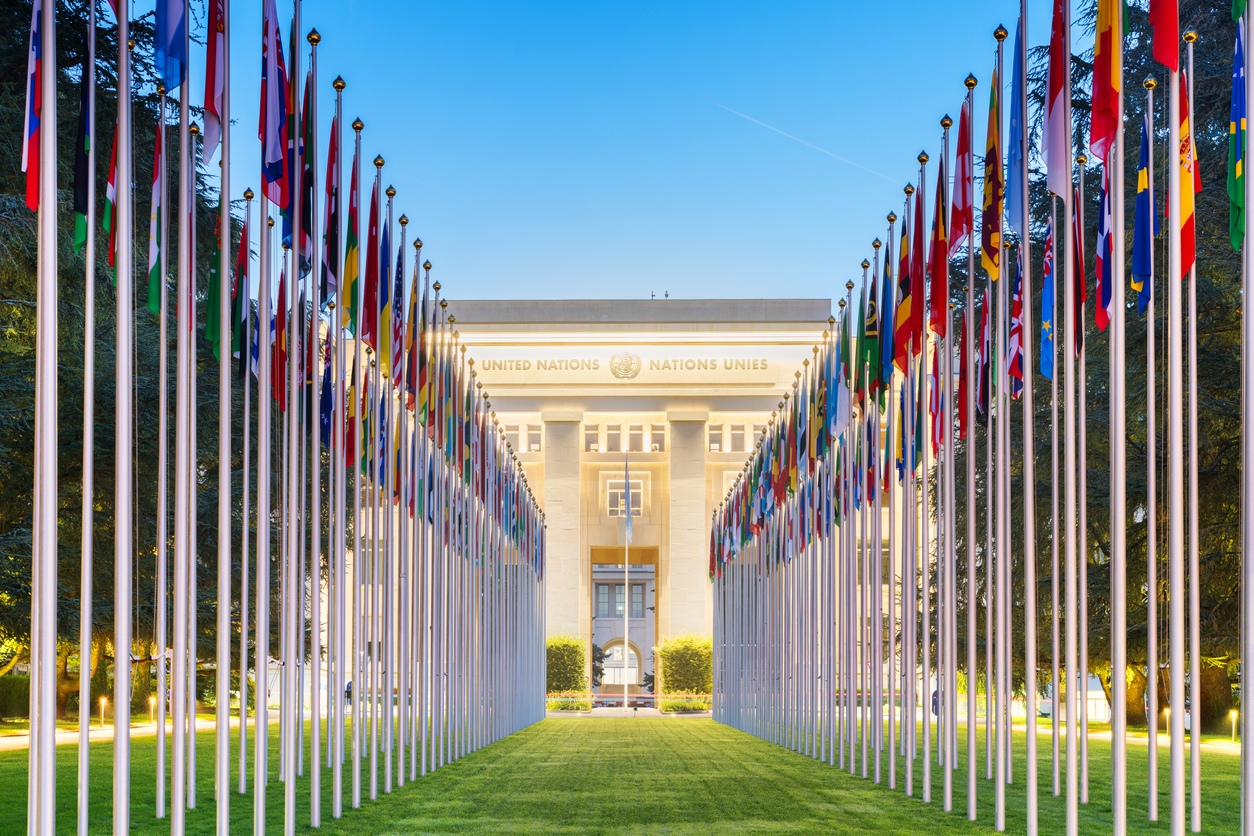
On 16 February, 2024 Sandra Epal Ratjen & Nicolas Agostini in Global Rights reported on a UN consultation on law enforcement’s role in peaceful protests which brought together practitioners and human rights defenders.
Over two days in Geneva, the UN special rapporteur on freedoms of peaceful assembly and association, Clément Voule, the UN Human Rights Office (OHCHR), and the UN Office on Drugs and Crime (UNODC) convened a consultation on the facilitation of peaceful protests by law enforcement. The event followed several regional workshops, organized in accordance with Human Rights Council resolution 50/21, which requested that the special rapporteur develop “technical and practical tools . . . to assist law enforcement officials in promoting and protecting human rights in the context of peaceful protests.” There was nothing unusual in this format—or in the event’s title. But despite its attractive feel (at least for human rights geeks), it ran the risk of turning into yet another academic discussion replete with theorizing but offering little in the way of practical solutions.
It turned out to be one of the most refreshing, engaging, and action-oriented human rights dialogues we’ve attended.
It’s about the makeup
What made the event rather unusual was its makeup. In addition to civil society members (public assembly, law enforcement, torture, and rule of law specialists attended), the consultation brought together practitioners from all over the world. By “practitioners,” we mean not just police watchdogs (oversight bodies and disciplinary authorities) but police officers and commanders, all on active duty.
While some activists would draw back with a wince, those human rights defenders and organizations who were present engaged with an open mind, as did law enforcement personnel. Participants weren’t going to talk amongst themselves or only preach to the converted. They were going to try to bring about an actionable outcome. After all, their aim was to devise how law enforcement can facilitate peaceful assemblies and protect rights in such contexts.
Peer pressure was minimal. On all sides, there was nothing to “prove”: no need to adopt an intransigent position, no need to show you’re smart, no need to cajole anyone—there were only incentives to share expertise and experience.
Sure, there were precedents. Recent workshops brought together practitioners and outlined best practices. For instance, the “Istanbul Process” meeting on promoting religious tolerance held in Singapore was practitioner-centric. Since then, however, the Istanbul Process has collapsed as the Organization of Islamic Cooperation (OIC) revived the “defamation of religions” agenda.
Without naïveté but considering the “real-world” nature of the outputs of this process, we’re confident that the work done under the auspices of Clément Voule, OHCHR, and UNODC will, to some extent, enhance human rights compliance in police practice and benefit both peaceful protesters and law enforcement officials. Notably, the outcome documents are less technical than most human rights documents.
It’s also about the substance
The consultation was also innovative because of its hands-on approach. In addition to the main working document, a “Model Protocol” for the law enforcement facilitation of peaceful protests, the project led by Clément Voule and his team, OHCHR, and UNODC will produce a “Handbook” and a “Checklist” for law enforcement professionals. The latter two will be practical documents guiding police practice.
The magnitude and diversity of experiences in the room meant that discussions were light-years away from sterile sloganeering or divisive debates—the kind we see on social media. On civil society’s side, no one advocated “defunding the police.” On the police side, no one advocated for qualified immunity. All participants created a fertile ground for dialogue on how to ensure human rights-compliant, competent, and respected law enforcement that is able to facilitate, not hinder, public assemblies.
Civil society participants recognized the need for well-funded, well-trained police. We kept in mind (and were reminded of) the realities of the job—what the average law enforcement officer faces daily. The challenges include understaffing, lack of adequate training, and, quite simply, fear (facing a crowd, even peaceful, will never feel like sitting on your sofa sipping a Whiskey Sour). Law enforcement participants, for their part, recognized the need for accountable police behavior and to confront discrimination and abuses of power. They kept in mind (and were reminded) that to be respectful is a sine qua non to be respected.
Also reviewed were “prior to protest,” “during protest,” and “after protest” issues, plus the situation of specific groups and accountability for violations. One section addressed police well-being, which is essential to human rights compliance, as strained police officers are much more likely to engage in misconduct. We didn’t shy away from addressing sensitive issues—police brutality, accountability, or budgeting.
It wasn’t an echo chamber, but participants agreed on key points. Among others: the role of police vs. the role of prosecution; the need for effective communication between protesters and police, de-escalation, and adequate training for police officers; or the fact that a clear distinction must always be made between peaceful and non-peaceful elements of an assembly.
It was a far cry from the way these conversations unfold online, and once again, one can see the toxicity of social media. Instead of fostering healthy discussions (differences aren’t that wide between most people), social media algorithms artificially promote simplistic views, entrench positions, and elevate the most divisive topics. This process distracts those seeking solutions from problem-solving. No one benefits from this situation—certainly not rights-holders.
Don’t forget political will
Assuredly, the outcomes of this consultation will go unheeded in many countries, where protests are rare or police have total impunity. Elsewhere, not much will happen without political will.
But the beauty of this consultation is that political will to facilitate assemblies won’t need to come from the highest level. Once publicly available, the outcome documents—particularly the Handbook and Checklist, with their guidelines on communication, de-escalation, and risk assessment regarding protests—will be available for law enforcement agencies and officers at all levels to use. The ideal scenario, of course, will be governments publicly committing to using the outcome documents.
The final documents will stem from a dialogue that brought together people with hands-on experience who tried to build bridges and maximize their chances of having an impact on the ground. This model should inform future human rights dialogues.
The Protocol, Handbook, and Checklist will be presented at the next session of the UN Human Rights Council, February 26–April 5, 2024. Clément Voule will make his last appearance as special rapporteur. For his successor—and for all people of goodwill who want to see peaceful protests proceed without hindrance, as well as rights-compliant law enforcement, joint work will be needed to popularize, operationalize, and implement the documents.
https://www.openglobalrights.org/sandra-Epal-Ratjen/Human-rights-dialogue-we-need

 Hans Thoolen on Human Rights Defenders and their awards