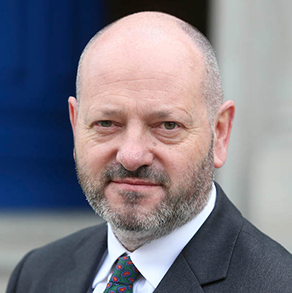
On 27 January 2023, it was announced that Andrew Anderson is stepping down as Executive Director of Front Line Defenders, after two decades of leading the organisation’s work to support and protect human rights defenders at risk.
Andrew joined the organisation as Deputy Director in 2003 and has since 2016 served as its second Executive Director.
“This February marks my 20th anniversary with Front Line Defenders, an organisation I have been honoured to lead. I think it is a good time for others to take on the leadership of this exceptional organisation,” said Andrew Anderson. “I am confident I am leaving an organisation that is in excellent shape with a hugely dedicated and talented staff team, a strong new Strategic Plan for 2023-27, robust funding and a track record of delivery on behalf of human rights defenders at risk.”
“Last year, the organisation delivered another record of over 1,000 protection grants to the most at risk HRDs around the world, including in severe crises such as Ukraine, Afghanistan, Iran and Myanmar. With over 100 defenders in attendance, the 2022 Dublin Platform last October was again a brilliant manifestation of the range and diversity of human rights defenders we are providing support to.”
Front Line Defenders expanded significantly in size and scope during Andrew’s tenure as Executive Director, further establishing the organisation as a trusted and central partner for HRDs at risk globally In 2018 the organisation was awarded the UN Prize for Human Rights.
The Board of Front Line Defenders has asked Olive Moore to take on the role of Interim Director, supported by the organisation’s management team. Olive has served as Deputy Director of Front Line Defenders since 2020, prior to which she held a range of roles working on human rights and humanitarian issues for Trócaire, Amnesty International, The World Bank and the Irish Government.
The Board will oversee a competitive, international recruitment process for a new Executive Director of Front Line Defenders to take forward the organisation’s work to support and protect human rights defenders.
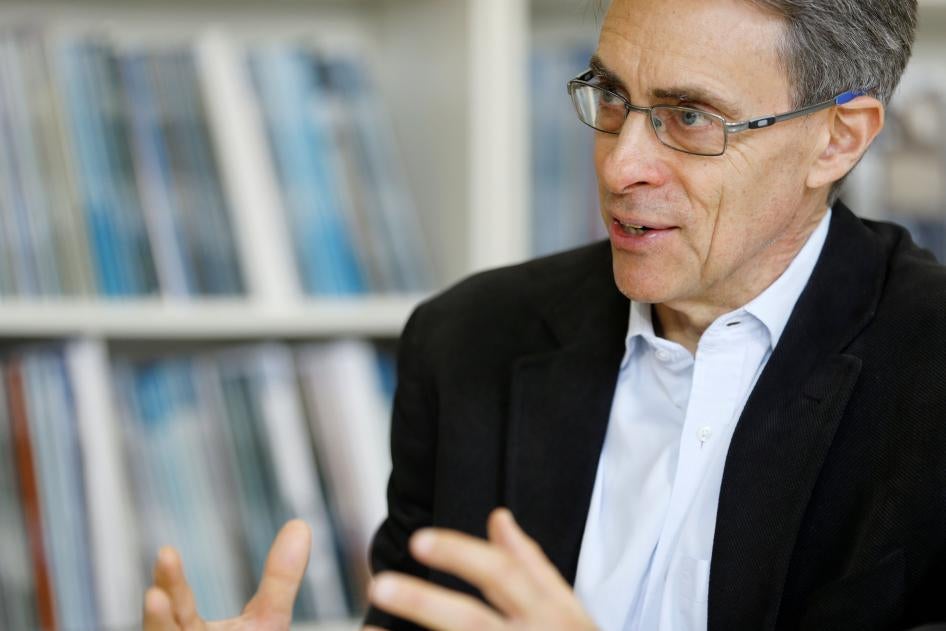
Human Rights Watch Executive Director Kenneth Roth has announced that he plans to step down at the end of August 2022, Human Rights Watch said on 26 April. Roth has led the organization since 1993, transforming it from a small group of regional “watch committees” to a major international human rights organization with global influence.
“I had the great privilege to spend nearly 30 years building an organization that has become a leading force in defending the rights of people around the world,” Roth said. “I leave Human Rights Watch with confidence that a highly talented and dedicated staff will carry on that defence with great energy, creativity, and effectiveness.”
Under Roth’s leadership, Human Rights Watch grew from a staff of about 60 with a $7 million budget, to 552 covering more than 100 countries and a nearly $100 million budget.
Roth began his human rights career as a volunteer, working on nights and weekends while serving as an attorney and a federal prosecutor. He joined Human Rights Watch in 1987 as deputy director. At the time, the organization consisted of Helsinki Watch, formed in 1978 to support dissident movements in Eastern Europe; Americas Watch, founded in 1981; and Asia Watch, formed in 1985. Shortly after Roth joined, the organization created Middle East Watch and Africa Watch. Early in his tenure, Roth moved the organization toward a single identity as Human Rights Watch…
Roth recognized the need for real time documentation of atrocities to generate immediate pressure to end them. That led to the creation of a group of specially trained researchers who could provide a surge capacity to the organization’s regular country researchers.
Roth also embraced new possibilities to bring perpetrators to justice. As Human Rights Watch researchers meticulously documented abuses, the organization pressed the United Nations Security Council, then in a more cooperative moment, to create international war crimes tribunals for the former Yugoslavia and Rwanda. Human Rights Watch research was used to build some of the cases, and staff testified at both UN tribunals. Human Rights Watch also played a prominent role in establishing the International Criminal Court, fending off pressure from the US government seeking to ensure immunity for its own forces.
“Ken’s fearless passion for justice, his courage and compassion towards the victims of human rights violations and atrocity crimes was not just professional responsibility but a personal conviction to him,” said Fatou Bensouda, former chief prosecutor of the International Criminal Court. “He has indeed been a great inspiration to me and my colleagues.”
Today, amid the horrific abuse taking place in Ukraine, an infrastructure is in place to hold perpetrators accountable.
Roth also created special teams to address the needs of certain marginalized people, including women, children, lesbian, gay, bisexual and transgender (LGBT) people, refugees, people with disabilities, and older people. He also oversaw the development of specialized programs on poverty and inequality, climate change, technology, and corporate social responsibility. In addition, he initiated a program to address human rights in the United States.
Roth changed the way that Human Rights Watch directed its advocacy. The organization began focusing mainly on US foreign policy. Roth globalized the organization’s advocacy, establishing offices in Brussels, London, Paris, Berlin, Stockholm, Tokyo, Sao Paolo, Johannesburg, and Sydney. He also spearheaded the organization’s work with the United Nations, with dedicated advocates in New York and Geneva.
After the 9/11 attacks, Human Rights Watch documented and exposed the use of “black sites” where US officials interrogated and tortured terrorism suspects. Under Roth, Human Rights Watch pressed the US government to investigate and prosecute those responsible for issuing the orders. Eventually the US Senate issued the Torture Report confirming Human Rights Watch’s findings and denouncing the Central Intelligence Agency’s use of torture.
“Ken Roth turned Human Rights Watch into a juggernaut for justice,” said Anthony Romero, executive director of the American Civil Liberties Union. “He has inspired a generation of human rights defenders to fight for a better world. During the so-called ‘war on terror,’ Ken went to Guantanamo and brought to bear his acumen and stature in exposing the farce of the military commission process. No organization and no leader have had a greater impact in human rights on a global scale.”
Human Rights Watch’s communication strategy evolved dramatically under Roth. The organization began by writing reports. Over time, it also began producing shorter and quicker reports and built a strong multimedia capacity, so that videos, photos, and graphics now routinely accompany the organization’s publications and sometimes are the publication itself. The organization also embraced social media. The organization has amassed nearly 14 million followers on the major social media platforms. Roth himself has more than half a million Twitter followers.
In his nearly 30 years at the helm of Human Rights Watch, Roth traveled the world, pressing government officials of all stripes to pay greater respect to human rights. He met with more than two dozen heads of state and government along with countless ministers and made investigative or advocacy trips to more than 50 countries. Whenever he could, he also met with communities affected by human rights violations. During his early years with the organization, he conducted fact-finding investigations himself, including in Haiti, Cuba, Israel-Palestine, Kuwait after the Iraqi invasion, and Serbia after the US bombing. In recent years, he has been especially concerned with addressing atrocities during the Syrian war as well as Chinese government repression in Xinjiang.
Roth inevitably earned many enemies. Despite being Jewish (and having a father who fled Nazi Germany as a 12-year-old boy), he has been attacked for the organization’s criticism of Israeli government abuses. The Rwandan government was particularly vitriolic in its criticism of Roth after Human Rights Watch, which had issued a definitive account of the genocide, also reported on atrocities and repression under President Paul Kagame.
The Chinese government imposed “sanctions” on him and expelled him from Hong Kong when he traveled there to release the annual World Report in January 2020, which spotlighted Beijing’s threat to the global human rights system. Roth responded to these and many other criticisms by noting that the organization employs the same fact-finding methodology and applies the same human rights principles in every country where it works.
Roth has written extensively on a range of human rights issues. In addition to writing the introduction to the World Report since 1990, he has published more than 300 articles including in the New York Times, The Washington Post, The Guardian, The New York Review of Books, Foreign Policy, and Foreign Affairs. I quoted him often in this blog: see e.g. : https://humanrightsdefenders.blog/tag/kenneth-roth/
Roth plans to write a book drawing on his personal experiences about the most effective strategies for defending human rights. “I am leaving Human Rights Watch but I am not leaving the human rights cause,” Roth said.
Human Rights Watch will conduct an open search for Roth’s successor. Tirana Hassan, chief programs officer, will serve as interim executive director.
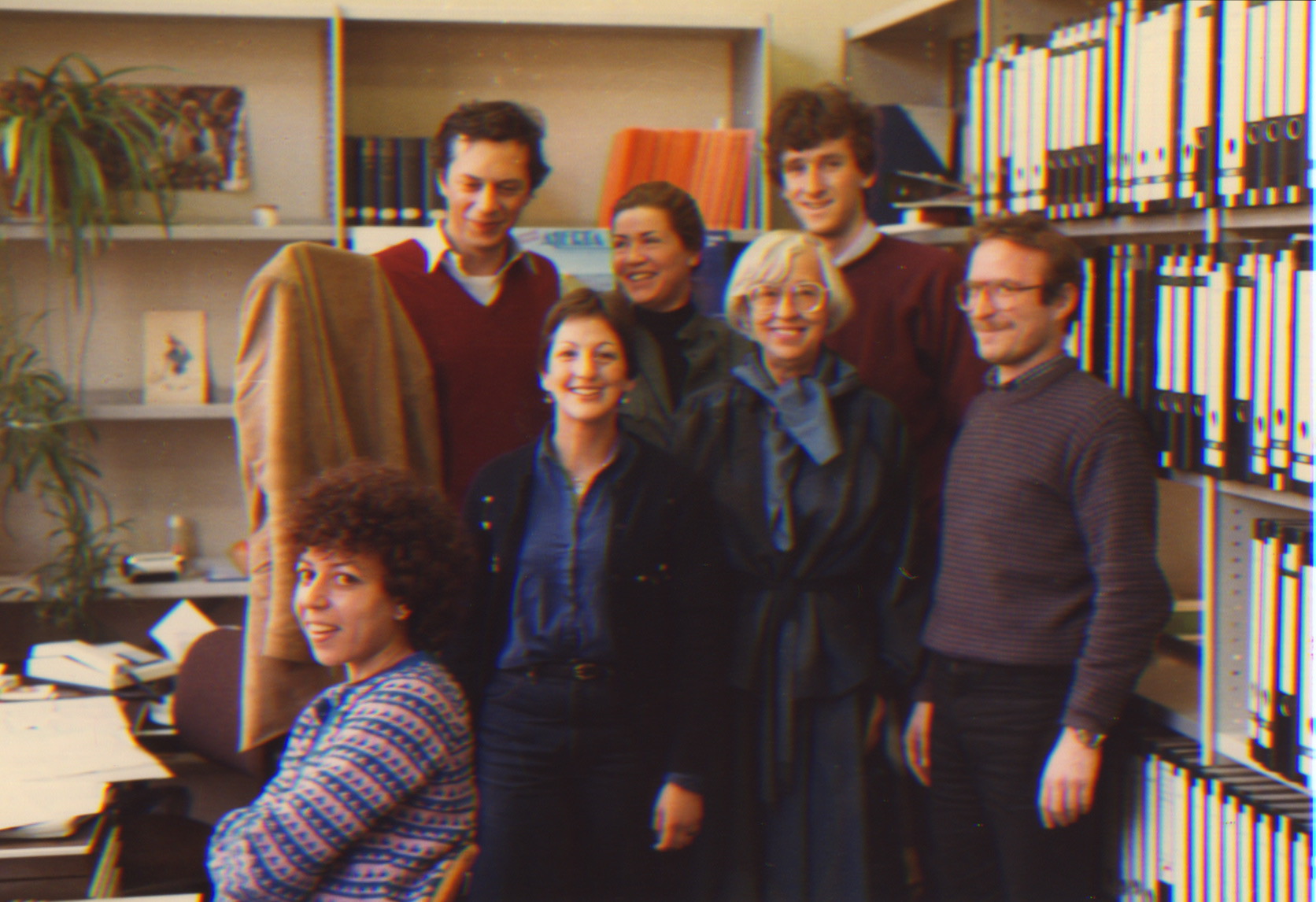
The SIM team in 1984, Bert Verstappen on the right
It is usually not a compliment when somebody is described as ‘furniture’. But Bert Verstappen, senior documentalist at HURIDOCS, is the exception. And the furniture in mind is an expensive, solid oak Dutch cupboard where all valuables are kept. Bert Verstappen – an historian by education – started working as a conscientious objector doing alternative service in the Netherlands Institute for Human Rights (SIM) in approximately 1983, soon after I became the founding director.
He proved his value immediately by working on themes such as documenting human rights violations and together we started a long term research project on the practice of fact finding by NGOs, which resulted in the first-of-its-kind publication of Human Rights Missions, a Study of the Fact‑Finding Practice ofNon‑governmental Organizations, published in 1986 by Martinus Nijhoff Publishers (ISBN: 90 247 3355 3). Morever, as SIM had become the initial ‘secretariat’ of the new HURIDOCS network created in 1982, Bert gave a lot of support to the fledgling unit. In 1987 HURIDOCS moved to Oslo and Bert moved with it, learned Norwegian very quickly and kept the flame burning for many years. He moved to Geneva with HURIDOCS after the big Crete conference in 1992.
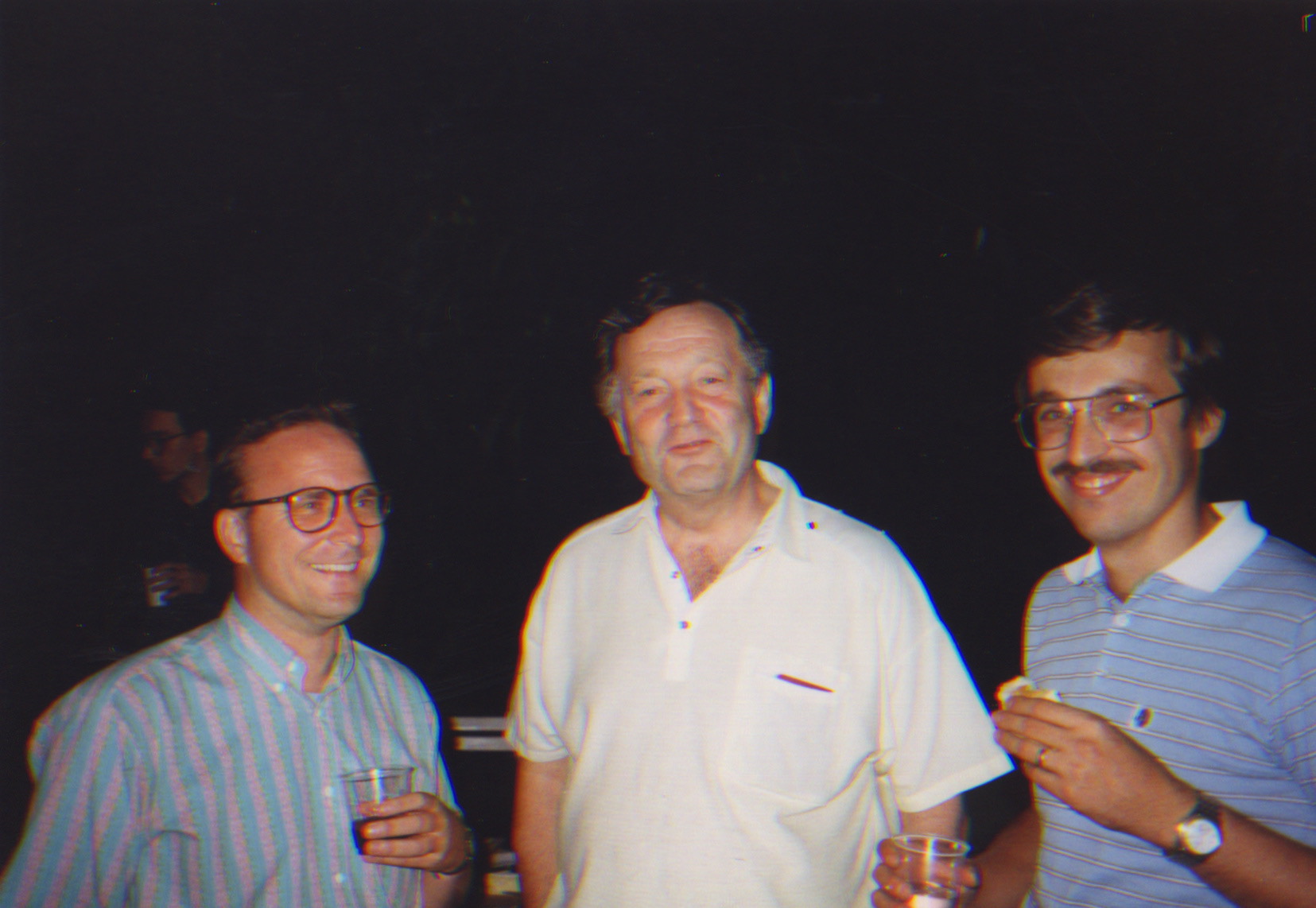
Bert (l.) 1993 in Geneva with Theo van Boven and Oldrich Andrysek
There he continued to coordinate the work of different task forces and co-authored essential HURIDOCS publications. He was involved in many capacity building projects, providing expertise mainly from the documentation angle. As from 1 October 2019 he goes into retirement but will remain involved in some HURIDOCS projects on a part-time basis until the end of the year, ensuring a “soft bertxit”.
“The development of new tools deeply changed HURIDOCS’ work throughout the years. We renew ourselves constantly. I have committed my career to this exciting challenge because I want to feel useful to human right defenders. Their courage is a source of inspiration for all of us” says Bert Verstappen on the HURIDOCS website
If you want to know more about the history of HURIDOCS in which Bert has played such an important role, see:
As some of you would know, after eight great years with Amnesty International, I am moving on. My time as Secretary General formally drew to a close on 8 July after the annual gathering of our global leadership in Poland. I wanted to take this opportunity to thank you for your important and generous support through this period – a turbulent time in the world at large, and a crucial transformation process internally. It is difficult to sum up eight years in a pithy way, but as we look back on the so-called Arab Spring, the Syrian conflict, spiralling refugee numbers, the social impact of government policies in the aftermath of the 2008 financial crisis, and the rise of popular authoritarians in many countries, it is clear that we have lived – and continue to live – through very challenging times. The voices of those who stand up against oppression and the abuse of power are more isolated but more important than ever. And Amnesty has played a vital role in supporting these voices. We have seen much fruit from the work in virtually every region of the world we have done together during this period – from the adoption of the Arms Trade Treaty to some important breakthroughs on corporate accountability, from another 10 countries abolishing the death penalty to the release of innumerable prisoners unjustly detained. We have built a new body of work on technology and human rights, ready to confront important new challenges ahead. We have also seen some crucial steps forward on women’s rights and have good reason to hope for much more progress in the coming months and years. Above all, it has been a privilege to work with so many extraordinary people from every part of the world. I will treasure the memories of so many courageous activists I have met during my time with Amnesty. For me, the biggest source of hope has always been people at the local level who refuse to accept injustice. During the past eight years we have had a strong focus on building a truly global human rights movement, particularly by rebalancing the centre of gravity from our traditional strongholds in the richer countries of the world towards a more distributed centre with a much stronger voice for the global south. The growth of Amnesty’s membership in key southern powerhouses such as Brazil, India, Indonesia, Egypt and Nigeria, has been very encouraging, and gives us stronger foundations for the future.
…….. I am delighted to hand over to my successor, Kumi Naidoo from South Africa, who will take up the reins on 15 August. Kumi is a well-respected activist and leader in the international NGO sector, having previously led Greenpeace International and CIVICUS. …
 Hans Thoolen on Human Rights Defenders and their awards