Posts Tagged ‘Christian Science Monitor’

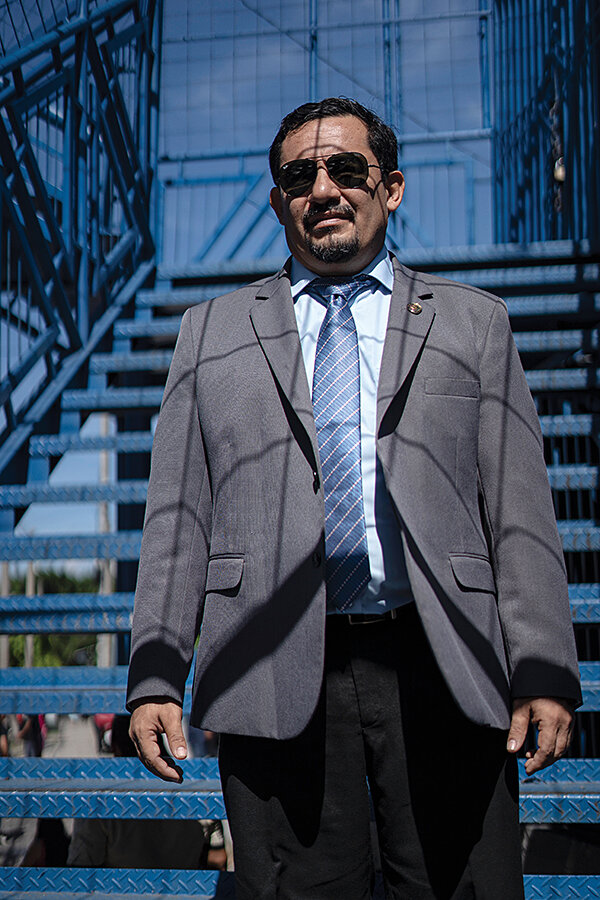
Meet lawyer Dennis Muñoz, human rights defender in El Salvador

October 31, 2023

The Christian Science Monitor of 30 October 2023, tells the story of attorney Dennis Muñoz who seeks to uphold human rights in El Salvador, despite increasingly difficult and dangerous odds.
Víctor Peña/Special to The Christian Science Monitor

Mr. Muñoz found a way to channel his deep-seated desire for justice by becoming a lawyer in 2005. But he doesn’t work with just anyone – he goes for the tough cases of human rights abuses. He has defended multiple women who suffered miscarriages but were accused of murder in a nation where abortion is banned without exception. He has fought arbitrary arrests of environmentalists, activists, and average citizens. He could be called a defender of lost causes.

There’s no shortage of demand for Mr. Muñoz’s work in El Salvador, which has the highest incarceration rate in the world. And these days the risks of his work are almost as high as the demand for it.

In March 2022, a monthlong “state of exception” was enacted in response to extreme gang violence. The order suspended basic constitutional rights for those arrested under it. Securing a court warrant before searching private communications was no longer required, for example, and arrestees were barred from their right to a defense attorney and their right to see a judge within 72 hours. 

But what started as an emergency measure has become ordinary practice. The state of exception has been extended every month for more than a year and a half now, with no end in sight. Violence has declined dramatically, but critics say the order’s extreme powers are seeping far beyond the gang-related arrests they were meant to address. Even those detained outside of the state-of-
exception category are having their rights suspended. 

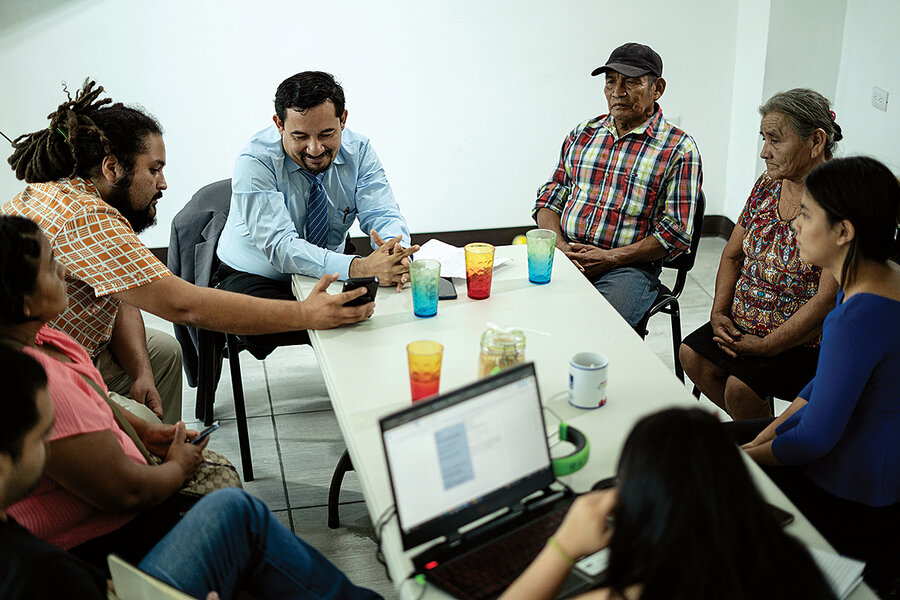
That’s the group Mr. Muñoz focuses on. While he has taken a few state-of-exception cases, he primarily works on human rights violations, with the added burden now of his clients getting caught in the emergency order’s crosshairs. Despite death threats and intimidation, he’s not slowing down. Instead, fellow lawyers doing similarly risky work ask him to be on call if – or, perhaps more likely, when – they themselves are arrested. 

… Despite quashing constitutional rights, the move has been overwhelmingly popular for providing a long-elusive sense of calm. 

A tired society, fed up with a lack of answers to the chronic problem of violence, is willing to accept short-term answers,” says Verónica Reyna, director of human rights for the Passionist Social Service, a nongovernmental organization focused on local violence prevention and support of human rights. 

Gustavo Villatoro, minister of justice and public security, acknowledges that the state of exception is affecting more than gang members. Over 7,000 innocent people have been arrested, Mr. Villatoro said in August, noting that some degree of error is inevitable. But the consequences of those errors can be grave. Even if a case has nothing to do with gang activity, lawyers can be blocked from visiting their clients in detention, and court hearings can be suspended. Over 71,000 Salvadorans have been arrested under state-of-exception rules. With 6 million people in El Salvador, close to 2% of the adult population is currently behind bars. And many of them, even those not under the emergency order, lack access to a lawyer and may be tried en masse.

Margaret Satterthwaite, the United Nations special rapporteur on the independence of judges and lawyers, tweeted in May that in El Salvador, “public defenders reportedly have 3-4 minutes to present the cases of 400 to 500 detainees.” She warned that “fair trial rights must not be trampled in the name of public safety.” 

In the last week of July, Salvadoran lawmakers eliminated a previous two-year limit on pretrial detentions and passed reforms to allow mass trials that could bring together 1,000 individuals in a single appearance before a judge.

Maybe they won’t let us be lawyers anymore,” says Mr. Muñoz, “at least not private attorneys with independent criteria.

The reforms have disrupted the whole system and have turned innocence into an exception,” says Ursula Indacochea, program director at the Due Process of Law Foundation, based in Washington. “Presumption of innocence is disappearing because the roles have shifted. The state no longer has to prove I’m guilty, but now I’m guilty and have to prove I’m innocent,” Ms. Indacochea said in a Sept. 7 radio interview in El Salvador. 

Of the 35,000 authorized lawyers registered in El Salvador, Mr. Muñoz stands out for almost exclusively taking cases of human rights violations.

“Things aren’t easy right now,” he says, describing the justice system as “made to convict.” The government is “criminalizing the job of lawyers,” he adds.

Yet Mr. Muñoz looked anything but cautious at a press conference in early July, where he was the only person wearing a suit at the San Salvador offices of the Christian Committee for Displaced People in El Salvador, a wartime human rights organization. He headed to the podium in the ample room, sparsely decorated with pictures of St. Óscar Romero, the archbishop of San Salvador murdered by right-wing death squads in 1980. 

Mr. Muñoz discussed openly a forbidden topic. Five environmentalists were arrested in January over the alleged 1989 murder of a Salvadoran woman during the war. The case was under a court-issued gag order.  

It’s very serious that environmentalists are being unjustly accused, bending [what are considered] the rules of due process anywhere in the world,” Mr. Muñoz said, staring into the cameras.

His clients in this case are former guerrilla members, and two of the accused are part of the Association of Economic and Social Development Santa Marta, known as ADES. One of the country’s oldest environmental organizations, ADES was key in achieving the total ban on mining here in 2017. In a country where almost the entirety of war crimes remain unresolved and defendants in active cases are rarely imprisoned, the arrest of these men was an outlier, apparently due to their vocal criticism of the government. The U.N. called for the activists’ immediate release. 

“Dare I say there are crimes being committed against these environmentalists,” Mr. Muñoz said before the media. “It’s nefarious that things like this happen in a country that calls itself democratic but really has a criminal injustice system in place.” 
Víctor Peña/Special to The Christian Science Monitor

By late August, Mr. Muñoz had successfully convinced a judge to grant an order for his clients’ release. “It’s a crumb of justice, but we shouldn’t celebrate until there’s a dismissal of proceedings,” he said at a later press conference.

It’s hard to reconcile this image of seeming fearlessness with Mr. Muñoz’s request when the Monitor approached him for an interview: Could the piece leave out his last name? The question reflects a sense of fear that has built up over many years of doing this work. 

Mr. Muñoz downplays receiving death threats, normalizing the culture of violence he’s lived under for most of his professional life. “They say they wish that I was extorted or killed because of the people I’ve defended,” he says about the social media threats. He thinks he’s been able to stay off the political radar by censoring his opinions. “I issue legal and technical opinions,” he explains. “Other colleagues have entered the political arena and expose themselves more to attacks.” 
https://www.csmonitor.com/World/Americas/2023/1030/Meet-Dennis-Munoz-defender-of-lost-causes-in-El-Salvador

More about MEA finalist Sizani Ngubane from South Africa

January 7, 2020
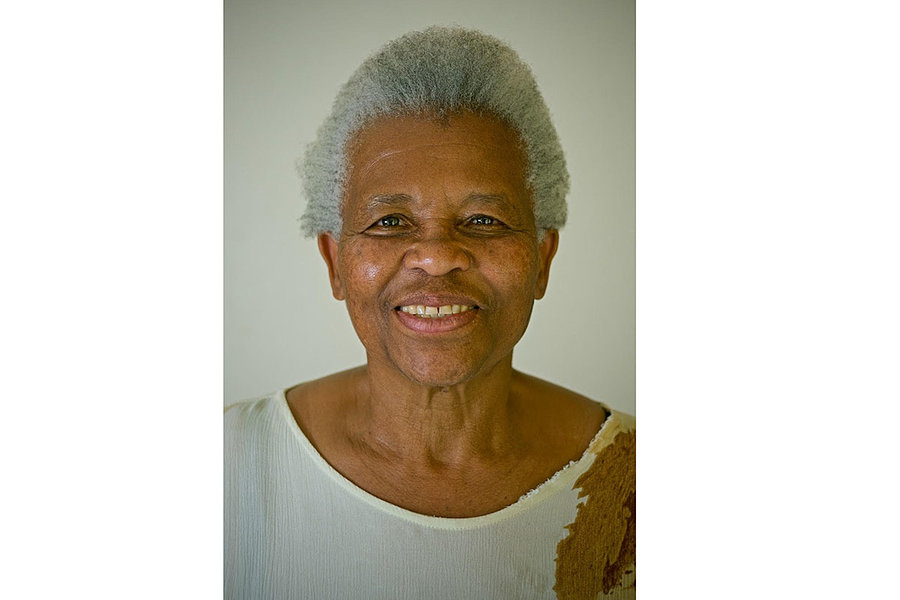
staff writer on the Christian Science Monitor published on 6 January 2020 a Question and Answer piece with Sizani Ngubane, the South African land rights defender who became a finalist for the Martin Ennals Award [see: https://humanrightsdefenders.blog/2019/11/26/breaking-news-mea-has-3-women-hrds-as-finalists-for-2020/ ]
The first inkling Sizani Ngubane had that she might grow up to be an activist came when she was just 6 years old. It was the early 1950s, and while her father, a migrant worker, was away from the family home near the eastern city of Pietermaritzburg, his brother evicted her mother from their land. “You’re a woman,” she remembers her uncle telling her mother, “so you have no right to this property if your husband isn’t around. Those were the early years of apartheid, South Africa’s infamous system of white minority rule, and a woman like Ms. Ngubane’s mother had few places to turn. The white government wasn’t likely to be on her side, and neither were the men in charge in her own community. At 6, of course, Ms. Ngubane didn’t know exactly what was happening, but her mother’s humiliation told her all she needed to know. “From that experience I just said to myself, when I grow up I want to be part of the people who are going to correct these wrongs,” she says. 

In the 70 years since, indeed, she has become the voice for tens of thousands of women like her mother. In the late 1990s, Ms. Ngubane was a founding member of the Rural Women’s Movement, which today counts some 50,000 members. Among other work, the organization fights to make sure women have access to, and ownership over, the land on which they live and work. This has been a major challenge in many rural areas under the authority of semi-autonomous traditional chieftaincies that were originally set up by the apartheid and colonial governments. These leaders have often been reticent to give more rights to women. As South Africa’s government mulls over whether to expropriate some land from white owners and return it to the country’s black majority, her work has become all the more urgent – and complicated.

Ms. Ngubane spoke by phone with the Monitor’s Johannesburg bureau chief Ryan Lenora Brown about why land is so important in South Africa, and what keeps her going as an activist.

Since the start of democracy in South Africa, there’s been a program to provide land or money to people who were stripped of their land during the colonial or apartheid periods. But it’s moved slowly, and over the last few years, there’s been a lot of talk about expropriating land – that is to say, redistributing the land, whether current landowners want that or not. What do you think of that idea? And do you think it will really happen?

I support it. A large percentage of South African arable land is still in the hands of white people, even though they are a small minority in this country. How equal is that? How constitutional is that? But the problem now is that our government is not really doing anything about it. They promised us in the 1990s that by 2014 they would have redistributed 30% of land into hands of original users. I say users and not owners because in our culture land is not owned. Mother Nature was not a commodity that could be bought and sold. But only about 10% of that land has been returned to date. So I think those promises were politically motivated to get people to come out and vote in elections. I don’t see real transformation of the land situation happening anytime soon.  

Why is access to land so important for South African women in particular?

When you begin to give land to women, a lot of abuses in society are eliminated. They can feed their own families without fear of being evicted. They can inherit land when their male relatives die. And most importantly, they are not so controlled by the men in their lives. Because when land is the main value of a society and women cannot own land, we are nothing. We are not 100% human beings. It is easy to abuse and abandon us. So the land is the only way out for us.

What is the accomplishment you’re most proud of? 

The thing I’m most proud of isn’t necessarily any legal battle we’ve won. It’s the fact that before we started this movement women in many rural communities were not empowered to speak. Now we see our women speaking up for their rights, even at national and international levels. And no one tells them to shut up, because we have taught them that this is our constitutional right. [The men] know they must listen.

You’ve been an activist for nearly six decades. And there are still more battles to be fought. Right now, for instance, you’re preparing to go to court as part of a challenge against the Ingonyama Trust, an organization run by the Zulu king Goodwill Zwelithini that controls an area in eastern South Africa the size of Belgium. I’m wondering what keeps you going through battles like this one. 

It comes from my heart. From when I was 6 years old I knew exactly what I was going to do with my life. Don’t ask me how exactly I knew there was a world outside that rural community where I grew up. The only other place I had ever seen was the city of Pietermaritzburg [10 miles away], where I went once a year with my mother to buy school shoes. But somehow I knew even then I was going to grow up to see the world, and learn from it. And that’s exactly what I’ve done.

——

On 28 November 2019 Kim Harrisberg reports for the Thomson Reuters Foundation about the “Death-Defying South African Nominated for International Human Rights Award“. A South African women’s land rights activist who has been stabbed with a knife, slapped with a gun and hit by a speeding car and those are just a few of the murder attempts on Sizani Ngubane who is currently in hiding to prevent further attempts on her long life of activism.

“We cannot separate women’s land rights from gender based violence in South Africa,” said the 74-year-old activist who frequently champions women’s access to land in rural KwaZulu-Natal (KZN) province. “We are celebrating 25 years of democracy, but rural women are still treated like children. It is not in line with our constitution,” Ngubane, founder of the Rural Women’s Movement (RWM) land rights group, said in a phone interview.

Land is a hot topic in South Africa, where President Cyril Ramaphosa last year launched a process to change the constitution with a proposed redistribution of land aimed at addressing high levels of inequality. But in KZN, Zulu King Goodwill Zwelithini controls 2.8 million hectares of land, a fragmented sub-tropical area the size of Belgium, under an entity called the Ingonyama Trust established in 1994. The Zulu monarch wants President Cyril Ramaphosa to sign an agreement promising to exclude territories that the king controls from land reform.

Land rights activists are challenging the control wielded by such traditional authorities over rural communities, particularly on women who are often evicted once widowed. “The trust has turned communities into tenants by leasing ancestral land to them,” said Ngubane, adding that a compulsory rent, rising 10% every year, had to be paid by community members who otherwise face eviction.

Ngubane, along with rights groups, is challenging the Ingonyama Trust in Pietermaritzburg High Court in March 2020. The work of the Rural Women’s Movement includes finding housing for evicted women and children, helping grow food on communal land for the hungry and sick, campaigning for better legal protection of women’s land rights and more. “We are like one big family,” Ngubane said. “We have now begun to spread our wings into different parts of the country.” Launched in 1998, the Rural Women’s Movement has grown to 50,000 women, said Ngubane.

Ngubane said there was retaliation and danger involved in challenging the traditional authorities, citing burnings, kidnappings and beatings of outspoken women and men. “My dream is that one day KwaZulu-Natal will be like other provinces, where women’s rights are seen as human rights and women are given the same power over land that men are keeping for themselves,” Ngubane said.

https://www.csmonitor.com/World/Africa/2020/0106/A-woman-s-right-to-her-land-Q-A-with-Sizani-Ngubane

Death-Defying South African Nominated for International Human Rights Award

https://www.businesslive.co.za/bd/national/2019-11-28-human-rights-award-nominee-in-hiding-as-she-fights-for-womens-land-rights/

Myanmar President to get peace prize today, despite ethnic cleansing charge

April 23, 2013

I have on earlier occasions tried to point out that there is a (big) difference between peace awards and human rights awards. This time it is Dan Murphy in the Christian Science Monitor, who points to another example. While it could be argued that  Myanmar President U Thein Sein deserves to be praised for having made bold steps to move his country away from repression and conflict, he human rights record in the past and [as Human Rights Watch argues in a recent report) in the present would not be considered by many as a likely candidate for a human rights award.

The International Crisis Group’s plan to give its “In Pursuit of Peace” award to Myanmar President U Thein Sein later today and a new Human Rights Watch report on ethnic cleansing against ethnic Rohingya form such striking contrast, that Murphy wonders if Human Rights Watch timed the report to coincide with the gala party that the International Crisis Group (ICG) is planning to host for President Thein Sein later today at the swanky Pierre Hotel in New York City, and with a scheduled lifting of all but arms sanctions against Myanmar (also known as Burma) from the European Union.

Myanmars ruler to get peace prize, despite ethnic cleansing charge – CSMonitor.com.