Two weeks ago, detectives raided ActionAid Uganda and GLISS on the same allegations. The offices of the two CSOs were searched and financial documents and mobile phones of the workers seized by detectives. Another CSO, Solidarity Uganda in Lira District, was raided and its workers arrested on September 21. All affected organisations deny allegations that they are funding projects to destabilise the country. Since the raids, police have not got back to the NGO managers on the offences they committed. The affected NGOs are still open, but their operations have been constrained since their financial departments were disrupted by the detectives.
Since then Arthur Larok, the country director of ActionAid Uganda, shared his view: Our offices were raided in Uganda. Here’s what to do if yours are, too. This may be useful advice for other NGOs in other countries:
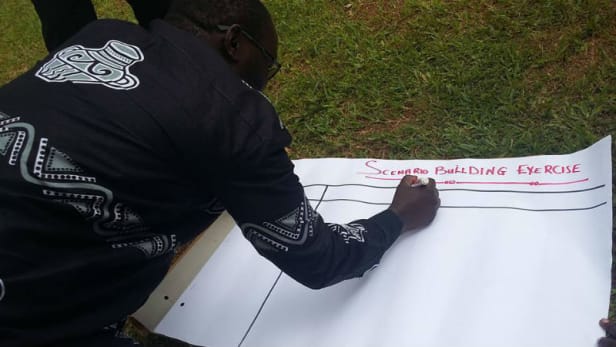 ActionAid Uganda leads a scenario building exercise. Photo by: ActionAid Uganda
The office raid appears to be part of a wider crackdown on legitimate protests against the plan to remove the presidential age limit from the Ugandan Constitution, thus allowing the current president to remain in power indefinitely.
We think these attacks have ulterior motives.
1. To delegitimize civil society. Police raids on our offices immediately present us as subversive elements. This could affect our public image, and that of civil society in general. It could also scare away our funding partners and threaten the stability of our work.
2. To compromise our systems and information. These attacks disrupt our work, and potentially sow seeds for future surveillance by targeting our communications systems and infrastructure.
3. To disrupt and derail us from our mission. Part of our mission as civil society is to help articulate public positions. We are opposed to regressive constitutional amendments. We will invest in organizing citizens to resist attempts to remove the age-limit, even though we know this puts us in direct conflict with the ruling party.
4. To threaten and demoralize civil society. In the hopes of driving us into self-censorship, weakening our resolve, and preventing us from tackling injustice.
5. To provide a justification for further action. Such as halting activities of civil society under the pretext that investigations are still ongoing. We have already seen this happening in the case of ActionAid, where two field activities have been halted by the police.
What can we learn from these attacks and what should civil society do to defend ourselves in ongoing efforts to protect civic space? How can we ensure that we are not derailed in our mission to tackle injustice and poverty?
Here are some tips if your office is at risk of being raided.
1. Always keep your house in order. You must update and back up all institutional information and documentation. During the impromptu siege, the police demanded documents without delay. If we had failed to do so, it may have caused unnecessary suspicion.
2. Staff and board members must understand all processes in the organization. If interrogated, we do not want colleagues to inadvertently arouse suspicion by saying inconsistent things about how we organize ourselves and what our business processes are.
3. Rapid legal response is necessary. As civic and political space continues to shrink in Uganda and globally, we must strengthen our legal response capabilities. The presence of competent lawyers is extremely important.
4. A positive relationship with the media is essential. The media were very helpful in reporting the siege — and established relations meant they did so in a manner that was both supportive and objective. Social media platforms were of increased importance during this crisis, and future investment here is key.
5. Being relevant to civil society and wider citizens’ struggles. The immense show of solidarity from other civil society organizations, politicians, and the public at our time of need demonstrated our value and relevance to civil society. The more outward looking an NGO, the more likely it is to receive much-needed solidarity from others. We were able to call upon our supporters both in Uganda and across the world to amplify our voice and provide solidarity.
6. Beware of potential informers. Finally, we have learned that the forces that seek to undermine our work are in our midst. It is therefore important to better understand our internal environment and partners with whom we work. We must remain vigilant and transparent and have the confidence to defend what we stand for.
The threat to civil society is far-reaching. We must learn from these attacks and work together to protect and defend the legitimacy and effectiveness of the work that we do.

Arthur Larok is the current country director of ActionAid Uganda. He has previously worked with the Uganda National NGO Forum, the Forum for Education NGOs in Uganda and World Learning for International Development. He is the current chairperson of the Uganda National NGO Forum, the largest NGO platform in Uganda.
Sources:
Opinion: Our offices were raided in Uganda. Here’s what to do if yours are, too. | Devex
 Hans Thoolen on Human Rights Defenders and their awards