| On Thursday 21 October 2010, a week after the MEA ceremony in Geneva, Muhannad Al-Hassani, has also received the Amsterdam Dean’s Award. The Amsterdam Bar Association has been following his case and is convinced that the actions taken against him are textbook examples of violations of human rights. His freedom of speech, freedom of association and freedom of assembly, in addition to the freedom to practice his profession, have been unacceptability restricted. Muhannad al-Hassani, was very well aware of the personal risks of his work, but did not allow these to discourage him. Iyas Maleh, the son of the 80-year old Syrian lawyer, Haitham al-Maleh (who was Al-Hassani’s counsel) and who is also serving a prison sentence, accepted the award on behalf of Muhannad al-Hassani. You can read more about this and the speech given by Amsterdam Dean Germ Kemper at http://www.advocatenvooradvocaten.nl/cms/content/view/403/31/. The pressure on the Credentials Committee of the International Bar Association to throw out the Syrian Bar is growing.
|
Archive for the 'human rights' Category
Amsterdam Dean’s Award presented to Muhannad al-Hassani
October 22, 2010Al-Hassani, MEA 2010 Laureate on You Tube and reaction by the EU
October 21, 2010The portrait of the 2010 MEA Laureate Muhannad Al-Hassani (duration approximately 15 mn) can now be found on:
VIMEO: http://vimeo.com/16030613 as well as YouTube (where it had to be in 2 parts) http://www.youtube.com/watch?v=TiZOF_8OOdM PART 1 andhttp://www.youtube.com/watch?v=zkZ5ZOwU5KQ PART 2.
It was made by True Heroes, Films for Human Rights Defenders.
There is also a strongly worded EU statement that can be found on: http://ec.europa.eu/delegations/syria/press_corner/all_news/news/2010/20101018_ar.htm (in Arabic) and http://ec.europa.eu/delegations/syria/press_corner/all_news/news/2010/20101018_en.htm (in English)
Please pass on this information to those who need to know
Introducing the MEA Laureate Al Hassani at his ceremony
October 19, 2010Last Friday – 15 October 2010 – I had the honour to introduce MUHANNAD AL-HASSANI, the 2010 Laureate of the Martin Ennals Award for Human Rights Defenders. The ceremony took place at the beautiful Victoria Hall in Geneva in front of an audience of five hundred people and with more watching it on the internet because the event was being streamed in English as well as Arabic.
I first briefed the audience on what happened to Emad Baghi, last year’s Laureate from Iran. He was arrested at his home on December 28, 2009 and detained without charge. After elaborate campaigns NGOs on the Jury and many others, he was released on bail in June this year. However, immediately the regime revived the pending charges against him and in July and September Baghi was sentenced to respectively one and six years in prison and banned from media and political activities for five years. He remains free from imprisonment for now, pending an appeal, but he and other human rights defenders in Iran should not be forgotten.
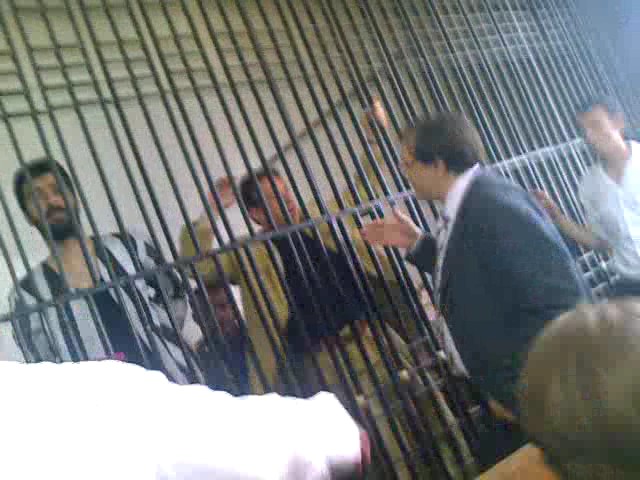
al hassani in court
Al-Hassani was unanimously selected as Laureate 2010 by the MEA Jury which is composed of 10 leading human rights NGOs. If Al-Hassani looked sad on the huge posters that were placed throughout Geneva there are good reasons. He was sentenced to 3 years imprisonment for – pay attention to the dangerously vague wording – “weakening national sentiments” and “spreading false news” and…, on top of it, he had to prove his own innocence against these ludicrous charges. Muhannad Al-Hassani, as a well-established lawyer, has challenged the oppressive legal framework imposed by the Syrian government. He decided to report on legal proceedings before the State Security Court (which are supposed to be public). His NGO Swasiya has been denied registration for the past six years. He has been subjected to a travel ban and his office and communications have been under constant surveillance by Syrian security. I think that the Government of Syria should understand that its efforts to gain respect in the international community will lack credibility as long as it keeps imprisoning those defending human rights. In addition, in an appalling demonstration of servility to the Government, the Syrian Bar Association in 2009 prohibited Mr Al-Hassani from practicing law for the rest of his life… It should be the Bar Association itself that is debarred and I hope that the International Bar Association will soon address this shocking issue. The single most important goal of the Martin Ennals Award is to increase the visibility of Mr Al-Hassani’s situation and that of the many other Human Rights Defenders in Syria. The ceremony in Geneva was a show of solidarity with Al-Hassani and his family, who were not allowed to travel to Geneva and receive the award.
Ceremony for Al-Hassani, 2010 MEA Laureate, very impressive
October 19, 2010The annual MEA ceremony has just taken place on Friday 15 October 2010 in Geneva. The forced absence of the Laureate, Muhannad Al-Hassani, who is serving a 3-year sentence, was to a large extent compensated for by the very ‘personal’ and exclusive portrait made by film produced by True Heroes (THF). The whole 1-hour ceremony can still be viewed on: http://www.martinennalsaward.org/video/bceremony_en.m4v. The audience in the Victoria Hall was approximately 500 persons and at least the same number of people has watched it in English or Arabic on the website, including the family of Al-Hassani. The UN High Commissioner for Human Rights handed over the award to the representative of the laureate.
In addition to being convicted on ludicrous charges (see my other blog about what I said about Al-Hassani) the laureate was barred for life by the Syrian Bar Association. Fortunately the International Bar Association at its recent meeting in Vancouver has started to look into this misbehaviour by its Syrian member. Also the European Union made a strong statement in support of the Laureate. It can be viewed on: http://ec.europa.eu/delegations/syria/press_corner/all_news/news/2010/20101018_en.htm
MEA Laureate 2009 Emad Baghi under threat again
August 6, 2010The Laureate of the Martin Ennals Award for Human Rights Defenders Emad(dedin) Baghi was released from jail only a month ago, but according to a new court ruling – issued 2 years after the trial related to Defending Prisoners’ Rights Society – he has been sentenced to 1 year imprisonment and 5 years prohibition from political, organizational, and media activities. Does the harassment ever stop?
specialized search engine on human rights relaunched
July 5, 2010The NGO HURIDOCS announces the launch of a new, Open-Source version of HuriSearch (http://www.hurisearch.org) , its specialised search engine for human rights information. HuriSearch is an effective Internet search tool, very useful for human rights researchers and advocates, academic staff and students, journalists, diplomats and staff of international organisations. HuriSearch searches the content of over 5000 human rights websites, with a total of almost 7 million pages. This content is always fresh, because HuriSearch indexes the content of these websites very frequently. The source of information is crucially important in human rights work and HuriSearch makes it possible to focus searches on information published in a particular country, by a particular type of organisation, by a specific organisation, or in a specific language. Search results are based upon relevance of contents rather than website popularity – which makes the pages from smaller, specialized organisations more visible than on other search engines.
Feedback is appreciated but please send it directly to: search@huridocs.org
Feeding the inmates through the bars
June 30, 2010This does not deal directly with Human Rights Defenders but as it is such a clear piece of work I include it anyway. Ross Mountain’s Op-Ed on the humanitarian situation in Gaza and the West Bank was published in An Nahar, a leading newspaper in Lebanon on Saturday 19th June 2010. http://www.annahar.com/content.php?priority=3&table=kadaya&type=kadaya&day=Sat. For those who do not read Arabic, here is the English version:
“The killing in “self-defense” of unarmed civilians during Israel’s assault in international waters on a flotilla carrying humanitarian aid supplies to Gaza calls attention, once again, to the terrible situation of civilians living trapped under unbearable conditions in Gaza. Anyone asserting that these few boats could constitute a threat to the security of Israel is simply not credible. It is also the latest in a series of actions that perpetuate an artificial humanitarian crisis –not only in Gaza, but also in the West Bank – in which Israeli impediments to the movement of people and goods, on a daily basis test the tolerance and patience of the Palestinians beyond limits. Israel´s construction of the West Bank Barrier, based on its claim that it needs to secure its people, is a cornerstone of this unnecessary crisis. It is the largest infrastructure project in Israeli history, expecting to cost around US$4 billion on completion. Although Israel signed an agreement to reduce the number of checkpoints and obstacles, these increased from 390 in 2005 to 630 in 2008, of which 550 were still in place in February this year.
The barrier and all the closures, differentiated passes and permits, settler- only roads and the enforced separation between Palestinians and Israelis resemble nothing so much as the laws and practices of racial segregation and forced removals that South Africa knew under Apartheid.Perhaps more cruel than the barrier itself is the arbitrary system of the opening and closing of checkpoints. These often cut West Bank residents from their land, their neighbours and friends, deliberately impeding access between East Jerusalem and the rest of the West Bank- let alone movement to and from Gaza. The Israeli authorities’ arbitrary decisions determine when, or whether, different border crossings are opened or if the different permits they insist are required are valid for movement or not, and make predictable humanitarian access impossible. Indeed a direct product of this massive expenditure is the progressive impoverishment and heightened frustration of the Palestinian people! The suffering of civilians in Gaza and frustration of the humanitarian organizations on the ground struggling to provide aid have only increased in the aftermath of “Operation Cast Lead”, the military operation launched by Israel in December 2008. During this operation, houses, factories, wells, schools, hospitals, police stations, the recently built airport, and many UN and public buildings were destroyed and damaged – as were food supply warehouses and water and sanitation systems. More than a year later, families are still living amid the rubble of their former homes, since the continuing blockade has made meaningful reconstruction impossible despite the billions pledged by the international community. Virtually no improvement has been possible due to the item-by-item restrictions and elaborate procedures insisted upon by the Israeli authorities. With a broken economy and collapsed infrastructure, Gaza’s society has become increasingly destabilized. Over 1.5 million Palestinians remain trapped in Gaza, heavily dependent on restricted aid flows for basic necessities. Around 80% of the population now depends on food aid provided by the international community. As one humanitarian worker, struggling daily with this situation, graphically described it,“we are feeding the inmates through the bars.” In 2009 the international community contributed US$765 million to United Nations appeals for Gaza and the rest of the occupied Palestinian territory. The UN appeal for 2010 seeks US$644.5 million. This huge amount of money would be unnecessary if the Israeli authorities removed the barriers, lifted the blockade and respected International Humanitarian Law as repeatedly demanded by the UN, the US, the EU, Russia- the members of The Quartet. The International Committee of the Red Cross (ICRC) has exceptionally now also called for the Gaza closure to end. During my recent mission to the region, humanitarian actors on the ground, amongst them donors, NGOs, UN agencies, and other partners shared with my team their concern that international humanitarian assistance was in effect subsidizing the Israeli occupation. How much better and more helpful to building peace between the two communities would it be to invest such money in improving the skills and future prospect of the Palestinian people instead of serving as a band aid to avert the absolute collapse of their living conditions. Let us be clear. This is a manufactured humanitarian crisis that need not exist, that does not need to demand hundreds of millions of dollars year by year. The collective punishment the civilian population in Gaza is facing means that the international community has to deliver aid to cover needs brought about by the actions of the Israeli authorities. And at a high cost. As an illustration, the World Food Programme reports that the additional costs for procedures demanded by the Israeli authorities for the delivery of their food supplies to the citizens of Gaza has trebled their transport and handling costs. Who pockets this difference? Not the Palestinians, as purchases and storage take place mostly in Israel. There are many examples of protracted and trivial negotiations to import items such as pencils for schools. Only after months of negotiations, progress was made with the Israelis allowing materials like glass into Gaza to repair windows shattered by the attack in December 2008. However, this was only achieved after involving the highest level of the UN and diplomatic missions. Making matters worse, the application of the political “no contact” policy with Hamas by a number of key donors to humanitarian programs in the occupied Palestinian territories violates the basic humanitarian principle of dealing with all authorities – de facto as well as de jure – to ensure that humanitarian assistance reaches the vulnerable on the basis of their needs. Indeed, as the International Crisis Group has emphasized the international donor community must shoulder its share of the blame for continuing to politically support the isolation of Gaza.
The thwarted efforts of the flotilla to bring humanitarian and building supplies have highlighted Israel´s restrictive policies despite the outcry of the international community. In the wake of the Israeli killings, will donor countries now insist on the lifting of the blockade on humanitarian supplies for Gaza and the absurd limitations on movement including in the West Bank? None of these pose a credible threat to the security of Israel and would make all the difference to the health and welfare of the population of the occupied Palestinian territory. Or will the obstinacy of the Israel government and the spin of its skilled spokespersons be allowed to prevail once more?”
Laureate Martin Ennals Award 2010 announced today
May 7, 20103 hours ago in Geneva I had the honor to announce to the international media that the Jury of the Martin Ennals Award for Human Rights Defenders (MEA) had selected the Syrian lawyer Muhannad Al-Hassani as its laureate for 2010. He lingers in jail since 28 July 2009 for having defended human rights and challenged the oppressive legal framework imposed by the Syrian government. He was charged with ‘crimes’ such as “weakening national sentiments,” and “spreading false news.”
A man of an exceptional courage, arbitrarily detained in unacceptable conditions for defending the rule of law deserves your support. See http://www.martinennalsaward.org

The enforcement gap: what human rights NGOs should concentrate on in the next few years
April 28, 2010In many ways human rights has been an enormous success story. In about half a century, it has gone from a relatively minor issue in diplomatic relations to a major and ongoing international concern, with elaborate treaties, mechanisms and codes. Specialized human rights organizations have among them millions of active members. The weakness remains enforcement, even in cases where the binding legal character of the rules is not in doubt.
This non-enforcement is of such a blatant character that there is a serious risk that many of the gains described above will be lost. Only half-jokingly the best advice one can give a tyrannical regime is to simply ignore all international condemnations, refuse to answer any queries, do not let any UN Rapporteurs or NGOs in, and after a while – usually quite quickly – the furor, if any, will dampen and the media will shine their light elsewhere, most likely where there is some degree of cooperation and access. This does not encourage States to follow human rights norms!
An example from the category of treaty obligations where a country has formally pledged to honor its obligations (Communication no 1150/2033 Uteeva vs Uzbekistan):. When the sister of a man condemned to death complained that the confession was obtained under torture, the Human Rights Committee requested Uzbekistan not to carry out the execution while the case was under consideration. Six months later the Uzbek Government informed the Committee that the death sentence had been carried out.
Several countries have steadily refused to cooperate with the UN Human Rights Council and do not let Rapporteurs in (e,g, Iran, Cuba, Burma). Even more refuse to let NGOs in.
In the area of business and human rights in 2008 over 3.000 companies had signed up to the Global Compact (a voluntary code to uphold basic standards – no real teeth, but striking off the list is possible). In 2006, 335 companies were struck off the list, but who knows?
Rather than speculate about why most human rights bodies and persons seem to accept this state of affairs (fatigue, not interesting for the media, not attractive for donors, etc), we should devise urgently mechanism to remedy this situation, to make sure that “crime does not pay”.
Some ideas:
- Every year on 10 December, Human Rights Day, the human rights movement – through a coalition of major and representative NGOs – makes public a list of the top 10 ‘refusniks’ (countries that stand out in ‘non-cooperation’)
- Non-enforcement of decisions by any of the UN treaty bodies will have to be strengthened (report to the General Assembly is not enough). The UN High Commissioner for Human Rights could be asked to compile annually a list of non-enforced decisions and give it the widest possible dissemination, including to the meetings of the States Parties. Persistent non-compliance should be routinely followed by inter-state complaints.
- A business company struck of the list of the Global Compact MUST make this known in the same media and publications in which its joining was announced and with same emphasis (this should be made this part of the code). Non-compliance with this requirement should lead to an active campaign by the UN to explain why the company was struck off the list.
Reactions and other ideas are most welcome.
 Hans Thoolen on Human Rights Defenders and their awards