Archive for the 'Human Rights Defenders' Category
October 14, 2013

The Economist of this week (11 October) carries an interesting piece on peace under the title “Peace comes dropping slow”. It argues that MALALA YOUSAFZAI would have been an appropriate recipient of the Nobel peace prize, but that her admirers should be not be too disappointed that the award went instead to the Organisation for the Prohibition of Chemical Weapons. For the Western world, and indeed for many of her fellow Muslims, Malala is an extraordinary example of disinterested courage in the face of theocrats who practise tyranny by claiming a monopoly on religion and religious law. She was already famous at the age of 11 as the writer of a blog for the BBC Urdu service, giving an impression of life under the rule of the Taliban in her native Swat Valley.
She has been showered with accolades, as this blog has also shown including last week the European Union’s Sakharov prize. However, the Economist piece says that “people who really wish Malala and her cause well should be more relieved than let down. The Nobel Prize has not always brought blessings to its recipients. Mistakes made by Barack Obama as America’s commander-in-chief will be judged even more harshly because he was granted the award in 2009 as a kind of down-payment before his presidency had really got going. Mikhail Gorbachev will probably go down in history as a peace-maker, but the award (in 1990) did nothing to enhance his domestic standing which was in freefall at the time. And whatever history has to say about Henry Kissinger and North Vietnam’s Le Duc Tho, garlanded in 1973, it will hardly describe them as doves of peace“[De Klerk and Arafat are not mentioned!]
In Northern Ireland, the article states the peace prize had in some respects a “kiss of death” [mentioning David Trimble, John Hume, Betty Williams and Mairead Corrigan Maguire] ….”Does 16-year-old Malala really need that? She too comes from a part of the world where international accolades can cause jealousy and cynicism as well as admiration. So she may be better off without the big prize. In any case, Malala will continue to pile up various honours and distinctions; and as with Ms Maguire, there is probably a good chance that she will use her fame to say things that disturb and provoke people, even those who are lining up to admire her.“
The Nobel peace prize: Peace comes dropping slow | The Economist.
Posted in human rights, Human Rights Defenders | Leave a Comment »
Tags: awards, Barack Obama, European Union, human rights awards, Kissinger, Le Duc Tho, Malala, Malala Yousafzai, Mikhail Gorbachev, Nobel Peace Prize, Organisation for the Prohibition of Chemical Weapons, peace prize, The Economist, woman human rights defender
October 14, 2013
That there can be a risk in accepting (monetary) awards is demonstrated again by the case of Massoumeh Dehghan, retired teacher and wife of imprisoned human rights lawyer Abdolfattah Soltani in Iran. She told the International Campaign for Human Rights in Iran that her one-year prison sentence for accepting her husband’s human rights award has been upheld (suspended for five years, and five years’ ban on foreign travel). Read the rest of this entry »
Posted in human rights, Human Rights Defenders | Leave a Comment »
Tags: Abdolfattah Soltani, awards, backlash, Germany, human rights, human rights award, human rights awards, human rights lawyer, International Campaign for Human Rights in Iran, Iran, judicial harassment, Massoumeh Dehghan, Nasrin Sotoudeh, Nuremberg, Nuremberg Human Rights Award
October 14, 2013
While 130 NGOs in Africa and elsewhere call in a joint letter to the African Union not to abandon the International Criminal Court, Bishop Desmond Tutu publishes in the New York Times of 10 October an excellent piece explaining why it is a terrible mistake. Here is it is in full:
CAPE TOWN — MEMBERS of the African Union will meet in Addis Ababa, Ethiopia, today to discuss recent calls by some African leaders to withdraw from the International Criminal Court. These calls must be resisted. The continent has suffered the consequences of unaccountable governance for too long to disown the protections offered by the I.C.C. Read the rest of this entry »
Posted in human rights, Human Rights Defenders | Leave a Comment »
Tags: Africa, African countries, African Union, AU, campaign, Desmond Tutu, human rights, Human Rights Defenders, Human Rights Watch, ICC, impunity, International Criminal Court, international justice, Protection International
October 14, 2013

You can Join the Center for Story-based Strategy CSS and the New Tactics community for an online conversation on Change the Story: Harnessing the power of narrative for social change from October 14 to 18.
People and communities use stories to understand the world and our place in it. These stories are embedded with power – the power to explain and justify the status quo as well as the power to make change imaginable and urgent. …This conversation is an opportunity for human rights defenders to learn more about story-based strategy and how to integrate it into campaign planning. This is also an opportunity for those practitioners using story-based strategy to share their experiences, questions, and ideas with each other. Practitioners to lead this conversation are:
Danielle Coates-Connor, Conversation Facilitator of the Center for Story-based Strategy
Nathan Schneider of Waging Nonviolence
Soriano of Lionswrite Communications
Kathleen Pequeño of the Progressive Communicators Network
Nadia Khastaqir of the Design Action Collective
Kristi Rendahl of the Center for Victims of Torture
Lama Sangye and Justin Von Bujdoss of the New York Tsurphu Goshir Dharma Center
Chris Cavanagh of the Catalyst Centre
Dr. Cara Lisa Berg Powers of Press Pass TV
Laura Revels, Digital Storytelling Trainer
Shreya Atrey, practitioner.
September’s Conversation on Media Tactics for Social Change now has a summary posted and in November there will be a Conversation on Visualizing Information for Advocacy, in partnership with Tactical Technology Collective.
via Join our conversation on the power of narrative, this week!.
Posted in human rights, Human Rights Defenders | Leave a Comment »
Tags: activism, Advocacy, audiovisual communication, conversation, Human Rights Defenders, internet, Mass media, Narrative, New Tactics in Human Rights, New Tactics online, on-line conversations, social change, Tactical Technology collective, television, Visualizing
October 14, 2013
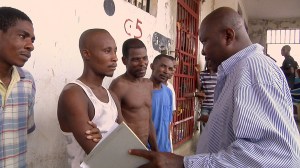
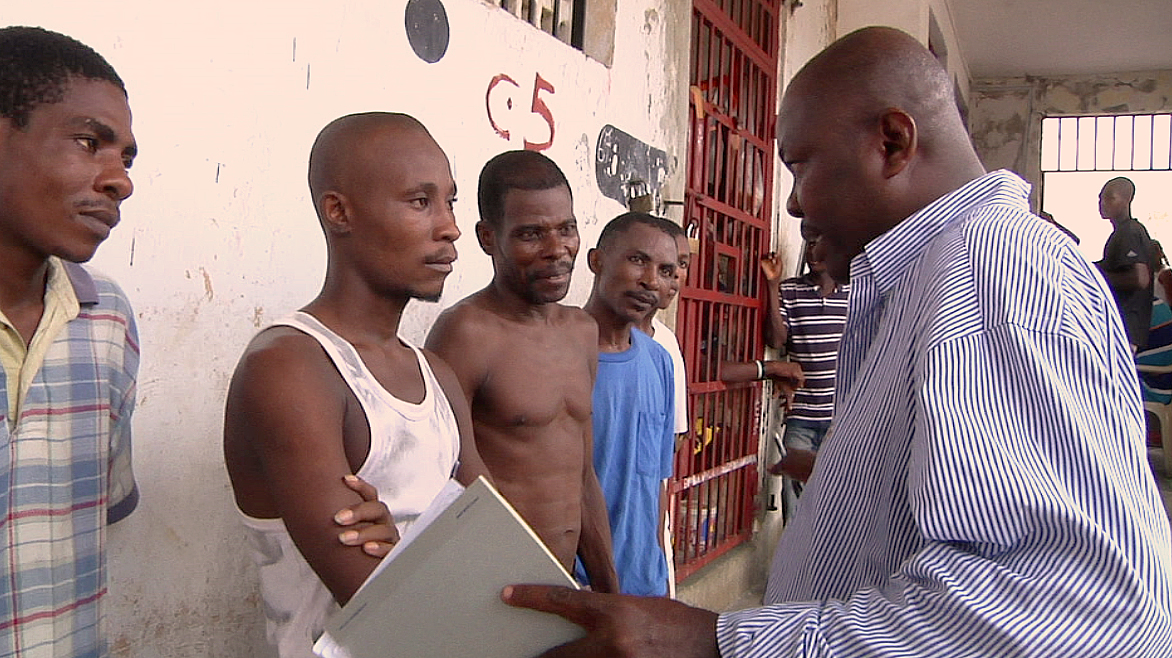
Mario Joseph, Haiti – Final Nominee MEA 2013
An unintended consequence of the MEA ceremony on 8 October was that Mario Joseph – one of the 3 Final Nominees for this award – used his speech to make clear how disturbed he was by the UN’s refusal to assume its responsibility for the cholera epidemic caused by UN troops in Haiti. Mrs Pillay – the UN High commissioner for human rights – in her speech replied to the challenge by repeating an earlier position that had mostly gone unnoticed: “I have used my voice both inside the United Nations and outside to call for the right — for an investigation by the United Nations, by the country concerned, and I still stand by the call that victims of — of those who suffered as a result of that cholera be provided with compensation”. Associated Press reported this on 8 October but left out the context by just stating: ‘Pillay said at an awards ceremony for human rights activists in Geneva… streamed live on the Internet.’ So, now you know!
via UN human rights official urges compensation for Haiti cholera victims – Washington Post.
Posted in human rights, Human Rights Defenders, MEA | 2 Comments »
Tags: Associated Press, Cholera, compensation, Geneva, Haiti, immunity, Mario Joseph, Martin Ennals Award for Human Rights Defenders, MEA, MEA ceremony, MEA nominees 2013, Office of the United Nations High Commissioner for Human Rights, United Nations, Washington Post
October 10, 2013

(Malala Yousafzai during ceremony for the Amnesty International Ambassador of Conscience Award 2013 – (c) AFP/Peter Muhly)
On 5 October I reported that Malala got the RAW award – after receiving quite a few others (as seen above in the picture). Since yesterday she is also laureate of the European Parliament’s Sacharov award, beating Edward Snowden and dissidents from Belarus. In the meantime the rumors are that she also gets the Nobel Peace Prize.
Posted in human rights, Human Rights Defenders | 1 Comment »
Tags: Amnesty International, awards, Belarus, Edward Snowden, European Parliament, human rights awards, Malala, Malala Yousafzai, Nobel Peace Prize, Sacharov, Sakharov Prize
October 10, 2013
24 hours after the event, those who missed the 2013 ceremony of the Martin Ennals Award for Human Rights Defenders can already see the highlights on Vimeo. Gives absolutely good impression of the impressive evening.
Posted in human rights, Human Rights Defenders, MEA | Leave a Comment »
Tags: 2013 ceremony, Advocacy Organizations, Chechnya, City of Geneva, Egypt, Haiti, Human right, Human Rights and Liberties, Joint Mobile Group, Mario Joseph, Martin Ennals, Martin Ennals Award, Martin Ennals Award for Human Rights Defenders, MEA, Mona Seif, Russia, Vimeo
October 8, 2013
 The Joint Mobile Group was selected by the International Human Rights Community (See Jury Below) as the Laureate 2013 of the Martin Ennals Award for Human Rights Defenders. Read the rest of this entry »
Posted in human rights, Human Rights Defenders, MEA | 1 Comment »
Tags: award, Chechnya, Civil society, Egypt, Geneva, Haiti, Human right, human rights, human rights awards, Human Rights Defenders, international community, Joint Mobile Group, Jury MEA, Mario Joseph, Martin Ennals, Martin Ennals Award for Human Rights Defenders, MEA 2013, Micheline Calmy Rey, Mona Seif, NGOs
October 7, 2013
This blog tends to prioritize news on human rights defenders who are in trouble. This makes one overlook perhaps too often the contribution made by those who are working for the cause in other ways. To rectify I want to pay tribute to another woman who has contributed enormously to the creation and growth of the Martin Ennals Award for Human Rights Defenders: Simia Ahmadi. After 20 years she is leaving the Board of the Foundation on 7 October, just before the 20th ceremony tomorrow.
In 1992 Simia was a young, upcoming human rights worker who had just finished an internship with the UN. To her great regret she never met Martin Ennals in person. Her main motivation was that an award could be effective and volunteered to help it being set up. After successful initial fundraising she was the part-time Secretariat in the first year.

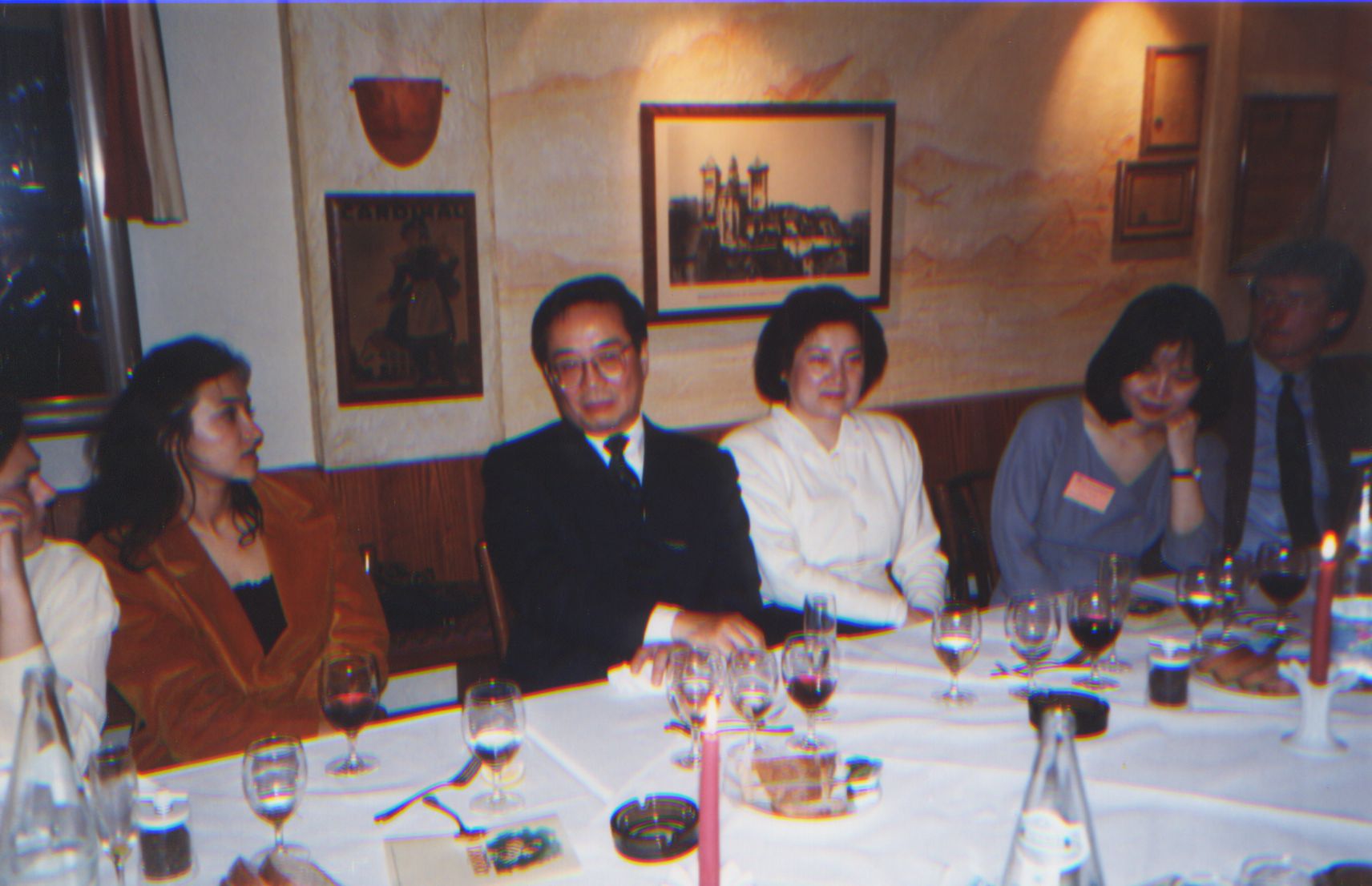
(Simia, left of first Laureate Harry Wu in 1994, Geneva)
After that, she worked several years for the International Federation for Human Rights (FIDH). Thereafter she was Programme Coordinator of the Legal and Human Rights Centre in Tanzania and from 2006-2009 she served as FIDH’s Representative to the UN in Geneva. After her move to Kenya in 2010, she served as the Chief of Party of the Public International Law and Policy Group in Kenya. Now she devoting her considerable energy to Kahesa, of which she is the Director-Founder and undertakes consultancy work such as evaluations KAHESA is a social enterprise that produces decorative and environmentally-sound paper through the employment of mentally-challenged Kenyans. Check out her www.kahesa.com and Facebook page: Kahesa paper
For being at the cradle of the MEA and making sure that the there is no grave for long time she deserve the deepest thanks from all especially Human Rights Defenders around the world.
Posted in FIDH, human rights, Human Rights Defenders, MEA | Leave a Comment »
Tags: FIDH, Geneva, Harry Wu, human rights, International Federation for Human Rights, Kahesa, Kenya, Legal and Human Rights Centre, Martin Ennals, Martin Ennals Award, Martin Ennals Award for Human Rights Defenders, Martin Ennals Foundation, MEA, Tanzania, United Nations, woman human rights defender
October 7, 2013
This blog tends to prioritize news on human rights defenders who are in trouble. This makes one overlook perhaps too often the contribution made by those who are working for the cause in other ways. To rectify I want to pay tribute to a woman who made an enormous contribution to the creation and development of the Martin Ennals Award for Human Rights Defenders: Leah Levin. After 20 years she is leaving the Board of the Foundation today, 7 October, just before the ceremony on October.
Leah was there from the start; from the now ancient looking logo of the first years

to the current one:
When the MEA came into being in 1992, a year after Martin died, Leah was already an ‘old hand’ and a well-known name in the international human rights movement. She was one of Martin’s closest friends and felt very strongly motivated by the idea of making sure his legacy was honored and made useful.
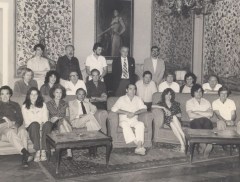
(one of the last pictures where Leah and Martin are seen together – 1979 Bellagio)
But Leah is more than the MEA. She has a OBE and is Hon. Doctor of the University of Essex. She served on the Boards of United Nations Association, Anti-Slavery and International Alert. Was Director of JUSTICE from 1982-1992 and is currently on Boards of Redress, Readers International and The International Journal of Human Rights. She is the author of UNESCO’s ‘Human Rights : Questions and Answers’, one the world’s widely disseminated books on human rights.
Twenty years of active Board membership in any enterprise is impressive; doing it on a voluntary basis without always getting the recognition deserved is outright admirable. We all owe her a lot.
Posted in Human Rights Defenders, MEA | 1 Comment »
Tags: Board of the Martin Ennals Foundation, human rights, Human Rights and Liberties, International Alert, International Journal of Human Rights, Justice (NGO), Leah Levin, Martin Ennals, Martin Ennals Award, Martin Ennals Award for Human Rights Defenders, MEA, REDRESS, Unesco

 Hans Thoolen on Human Rights Defenders and their awards