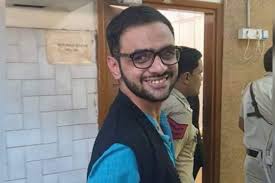
On 19 February 2026, an important group of NGOs stated that the international community must call for the immediate release of Umar Khalid
On Jan. 5, 2026, the Indian Supreme Court denied bail to human rights defender and student activist Umar Khalid, who has been detained for over five years without trial, in violation of India’s obligations under international human rights law. The undersigned organisations are disturbed by the Court’s decision. As domestic legal remedies have proven ineffective, we urge the international community to take urgent and coordinated action.
Khalid was arrested on Sept. 13, 2020, after he became a prominent face of nationwide peaceful protests against the discriminatory Citizenship Amendment Act, a law excluding Muslims from eligibility for a fast-tracked path to Indian citizenship. Khalid’s unfounded prosecution stems solely from the exercise of his rights to freedom of expression and peaceful assembly.
Khalid was charged under India’s anti-terror law, the Unlawful Activities (Prevention) Act (UAPA), as well as other laws, for a total of 29 charges. The UAPA has been criticised by the UN Working Group on Arbitrary Detention and several other UN Special Procedures mandate holders, particularly for its vague definitions and restrictive bail provisions that enable prolonged pre-trial detention. Indian authorities have frequently used these anti-terror legislations to detain political dissenters, human rights defenders, activists, and Muslims by keeping them in prison for extensive periods of time prior to trial. Indian grassroots organisation People’s Union for Civil Liberty has demonstrated through its investigation how UAPA has been systematically abused to silence dissent.
Since his arrest, Khalid has been languishing in Delhi’s Tihar jail for over five years awaiting trial. According to the Supreme Court, this excessively long pre-trial detention has not “crossed the threshold of constitutional impermissibility,” but Khalid should not be detained at all — he is being held simply for exercising his rights. The Supreme Court’s Jan. 5, 2026, decision also forbids Khalid from applying for bail for one year. His trial is yet to begin.
In the same judgment in which the Court denied bail to Khalid, it released his co-defendants in the case, activists Gulfisha Fatima, Shifa Ur Rehman, Meeran Haider, Saleem Khan, and Shadab Ahmed, a development the undersigned organisations welcome. However, Khalid’s co-defendants, released on bail, are not entirely free. The Supreme Court imposed strict bail conditions: a blanket ban on participating in “any programme or address”, attending “any gathering, rally or meeting, whether physically or virtually” and on circulating “any post either in electronic or physical form or circulate any hand bills, posters, banners, etc. in any form whatsoever.” These conditions violate their rights to freedom of expression and association.
All of Khalid’s co-defendants remain at risk of re-arrest if eventually convicted in the case. This includes activist Safoora Zargar, who was charged in the same case but released on bail in June 2020 due to her pregnancy, and following a decision of the United Nations Working Group on Arbitrary Detention rendering her detention arbitrary.
Umar Khalid’s case is a stark example of how the current government has weaponised anti-terror laws to restrict civic space, disproportionately targeting Muslim voices. Umar Khalid’s case is garnering increasing global attention, including recently from eight US lawmakers, human rights organisations, and the UN Special Rapporteur on human rights defenders.
The Indian judicial system has failed Umar Khalid and his co-defendants. It is time for the international community to take meaningful and coordinated action. Governments, particularly those with strong bilateral relationships with India, should publicly and privately call for Umar Khalid’s immediate and unconditional release and raise his case in all high-level diplomatic engagements.
As a sitting member of the UN Human Rights Council, India should be reminded of its commitment under UN General Assembly Resolution 60/251 to “uphold the highest standard in the promotion and protection of human rights.”
Pending the acquittal of Khalid and his co-defendants, diplomatic missions in New Delhi should also closely monitor court proceedings and reaffirm the importance of due process and presumption of innocence.
Signed by;
Human Rights Foundation
Hindus for Human Rights
Diaspora in Action for Human Rights and Democracy (DAHRD)
Amnesty International
InSAAF India
Indian American Muslim Council
UK Indian Muslim Council
Scottish Indians for Justice
India Alliance Paris
South Asia Solidarity, UK
South Asia Justice Campaign
Joint Committee to Stop Repression in India
India Labour Solidarity
Freedom House
India Civil Watch International
Karwaan-e-Mohabba
World Organisation Against Torture (OMCT), within the framework of the Observatory for the Protection of Human Rights Defenders
Free Voices Collective e.V.
International Federation for Human Rights (FIDH), within the framework of the Observatory for the Protection of Human Rights Defenders
FORUM-ASIA
https://en.wikipedia.org/wiki/Umar_Khalid
on 17 March 2026: https://hrf.org/latest/hrf-succeeds-in-un-petition-india-condemned-for-arbitrary-detention/?mc_cid=6e1cdaed14&mc_eid=f80cec329e
 Hans Thoolen on Human Rights Defenders and their awards
Leave a comment