Posts Tagged ‘Tanzania’
April 9, 2014
“Like other people, journalists have personal interest in the rights that allow them to live in freedom and to be free from fear or oppression…” said Onesmo Olengurumwa, National Coordinator of Tanzania Human Rights Defenders – Coalition (THRD-C). He was speaking recently in Dar es Salaam at a 3-day seminar for journalists meant to train them in Security Management and Risk Assessment. Similar trainings will be conducted periodically to ensure journalists are equipped with the knowledge on how to best respond and tackle volatile and potentially dangerous situations. “Media owners, editors, journalists, human rights NGOs, community and the government should take security and protection issues for journalists much more seriously,” said Olengurumwa. He also reminded journalists that their personal behaviour, lifestyle and how they approach their work may place them at risk. “Investing on security management and protection for journalists should be undertaken by all media owners,”
![Journalists, CSOs, Human Rights and CBOs representatives posing for a group photo during the two-day training on Human rights in NBGS. [Gurtong| Abraham Agoth]](https://i0.wp.com/www.gurtong.net/Portals/0/GlobalResources/EN/images/Editorial2/journalists%20and%20Human%20Rights%20Defenders.jpg)
group photo of training on Human rights in NBGS. [Gurtong| Abraham Agoth]
On 28 March 2014 Abraham Agoth in “Oye! News from Africa” reported that Journalists and Civil Society Organisations (CSOs) has completed a Human Rights Defenders training course organised by the Human Rights Protection and Civil Affairs Departments of the United Nations Mission in
South Sudan (UNMISS). Speaking at the closing ceremony, the acting UNMISS state coordinator, Numa Shams urged the participants to apply what they learnt during the training in their daily work so that human rights abuses are minimized. “
We hope this work will be incorporated into your daily activities of monitoring human right in your respective working locations and within your communities,” he said. “
I have seen your participation and commitments in this training. It clearly shows that you have learnt something and are eager to learn more,” said Mary Makelele, the director general in the state ministry of Information, “
My appeal to everyone is that; do not take these skills for granted but instead use them to educate others.” During the training, it was generally observed that human rights have been mostly violated due to negligence and ignorance.
Journalists, CSOs Complete Human Rights Defenders Training | Oye Times.
Posted in human rights, Human Rights Defenders | 1 Comment »
Tags: Abraham Agoth, Africa, civil society organisations, freedom of information, human rights, human rights abuses, Human Rights Defenders, journalists, media, Oye! News from Africa, security, South Sudan, Tanzania, Tanzania Human Rights Defenders Coalition, training, UNMISS
October 7, 2013
This blog tends to prioritize news on human rights defenders who are in trouble. This makes one overlook perhaps too often the contribution made by those who are working for the cause in other ways. To rectify I want to pay tribute to another woman who has contributed enormously to the creation and growth of the Martin Ennals Award for Human Rights Defenders: Simia Ahmadi. After 20 years she is leaving the Board of the Foundation on 7 October, just before the 20th ceremony tomorrow.
In 1992 Simia was a young, upcoming human rights worker who had just finished an internship with the UN. To her great regret she never met Martin Ennals in person. Her main motivation was that an award could be effective and volunteered to help it being set up. After successful initial fundraising she was the part-time Secretariat in the first year.

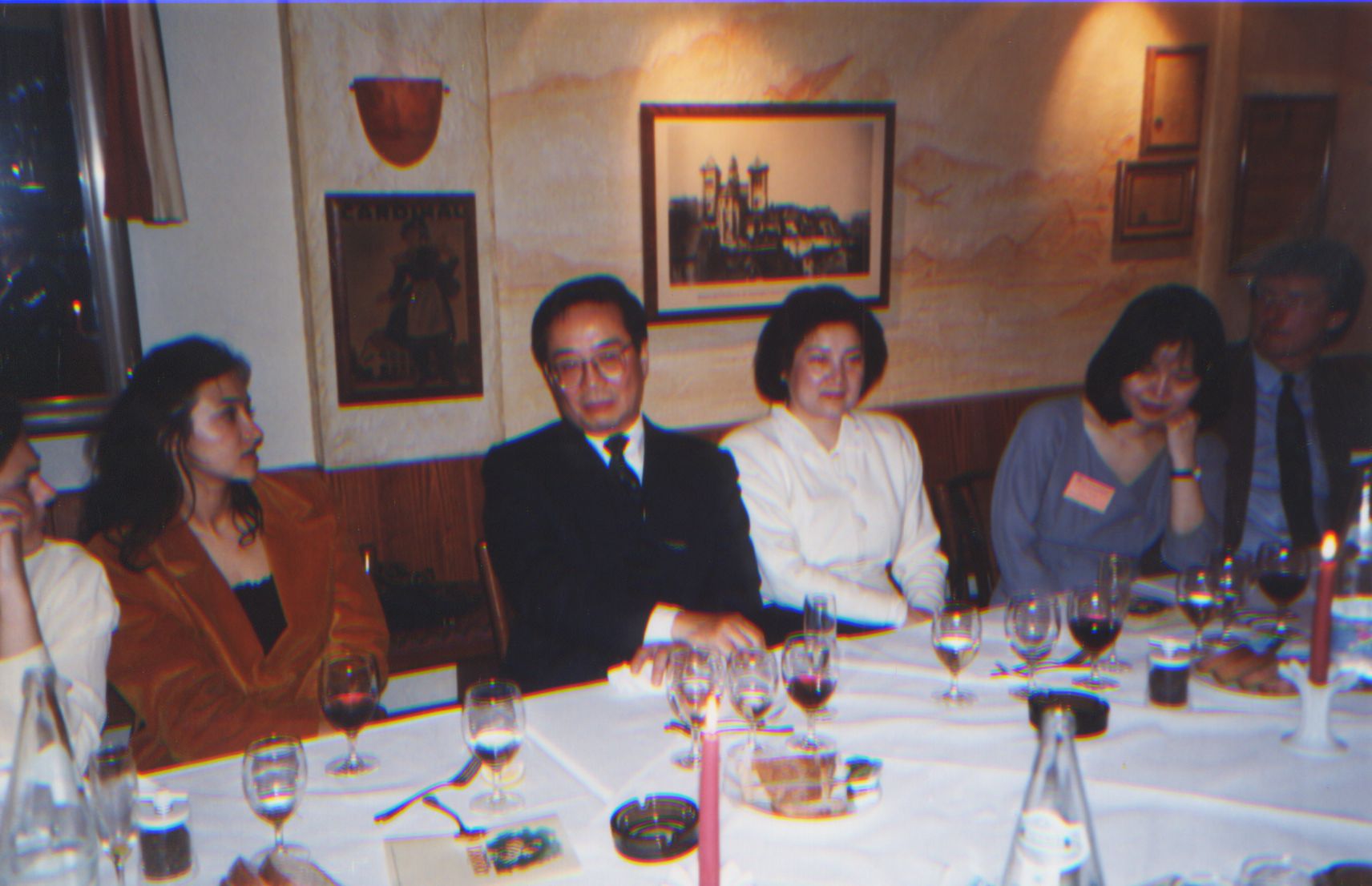
(Simia, left of first Laureate Harry Wu in 1994, Geneva)
After that, she worked several years for the International Federation for Human Rights (FIDH). Thereafter she was Programme Coordinator of the Legal and Human Rights Centre in Tanzania and from 2006-2009 she served as FIDH’s Representative to the UN in Geneva. After her move to Kenya in 2010, she served as the Chief of Party of the Public International Law and Policy Group in Kenya. Now she devoting her considerable energy to Kahesa, of which she is the Director-Founder and undertakes consultancy work such as evaluations KAHESA is a social enterprise that produces decorative and environmentally-sound paper through the employment of mentally-challenged Kenyans. Check out her www.kahesa.com and Facebook page: Kahesa paper
For being at the cradle of the MEA and making sure that the there is no grave for long time she deserve the deepest thanks from all especially Human Rights Defenders around the world.
Posted in FIDH, human rights, Human Rights Defenders, MEA | Leave a Comment »
Tags: FIDH, Geneva, Harry Wu, human rights, International Federation for Human Rights, Kahesa, Kenya, Legal and Human Rights Centre, Martin Ennals, Martin Ennals Award, Martin Ennals Award for Human Rights Defenders, Martin Ennals Foundation, MEA, Tanzania, United Nations, woman human rights defender
March 5, 2013
In IPP Media of 5 March 2013 appears a lengthy piece by correspondent GERALD KITABU who interviewed the head of the NGO ‘Tanzania Human Rights Defenders Coalition’ (THRD-Coalition) Mr ONESMO OLENGURUMWA on the protection of human rights defenders in Tanzania. It interesting to see such an article which demonstrates the depth of the Human Rights Defenders issue at the local level. Here follow a few quotes:
QUESTION: Who is a human right defender?
ANSWER: A human rights defender is any individual, groups and organs of society seeking to promote and protect universally recognized human rights and freedom. Human rights defenders include lawyers, judges, journalists, whistle blowers, bloggers, students, religious leaders, trade unionists and any other person working to combat human rights abuses in a peaceful manner.
Q: What is the current situation of human rights defenders in Tanzania?
A: Our organization has recorded a number of security incidents towards human rights defenders. Despite being change agents, these activists are continuously harassed, detained, interrogated, imprisoned, tortured and even at times paying the ultimate price when they are killed for what they do. A good example is the last year’s killing of Iringa based Channel Ten journalist Daudi Mwangosi, the barbaric and brutal torture of Dr. Stephen Ulimboka, the death of Issa Gumba, the suspicious death of women human right defender in Mara Eustace Nyarugenda who was the director of Action Based Foundation, continuing constant threats towards other journalists like Cosmas Makongo, Josephat Isango, Charless Misango, the indefinite ban of Mwanahalisi and the arbitrary arrest of human rights defenders. These are just few incidents that paints a bad picture on the map of Tanzania when it comes to observing human rights….
Posted in human rights, Human Rights Defenders | Leave a Comment »
Tags: Human right, human rights, human rights abuses, Human Rights and Liberties, Human rights defender, Human Rights Defenders, impunity, IPP media, journalists, Non-governmental organization, Non-state actor, ONESMO OLENGURUMWA, protection, Tanzania, THRD-Coalition, UN Declaration
February 16, 2013
Disabled Peoples International (DPI) has a special Human Rights Defenders Project, funded by the Canadian International Development Agency (CIDA). It aims to positively influence the lives of persons with disabilities in mainly five CIDA Countries of Focus that have ratified the Convention on the Rights of Persons with Disabilities CRPD: Bangladesh, Jamaica, Peru, Tanzania and Ukraine.The Human Rights Defenders Project includes four components: (1) Institutional strengthening of five national member organizations to monitor the Convention (2) Development and the use of educational material to assist with the monitoring of the Convention (3) Publications, promotion and networking related to the rights of disabled people, and (4) Data collection, reporting and monitoring related to disability issues.
via Human Rights Defenders: Disabled Peoples International.
Posted in human rights, Human Rights Defenders | 1 Comment »
Tags: Bangladesh, Canada, CIDA, Convention on the Rights of Persons with Disabilities, Disabled Peoples International, DPI, Human Rights Defenders, Jamaica, Peru, Tanzania, Ukraine
February 23, 2012
Earlier this month, 16 prominent human rights activists were arrested in Dar es Salaam on the grounds of unlawful assembly. The human rights defenders were arrested at the Muhimbili National Hospital, where the police allege they had gathered illegally and were intending to hold an illegal demonstration, although the group maintained that they were merely going to observe the dialogue between the government and health officials.
Article 20 of the Constitution of Tanzania enshrines the right for people; “to freely and peaceably assemble, associate and cooperate with other persons”. However, as expressed in the constitution, this right can be limited by other national legislation for certain purposes, including ensuring public order or where it is in the public interest. The Police Force and Auxiliary Services Act forms part of the national legislation, which regulates public assemblies. This Act states that notification must be provided to the police 48 hours in advance of a planned public assembly. The police are given broad powers to prohibit the assembly if they believe it “is likely to cause a breach of the peace, or to prejudice public safety or the maintenance of public order”.
Africa Review who reports on this rightly asks the question : did the 16 activists cause a breach of the peace, or prejudice public safety and the maintenance of public order? Were the police, by prohibiting the alleged assembly and subsequently arresting the activists, using their discretion appropriately? Arguably a “breach of the peace” could be interpreted very broadly by police, allowing them to use their discretion to prohibit all public assemblies. Without further explanation by the Tanzanian police this is bound to be considered an unnecessary restriction in international law.
Posted in human rights, Human Rights Defenders | Leave a Comment »
Tags: Africa Review, demonstrations, freedom of assembly, human rights, Human rights defender, Police, Tanzania

![Journalists, CSOs, Human Rights and CBOs representatives posing for a group photo during the two-day training on Human rights in NBGS. [Gurtong| Abraham Agoth]](http://www.gurtong.net/Portals/0/GlobalResources/EN/images/Editorial2/journalists%20and%20Human%20Rights%20Defenders.jpg)

 Hans Thoolen on Human Rights Defenders and their awards