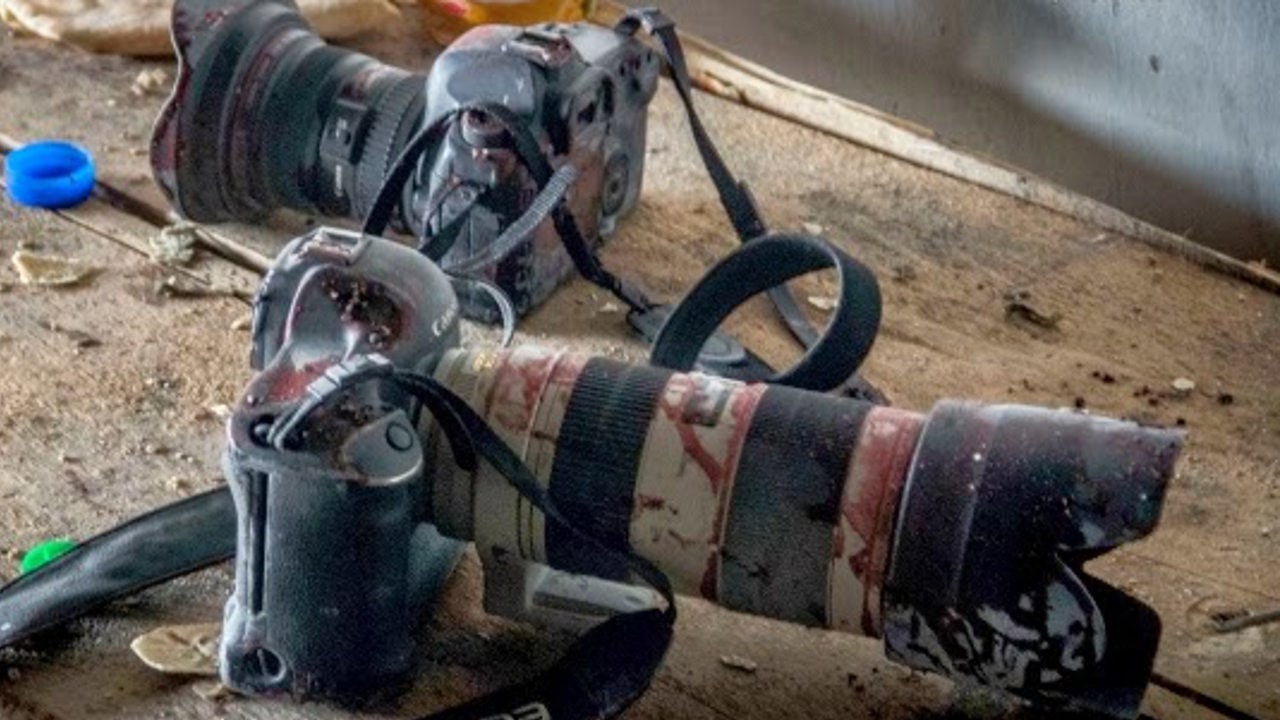
A total of 45 journalists died in 2021 while practicing their profession, with Mexico being the most dangerous country in the world for reporters, the International Press Institute (IPI) reported today in Vienna.
Seven Mexican journalists were assassinated this year for their work, with which the Latin American country once again leads the annual list of dead reporters. India and Afghanistan follow, each with six journalists killed, ahead of the Democratic Republic of the Congo, with three.
According to the IPI, a global network of media owners and editors, the safety of journalists remains a global challenge. For this reason, the Institute “urges the authorities to end impunity for these crimes and to guarantee the protection of journalists, who must be able to carry out their work freely and safely.”
Of the 45 journalists killed, 40 were men and five were women, the IPI detailed. Twenty-eight of them were killed for their work, three died while working in a conflict zone and two when covering internal disturbances in a country.
In eleven cases the causes of the deaths are still being investigated, while a journalist drowned while covering the rescue of an elephant from a river in India, showing how dangerous the profession can be.
The number of journalists killed this year is the lowest recorded by the IPI since 1997. However, the IPI emphasizes that the decrease in the number of journalists killed and assassinated is not an indication of the good state of press freedom in the world.
“Waves of violence against the press can lead to self-censorship when journalists avoid certain topics that put their lives in danger,” says IPI.
“This is made even worse in a climate of impunity in which murderers must not answer for their actions. IPI stands in solidarity with the families and colleagues of all journalists killed for their work in 2021 and demands that those responsible be held accountable for their actions” the statement concludes.
On 14 Aya Wietzorrek posted a good overview piece on freedom of the press in the Organization for World Peace
…..Functioning as a “watch-dog” of these freedoms, journalism can be considered a public good, as it serves to inform citizens on political, economic, and social issues and ensures governance is transparent and accountable.
Acknowledging the many challenges journalism is currently facing…the focus of this article is on the everyday violations against journalists. This September, the UN Educational, Scientific and Cultural Agency (UNESCO) published a report with findings revealing a “wider upward trend” in the use of unlawful violence by police and security forces against journalists over the last five years. Attacks were reported across 65 countries, and many of the tactics used, violate international laws and norms. Globally, journalists are facing censorship, surveillance, detention and physical attacks by law enforcement. The reported abuses against journalists include harassment, intimidation, beatings, being shot with non-lethal as well as lethal ammunition, sometimes even resulting in death.
The UN High Commissioner for Human Rights, Michelle Bachelet, commented that around 1,000 journalists have been killed in the last decade – and that 9 in 10 cases “are unresolved”. The murders of journalists Daphne Caruana Galizia in 2017 in Malta, Jamal Khashoggi in 2018 in Turkey and Francisco Romero Díaz in 2019 in Mexico are only a few examples. Horrified by the fates of their colleagues, these events have deterring effects for other journalists. Besides the attacks on journalists being a deeply concerning issue in their own right, such attacks thus also constitute a direct threat to civil society and democracy. In democratic states, with separate legislative, executive and judiciary branches, a free press is often considered to be the 4th pillar of democracy. According to Freedom House, however, elected leaders in many democracies have made direct attempts to silence critical media voices and strengthen ones that provide favourable coverage. The trend is linked to a global decline in democracy itself: The erosion of press freedom is both a symptom of and a contributor to the breakdown of other democratic institutions and principles….
To intercept this upward trend of unlawful violence reported by UNESCO, and to ensure that journalists can serve society and do their job, we can improve and implement the following. Firstly, in terms of prevention, developing standard operating protocols and increasing training for law enforcement on the freedom of expression and appropriate behaviour in dealing with journalists – respecting their special status as ‘watch-dogs’ – is vital. Such training would include dialogues between law enforcement and journalists, to establish working relationship between the two groups, respecting the roles of each in society. It is imperative that national legal frameworks for police use of force align with the international standards of necessity and proportionality. Secondly, in terms of protection, countries should renew their international human rights pledges, review relevant domestic laws and practice and revise them as necessary, to ensure conformity with states’ obligations under the UDHR and ICCPR. These legislative frameworks should be subject to periodic review by independent expert bodies, such as Human Rights Watch for instance. Thirdly, as the Committee to Protect Journalists has pointed out in its “Global Campaign Against Impunity”, murder is the ultimate form of censorship and the statistic that justice is not served in 9 out of 10 murders, highlights that urgent action is needed on this front. In terms of prosecution, appointing national ombudsmen to hold police accountable for the unlawful use of force against journalists is key. The implementation of such ombudsmen and the strengthening of criminal law provisions should also operate to deter offences against journalists. Internationally, the freedom of press is only implicitly protected by Article 19.2 of the International Covenant on Civil and Political Rights and deserves to be explicitly mentioned and protected. The appointment of a Special Representative of the UN Secretary-General for the Safety of Journalists, as proposed by Reporters Without Border and 70 media groups and freedom of expression NGOs, would be a valuable appointment. This proposal was officially rejected in 2019 by UN Secretary-General António Guterres. The creation of such a position would however help prevent resolutions and treaties from being largely empty words and would have the political weight, the capacity to move quickly and the legitimacy to coordinate with all UN bodies to implement change.
….. The international community has repeatedly stated the need for a more effective implementation of existing international and regional standards, yet the work still lies ahead of us. Governments should pro-actively (re-)establish their commitment to a free press and the protection of journalists as it is imperative that civil societies across the globe continue to defend right to freedom of expression. This is necessary for the enhancement of people’s lives and for the creation and maintenance of stable and healthy democratic societies.
Aya Wietzorrek is a graduate in International Development from The University of Manchester and is currently a research intern in the Governance and Inclusive Development Group at the Amsterdam Institute of Social Science Research.

 Hans Thoolen on Human Rights Defenders and their awards