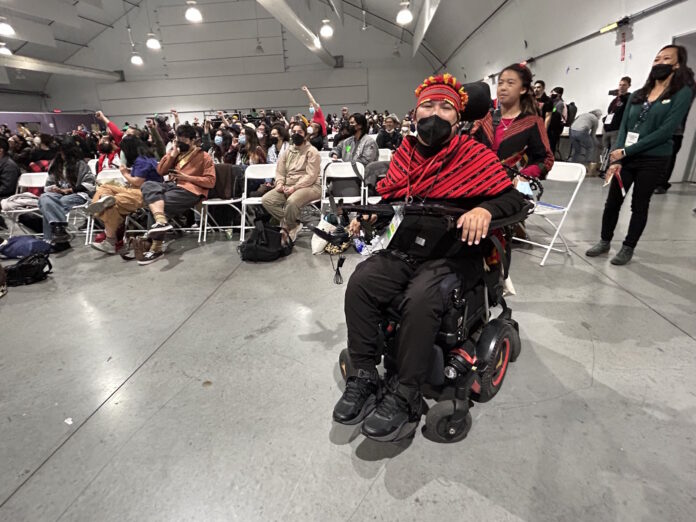
Jia Jung wrote on 20 November, 2023 about Chinese American Bay Area native Brandon Lee who gave the keynote speech at the No to APEC People’s Counter Summit, “People Over Profit and Plunder,” at San Francisco State University on Saturday, Nov. 11, 2023.
Lee was living with his wife and daughter in the Philippines and working as a human rights advocate, land defender, and journalist for the Northern Dispatch when he was shot by Philippine armed forces on Aug. 6, 2019. He survived – as a quadriplegic who remains steadfast in his international activism. Lee said, inter alia:
In high school, I was voted most shyest. I always preferred to work behind the scenes behind the camera, never in front. I was working security during rallies or painting posters the day before.
…In 2003, I transferred to this campus and joined the League of Filipino students at San Francisco State University. That’s where I learned that our country, the United States, continues to dominate and stagnate the Philippine economy, politics, and culture.
Around this time, I also started volunteering for the Chinese Progressive Association. That’s where I learned about the conditions and struggles of immigrant Chinese workers, and tenants. It was at that time I met Pam Tau Lee, the founder of the Chinese Progressive Association.
She was one of my mentors. And that’s where I learned that in the late nineties, San Francisco had 20,000 garment workers. But in less than 10 years, many of the immigrant monolinguistic women workers lost their jobs, with 88% of the workers being offshored to countries with weaker labor protection. It was during these years that I learned how interconnected our struggles are, and I became an internationalist and an anti-imperialist.
In 2007, I went on a life changing exposure trip to the Philippines. I met Youth and Students who are now movement leaders. I joined with workers boycotting Nestlé on their picket line. Ka Fort [Diasdado Fortuna], the chair of their union, was killed in cold blood by state agents. Ka Fort was dearly, dearly loved by the Nestlé workers for his leadership in building the union and his ultimate sacrifice.
So workers also launched a public campaign – “there’s blood in your coffee” – to draw international attention against Nestlé. Nestlé believes that water is a corporate right and not a human right. In this same trip, we visited many sectors, including the most oppressed majority and largest class – the peasants – as well as the Igorot Indigenous people in the northern part of the Philippines.
The Igorots, who live on resource-rich lands, are considered squatters on their own land because the Philippine government considers any land with a slope of 18 degrees Philippine land. The Igorots have been fighting against foreign occupation and colonization for hundreds of years.
And until now, they have continued their fight against government neglect and development aggression, militarization, and for the recognition for the right to ancestral land and self-determination.
On that exposure trip, our group also attended the one-year death anniversary of Alyce Claver, the wife of Chandu [Constancio]Claver, who was the provincial chair of the progressive party, Bayan Muna, and the president of the Red Cross. Chandu and Alyce were driving their kids to school when a motorcycle pulled up and shot at their car. Alyce shielded her husband and was riddled with two dozen bullets. Chandu made it out alive and is now in Canada with his kids after filing for political asylum, but the family today continues to be traumatized.
During this trip, we joined a medical and fact-finding mission to a remotevillage, and thankfully, the military had pulled out. The Indigenous peasants taught us about how the soldiers had blindfoldedthem and pointed a gun to their nape. The soldiers accused the farmers of supporting the land defenders and the resistance fighters known as the New People’s Army. The Philippine militarypretended to have a fake medical mission, giving out expired medicine to the local Indigenous people.
This trip, 16 years ago, changed the direction of my life.
I believe that we are shaped by our experiences, and this exposure program gave me new direction. It fortified my commitment to serving the fight for the Philippine liberation from U.S. imperialism. And to this day, the stories and sacrifices of Alyce Claver, Ka Fort, and so many others continue to fuel my commitment.
Two years later in 2009, I decided to deepen my commitment and decided to do a three-month integration in a remote area deep in the mountains. When I returned, I learned about Melissa Roxas, who was also from the U.S. and was abducted by the Armed Forces of the Philippines. She was conducting a medical mission. After a week, her captors released her as long as she promised to shut up.
She didn’t, though – she didn’t shut up. As she was she was released, she told the world what happened. As a health worker, Melissa diagnosed the Philippines’ societal problems and saw the illness of neoliberal policies from living among the poor. Melissa was brave. Her journey back from the trauma perpetuated by the Philippine military would soon follow for me.
The year following, 2010, I went all in and decided to live and serve the Igorot Indigenous people. I married my girlfriend, who is an Indigenous Ifugao, and we had a daughter, Jesse Jane, who is here with us today. I lived nine years with Indigenous people in the northern part of the Philippines, and I learned how they defended their land rights and lives in the resource-rich area known as the Cordillera region.
I saw firsthand how neoliberal policies promoted by APEC, such as the Philippine Mining Act of 1995, liberalize the mining industry, allowing foreign mining companies to reap 100% profit from the plundering of Indigenous people’s lands, unbridled large-scale destructive mining, dams, energy and other foreign projects, masquerading as development projects, and destroy the environment and forcibly displace Indigenous people who have been living there for generations.
Now, 13 years later, I’m speaking in front of you, a survivor of state violence and war that is spread by APEC and neoliberalism. They say APEC will promote sustainability. The Indigenous community say no. They are robbed of their life, land, culture, and worse, their future. Despite decades of people’s resistance, the plunder the natural resources, of indigenous – of ancestral – domains, continues. The region is blanketed with 176 large-scale mining and more than 100 energy projects, such as hydropower and geothermal projects awarded to private corporations.
One such energy project is the Chevron geothermal power project, which covers a large area in Kalinga. If left unchallenged and unopposed, all these could mean the ethnocide of the Igorots and the massive destruction of the ecosystem in the Cordillera region…
Indigenous communities were militarized, bombed, and strafed with artillery shelling, but they did not cower and they did not back down. They remained steadfast. They took care of each other. And they continued to hold the line.
They say APEC is innovative and will solve our problems. Hell, no.
We know this because the people do not stand to gain anything from APEC. Instead, the people are threatened, harassed, surveilled, abducted, slapped with legal cases based on fabricated evidence, illegally arrested, and even assassinated. I lost two of my dear friends and comrades, William Bugatti in 2014 and Ricardo Mayumi in 2018, at the hands of state agents. [see: https://humanrightsdefenders.blog/2014/03/27/another-human-rights-defender-shot-dead-in-philippines/]
Because I protested alongside the Indigenous communities, and, as a journalist, wrote about the daily attacks they face, I was also threatened and harassed. I was placed under surveillance. Tailed. Followed. They watched our office. They took pictures of us at our office and homes, as well as the tricycle, jeep, and bus terminal. I was red-tagged and politically vilified as a terrorist. I experienced death threats in the form of the burial blanket for the dead. I was detained and had my bag illegally searched at a military checkpoint the week before members of the 54th Infantry Battalion of the Philippine Army shot me in front of my daughter in front of my home on August 6th, 2018.
They had visited me at my house and office looking for me. They said they wanted to partner with my organization, the Ifugao Peasant Movement, but we refused. I told them two names – William Bugatti and Ricardo Mayumi – on why we do not want to partner with them.
While their assassination attempt against me was unsuccessful, I am permanently scarred and paralyzed. I am now quadriplegic, unable to use my hands and legs. I am considered one of the lucky ones. But I live with trauma every day. [see also: SF human rights activist fights for his life after being shot in the Philippines]
I know firsthand that the backdoor trade deals handled by APEC will not benefit the people; they only benefit the corporations and imperialist countries like the United States. That is why the United States sends its military around the world, finance schools, support fascist governments – to open up industries.
In fact, I have no doubt that the bullets lodged in my body today are paid by our taxpayer dollars.
Although I am paralyzed physically, they have failed to shut me up.
Today, I am proud to be standing with you, metaphorically speaking, in fighting back against APEC. Against state and political repression. Against corporate greed and power. Against the wealthy elite. Against the plunder of our planet. Against foreign domination of our peoples.
The Indigenous communities are resilient also. Like millions of people in the Global South, they are fighting back. They continue to protest despite being attacked. They have successfully barricaded several mines, rejecting countless mining and dam projects.
They have been on the frontlines of fighting the WTO [World Trade Organization], dismantling the Chico Dam equipment during the late dictator Marcos, which launched a coordinated people’s response that brought the Indigenous people to the national liberation struggle.
They are also on the frontlines of fighting APEC; a fight has led thousands to take up armed struggle as an appropriate response to defending their land, which is their life.
One of their martyr freedom fighter, Arnold “Ka Mando” Jaramillo, favorite expression ispayt latta! It means fight to the end, or continue to fight, and it’s today emulated by the Cordillera mass movement. Payt latta.
I will continue to fight as long as I breathe. Take a look around – my story is just one of many. There are a thousand people here today, diverse and multigenerational, coming from across the world, each with their own journey, own experiences, and reason for being here. But what unites us all is our opposition to APEC and neoliberal policies. We have so much in common – so much we can unite and rage against. A common enemy – APEC – and the neoliberal policies that prioritize profit and plunder over people and planet.
We will not go gently into that night. Rage. Rage! We will fight!
We will fight for a better future for all. Let us continue to talk, to build and work together, now and after APEC. For now, are you ready? Are you ready to shut down APEC?

 Hans Thoolen on Human Rights Defenders and their awards