If anybody represents the very British values of democracy, respect for human rights, justice and due process, it is the Egyptian activist, says Peter Greste in the Guardian of 15 January 2025. The piece is so rich in detail that I give here in full:
I first encountered Alaa Abd el-Fattah 11 years ago, as a disembodied whisper of reassurance from outside the bars of my grubby prison cell in Cairo. I had just been tossed in the box by Egypt’s El Mukhabarat– the malevolent general intelligence service responsible for internal security – and I was facing an indeterminate run in solitary confinement after being arrested on bogus terrorism charges for my work as a journalist.
Alaa knew the drill. Then just 32, he’d been imprisoned by each of the four previous regimes, and he understood both the institutional meat grinder we were confronting and the psychological stresses I’d have to grapple with.
“Welcome to Ward A, Political, in Tora prison,” he told me in a hushed voice through the door. “Here, you are surrounded by people who have been fighting for justice and democracy. We are a collection of activists, trade unionists, judges, writers and now you – a journalist. This is a very prestigious place, and you are with friends.”
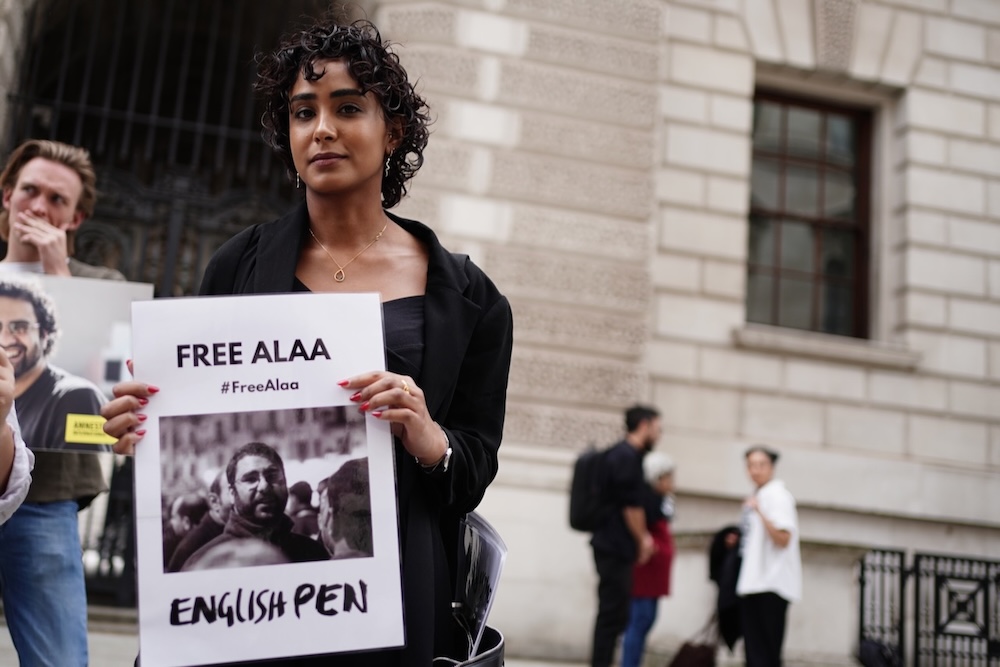
A significant part of the prestige came from Alaa himself. He was – and remains – Egypt’s most prominent political prisoner. That also makes him the one the government fears the most. I owe him my life, which is why I am helping step up the campaign to free him.
When the country erupted in its chapter of the Arab spring revolution in January 2011, it was driven by a loose collection of young, middle-class, secular activists – including Alaa – who understood the power of social media.
He was already well known in Egypt as a software developer, online publisher and prolific writer from a long line of campaigners. His late father was a human rights lawyer, and his mother is a mathematics professor and pro-democracy activist. His aunt is a novelist and political activist. One sister helped set up a group fighting against military trials for civilians, and another is a film editor who co-founded a newspaper. Before the 2011 revolution, Alaa learned coding and built his own award-winning blog publishing site where he wrote about national politics and social justice.
In short, activism is in his DNA.
At the time we met, Egypt was still convulsing with revolutionary turmoil. The military had installed an interim administration after ousting the elected Muslim Brotherhood government. The streets were filled with police rounding up protesters who were fighting to stop the country sliding back into autocracy, and Alaa found himself in prison on charges of rallying, inciting violence, resisting authorities and violating an anti-protest law.
After my period in solitary ended, we would use the precious hours of exercise to stride up and down a dusty walled yard discussing Egyptian history and society, political theory, and his ideas of resistance and reform. I found him to be an extraordinarily intelligent political thinker and humanitarian dedicated to turning his country into a functioning, pluralist democracy, and whose powerful writing from prison inspired millions. But more than that, I found a good friend.
In our conversations, he helped me understand the politics of my own imprisonment. I and two Al Jazeera colleagues had been charged with broadcasting terrorist ideology, conspiring with a terrorist organisation, and broadcasting false news to undermine national security. I struggled to reconcile those very serious allegations with the relatively straight reporting we had actually been doing. But as we talked, I came to see that our arrest had nothing to do with what we had done, and everything to do with what we represented – a press freely reporting on the unfolding political crisis. Inspired by his writing, I wrote two letters of my own that we smuggled out and that helped frame the campaign that ultimately got me free.
In March 2019, Alaa was released from prison but ordered to spend 12 hours each night in a police cell, “not free … even in the sense of imperfect freedom common in our country,” he wrote at the time.
Six months later, he was once again arrested, this time for spreading “false news to undermine security”, and sentenced to five years.
By rights, his prison ordeal should have ended on 29 September last year, including the time he spent in pre-trial detention. But in an act of extraordinary cynicism and callousness, the authorities decreed that they’d count his stretch from the day he was sentenced, violating their own laws and adding another two years to his time behind bars.
In protest, his 68-year-old mother, Laila Soueif, began a hunger strike on the day he was supposed to walk free. She has vowed not to eat until he is once again out of prison, and she is now 108 days into the fast. That is an extraordinarily risky undertaking for anybody, let alone someone her age, and although she is showing remarkable resilience she is in serious danger.[see https://humanrightsfirst.org/library/dr-laila-souiefs-downing-street-hunger-strike-continues-as-her-son-alaa-remains-in-egyptian-prison/]
Laila is a British national now living in London, and through her, Alaa also has British citizenship. That gives the British government consular responsibility, and powerful diplomatic leverage to get him released.
If anybody represents the very British values of democracy, respect for human rights, justice, rule of law and due process, it is Alaa Abd el-Fattah.
That is why I feel compelled to join Laila, in London and in solidarity, also on a hunger strike for the next 21 days. It may not work – at least in the short term – and Alaa might not walk free. But I don’t think that matters.
While we were in prison together, Alaa’s father passed away. At a later memorial service, here is what he told the audience: “All that’s asked of us is that we fight for what’s right. We don’t have to be winning while we fight for what’s right, we don’t have to be strong while we fight for what’s right, we don’t have to be prepared while we fight for what’s right, or to have a good plan, or be well organised. All that’s asked of us is that we don’t stop fighting for what’s right.”
This injustice has gone on far too long. Alaa Abd el-Fattah is one of the most remarkable people I know, and he deserves to be free. I am determined to do whatever I can to help.
- Peter Greste is a professor of journalism at Macquarie University and the executive director for the Alliance for Journalists’ Freedom. In December 2013, he was arrested on terrorism charges while working for Al Jazeera and he was eventually convicted and sentenced to seven years. Under intense international pressure, the Egyptian president ordered his release after 400 days. He is undertaking this protest in his personal capacity
 Hans Thoolen on Human Rights Defenders and their awards