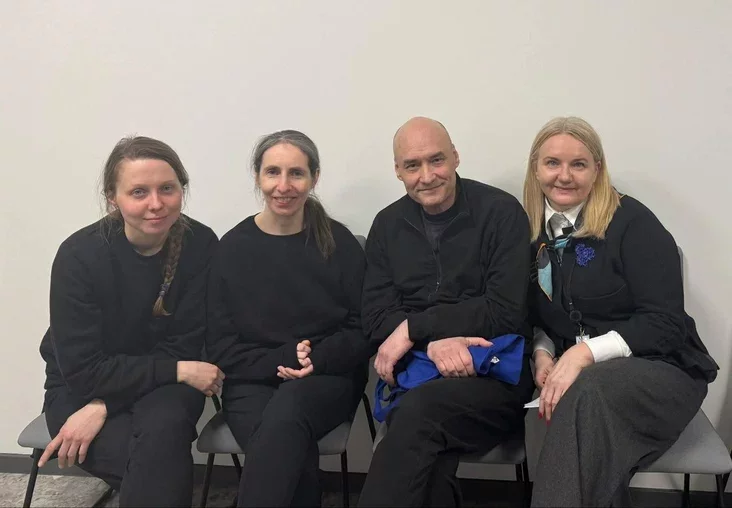
The Human Rights Center “Viasna” published a joint photo of three of its employees — Marfa Rabkova, Nasta Loika, and Valiantsin Stefanovich — who were released.
Belarusian leader Alexander Lukashenko released 250 political prisoners on 19 March 2026, the largest group freed so far, as the United States moved to lift more sanctions, The releases are part of a broader effort by Minsk to improve ties with Washington after years of isolation and sanctions. Among those freed was Katsyaryna Andreyeva, a journalist with Polish Belarusian-language broadcaster Belsat, according to reports.
Also released was Marfa Rabkova, an activist with Belarusian human rights group Viasna who was arrested in September 2020 and sentenced to 14 years and nine months on charges including “extremism,” the Reuters news agency reported.
Coale – an envoy for US President Donald Trump – said he expected all remaining political prisoners to be released by the end of the year, adding that Washington would lift all sanctions imposed over the 2020 crackdown on protesters if that happens, Reuters reported. He also said Lukashenko had been urged to halt further arrests. The United States has agreed to lift sanctions on several Belarusian banks and the country’s finance ministry, as well as fertiliser producers, according to the AFP news agency.
Coale said earlier on Thursday that Lukashenko may soon visit the United States, a trip that would signal a potential breakthrough after years of diplomatic isolation over human rights abuses and his support for Russia’s invasion of Ukraine. Previous talks between Coale and Lukashenko led to the release of dozens of political prisoners in September and a further 123 in December, including Nobel Peace Prize winner Ales Bialiatski. In response, the United States lifted sanctions on Belarusian potash, a key export used in fertilisers. [see: https://humanrightsdefenders.blog/2025/12/16/ales-bialiatski-free-but-more-human-rights-defenders-must-be-released-in-belarus/]
Exiled Belarusian opposition leader Sviatlana Tsikhanouskaya welcomed the latest prisoner release as a moment of “great joy” and “huge relief.”
Civil Rights Defenders welcomes the news that human rights defender Nasta Loika has been released from prison in Belarus as part of the country’s largest mass release of political prisoners to date. Nasta is a longstanding advocate for human rights in Belarus and an alarm bearer in the Natalia Project, the world’s first alarm and positioning system for human rights defenders at risk.
“We are deeply relieved that Nasta Loika is finally free. Her courage, resilience, and commitment to human rights have inspired countless people in Belarus and beyond. While we celebrate her release, it comes after years of unjust persecution. No one should ever be imprisoned for defending fundamental rights,” says Gabrielle Gunneberg, Global Department Director at Civil Rights Defenders.
Reacting to the release of 250 individuals imprisoned in Belarus on politically motivated grounds, including human rights defenders Marfa Rabkova and Nasta Loika, as a part of a deal with the United States, Marie Struthers, Amnesty International’s Eastern Europe and Central Asia Director, said:
“While the release of hundreds of individuals unjustly detained on politically motivated charges is a welcome step, it must not be mistaken for justice. Marfa Rabkova, Nasta Loika, Valiantsin Stefanovich and others should not have spent a day in prison. Freedom should never be the product of geopolitical bargaining in human beings. Justice will not be served until those responsible for their unlawful imprisonment are held accountable.
Viasna human rights defender, Valiantsin Stefanovich, spoke with reporters about his release, family, and desire to continue his human rights work.
https://spring96.org/en/news/119858
https://nashaniva.com/amp/en/390812
Human rights activist and Nobel Peace Prize laureate Ales Bialiatski reacted to the release of fellow human rights defenders:
“I am immensely happy, like all my colleagues, about the release of our friends, our colleagues: Valiantsin Stefanovich, Marfa Rabkova, and Nasta Loika. The thing that we expected — I have been expecting it for the last three months, and my colleagues have been expecting it for more than five years — has come true. Because Marfa Rabkova served five and a half years, Valiantsin Stefanovich served four and a half years, and Nasta Loika served several years. And it was an absolute injustice, it shouldn’t have been like this.
https://spring96.org/en/news/119855
 Hans Thoolen on Human Rights Defenders and their awards
Leave a comment