Ahead of the International Day to End Impunity for Crimes against Journalists on 2 November, and in the year that marks the 75th anniversary of the Universal Declaration of Human Rights, High Representative Josep Borrell and Vice-President Věra Jourová issued the following statement:
“In these difficult times, marred by wars*, conflict and terrorist acts, we recall and praise the essential role played by journalists and media workers in fighting for the truth and for human rights. Journalists contribute to counter disinformation and hate speech and to keep checks and balances on governments and public institutions. They shed light on war crimes and human rights violations, sometimes at the risk of their own lives.
We firmly condemn the killings, physical attacks, arbitrary detentions, online and offline intimidation, harassment, and surveillance, that journalists at times face while exercising their profession. Media worldwide continue to be raided or closed, and journalists are increasingly targeted by legislation that curtails freedom of expression, and by abusive litigation, thus limiting pluralism, editorial independence, and infringing freedom of expression.
…
The EU remains committed to support independent journalists and media workers everywhere. We will continue to mobilise all the diplomatic tools at our disposal to raise attention to individual cases of journalists in detention or at risk. We have also established ProtectDefenders.eu to provide journalists at high risk with physical and digital protection, legal support, and relocation.
Protecting journalists means protecting our own rights. Democracy cannot work without free and independent media. This is why the EU is also taking unprecedented steps at home to protect journalists.
We call on Member States to implement the Commission Recommendation on the safety of journalists. The proposal for a Media Freedom Act aims to safeguard their independence and media pluralism. The Commission also took action to fight strategic lawsuits against public participation, which put pressure on journalists and want to silence them. These legislative proposals should be adopted swiftly to improve the environment in which journalists and media operate and to set global standards. See also: https://humanrightsdefenders.blog/2023/07/02/eu-directives-for-slapps-and-media-freedom-being-weakened-european-parliament-should-come-to-the-rescue/
The European Union stands with journalists around the world who, each and every day, exercise their freedom of expression for the benefit of us all.”
Maria Psara – writing for Euronews of 27June 2023 – says that European Union member States are trying to water down the directives for SLAPPs and Media Freedom…European lawmakers are accusing member states of trying to water down EU legislation aimed at strengthening protections for journalists and media freedom.
It would also establish several procedural safeguards and remedies, such as compensation for damages, and dissuasive penalties for launching abusive lawsuits. The JURI vote will form the basis of the Parliament’s position in negotiations with member states if it is also endorsed by the plenary in mid-July.
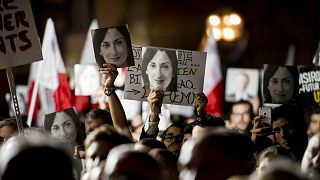
SLAPPs or Strategic lawsuits against public participation are a particular form of harassment used primarily against journalists and human rights defenders to prevent or penalise speaking up on issues of public interest. The Commission’s proposal has been dubbed as the ‘Daphne Law’ in honour of murdered Maltese journalist Daphne Caruana Galizia.
Member states, which together form the Council of the EU, have however sought to water down the text, drawing criticism for the Commission.
“I would like to express my regret concerning the weakening of the remedies against abusive court proceedings, in particular the deletion of the provision on compensation of damage and the weakening of the provision on award of costs,” Didier Reynders, Commissioner for Justice, said earlier this month after member states agreed on their negotiating position.
Parliament is seeking to redress that with German MEP Tiemo Wölken (S&D), the rapporteur on the draft directive, telling Euronews: “We made it stronger and we also added other provisions such as a creation of an ‘one stop shop’ which the SLAPPs targets can contact to receive help by dedicated national networks of specialized lawyers, legal practitioners and psychologists.”
It is not the first time member states are accused of trying to water down a proposal on media freedom. Earlier this month, a deal among the 27 member states on the European Media Freedom Act (EMFA) made a lot of eyebrows rise, because of a planned exemption to allow for the wiretapping of journalists. The regulation, first proposed by the Commission in September 2022, included safeguards against political interference in editorial decisions and against surveillance. The EU’s executive wanted to put focus on the independence and stable funding of public service media as well as on the transparency of media ownership and the allocation of state advertising.
“We have welcomed in particular as a political symbol the draft regulation for EMFA, as the Commission for the first time has adopted a legislative act dealing with all media, a traditionally sensitive subject dealt with at national level only,” Renate Schroeder, director of the European Federation of Journalists (EFJ), told Euronews. Yet, the EPJ and other NGOs, still criticised the proposal as “not ambitious enough”.
“In particular we believed that Article 4 on the protection of journalists’ sources and protection from surveillance has not met Council of Europe standards. We also advocated for stronger binding rules on media transparency,” Schroeder added.
But member states are seeking to add an exemption to Article 4, introduced by France and opposed by Germany only, that would allow them to spy on journalists in the name of national security.
The original proposal sought to ensure that governments could not “detain, sanction, intercept, subject to surveillance or search and seizure” journalists in order to uncover their sources, unless “justified by an overriding requirement in the public interest” while the deployment of spyware was to be restricted only to “serious crimes”.
The Council’s is hoping to broaden the number of offenses allowing such surveillance from 10 to 32.
“The text doesn’t protect journalists anymore and thereby makes the Act almost useless for journalists’ protection at least,” Schroeder said.
“It still proposes useful tools when it comes to independence of public service media, transparency on state advertisement, some minimum rules on media ownership and on editorial independence. But yes, some member-states are afraid of journalism and thereby give hands to illiberal countries such as Hungary who oppose the Act. We hope the European Parliament will be firm, but we are not too optimistic,” underlined the director of EFJ.
However, on 12 July, with 498 votes to 33 and 105 abstentions, MEPs adopted their negotiating position on new rules to protect those working on matters of public interest like fundamental rights, the activities of public officials or corruption allegations.
 Hans Thoolen on Human Rights Defenders and their awards