As a child, Jordan’s Tala Odeh used to ask why the world was so unfair — now she defies injustice.
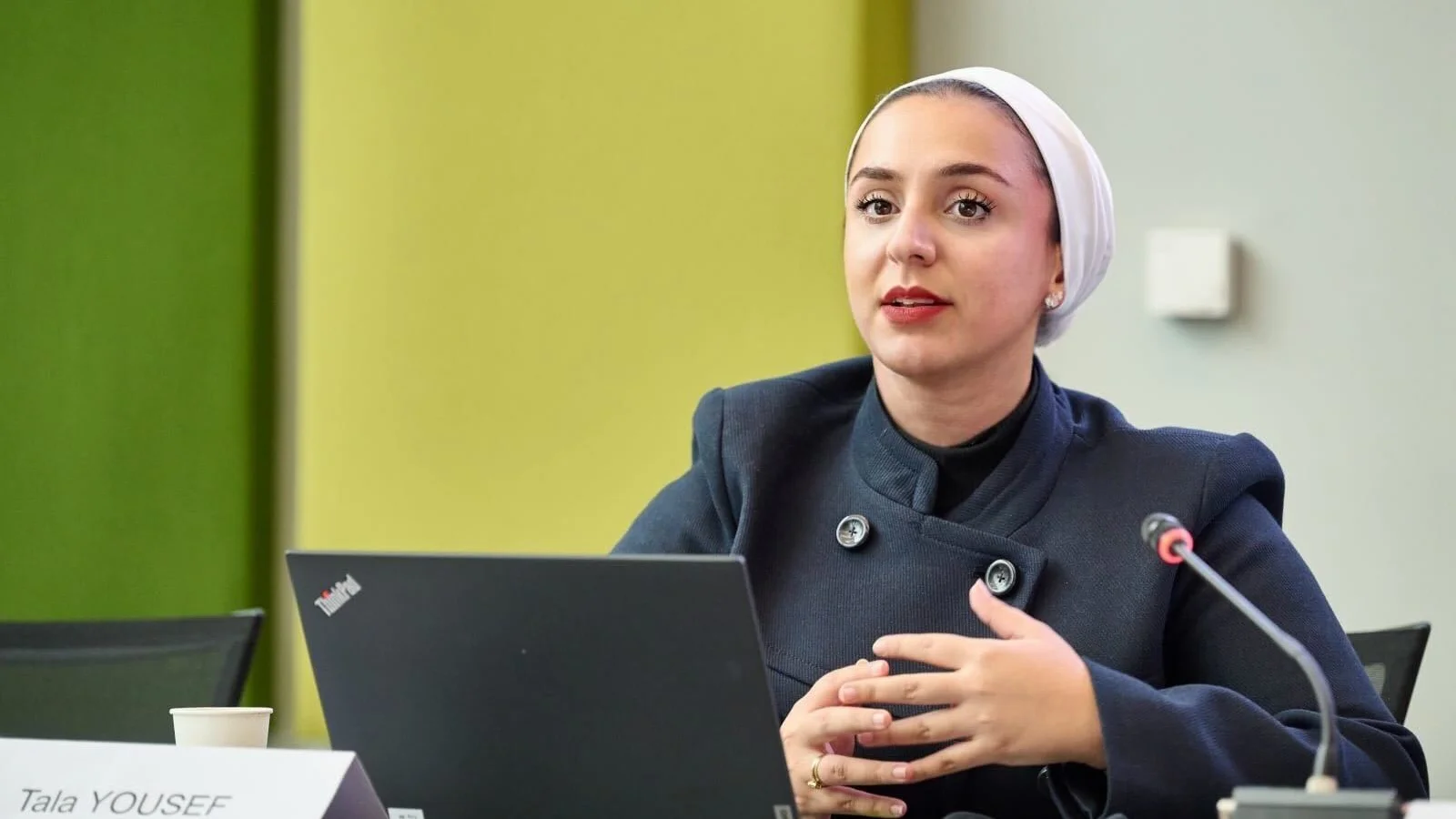
Jordanian Human Rights Defender, Tala Odeh speaks at the World Democracy Forum in Strasbourg, 2024. For Odeh, speaking on global platforms is about ensuring that voices from her region are no longer sidelined in conversations that shape their future. | Supplied
Tala Odeh is a human rights defender from Jordan in the Middle East and North Africa (MENA) region where civic space is repressed. She has participated at various global platforms, including serving as a Youth Advisor to the UN Human Rights (OHCHR) which forms parts of the Office’s ongoing focus and work with youth and their human rights. In her own words Odeh details her journey to advocacy and explains how working with the OHCHR has allowed her to have greater impact.
I don’t usually like to be called a “young activist.”
Or“nashet shababi” as it is called in Arabic. I don’t like it because, in my region, the title is often overused and claimed without necessarily living the values behind it. Instead, I see myself as a human rights defender, and more simply, as a young person with a vision for humanity.
I co-founded the NAMA Network for Human Rights Defenders, a youth-led regional platform operating in eight Middle East and North African countries (MENA). Through NAMA, we empower young people to engage in conflict resolution, peace mediation, and rights-based advocacy, creating cross-border solidarity even in fragmented contexts.
The focus is on young human rights defenders, not only human rights issues, this is crucial to make sure that those who defend rights are empowered enough.
Young campaigners and defenders need three things to keep going…
…recognition, resources, and protection.
Recognition because too often our voices are dismissed as “inexperienced” or “naïve,” when in fact young people are closest to the realities of our communities. Resources because passion alone cannot sustain human rights defense work; we need access to training, funding, and safe spaces to organize. Protection because defending rights comes with real risks, from harassment to repression, and defenders need to know they are not alone.
UN Human Rights (OHCHR) plays a vital role in meeting these needs. It gives legitimacy to our voices and ensures they are heard in front of governments and international bodies. I remember one moment during my time in the Youth Advisory Group when I felt that global conversations were moving forward without truly reflecting the realities of my region, a region burning with conflict, displacement, and repression but nobody talked about its youth’s struggles.
My focus is on ensuring that human rights are not just words in documents, but lived realities for people.
Instead of overlooking that concern, OHCHR gave me the opportunity to lead that conversation myself. I spoke in front of member states about what human rights mean to young people in the MENA, and what we urgently need as a generation living through conflict.
For me, what matters most is that OHCHR doesn’t just consult young people — it actively involves us in shaping human rights agendas. That kind of partnership gives us strength and sustainability, ensuring that even in repressed environments, young people can continue to fight for dignity, justice, and equality — and they are never left to fight alone.
Growing up in the Middle East meant living with constant conflict and uncertainty.
I cannot remember a time when our region truly had peace. Rights violations were rising, and it seemed as though the world often treated us with double standards, denying our dignity. I used to ask my father, “Why do we always have to see this? Why can’t we live like anyone else in the world?” And he would answer, “Tala, that’s simply because of where you were born — your nationality, your race, even being an Arab. One day you will see that the world is much more complicated than you think.”
His words stayed with me. That deep sense of injustice and marginalization made me promise myself that I would not leave this life without doing something meaningful for my people — to show the world who we really are, to defend our rights, and to bring our voices to every platform I can reach.
 Outside of working on furthering human rights at the UN, Tala Odeh is a co-founder of the NAMA Network, which helps young people across the Middle East and North Africa defend rights and build peace.
Image: UN Human Rights
My turning point came during my clinical pharmacy training in a diabetes clinic.
One day, a mother came in with her eight-year-old daughter, who had just been diagnosed with diabetes. Instead of feeling a sense of relief that there was treatment, the mother broke down in tears and begged us not to tell the father. She refused to give her daughter the necessary treatment and whispered through her tears, “If people knew, who would marry her?”
A year later, the same girl returned to the clinic with partial loss of vision — something that could have been prevented. That moment shattered me. It showed me that injustice is not only about wars or politics, but also about the silent struggles created by fear, stigma, and inequality.
I remembered the questions I used to ask my father as a child, and I realized I couldn’t just witness this and move on. That girl’s story became my call to action. At first, I only wanted to fight for her right to health, but it grew into something much larger — a promise to defend human rights in all their forms, and to bring the voices of the silenced to every platform I could reach.
Beyond NAMA, I work as an Associate Human Rights Officer with the United Nations in Jordan.
My focus is on ensuring that human rights are not just words in documents, but lived realities for people — especially young people and marginalized communities. My work bridges different areas: I lead initiatives on disability inclusion in climate action, youth participation, SDGs localization, and interaction with human rights mechanisms. For example, I organize trainings that bring together persons with disabilities and climate activists to ensure no one is left behind in shaping climate solutions.
I carried with me the stories, struggles, and hopes of young people from across the MENA.
I am also representing Jordan as one of the youth participants in the Youth Peace Mediators Programme (YPMP), a global initiative co-led by Finland and South Africa. Being part of YPMP has given me the chance to bring the perspectives of MENA youth into peacebuilding spaces that rarely include us. My focus is on ensuring that human rights are not seen as “extras” in peace negotiations but are embedded from the start — because peace without rights is never sustainable.
Through YPMP, I have been able to exchange with young mediators from Africa, Asia, Europe, and beyond, learning how local struggles connect to global patterns of injustice, and contributing to shaping peace processes that recognize dignity and justice as non-negotiable.
https://www.globalcitizen.org/en/content/human-rights-defender-experience-jordan-mena-essay/
 Hans Thoolen on Human Rights Defenders and their awards
Leave a comment